November 1

What was advertised in a colonial American newspaper 250 years ago today?

Nov 1 - 11:1:1768 South-Carolina Gazette and Country Journal Page 1
South-Carolina Gazette and Country Journal (November 1, 1768).

“Offers his Attendance gratis, to every Person in Charles-Town, whose Circumstances or Situation demand it.”

When T. Lowder arrived in Charleston and established his own medical practice in 1768, he placed an advertisement to introduce himself to the residents of the city and its environs. Like many other physicians who placed newspaper advertisements in the eighteenth century, Lowder first provided his credentials to potential clients who might avail themselves of his services. He indicated that he had worked as “MIDWIFE and APOTHECARY, to St. Peter’s Hospital” in Bristol. Furthermore, he reported that “he has for some Years been largely engaged in” the “Practice of Midwifery.” Although he did not provide the particulars, Lowder stated that he had received “a regular, physical Education.” He hoped that prospective clients would consider it, in combination with “a considerable Degree of Experience,” as “sufficient Qualifications.” He also pledged to exert the “utmost Assiduity” in attending to his patients. As a newcomer to the city, Lowder did not enjoy a local reputation. Until he could establish that he was not “deficient” as a midwife and apothecary, he relied on his credentials to promote his services to prospective clients who otherwise knew little else about him.

To aid in establishing his reputation in the busy port, Lowder “offers his Attendance gratis, to every Person in Charles-Town, whose Circumstances or Situation demand it.” To that end, he reserved three hours each afternoon for consulting with “The Poor” at his office on Church Street. Offering “Advice in all Cases” provided an opportunity to work with local patients who could then testify to his skill and care. Lowder likely hoped that demonstrating his competence in cases that he attended without charge would yield additional clients from among the ranks of residents who could afford to pay his fees. Providing free medical advice to the poor also attested to his character, further enhancing the public relations campaign Lowder launched in an advertisement introducing himself to colonists in Charleston. In case his credentials were not enough to attract clients, his altruism might attract the attention necessary for the newcomer to sustain his practice.

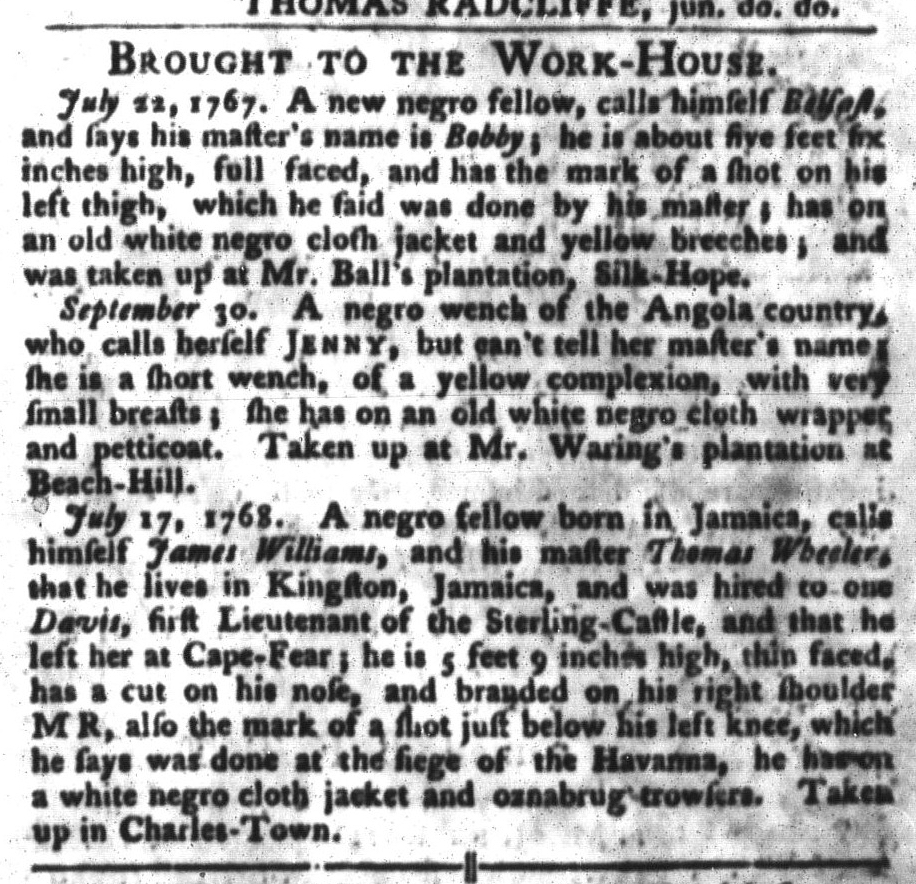
Slavery Advertisements Published November 1, 1768

GUEST CURATOR: Shannon Holleran

The Slavery Adverts 250 Project chronicles the role of newspaper advertising in perpetuating slavery in the era of the American Revolution. The project seeks to reveal the ubiquity of slavery in eighteenth-century life from New England to Georgia by republishing advertisements for slaves – for sale, wanted to purchase, runaways, captured fugitives – in daily digests on this site as well as in real time via the @SlaveAdverts250 Twitter feed, utilizing twenty-first-century media to stand in for the print media of the eighteenth century.

The project aims to provide modern audiences with a sense of just how often colonists encountered these advertisements in their daily lives. Enslaved men, women, and children appeared in print somewhere in the colonies almost every single day. Those advertisements served as a constant backdrop for social, cultural, economic, and political life in colonial and revolutionary America. Colonists who did not own slaves were still confronted with slavery as well as invited to maintain the system by purchasing slaves or assisting in the capture of runaways. The frequency of these newspaper advertisements suggests just how embedded slavery was in colonial and revolutionary American culture in everyday interactions beyond the printed page.

These advertisements also testify to the experiences of enslaved men, women, and children, though readers must consider that those experiences have been remediated through descriptions offered by slaveholders rather than the slaves themselves. Often unnamed in the advertisements, enslaved men, women, and children were not invisible or unimportant in early America.

During the week of October 28 to November 3, 2018, the Slavery Adverts 250 Project is guest curated by Shannon Holleran (2019), a History major at Assumption College in Worcester, Massachusetts.

These advertisements appeared in colonial American newspapers 250 years ago today.

Nov 1 - South-Carolina Gazette and Country Journal Slavery 1
South-Carolina Gazette and Country Journal (November 1, 1768).

**********

Nov 1 - South-Carolina Gazette and Country Journal Slavery 2
South-Carolina Gazette and Country Journal (November 1, 1768).

**********

Nov 1 - South-Carolina Gazette and Country Journal Slavery 3
South-Carolina Gazette and Country Journal (November 1, 1768).

**********

Nov 1 - South-Carolina Gazette and Country Journal Slavery 4
South-Carolina Gazette and Country Journal (November 1, 1768).

**********

Nov 1 - South-Carolina Gazette and Country Journal Slavery 5
South-Carolina Gazette and Country Journal (November 1, 1768).

**********

Nov 1 - South-Carolina Gazette and Country Journal Slavery 6
South-Carolina Gazette and Country Journal (November 1, 1768).

**********

Nov 1 - South-Carolina Gazette and Country Journal Slavery 7
South-Carolina Gazette and Country Journal (November 1, 1768).

**********

Nov 1 - South-Carolina Gazette and Country Journal Slavery 8
South-Carolina Gazette and Country Journal (November 1, 1768).

**********

Nov 1 - South-Carolina Gazette and Country Journal Slavery 9
South-Carolina Gazette and Country Journal (November 1, 1768).

**********

Nov 1 - South-Carolina Gazette and Country Journal Slavery 10
South-Carolina Gazette and Country Journal (November 1, 1768).

**********

Nov 1 - South-Carolina Gazette and Country Journal Slavery 11
South-Carolina Gazette and Country Journal (November 1, 1768).

**********

Nov 1 - South-Carolina Gazette and Country Journal Supplement Slavery 1
Supplement to the South-Carolina Gazette and Country Journal (November 1, 1768).

**********

Nov 1 - South-Carolina Gazette and Country Journal Supplement Slavery 2
Supplement to the South-Carolina Gazette and Country Journal (November 1, 1768).

**********

Nov 1 - South-Carolina Gazette and Country Journal Supplement Slavery 3
Supplement to the South-Carolina Gazette and Country Journal (November 1, 1768).