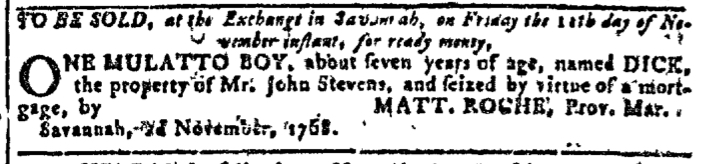
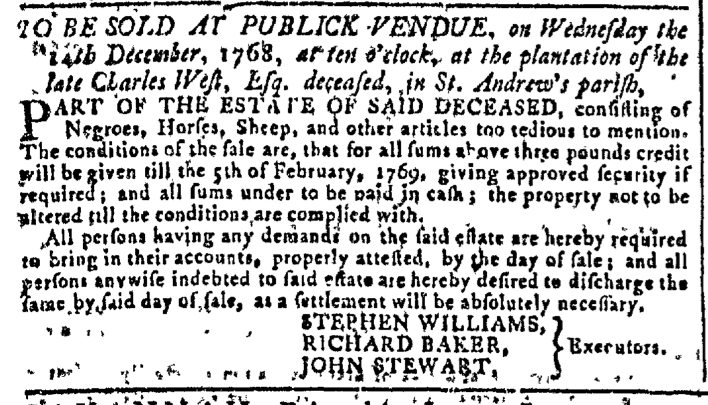
November 7

What was advertised in a colonial American newspaper 250 years ago today?

Nov 7 - 11:7:1768 Boston Evening-Post
Boston Evening-Post (November 7, 1768).

“A large Assortment of the following Goods.”

William Scott operated a store on the “North Side of Faneuil Hall, next Door to the Sign of General Wolfe” in Boston. There he sold “a large Assortment” of goods, including “Manchester Cotton Checks and Handkerchiefs,” “Forest Cloths, Plains and Kerseys,” and “Irish Linens” of various widths.

To attract customers to his store, Scott inserted advertisements in every newspaper published in Boston. On Monday, November 7, 1768, his advertisement appeared in the Boston Chronicle. On the same day it simultaneously ran in the Boston Evening-Post, the Boston-Gazette, and the Boston Post-Boy, a joint publication with Green and Russell’s Massachusetts Gazette. On Thursday of that week, it ran in Richard Draper’s Massachusetts Gazette, a publication printed on the same broadsheet and distributed with the Boston Weekly News-Letter. No matter which newspapers they read, residents of Boston and the surrounding area encountered Scott’s advertisement. He made a significant investment in advertising in his efforts to saturate the local print media with his notices.

Scott likely exercised little influence over where his advertisement appeared in each newspaper. The compositors made those choices. Still, his advertisements occupied a privileged position in the Boston Chronicle, appearing as one of only three advertisements on the final page, and in the Boston-Gazette, appearing on the first page above a news item. This increased the chances that readers of those newspapers would notice Scott’s advertisement.

The format of the advertisements provides further evidence of the role played by compositors in presenting them to the reading public. Scott apparently submitted identical copy to each printing office, but the compositors made unique decisions when it came to typography. For instance, the list of merchandise had one item per line in the Boston Evening-Post iteration while the Boston Post-Boy version grouped all the items together into a single paragraph. Although Scott carefully planned for widespread distribution of his advertisement, he entrusted the compositors with its final format in each publication. He oversaw certain aspects of his marketing campaign – copy and distribution – while yielding others – format and placement on the page – to the printing offices. He considered some, but not all, of the opportunities made possible by print.

Slavery Advertisements Published November 7, 1768

GUEST CURATOR: Patrick Keane

The Slavery Adverts 250 Project chronicles the role of newspaper advertising in perpetuating slavery in the era of the American Revolution. The project seeks to reveal the ubiquity of slavery in eighteenth-century life from New England to Georgia by republishing advertisements for slaves – for sale, wanted to purchase, runaways, captured fugitives – in daily digests on this site as well as in real time via the @SlaveAdverts250 Twitter feed, utilizing twenty-first-century media to stand in for the print media of the eighteenth century.

The project aims to provide modern audiences with a sense of just how often colonists encountered these advertisements in their daily lives. Enslaved men, women, and children appeared in print somewhere in the colonies almost every single day. Those advertisements served as a constant backdrop for social, cultural, economic, and political life in colonial and revolutionary America. Colonists who did not own slaves were still confronted with slavery as well as invited to maintain the system by purchasing slaves or assisting in the capture of runaways. The frequency of these newspaper advertisements suggests just how embedded slavery was in colonial and revolutionary American culture in everyday interactions beyond the printed page.

These advertisements also testify to the experiences of enslaved men, women, and children, though readers must consider that those experiences have been remediated through descriptions offered by slaveholders rather than the slaves themselves. Often unnamed in the advertisements, enslaved men, women, and children were not invisible or unimportant in early America.

During the week of November 4-10, 2018, the Slavery Adverts 250 Project is guest curated by Patrick Keane (2019), a History major at Assumption College in Worcester, Massachusetts.

These advertisements appeared in colonial American newspapers 250 years ago today.

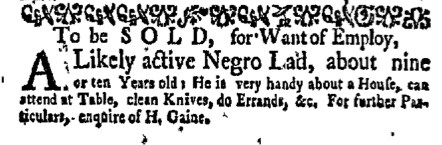
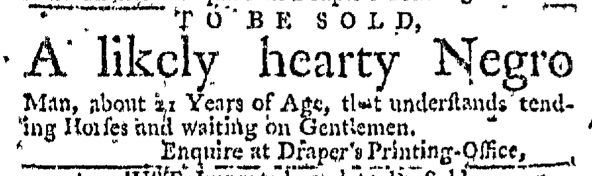
Nov 7 - Boston Evening-Post Slavery 1
Boston Evening-Post (November 7, 1768).

**********

Nov 7 - Boston-Gazette Slavery 1
Boston-Gazette (November 7, 1768).

**********

Nov 7 - Boston-Gazette Slavery 2
Boston-Gazette (November 7, 1768).

**********

Nov 7 - Boston-Gazette Slavery 3
Boston-Gazette (November 7, 1768).

**********

Nov 7 - New-York Gazette Weekly Mercury Slavery 1
New-York Gazette and Weekly Mercury (November 7, 1768).

**********

Nov 7 - New-York Gazette Weekly Mercury Supplement Slavery 1
Supplement to the New-York Gazette and Weekly Mercury (November 7, 1768).

**********

Nov 7 - New-York Gazette Weekly Mercury Supplement Slavery 2
Supplement to the New-York Gazette and Weekly Mercury (November 7, 1768).

**********

Nov 7 - New-York Gazette Weekly Mercury Supplement Slavery 3
Supplement to the New-York Gazette and Weekly Mercury (November 7, 1768).

**********

Nov 7 - New-York Gazette Weekly Post-Boy Slavery 1
New-York Gazette: Or, the Weekly Mercury (November 7, 1768).

**********

Nov 7 - Newport Mercury Slavery 1
Newport Mercury (November 7, 1768).

**********

Nov 7 - Pennsylvania Chronicle Slavery 1
Pennsylvania Chronicle (November 7, 1768).

**********

Nov 7 - Pennsylvania Chronicle Slavery 2
Pennsylvania Chronicle (November 7, 1768).

**********

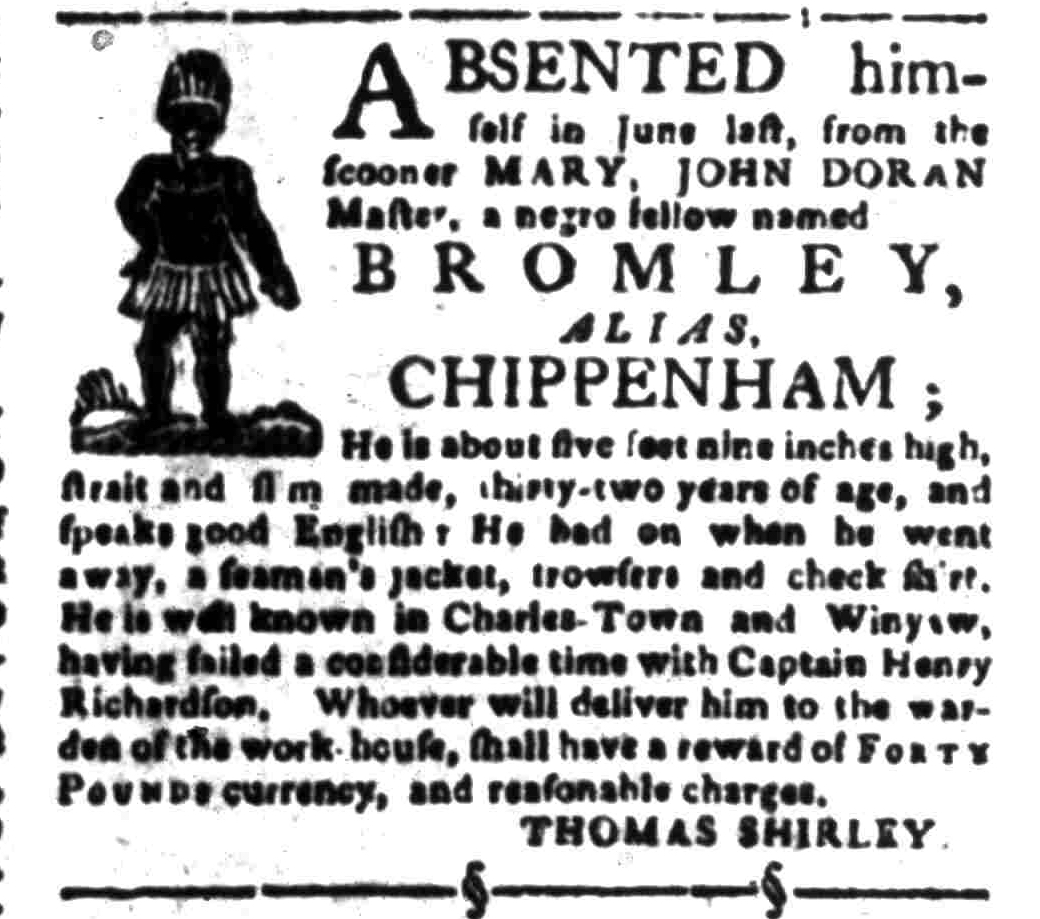
Nov 7 - South-Carolina Gazette Slavery 1
South-Carolina Gazette (November 7, 1768).

**********

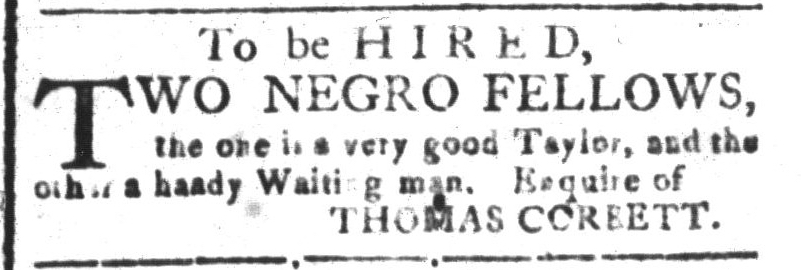
Nov 7 - South-Carolina Gazette Slavery 2
South-Carolina Gazette (November 7, 1768).

**********

Nov 7 - South-Carolina Gazette Slavery 3
South-Carolina Gazette (November 7, 1768).

**********

Nov 7 - South-Carolina Gazette Slavery 4
South-Carolina Gazette (November 7, 1768).

**********

Nov 7 - South-Carolina Gazette Slavery 5
South-Carolina Gazette (November 7, 1768).

November 6

What was advertised in a colonial American newspaper 250 years ago this week?

Nov 6 - 11:3:1768 Virginia Gazette Purdie and Dixon
Virginia Gazette [Purdie and Dixon] (November 3, 1768).
“All the above are fashionable, new, and good.”

Like her male counterparts, shopkeeper Catherine Rathell ran lengthy advertisements that listed all sorts of goods, especially textiles, adornments, apparel, and accessories, that she “Just imported from London” and sold at low prices. In the process of enumerating her inventory, Rathell also offered further descriptions of several items. For instance, she stocked “a large and fashionable assortment of ribands [ribbons], caps, egrets [decorative feathers], plumes, feathers, and fillets [headbands]” as well as “a neat assortment of garnet and paste, hoop, and other rings.” As these examples make clear, Rathell emphasized variety and consumer choice in her marketing efforts. Her customers did not have to be content with a narrow range of options shipped across the Atlantic. Instead, they could choose which items they liked best, even when it came to accessories like fans. Rathell sold “a very neat and genteel assortment of wedding, mourning, second mourning, and other fans.” In addition, visitors to her shop would encounter “many other articles too tedious to insert” in a newspaper advertisement.

Yet choice was not the only appeal this shopkeeper made to prospective customers. After concluding her list she underscored that “all the above goods are fashionable, new, and good.” Quality was important, but when it came to the sorts of wares that Rathell peddled fashion may have been even more important. Her customers did not have to choose from among castoffs that had lingered on shelves and not sold in London. Rathell’s merchandise was “new” as well as “fashionable.” Note that she described her assortment of fans as “genteel.” She offered the most extensive description for “breast flowers, equal in beauty to any ever imported, and so near resemble nature that the nicest eye can hardly distinguish the difference.” Here Rathell combined appeals to quality and fashion into a single description of artificial flowers intended to adorn garments according to the latest styles.

In making appeals to choice, fashion, and quality, Rathell advanced some of the most popular marketing strategies deployed by shopkeepers throughout the colonies in the middle of the eighteenth century. T.H. Breen has argued that colonists from New England to Georgia experienced a standardization of consumer culture in terms of the goods available to them. They also often experienced a standardization of advertising. Although some advertisers did introduce innovations into their marketing efforts, many relied on the most familiar means of promoting their goods to the public. Rathell’s advertisement was more than a mere announcement that she had goods for sale, but she reiterated the sorts of appeals known far and wide in colonial America.

November 5

What was advertised in a colonial American newspaper 250 years ago today?

Nov 5 - 11:5:1768 Providence Gazette
Providence Gazette (November 5, 1768).

“Sentiments of Gratitude to the Subscribers for the PROVIDENCE GAZETTE.”

The colophon of the Providence Gazette read “Printed by SARAH GODDARD, and JOHN CARTER, at the PRINTING-OFFICE, the Sign of Shakespear’s Head” for the last time on November 5, 1768. For over two years Sarah Goddard had been the publisher of the Providence Gazette, ever since it recommenced in August 1766 following the repeal of the Stamp Act. It had not been the Stamp Act, however, that caused the newspaper’s suspension. Instead, insufficient subscribers prompted William, Sarah’s son and the original publisher of the Providence Gazette, to suspend the newspaper in May 1765. He hoped that local readers would so miss the publication that enough would subscribe in order to revive it in six months. Then the Stamp Act made doing so prohibitively expensive. Once that legislation had been repealed and sufficient subscribers had pledged to support the newspaper, the Providence Gazette returned, but now published by Sarah rather than William. For approximately a year the colophon listed “SARAH GODDARD, and Company” as the printers, before Carter’s name replaced “and Company.”

On the occasion of her retirement, Goddard inserted a farewell address after the news and before the paid notices in her final issue as publisher. It served as an announcement, a note of appreciation, and a promotion of the continued publication of the Providence Gazette under the direction of Carter. She planned to relocate to Philadelphia, where William published the Pennsylvania Chronicle, though she would have been content “to have passed the Remainder of her Days in a Town where she has so many Friends and Acquaintance, for whom she entertains the highest Regard, and from whom she has received many Favours and Civilities.” Only the “more endearing Ties of Nature which exist between a Parent and an only Son” motivated her to leave Providence.

As she prepared for her departure, Goddard recognized both the subscribers and Carter for everything they had done, each in their own way, to make the Providence Gazette into a successful venture. For the subscribers and “all who have kindly favoured the [Printing] Office with their business” (including advertisers), she “acknowledges herself peculiarly obligated.” She then endorsed Carter, encouraging readers to continue their patronage of the newspaper now that he took the helm alone. She proclaimed that it was due to his “Diligence and Care” that “the GAZETTE has arrived to its present Degree of Reputation.” Combining her affection for the readers and her support for her successor, Goddard “takes the Liberty to request a Continuance of the public Favour in his behalf, which will be considered as an additional Mark of their Esteem conferred on her.”

Goddard’s notice served multiple purposes in the final issue of the Providence Gazette that bore her name as printer and publisher. It was simultaneously a news item, an editorial, and an advertisement. In fulfilling each of those functions, it promoted print culture to the residents of Providence and beyond.

November 4

What was advertised in a colonial American newspaper 250 years ago today?

Nov 4 - 11:4:1768 New-Hampshire Gazette
New-Hampshire Gazette (November 4, 1768).

“Said BARRELL having an utter Abhorrence of Law Suits.”

In the fall of 1768, William Barrell placed an advertisement in advance of departing New Hampshire on a voyage. He did not indicate where he was going, how long he planned to be away, or whether he intended to return to the colony. He did make it clear, however, that he wished to settle accounts, especially with those who owed him money. Merchants and shopkeepers frequently extended credit to customers, one of the factors that contributed to the widespread consumer revolution during the eighteenth century. Their advertisements for all sorts of imported goods often included or ran alongside calls for settling accounts.

Barrell made an investment in recovering what he was owed. His notice ran in the New-Hampshire Gazette for six consecutive weeks, commencing in the September 30 edition (the same date that appeared on the final line of the advertisement each time it appeared) and appearing for the last time on November 4. He advised that he planned to depart “within six or eight weeks at farthest.” He gave those who had done business with him plenty of opportunities to spot his notice, as well as time to make arrangements for payment. He “begs they wou’d be so obliging as to wait on him at his Store for that Purpose, any Day within the said Time.”

Yet Barrell anticipated that he might need to make an additional investment to “discharge any Ballances.” He confided that he had “an utter Abhorrence of Law Suits.” To that end, he pleaded that no one would “lay him under the painful Necessity of impowering an Attorney” to pursue payment. After all, everyone would be much happier if they voluntarily settled accounts “with but little Trouble, and no charge.” In other words, his customers would find their purchases much more expensive, despite having received credit to acquire them initially, if they found themselves in the position of paying legal fees as well as the price of the merchandise. Like other merchants and shopkeepers, Barrell was polite but firm in making this point. Given his “utter Abhorrence of Law Suits,” those found themselves prosecuted to make payment would have only themselves to blame.

Slavery Advertisements Published November 4, 1768

GUEST CURATOR: Patrick Keane

The Slavery Adverts 250 Project chronicles the role of newspaper advertising in perpetuating slavery in the era of the American Revolution. The project seeks to reveal the ubiquity of slavery in eighteenth-century life from New England to Georgia by republishing advertisements for slaves – for sale, wanted to purchase, runaways, captured fugitives – in daily digests on this site as well as in real time via the @SlaveAdverts250 Twitter feed, utilizing twenty-first-century media to stand in for the print media of the eighteenth century.

The project aims to provide modern audiences with a sense of just how often colonists encountered these advertisements in their daily lives. Enslaved men, women, and children appeared in print somewhere in the colonies almost every single day. Those advertisements served as a constant backdrop for social, cultural, economic, and political life in colonial and revolutionary America. Colonists who did not own slaves were still confronted with slavery as well as invited to maintain the system by purchasing slaves or assisting in the capture of runaways. The frequency of these newspaper advertisements suggests just how embedded slavery was in colonial and revolutionary American culture in everyday interactions beyond the printed page.

These advertisements also testify to the experiences of enslaved men, women, and children, though readers must consider that those experiences have been remediated through descriptions offered by slaveholders rather than the slaves themselves. Often unnamed in the advertisements, enslaved men, women, and children were not invisible or unimportant in early America.

During the week of November 4-10, 2018, the Slavery Adverts 250 Project is guest curated by Patrick Keane (2019), a History major at Assumption College in Worcester, Massachusetts.

These advertisements appeared in colonial American newspapers 250 years ago today.

Nov 4 - New-London Gazette Slavery 1
New-London Gazette (November 4, 1768).

**********

Nov 4 - South-Carolina and American General Gazette Slavery 1
South-Carolina and American General Gazette (November 4, 1768).

**********

Nov 4 - South-Carolina and American General Gazette Slavery 2
South-Carolina and American General Gazette (November 4, 1768).

**********

Nov 4 - South-Carolina and American General Gazette Slavery 3
South-Carolina and American General Gazette (November 4, 1768).

**********

Nov 4 - South-Carolina and American General Gazette Slavery 4
South-Carolina and American General Gazette (November 4, 1768).

**********

Nov 4 - South-Carolina and American General Gazette Slavery 5
South-Carolina and American General Gazette (November 4, 1768).

**********

Nov 4 - South-Carolina and American General Gazette Slavery 6
South-Carolina and American General Gazette (November 4, 1768).

**********

Nov 4 - South-Carolina and American General Gazette Slavery 7
South-Carolina and American General Gazette (November 4, 1768).

**********

Nov 4 - South-Carolina and American General Gazette Slavery 8
South-Carolina and American General Gazette (November 4, 1768).

**********

Nov 4 - South-Carolina and American General Gazette Slavery 9
South-Carolina and American General Gazette (November 4, 1768).

November 3

What was advertised in a colonial American newspaper 250 years ago today?

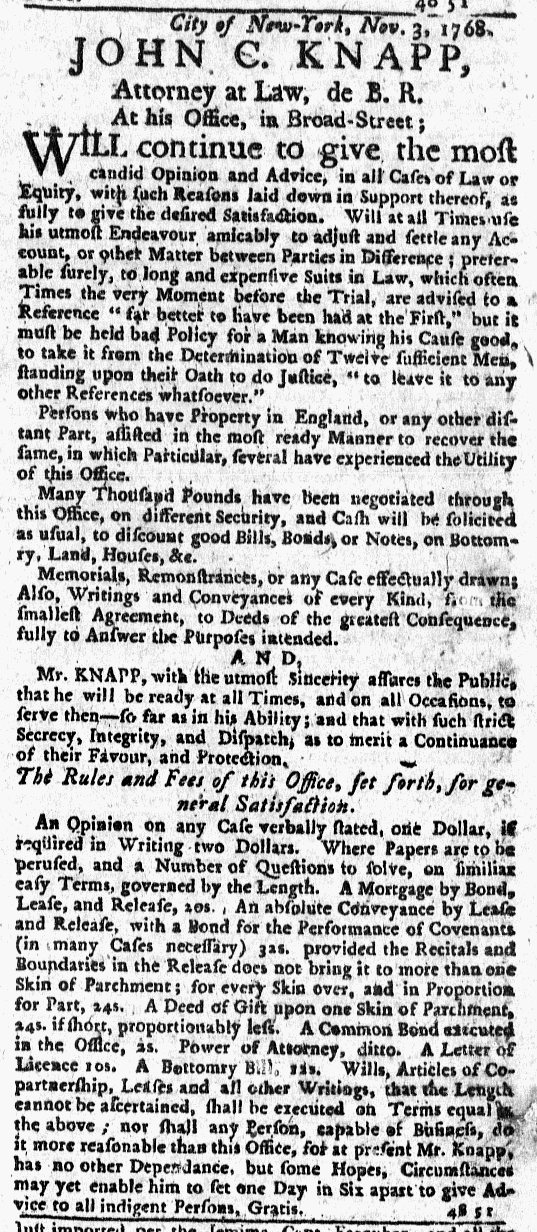
Nov 3 - 11:3:1768 New-York Journal
New-York Journal (November 3, 1768).

“Circumstances may yet enable him to set one Day in Six apart to give Advice to indigent Persons, Gratis.”

John Coghill Knapp, “Attorney at Law,” was a familiar figure to colonists who read the New York newspapers in the 1760s. He frequently placed lengthy, chatty advertisements offering a variety of legal services. In November 1768 he inserted a new advertisement, one that extended half a column, in the New-York Journal. He proclaimed that he “WILL continue to give the most candid Opinion and Advice, in all Cases of Law or Equity, with such Reasons laid down in Support thereof, as fully to give the desired Satisfaction.” He drew up “Memorials, Remonstrances, or any Case” as well as “Writings and Conveyances of every Kind, from the smallest Agreement, to Deeds of the greatest Consequence.” Although he did not state it explicitly in this new advertisement, earlier notices made clear that “Conveyances of every Kind” included the buying and selling of enslaved men, women, and children. As he had done in previous advertisements, he promised “strict Secrecy, Integrity, and Dispatch” in serving all his clients no matter what kind of work they brought to his office.

In addition to those attributes particularly valued in an attorney, Knapp concluded by declaring that he had “some Hopes, Circumstances may yet enable him to set one Day in Six apart to give Advice to indigent Persons, Gratis.” He aspired to some day be in a position to provide free legal services to those who could not otherwise afford his fees, but he did not have the means to do so at the moment. The lawyer cleverly leveraged his best intentions, which testified to his character, to attract clients who could pay. He did so while simultaneously promoting his industriousness, indicating that he pursued his profession six days of every week. Just as he set the seventh day aside for worship, he desired to set the sixth day aside for altruism. That was only possible, however, if he earned enough throughout the rest of the week to support himself. Knapp suggested that he wanted to provide aid “to all indigent Persons,” but called on prospective clients to give him the opportunity to do so. By engaging his services, they indirectly contributed to a charitable enterprise. Knapp attempted to distinguish himself from other attorneys by deploying philanthropy as a marketing strategy.
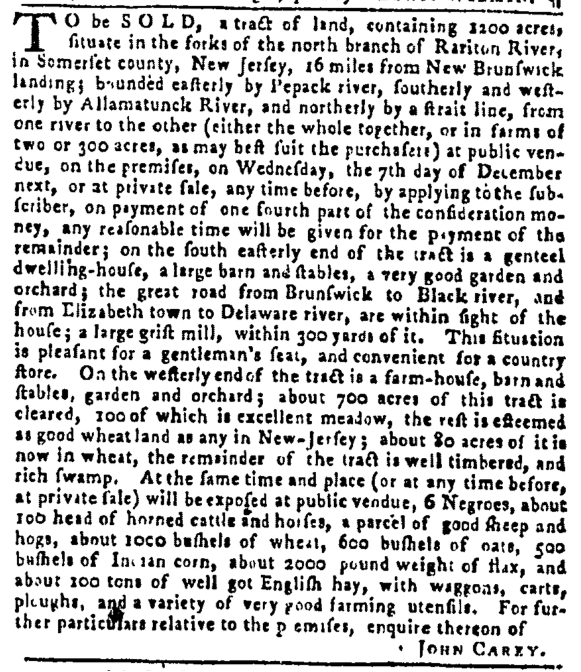
Slavery Advertisements Published November 3, 1768

GUEST CURATOR: Shannon Holleran

The Slavery Adverts 250 Project chronicles the role of newspaper advertising in perpetuating slavery in the era of the American Revolution. The project seeks to reveal the ubiquity of slavery in eighteenth-century life from New England to Georgia by republishing advertisements for slaves – for sale, wanted to purchase, runaways, captured fugitives – in daily digests on this site as well as in real time via the @SlaveAdverts250 Twitter feed, utilizing twenty-first-century media to stand in for the print media of the eighteenth century.

The project aims to provide modern audiences with a sense of just how often colonists encountered these advertisements in their daily lives. Enslaved men, women, and children appeared in print somewhere in the colonies almost every single day. Those advertisements served as a constant backdrop for social, cultural, economic, and political life in colonial and revolutionary America. Colonists who did not own slaves were still confronted with slavery as well as invited to maintain the system by purchasing slaves or assisting in the capture of runaways. The frequency of these newspaper advertisements suggests just how embedded slavery was in colonial and revolutionary American culture in everyday interactions beyond the printed page.

These advertisements also testify to the experiences of enslaved men, women, and children, though readers must consider that those experiences have been remediated through descriptions offered by slaveholders rather than the slaves themselves. Often unnamed in the advertisements, enslaved men, women, and children were not invisible or unimportant in early America.

During the week of October 28 to November 3, 2018, the Slavery Adverts 250 Project is guest curated by Shannon Holleran (2019), a History major at Assumption College in Worcester, Massachusetts.

These advertisements appeared in colonial American newspapers 250 years ago today.

Nov 3 - Boston Weekly News-Letter Slavery 1
Boston Weekly News-Letter (November 3, 1768).

**********

Nov 3 - Boston Weekly News-Letter Slavery 2
Boston Weekly News-Letter (November 3, 1768).

**********

Nov 3 - New-York Journal Supplement Slavery 1
Supplement to the New-York Journal (November 3, 1768).

**********

Nov 3 - New-York Journal Supplement Slavery 2
Supplement to the New-York Journal (November 3, 1768).

**********

Nov 3 - Pennsylvania Gazette Slavery 1
Pennsylvania Gazette (November 3, 1768).

**********

Nov 3 - Pennsylvania Gazette Slavery 2
Pennsylvania Gazette (November 3, 1768).

**********

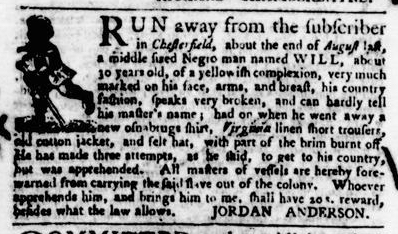
Nov 3 - Virginia Gazette Purdie and Dixon Slavery 1
Virginia Gazette [Purdie & Dixon] (November 3, 1768).

**********

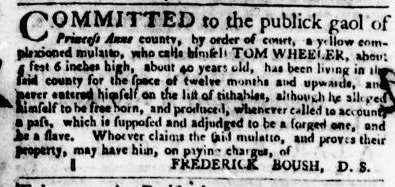
Nov 3 - Virginia Gazette Purdie and Dixon Slavery 2
Virginia Gazette [Purdie & Dixon] (November 3, 1768).

**********

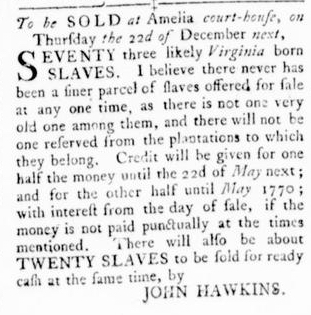
Nov 3 - Virginia Gazette Purdie and Dixon Slavery 3
Virginia Gazette [Purdie & Dixon] (November 3, 1768).

**********

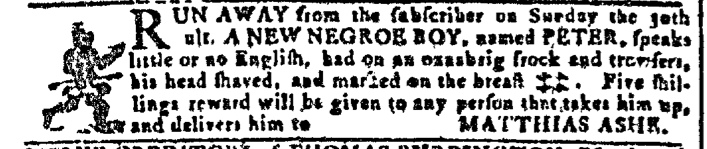
Nov 3 - Virginia Gazette Purdie and Dixon Slavery 4
Virginia Gazette [Purdie & Dixon] (November 3, 1768).

**********

Nov 3 - Virginia Gazette Purdie and Dixon Slavery 5
Virginia Gazette [Purdie & Dixon] (November 3, 1768).

**********

Nov 3 - Virginia Gazette Purdie and Dixon Slavery 6
Virginia Gazette [Purdie & Dixon] (November 3, 1768).

**********

Nov 3 - Virginia Gazette Purdie and Dixon Slavery 7
Virginia Gazette [Purdie & Dixon] (November 3, 1768).

**********

Nov 3 - Virginia Gazette Purdie and Dixon Slavery 8
Virginia Gazette [Purdie & Dixon] (November 3, 1768).

**********

Nov 3 - Virginia Gazette Purdie and Dixon Slavery 9
Virginia Gazette [Purdie & Dixon] (November 3, 1768).

**********

Nov 3 - Virginia Gazette Purdie and Dixon Slavery 10
Virginia Gazette [Purdie & Dixon] (November 3, 1768).

**********

Nov 3 - Virginia Gazette Purdie and Dixon Slavery 11
Virginia Gazette [Purdie & Dixon] (November 3, 1768).

**********

Nov 3 - Virginia Gazette Purdie and Dixon Slavery 12
Virginia Gazette [Purdie & Dixon] (November 3, 1768).

**********

Nov 3 - Virginia Gazette Purdie and Dixon Slavery 13
Virginia Gazette [Purdie & Dixon] (November 3, 1768).

**********

Nov 3 - Virginia Gazette Rind Slavery 1
Virginia Gazette [Rind] (November 3, 1768).

**********

Nov 3 - Virginia Gazette Rind Slavery 2
Virginia Gazette [Rind] (November 3, 1768).

**********

Nov 3 - Virginia Gazette Rind Slavery 3
Virginia Gazette [Rind] (November 3, 1768).

**********

Nov 3 - Virginia Gazette Rind Slavery 4
Virginia Gazette [Rind] (November 3, 1768).

**********

Nov 3 - Virginia Gazette Rind Slavery 5
Virginia Gazette [Rind] (November 3, 1768).

**********

Nov 3 - Virginia Gazette Rind Slavery 6
Virginia Gazette [Rind] (November 3, 1768).

**********

Nov 3 - Virginia Gazette Rind Slavery 7
Virginia Gazette [Rind] (November 3, 1768).

**********

Nov 3 - Virginia Gazette Rind Slavery 8
Virginia Gazette [Rind] (November 3, 1768).

**********

Nov 3 - Virginia Gazette Rind Slavery 9
Virginia Gazette [Rind] (November 3, 1768).

November 2

What was advertised in a colonial American newspaper 250 years ago today?

Nov 2 - 11:2:1768 Georgia Gazette
Georgia Gazette (November 2, 1768).

“[No. 266.]”

Earlier this week the Adverts 250 Project featured a supplement that accompanied the October 27, 1768, edition of the New-York Journal. Although the supplement carried some news, advertising filled the vast majority of space. This was not uncommon in eighteenth-century newspapers, especially those published in the largest urban ports.

Yet newspapers in Boston, Charleston, New York, and Philadelphia were not the only ones that sometimes circulated supplements devoted almost exclusively to advertising. Publications in smaller cities and towns sometimes did the same. Consider, for example, the November 2, 1768, edition of the Georgia Gazette. It included the standard four-page issue created by folding a broadsheet in half as well as a one-page supplement comprised entirely of paid notices. An excess of news did not make the advertising supplement necessary. James Johnston, the printer, devoted two entire pages to news items. A couple of those overflowed onto a third page, filling half a column. If anything, that issue carried slightly less news than usually appeared in the Georgia Gazette.

In contrast, it featured significantly more advertising, enough to fill an entire page, but not enough to merit printing on both sides of a half sheet. Johnston resorted to this strategy several times in the summer and fall of 1768, but apparently not so often that he devised a masthead that read “Supplement to the Georgia Gazette.” Newspapers that frequently distributed supplements had such mastheads. Instead, Johnston simply inserted “[No. 266.]” at the bottom of the second column, a brief notation to indicate that the extra page belonged with the November 2 issue, “No. 266” according to its masthead. Most likely the extra page had been tucked inside the standard issue prior to distribution.

Although it generally carried less advertising, in terms both of numbers and of proportion of space filled, than newspapers in the largest American cities, the Georgia Gazette was also a delivery mechanism for advertisements as much as for news and other content. It carried advertisements placed for a variety of purposes – consumer goods and services for sale, runaway slaves, real estate, legal notices, to name some of the most common – to readers in Savannah and throughout the colony.

Slavery Advertisements Published November 2, 1768

GUEST CURATOR: Shannon Holleran

The Slavery Adverts 250 Project chronicles the role of newspaper advertising in perpetuating slavery in the era of the American Revolution. The project seeks to reveal the ubiquity of slavery in eighteenth-century life from New England to Georgia by republishing advertisements for slaves – for sale, wanted to purchase, runaways, captured fugitives – in daily digests on this site as well as in real time via the @SlaveAdverts250 Twitter feed, utilizing twenty-first-century media to stand in for the print media of the eighteenth century.

The project aims to provide modern audiences with a sense of just how often colonists encountered these advertisements in their daily lives. Enslaved men, women, and children appeared in print somewhere in the colonies almost every single day. Those advertisements served as a constant backdrop for social, cultural, economic, and political life in colonial and revolutionary America. Colonists who did not own slaves were still confronted with slavery as well as invited to maintain the system by purchasing slaves or assisting in the capture of runaways. The frequency of these newspaper advertisements suggests just how embedded slavery was in colonial and revolutionary American culture in everyday interactions beyond the printed page.

These advertisements also testify to the experiences of enslaved men, women, and children, though readers must consider that those experiences have been remediated through descriptions offered by slaveholders rather than the slaves themselves. Often unnamed in the advertisements, enslaved men, women, and children were not invisible or unimportant in early America.

During the week of October 28 to November 3, 2018, the Slavery Adverts 250 Project is guest curated by Shannon Holleran (2019), a History major at Assumption College in Worcester, Massachusetts.

These advertisements appeared in colonial American newspapers 250 years ago today.

Nov 2 - Georgia Gazette Slavery 1
Georgia Gazette (November 2, 1768).

**********

Nov 2 - Georgia Gazette Slavery 2
Georgia Gazette (November 2, 1768).

**********

Nov 2 - Georgia Gazette Slavery 3
Georgia Gazette (November 2, 1768).

**********

Nov 2 - Georgia Gazette Slavery 4
Georgia Gazette (November 2, 1768).

**********

Nov 2 - Georgia Gazette Slavery 5
Georgia Gazette (November 2, 1768).

**********

Nov 2 - Georgia Gazette Slavery 6
Georgia Gazette (November 2, 1768).

**********

Nov 2 - Georgia Gazette Slavery 7
Georgia Gazette (November 2, 1768).

**********

Nov 2 - Georgia Gazette Slavery 8
Georgia Gazette (November 2, 1768).

**********

Nov 2 - Georgia Gazette Slavery 9
Georgia Gazette (November 2, 1768).

**********

Nov 2 - Georgia Gazette Slavery 10
Georgia Gazette (November 2, 1768).

**********

Nov 2 - Georgia Gazette Slavery 11
Georgia Gazette (November 2, 1768).

**********

Nov 2 - Georgia Gazette Slavery 12
Georgia Gazette (November 2, 1768).

**********

Nov 2 - Georgia Gazette Slavery 13
Georgia Gazette (November 2, 1768).