September 4

What was advertised in a colonial American newspaper 250 years ago today?

Sep 4 - 9:4:1769 New-York Gazette or Weekly Post-Boy
New-York Gazette or Weekly Post-Boy (September 4, 1769).

“She has had the Honour of being employed by several Ladies in this City.”

In an advertisement that ran in the September 4, 1769, edition of the New-York Gazette or Weekly Post-Boy, Mary Morcomb, a dressmaker, announced that she made “all Sorts of Negligees, Brunswick Dresses, Gowns, and every other Sort of Lady’s Apparel.” She also applied her skills to covering umbrellas, a fashionable accessory for many women and some men in the 1760s and 1770s.

Morcomb deployed the standard market strategies. She made appeals to price, quality, and fashion, promising prospective customers that she made garments and covered umbrellas “in the neatest, and most fashionable Manner, at the lowest Prices.” Morcomb also realized that reputation was important in attracting clients and building her business. She informed readers that she “has had the Honour of being employed by several Ladies in this City, who have declared their Approbation of her Work.” Given that Morcomb described herself as a “MANTUA-MAKER from LONDON,” she may have arrived in New York relatively recently. The newcomer may not have had time to establish a clientele in the city but had managed to find some work from “several Ladies,” leveraging their approval into a secondhand testimonial. Satisfied customers generated more customers, but word-of-mouth referrals and cultivating a reputation took time. To speed along the process, Morcomb asked the women of New York to trust her that she already served “several Ladies in this City.” In exchange for that trust, Morcomb pledged that new customers “may depend upon having their Work done with all possible Care and Dispatch.” This may not have been enough to convince every prospective client of her skills and the quality of her garments, but it may have been sufficient for some to take a chance with Morcomb. Even if the dressmaker entice only a few more clients with her advertisement, that new business could further enhance her reputation among female consumers in New York.
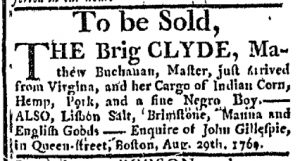
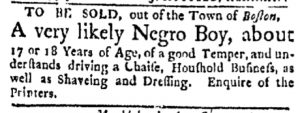
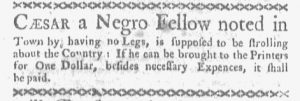
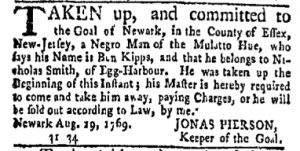
Slavery Advertisements Published September 4, 1769

The Slavery Adverts 250 Project chronicles the role of newspaper advertising in perpetuating slavery in the era of the American Revolution. The project seeks to reveal the ubiquity of slavery in eighteenth-century life from New England to Georgia by republishing advertisements for slaves – for sale, wanted to purchase, runaways, captured fugitives – in daily digests on this site as well as in real time via the @SlaveAdverts250 Twitter feed, utilizing twenty-first-century media to stand in for the print media of the eighteenth century.

The project aims to provide modern audiences with a sense of just how often colonists encountered these advertisements in their daily lives. Enslaved men, women, and children appeared in print somewhere in the colonies almost every single day. Those advertisements served as a constant backdrop for social, cultural, economic, and political life in colonial and revolutionary America. Colonists who did not own slaves were still confronted with slavery as well as invited to maintain the system by purchasing slaves or assisting in the capture of runaways. The frequency of these newspaper advertisements suggests just how embedded slavery was in colonial and revolutionary American culture in everyday interactions beyond the printed page.

These advertisements also testify to the experiences of enslaved men, women, and children, though readers must consider that those experiences have been remediated through descriptions offered by slaveholders rather than the slaves themselves. Often unnamed in the advertisements, enslaved men, women, and children were not invisible or unimportant in early America.

These advertisements appeared in colonial American newspapers 250 years ago today.

Sep 4 - Boston Chronicle Slavery 1
Boston Chronicle (September 4, 1769).

**********

Sep 4 - Boston Evening-Post Slavery 1
Boston Evening-Post (September 4, 1769).

**********

Sep 4 - Boston-Gazette Slavery 1
Boston-Gazette (September 4, 1769).

**********

Sep 4 - Boston-Gazette Slavery 2
Boston-Gazette (September 4, 1769).

**********

Sep 4 - Boston-Gazette Slavery 3
Boston-Gazette (September 4, 1769).

**********

Sep 4 - Boston-Gazette Slavery 4
Boston-Gazette (September 4, 1769).

**********

Sep 4 - Massachusetts Gazette Green and Russell Slavery 1
Massachusetts Gazette [Green and Russell] (September 4, 1769).

**********

Sep 4 - New-York Gazette and Weekly Mercury Slavery 1
New-York Gazette and Weekly Mercury (September 4, 1769).

**********

Sep 4 - New-York Gazette and Weekly Mercury Slavery 2
New-York Gazette and Weekly Mercury (September 4, 1769).

**********

Sep 4 - New-York Gazette or Weekly Post-Boy Slavery 1
New-York Gazette or Weekly Post-Boy (September 4, 1769).

**********

Sep 4 - New-York Gazette or Weekly Post-Boy Slavery 2
New-York Gazette or Weekly Post-Boy (September 4, 1769).

**********

Sep 4 - Newport Mercury Slavery 1
Newport Mercury (September 4, 1769).

**********

Sep 4 - Newport Mercury Slavery 2
Newport Mercury (September 4, 1769).

September 3

What was advertised in a colonial American newspaper 250 years ago this week?

Sep 3 - 8:31:1769 South-Carolina Gazette
South-Carolina Gazette (August 31, 1769).

“Orders from the country will be punctually answered.”

When William Wilson placed an advertisement about “a fresh Assortment of EUROPEAN and EAST-INDIA GOODS” in the August 31, 1769, edition of the South-Carolina Gazette, he listed dozens of the items in his inventory. Wilson stocked everything from “Womens black Silk Gloves and Mitts” to “Steel Coffee-Mills” to “Coopers and Carpenters Adzes.” In addition to the merchandise that he named, he also carried “several other Articles, too tedious to enumerate.” As they contemplated their participation in the consumer revolution that was taking place throughout the British Atlantic world, Wilson invited colonists to imagine the vast array of goods he made available to them. He encouraged them to savor the choices.

Although Wilson addressed “his Friends and Customers,” his advertisement made clear that those “Friends and Customers” did not need to do their shopping in person at his store on Broad Street in Charleston. For those who lived some distance from the busy port, he pledged that “Orders from the Country will be punctually answered.” Customers who placed such orders could depend on the same level of service bestowed on patrons who visited Wilson’s shop. As a convenience to his customers, he offered a precursor to mail order or internet shopping.

That service made the extensive list of goods in Wilson’s advertisement even more imperative to operating his business. His notice in the South-Carolina Gazette doubled as a catalog for much of his merchandise, advising prospective customers “from the Country” which items they could order from afar. Wilson did not merely name items like “playing Cards” and “Womens and Girls Velvet Masks” to impress readers with the variety of goods in stock; instead, he provided a list that ranged from common items to unexpected novelties so customers placing orders became aware of the many possibilities. Wilson’s advertisement included clothing and textiles, accessories, housewares, hardware and tools, and groceries, signaling to those who could not examine the “several other Articles, too tedious to enumerate” that they had a good chance of a favorable response when submitting special requests not listed in his catalog of goods. This shopkeeper’s lengthy list was more than a conspicuous display of consumer goods; it was a critical element of a service he offered for those who wished to place “Orders from the Country.”

September 2

What was advertised in a colonial American newspaper 250 years ago today?

Sep 2 - 9:2:1769 Providence Gazette
Providence Gazette (September 2, 1769).

“The PROPRIETORS of the Providence LIBRARY are hereby notified to meet.”

David S. Rowland was elected and served as librarian for the Providence Library Company (founded 1753) in the late 1760s and early 1770s. Late in the summer of 1769, he placed advertisements in the Providence Gazette to notify “PROPRIETORS of the Providence LIBRARY” of a meeting scheduled for September 4. He also published an outline of the agenda. The proprietors would gather “to concert Measures for the necessary Repairs of said Library, and to conclude whether or not Provision shall be made for the annual Enlargement of the Library, and transact other Affairs relative to its Wellbeing.”

All of this business was to be undertaken by the proprietors for the benefit of members of the Providence Library Company. The “Providence LIBRARY” was not open to the general public; instead members paid annual subscriptions for the privilege of using the library. Those subscriptions paid for the “Repairs,” “Enlargement” of the collection of books, and “other Affairs” that Rowland mentioned in his advertisement. The Providence Library Company was not alone in adopting this model for its operations. Indeed, this was standard practice for early American libraries, including the Library Company of Philadelphia (1731), the Company of the Redwood Library (Newport, 1747), the Charleston Library Society (1748), and the New York Society Library (1754).

The annual fees distinguished these subscription libraries, as they are known, from modern public libraries that open their doors to all users free of charge. Subscription libraries were not supported by the local municipalities for the benefit of all colonists, but rather by associations of readers and members who saw to their affairs and gained access only after pledging financial support. Many subscription libraries founded in the colonial era continue to operate today as research libraries patronized by scholars and others interested in early American history and culture. The Providence Library Company continues as the Providence Athenæum, incorporated in 1836. The new Providence Athenæum acquired the collections of both the Providence Library Company and an earlier Providence Athenæum (1831).

September 1

What was advertised in a colonial American newspaper 250 years ago today?

Sep 1 - 9:1:1769 New-Hampshire Gazette
New-Hampshire Gazette (September 1, 1769).

“He will mend and clean a WATCH for one half what Simnet will, let him mend as cheap as he will.”

Readers of the New-Hampshire Gazette were treated to the next chapter in the ongoing feud between watchmakers Nathaniel Sheaff Griffith and John Simnet when they perused the September 1, 1769, edition. Griffith had previously toned down his rhetoric targeting his rival, but a new development caused him to make direct comparisons to Simnet once again. A week earlier Griffith placed an advertisement to inform the community that “some VILLAIN or VILLAINS … broke open” his shop and stole a gold watch, five or six silver watches, several gold rings, and other items. To make matters worse, the stolen watches did not come exclusively from Griffith’s inventory. Many belonged to clients who had left them for repair. Griffith offered a reward to “Whoever apprehends said Thief or Thieves, so that the above Articles may be procured again.” Griffith faced ruin!

That advertisement ran a second time on September 1, this time immediately above an updated version of an advertisement that appeared two weeks earlier. The original advertisement did not make any allusions to Simnet; it simply encouraged prospective clients to entrust their watches to Griffith’s care if they wished to have them “speedily re-fitted and expeditiously returned.” He did his work “in the best and cheapest Manner.” Given the calamity that he had just experienced, however, the revised advertisement included a second paragraph that explicitly named his competitor. “AS said Nathaniel Sheaffe Griffith has begun anew, he will mend and clean a WATCH for one half what Simnet will, let him mend as cheap as he will.” Griffith went to extreme measures to save his business. No matter how much his rival might try to undercut his price, he vowed to charge only half as he faced the challenge of rebuilding.

Griffith also had a retort for Simnet’s oft-repeated credentials, which appeared once again in an advertisement immediately below Griffith’s revised notice. Simnet consistently argued that his training and experience made him the most skilled watchmaker in New Hampshire. He described himself as “Finisher to all the best original Workmen in the old Country.” Exasperated with the implied disparagement from Simnet, Griffith allowed that “I am not a Finisher to all the best original Workmen in the Old Country; but if I don’t do my Work well, I charge nothing.” Griffith valued honest labor and he expected prospective clients to value it as well. He also attempted to make up for not coming from the same background as his rival by pledging not to charge if clients found his work wanting.

Both Griffith and Simnet ran advertisements proclaiming that they set their prices at half what their competitor charged, giving prospective clients an opportunity to haggle for really low prices. A clever compositor arranged all three advertisements in a single column to better tell a dramatic story of their rivalry and the catastrophe that had recently befallen Griffith. Even readers who did not have watches to be repaired could be entertained by this spectacle as events continued to unfold.

Slavery Advertisements Published September 1, 1769

The Slavery Adverts 250 Project chronicles the role of newspaper advertising in perpetuating slavery in the era of the American Revolution. The project seeks to reveal the ubiquity of slavery in eighteenth-century life from New England to Georgia by republishing advertisements for slaves – for sale, wanted to purchase, runaways, captured fugitives – in daily digests on this site as well as in real time via the @SlaveAdverts250 Twitter feed, utilizing twenty-first-century media to stand in for the print media of the eighteenth century.

The project aims to provide modern audiences with a sense of just how often colonists encountered these advertisements in their daily lives. Enslaved men, women, and children appeared in print somewhere in the colonies almost every single day. Those advertisements served as a constant backdrop for social, cultural, economic, and political life in colonial and revolutionary America. Colonists who did not own slaves were still confronted with slavery as well as invited to maintain the system by purchasing slaves or assisting in the capture of runaways. The frequency of these newspaper advertisements suggests just how embedded slavery was in colonial and revolutionary American culture in everyday interactions beyond the printed page.

These advertisements also testify to the experiences of enslaved men, women, and children, though readers must consider that those experiences have been remediated through descriptions offered by slaveholders rather than the slaves themselves. Often unnamed in the advertisements, enslaved men, women, and children were not invisible or unimportant in early America.

These advertisements appeared in colonial American newspapers 250 years ago today.

Sep 1 - Connecticut Journal Slavery 1
Connecticut Journal (September 1, 1769).