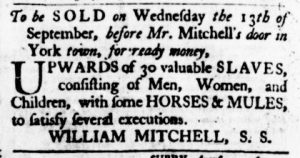
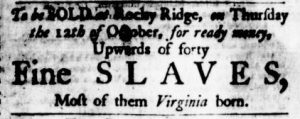
Slavery Advertisements Published September 11, 1769

The Slavery Adverts 250 Project chronicles the role of newspaper advertising in perpetuating slavery in the era of the American Revolution. The project seeks to reveal the ubiquity of slavery in eighteenth-century life from New England to Georgia by republishing advertisements for slaves – for sale, wanted to purchase, runaways, captured fugitives – in daily digests on this site as well as in real time via the @SlaveAdverts250 Twitter feed, utilizing twenty-first-century media to stand in for the print media of the eighteenth century.

The project aims to provide modern audiences with a sense of just how often colonists encountered these advertisements in their daily lives. Enslaved men, women, and children appeared in print somewhere in the colonies almost every single day. Those advertisements served as a constant backdrop for social, cultural, economic, and political life in colonial and revolutionary America. Colonists who did not own slaves were still confronted with slavery as well as invited to maintain the system by purchasing slaves or assisting in the capture of runaways. The frequency of these newspaper advertisements suggests just how embedded slavery was in colonial and revolutionary American culture in everyday interactions beyond the printed page.

These advertisements also testify to the experiences of enslaved men, women, and children, though readers must consider that those experiences have been remediated through descriptions offered by slaveholders rather than the slaves themselves. Often unnamed in the advertisements, enslaved men, women, and children were not invisible or unimportant in early America.

These advertisements appeared in colonial American newspapers 250 years ago today.
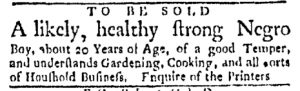
Sep 11 - Boston Evening-Post Slavery 2
Boston Evening-Post (September 11, 1769).

**********

Sep 11 - Boston Evening-Post Slavery 1
Boston Evening-Post (September 11, 1769).

**********
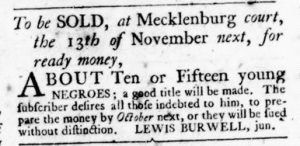
Sep 11 - Boston Post-Boy Slavery 1
Massachusetts Gazette [Green and Russell] (September 11, 1769).

**********

Sep 11 - Boston Post-Boy Slavery 2
Massachusetts Gazette [Green and Russell] (September 11, 1769).

**********

Sep 11 - Boston-Gazette Slavery 1
Boston-Gazette (September 11, 1769).

**********

Sep 11 - Boston-Gazette Slavery 2
Boston-Gazette (September 11, 1769).

**********

Sep 11 - Boston-Gazette Slavery 3
Boston-Gazette (September 11, 1769).

**********

Sep 11 - Boston-Gazette Slavery 4
Boston-Gazette (September 11, 1769).

**********

Sep 11 - New-York Gazette and Weekly Mercury Slavery 1
New-York Gazette and Weekly Mercury (September 11, 1769).

**********

Sep 11 - New-York Gazette and Weekly Mercury Slavery 2
New-York Gazette and Weekly Mercury (September 11, 1769).

**********

Sep 11 - New-York Gazette and Weekly Mercury Slavery 3
New-York Gazette and Weekly Mercury (September 11, 1769).

**********

Sep 11 - New-York Gazette and Weekly Mercury Slavery 4
New-York Gazette and Weekly Mercury (September 11, 1769).

**********

Sep 11 - New-York Gazette and Weekly Mercury Supplement Slavery 1
Supplement to the New-York Gazette and Weekly Mercury (September 11, 1769).

**********

Sep 11 - New-York Gazette or Weekly Post-Boy Slavery 1
New-York Gazette or Weekly Post-Boy (September 11, 1769).

**********

Sep 11 - New-York Gazette or Weekly Post-Boy Slavery 2
New-York Gazette or Weekly Post-Boy (September 11, 1769).

**********

Sep 11 - Newport Mercury Slavery 1
Newport Mercury (September 11, 1769).

**********

Sep 11 - Newport Mercury Slavery 2
Newport Mercury (September 11, 1769).

September 10

What was advertised in a colonial American newspaper 250 years ago this week?

Sep 10 - 9:7:1769 New-York Journal
New-York Journal (September 7, 1769).

“But few of them have yet had time to be perfected in their minuets.”

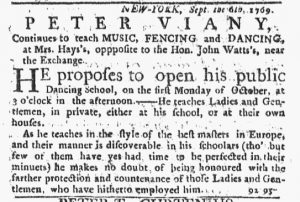
During the first week of September 1769, Peter Vianey announced that he “Continues to teach MUSIC, FENCING and DANCING” to the residents of New York. The dancing master periodically placed advertisements in the city’s newspapers as a means of both cultivating his reputation and attracting new clients. In this particular notice, he announced that he would open his “public Dancing School” on the first Monday of October. He also taught private lessons, either at the school or in the homes of pupils.

In addition to publishing his advertisement as an act of self-promotion, Vianey offered another means of enhancing his reputation. He suggested that others could observe the benefits of his instruction in his students. The dancing master declared that “he teaches in the style of the best masters in Europe, and their manner is discoverable in his scholars.” Here Vianey walked a careful line. He expressed confidence in both his own ability and the achievements of his student, yet he hedged his bets when it came to sweeping expressions of approbation for the latter. He asserted that “few of them have yet had time to be perfected in their minuets.” Should any of his pupils falter when observed by others, Vianey supplied an explanation that did not negatively reflect on his instruction: his students made good progress but needed more practice. Furthermore, he guarded his position as an expert by making it clear that he could accurately assess the level of skill exhibited by his students; he was not so blinded by his own regard for his abilities as a dancing master that he could not recognize that his students had not “perfected” their steps. Indeed, his continued employment depended on being the master of his craft, no matter how well his pupils learned to dance. For any of his current and former pupils who encountered his advertisement, Vianey’s acknowledgment that they were not yet “perfected in their minuets” served to coax them to continue under his tutelage in order to remedy such shortcomings. As he coached “Ladies and Gentlemen” in the refined comportment of dancing, Vianey had to demonstrate the benefits of his instruction yet also avoid making his lessons obsolete. He presented himself as a master who always had more to teach, no matter the accomplishments of his pupils.

September 9

What was advertised in a colonial American newspaper 250 years ago today?

Sep 9 - 9:9:1769 Providence Gazette
Providence Gazette (September 9, 1769).

Recommended by the most noted and skilful Professors of Physic and Chirurgery in America.”

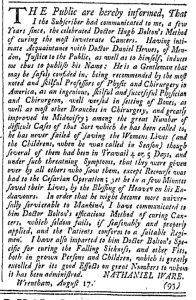
A curious advertisement, a testimonial of sorts, appeared in the Providence Gazette in the middle of August 1769 and then continued running for several weeks. In it, Nathaniel Ware of Wrentham, Massachusetts, informed the public had come into possession of “the celebrated Doctor Hugh Bolton’s Method of curing he most inveterate Cancers.” Yet Ware did not promote medical services that he provided. Instead, he reported that his “intimate Acquaintance with Doctor Daniel Hewes, of Mendon, Justice to the Public” had prompted him to pass along Bolton’s “efficacious” cure for cancers as well as “Doctor Bolton’s Specific for curing the Falling Sickness, and other Fits.” Ware also sang Hewes’s praises, proclaiming that he had established a remarkable reputation among his peers. “He is a Gentleman that may be safely confided in,” Ware gushed, “being recommended by the most noted and skilful Professors of Physic and Chirurgery in America, as an ingenious, skilful and successful Physician and Chirurgeon.” In addition to his abilities as physician and surgeon, Hewes was a competent midwife called to attend a “great Number of difficult Cases.” According to Ware, Hewes “has never failed of saving the Womens Lives” and, when summoned in a timely fashion, “the Childrens.” Ware expounded on Hewes’s expertise and experience at great length. Such a notable career spurred Ware to pass along Bolton’s cures “In order that [Hewes] might become universally serviceable to Mankind.”

Ware did not note that he had ever been the beneficiary of Hewes’s care, but he did testify to the reputation that the “skilful and successful Physician and Chirurgeon” had earned among patients and other doctors alike. Although Ware’s endorsement appeared to have been unsolicited by Hewes, the two men most likely coordinated its appearance in the Providence Gazette as a means of directing prospective patients to the physician in Mendon. The printer certainly did not treat Ware’s missive as a public service announcement or general interest story to insert among news items. Instead, it ran with the paid notices, funded by either Ware or Hewes or the two in combination. Hewes could have inserted an advertisement under his own name but may have opted for a testament from a third party as a better means of encouraging trust.

September 8

What was advertised in a colonial American newspaper 250 years ago today?

Sep 8 - 9:8:1769 Connecticut Journal
Connecticut Journal (September 8, 1769).

“A Negro Girl, between 2 and 3 Years of Age.”

In the late 1760s, the Connecticut Journal, published in New Haven by Thomas Green and Samuel Green, carried significantly less advertisements that most newspapers printed elsewhere in the colonies. Such was the case for some of the newspapers from smaller towns. For instance, the September 8, 1769, edition of the Connecticut Journal contained only four advertisements. The printers placed two of those advertisements themselves. In one, they announced “A Plan of Exercise, fro the Militia of the Colony of Connecticut” for sale at their printing office. In the other, they promoted two tracts concerning religion, one that would be available soon and the other already in stock.

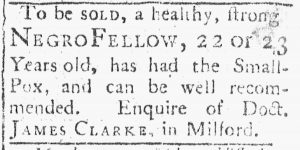
The other two advertisements merit particular notice. Both offered enslaved people for sale. One described “a healthy, strong NEGRO FELLOW, 22 or 23 Years old” who had “had the Small-Pox” and thus was not at risk of contracting it again. The other listed “a likely Negro Wench, aged about 23 Years” and also “a Negro Girl, between 2 and 3 Years of Age.” Nicholas Street, the colonist who held them in bondage, described the woman as “strong and healthy,” not unlike the “NEGRO FELLOW” in the other advertisement, and specified that she was “well-skilled in all Business suitable for a Wench.” He did not indicate the relationship between the woman and the girl, leaving readers to reach their own conclusions about whether Street compounded the violence being done by separating family members. He certainly did not express any compunction about selling the woman and girl separately.

Advertisements were an important source of revenue for printers. Paid notices made newspapers viable ventures; they funded the circulation of the news far and wide during the era of the American Revolution. Advertisements concerning enslaved people, whether offering them for sale or seeking the capture of those who attempted to seize their liberty by escaping, accounted for a significant portion of the paid notices that made it possible for printers to continue publishing newspapers. These two advertisements in the Connecticut Journal are especially striking because they represent the only advertising revenue the Greens accrued for the September 8 edition. Even in New England, enslavement was enmeshed in print culture. The two served as bulwarks for each other. Newspapers perpetuated slavery through the frequent publication of advertisements concerning enslaved people, while the advertising fees collected from enslavers contributed to the continuing operations of every newspaper published in colonial America.

Slavery Advertisements Published September 8, 1769

The Slavery Adverts 250 Project chronicles the role of newspaper advertising in perpetuating slavery in the era of the American Revolution. The project seeks to reveal the ubiquity of slavery in eighteenth-century life from New England to Georgia by republishing advertisements for slaves – for sale, wanted to purchase, runaways, captured fugitives – in daily digests on this site as well as in real time via the @SlaveAdverts250 Twitter feed, utilizing twenty-first-century media to stand in for the print media of the eighteenth century.

The project aims to provide modern audiences with a sense of just how often colonists encountered these advertisements in their daily lives. Enslaved men, women, and children appeared in print somewhere in the colonies almost every single day. Those advertisements served as a constant backdrop for social, cultural, economic, and political life in colonial and revolutionary America. Colonists who did not own slaves were still confronted with slavery as well as invited to maintain the system by purchasing slaves or assisting in the capture of runaways. The frequency of these newspaper advertisements suggests just how embedded slavery was in colonial and revolutionary American culture in everyday interactions beyond the printed page.

These advertisements also testify to the experiences of enslaved men, women, and children, though readers must consider that those experiences have been remediated through descriptions offered by slaveholders rather than the slaves themselves. Often unnamed in the advertisements, enslaved men, women, and children were not invisible or unimportant in early America.

These advertisements appeared in colonial American newspapers 250 years ago today.

Sep 8 - Connecticut Journal Slavery 1
Connecticut Journal (September 8, 1769).

**********

Sep 8 - Connecticut Journal Slavery 2
Connecticut Journal (September 8, 1769).

September 7

What was advertised in a colonial American newspaper 250 years ago today?

Sep 7 - 9:7:1769 Pennsylvania Gazette
Pennsylvania Gazette (September 7, 1769).

At the Sign of the Boot and Shoe.”

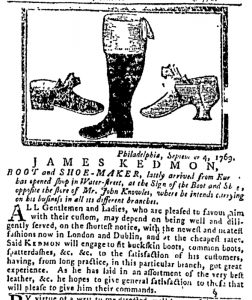
In an advertisement that ran in the September 7, 1769, edition of the Pennsylvania Gazette, boot- and shoemaker James Kedmon reported that he had “lately arrived from Europe” and opened a shop on Water Street in Philadelphia. The newcomer certainly knew how to make his presence known in the public prints. His advertisement featured a woodcut depicting a boot flanked by two shoes. The woodcut occupied approximately the same amount of space as the copy for Kedmon’s advertisement, representing a significant expense. In addition, the shoemaker had to commission the woodcut in the first place, but he apparently anticipated a return on his investment.

After all, this visual image distinguished his advertisement from all of the others that ran on the same page. None of them included visual images. Only two other images appeared elsewhere in the same issue. An advertisement on another page included a smaller woodcut that depicted a ship at sea, a stock image that would have belonged to the printers rather than being created for the exclusive use of an advertiser. Eighteenth-century readers regularly encountered multiple variations of such images of ships in a single issue of a newspaper. The masthead also included a familiar image inspired by William Penn’s coat of arms; it appeared in every issue. The September 7 edition, like every other, consisted almost entirely of text. As a result, readers’ eyes would have been drawn to the woodcut of the boot and shoes, a unique feature, when perusing the Pennsylvania Gazette.

A border enclosed that boot and shoes, transforming the woodcut into a depiction of a shop sign rather than just the merchandise Kedmon offered for sale. The shoemaker informed prospective customers that they could find him “at the Sign of the Boot and Shoe.” The woodcut may have faithfully replicated the sign that marked Kedmon’s shop; even if it did not, it suggests the type of images colonists would have seen as they traversed the streets of Philadelphia and other cities and towns. The consistent use of text and images invoking “the Sign of the Boot and Shoe” represented an eighteenth-century attempt at branding. Kedmon sought to make his presence in a new location known not only through newspaper advertisements but also through careful coordination with the images he displayed at his ship on Water Street. His newspaper advertisement with a striking woodcut was part of a larger campaign to attract customers.

Slavery Advertisements Published September 7, 1769

The Slavery Adverts 250 Project chronicles the role of newspaper advertising in perpetuating slavery in the era of the American Revolution. The project seeks to reveal the ubiquity of slavery in eighteenth-century life from New England to Georgia by republishing advertisements for slaves – for sale, wanted to purchase, runaways, captured fugitives – in daily digests on this site as well as in real time via the @SlaveAdverts250 Twitter feed, utilizing twenty-first-century media to stand in for the print media of the eighteenth century.

The project aims to provide modern audiences with a sense of just how often colonists encountered these advertisements in their daily lives. Enslaved men, women, and children appeared in print somewhere in the colonies almost every single day. Those advertisements served as a constant backdrop for social, cultural, economic, and political life in colonial and revolutionary America. Colonists who did not own slaves were still confronted with slavery as well as invited to maintain the system by purchasing slaves or assisting in the capture of runaways. The frequency of these newspaper advertisements suggests just how embedded slavery was in colonial and revolutionary American culture in everyday interactions beyond the printed page.

These advertisements also testify to the experiences of enslaved men, women, and children, though readers must consider that those experiences have been remediated through descriptions offered by slaveholders rather than the slaves themselves. Often unnamed in the advertisements, enslaved men, women, and children were not invisible or unimportant in early America.

These advertisements appeared in colonial American newspapers 250 years ago today.

Sep 7 - Boston Chronicle Slavery 1
Boston Chronicle (September 7, 1769).

**********

Sep 7 - Boston Weekly News-Letter Slavery 1
Boston Weekly News-Letter (September 7, 1769).

**********

Sep 7 - Boston Weekly News-Letter Slavery 2
Boston Weekly News-Letter (September 7, 1769).

**********

Sep 7 - Pennsylvania Gazette Slavery 1
Pennsylvania Gazette (September 7, 1769).

**********

Sep 7 - Pennsylvania Gazette Slavery 2
Pennsylvania Gazette (September 7, 1769).

**********

Sep 7 - South-Carolina Gazette Slavery 1
South-Carolina Gazette (September 7, 1769).

**********

Sep 7 - South-Carolina Gazette Slavery 2
South-Carolina Gazette (September 7, 1769).

**********

Sep 7 - South-Carolina Gazette Slavery 3
South-Carolina Gazette (September 7, 1769).

**********

Sep 7 - South-Carolina Gazette Slavery 4
South-Carolina Gazette (September 7, 1769).

**********

Sep 7 - South-Carolina Gazette Slavery 5
South-Carolina Gazette (September 7, 1769).

**********

Sep 7 - South-Carolina Gazette Slavery 6
South-Carolina Gazette (September 7, 1769).

**********

Sep 7 - Virginia Gazette Purdie and Dixon Slavery 1
Virginia Gazette [Purdie and Dixon] (September 7, 1769).

**********

Sep 7 - Virginia Gazette Purdie and Dixon Slavery 2
Virginia Gazette [Purdie and Dixon] (September 7, 1769).

**********

Sep 7 - Virginia Gazette Purdie and Dixon Slavery 3
Virginia Gazette [Purdie and Dixon] (September 7, 1769).

**********

Sep 7 - Virginia Gazette Purdie and Dixon Slavery 4
Virginia Gazette [Purdie and Dixon] (September 7, 1769).

**********

Sep 7 - Virginia Gazette Purdie and Dixon Slavery 5
Virginia Gazette [Purdie and Dixon] (September 7, 1769).

**********

Sep 7 - Virginia Gazette Purdie and Dixon Slavery 6
Virginia Gazette [Purdie and Dixon] (September 7, 1769).

**********

Sep 7 - Virginia Gazette Purdie and Dixon Slavery 7
Virginia Gazette [Purdie and Dixon] (September 7, 1769).

**********

Sep 7 - Virginia Gazette Rind Slavery 1
Virginia Gazette [Rind] (September 7, 1769).

**********

Sep 7 - Virginia Gazette Rind Slavery 2
Virginia Gazette [Rind] (September 7, 1769).

**********

Sep 7 - Virginia Gazette Rind Slavery 3
Virginia Gazette [Rind] (September 7, 1769).

**********

Sep 7 - Virginia Gazette Rind Slavery 4
Virginia Gazette [Rind] (September 7, 1769).

**********

Sep 7 - Virginia Gazette Rind Slavery 5
Virginia Gazette [Rind] (September 7, 1769).

**********

Sep 7 - Virginia Gazette Rind Slavery 6
Virginia Gazette [Rind] (September 7, 1769).

September 6

What was advertised in a colonial American newspaper 250 years ago today?

Sep 6 - 9:6:1769 Georgia Gazette
Georgia Gazette (September 6, 1769).

“IMPORTED in the Mermaid … WHITE PLAINS, LONDON DUFFILS, and HEADED SHAGS.”

A short editorial note appeared at the bottom of the second column on the third page of the September 6, 1769, edition of the Georgia Gazette. It informed readers (and advertisers) that “Advertisements left out this week” would appear in the next issue. James Johnston, the printer, did not have sufficient leftover content to merit distributing a supplement that week … or he did not consider it worth the time and resources to do so. In the past, supplements to the Georgia Gazette, unlike those that accompanied most other colonial newspapers, usually consisted of a single page printed on only side of a half sheet rather than two pages printed on both sides. In 1769 the Townshend Act leveled duties on imported paper; the revenue generated from any advertisements that did not appear on September 6 may not have justified the expense of an additional half sheet, especially if Johnston could not entirely fill it.

Yet Johnston or a clever compositor who labored in his printing office managed to squeeze in one additional advertisement in an unconventional manner. The first page featured a short advertisement: “IMPORTED in the Mermaid, Samuel Ball, from London, and for Sale, by COWPER and TELFAIRS, WHITE PLAINS, LONDON DUFFILS, and HEADED SHAGS.” Rather than setting type to appear in columns, this advertisement ran as one line in the right margin on the first page. It shared the first page with the masthead and an editorial, but no other advertisements appeared on that page. Johnston and others who produced the Georgia Gazette had not inaugurated this strategy for stretching the amount of content that would fit in an issue, but it was one used rather irregularly in newspapers printed throughout the colonies and almost never in the Georgia Gazette. Cowper and Telfairs frequently inserted paid notices in that publication, which may have contributed to Johnston’s decision to adopt innovative methods for running their advertisement as soon as possible rather than delaying it by a week. Timeliness may not have been the only benefit that accrued to Cowper and Telfairs as a result. Rather than have their advertisement appear among the nearly two dozen others in that issue, it occupied a privileged place that likely attracted greater attention as curious readers took note of the unusual format and investigated what the single line in the margin said.

Slavery Advertisements Published September 6, 1769

The Slavery Adverts 250 Project chronicles the role of newspaper advertising in perpetuating slavery in the era of the American Revolution. The project seeks to reveal the ubiquity of slavery in eighteenth-century life from New England to Georgia by republishing advertisements for slaves – for sale, wanted to purchase, runaways, captured fugitives – in daily digests on this site as well as in real time via the @SlaveAdverts250 Twitter feed, utilizing twenty-first-century media to stand in for the print media of the eighteenth century.

The project aims to provide modern audiences with a sense of just how often colonists encountered these advertisements in their daily lives. Enslaved men, women, and children appeared in print somewhere in the colonies almost every single day. Those advertisements served as a constant backdrop for social, cultural, economic, and political life in colonial and revolutionary America. Colonists who did not own slaves were still confronted with slavery as well as invited to maintain the system by purchasing slaves or assisting in the capture of runaways. The frequency of these newspaper advertisements suggests just how embedded slavery was in colonial and revolutionary American culture in everyday interactions beyond the printed page.

These advertisements also testify to the experiences of enslaved men, women, and children, though readers must consider that those experiences have been remediated through descriptions offered by slaveholders rather than the slaves themselves. Often unnamed in the advertisements, enslaved men, women, and children were not invisible or unimportant in early America.

These advertisements appeared in colonial American newspapers 250 years ago today.

Sep 6 - Georgia Gazette Slavery 1
Georgia Gazette (September 6, 1769).

**********

Sep 6 - Georgia Gazette Slavery 2
Georgia Gazette (September 6, 1769).

**********

Sep 6 - Georgia Gazette Slavery 3
Georgia Gazette (September 6, 1769).

**********

Sep 6 - Georgia Gazette Slavery 4
Georgia Gazette (September 6, 1769).

**********

Sep 6 - Georgia Gazette Slavery 5
Georgia Gazette (September 6, 1769).

**********

Sep 6 - South-Carolina and American General Gazette Slavery 1
South-Carolina and American General Gazette (September 6, 1769).

**********

Sep 6 - South-Carolina and American General Gazette Slavery 3
South-Carolina and American General Gazette (September 6, 1769).

**********

Sep 6 - South-Carolina and American General Gazette Slavery 4
South-Carolina and American General Gazette (September 6, 1769).

**********

Sep 6 - South-Carolina and American General Gazette Slavery 5
South-Carolina and American General Gazette (September 6, 1769).

**********

Sep 6 - South-Carolina and American General Gazette Slavery 6
South-Carolina and American General Gazette (September 6, 1769).

**********

Sep 6 - South-Carolina and American General Gazette Slavery 7
South-Carolina and American General Gazette (September 6, 1769).

**********

Sep 6 - South-Carolina and American General Gazette Slavery 8
South-Carolina and American General Gazette (September 6, 1769).

September 5

What was advertised in a colonial American newspaper 250 years ago today?

Sep 5 - 9:5:1769 Essex Gazette
Essex Gazette (September 5, 1769).

“BLANKS.”

Like printers in other towns and cities in the colonies, Samuel Hall sought to generate revenue by taking advantage of his access to the press to promote his own enterprises in the Essex Gazette. In addition to publishing a newspaper, Hall also produced “BLANKS” at his printing office in Salem. Colonists used blanks (or printed forms, as they would be described today) for a variety of common commercial and legal purposes. They saved significant time compared to writing out the same transaction repeatedly. In some instances, resorting to blanks allowed colonists to sidestep hiring a conveyancer or lawyer to draw up documents.

Most printers simply announced that they stocked blanks of all sorts at their printing offices. On occasion, however, some printers listed the different kinds of blanks, providing a better glimpse of how purchasing them could increase efficiency and streamline all variety of transactions. In his advertisement, Hall listed sixteen different blanks for purposes that ranged from “Apprentices Indentures” to “Bills of Lading” to “Short Powers of Attorney.”

Through his typographical choices, he made sure that readers of the Essex Gazette would notice his advertisement. Many eighteenth-century advertisements that listed goods for sale, especially those that ran in the Essex Gazette in the late 1760s, clustered the items together in dense paragraphs. Hall’s advertisement, on the other hand, listed only one type of blank per line, making it easier to read and identify forms of particular interest. Hall also selected a larger font for his advertisement than appeared throughout the rest of that edition of the Essex Gazette. His notice occupied nearly twice as much space as any other in the same issue. The combination of white space incorporated into Hall’s advertisement and the oversized type made it one of the most striking items on a page that included both news and paid notices. Another advertisement featured a woodcut depicting a ship at sea, but it appeared immediately above Hall’s advertisement for blanks, leading directly into it.

Hall promoted other aspects of his business in the Essex Gazette, hoping to generate revenue beyond subscriptions and advertising fees. In the process, he effectively used graphic design to draw attention to other products from his printing office, an array of blanks for commercial and legal purposes. His access to the press gave him opportunities to experiment with the format of his own advertisements to an extent not available to other colonists.