August 26

Who ere the subjects of an advertisements in a colonial American newspaper 250 years ago this week?
Aug 26 - 8:23:1770 New-York Journal
New-York Journal (August 23, 1770).

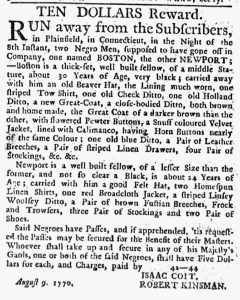
“Two Negro Men, supposed to have gone off in Company.”

Two Black men, known to their enslavers as Boston and Newport, liberated themselves in the summer of 1770.  They escaped from Isaac Coit and Robert Kinsman of Plainfield, Connecticut, during the night of August 8.  Coit and Kinsman, in turn, immediately set about placing newspaper advertisements describing Boston and Newport and offering rewards in hopes of enlisting other colonists in capturing the Black men and returning them to enslavement.  Unlike most enslavers who placed such advertisements in a single newspaper or multiple newspapers in a single city, Coit and Kinsman broadened the scope of their surveillance and recovery efforts by inserting advertisements in five newspapers published in five cities and towns in four colonies.  In addition to the reward they offered, they made an investment in advertisements that ran in Hartford’s Connecticut Courant, the Massachusetts Gazette and Boston Weekly Mercury, the New-London Gazette, the New-York Journal, and the Providence Gazette.

Although similar, these advertisements were not identical.  The variations tell a more complete story of the escape devised by Boston and Newport.  Consider the notice that ran in the New-London Gazette.  Dated August 9 (first appearing in the August 10 edition) and signed by Coit, it featured Boston only, describing him as “a stout, thick-set fellow, of middling stature, about 30 years old, very black.”  It was the only advertisement that included a visual image, a crude woodcut of a Black person in motion, wearing a grass skirt and carrying a staff, an “R” for runaway on the chest.  Another advertisement dated August 9 ran in the New-York Journal, but that one included the descriptions of both Boston and Newport.  It did not appear until August 23, likely due to the time it took for the copy to arrive in the printing office in New York from Plainfield.  An undated advertisement with almost identical copy also ran in the Providence Gazette for the first time on August 18, likely dispatched to the printing office at the same time as the one sent to New York.  Coit and Kinsman both signed it.  They noted in the final paragraph that “Said Negroes have Passes, and if apprehended, ‘tis requested the Passes may be secured for the Benefit of their Masters.”  Quite likely Coit sent the copy for his advertisement concerning Boston to the New-London Gazette, the newspaper closest to Plainfield, prior to discovering that Newport liberated himself from Kinsman.  When the enslavers realized that Boston and Newport liberated themselves on the same night, they collaborated on new advertisements with a narrative updated from what ran in the New-London Gazette.  The new version stated that Boston and Newport were suspected “to have gone off in Company,” a conspiracy to free themselves.  Determining that they had passes may have caused Coit and Kinsman to widen the scope of their efforts by publishing in multiple newspapers in New England and New York, realizing that the passes increased the mobility and chances of escape for Boston and Newport.

Two other advertisements, those that ran in the Connecticut Courant and the Massachusetts Gazette and Boston Weekly News-Letter, had identical copy.  They included short descriptions of Boston and Newport, signed by Coit and Kinsman.  In a nota bene, they declared, “It is suspected said Negroes have got a forg’d Pass.”  These advertisements were both dated August 10.  The notice in the Hartford newspaper first appeared on August 13 and in the Boston newspaper on August 16.  As the enslavers fretted about Boston and Newport having better prospects for making good on their escape thanks to the passes, they likely determined that they needed to place notices in additional newspapers.  Doing so amounted to an effort to recruit more colonists to participate in the surveillance of Black men to determine whether they might be Boston or Newport.

Advertisements for enslaved men and women who liberated themselves appeared in American newspapers just about every day in the era of the American Revolution.  The advertisements concerning Boston and Newport were not unique in their content or purpose.  What made them extraordinary was the geographic scope of the newspapers in which they appeared and the effort and expense undertaken by the enslavers Coit and Kinsman.  They marshalled the power of the press across a vast region in their attempt to return Boston and Newport to bondage.

August 25

What was advertised in a colonial American newspaper 250 years ago today?

Aug 25 - 8:25:1770 Providence Gazette
Providence Gazette (August 25, 1770).

“ALL Persons indebted to the Printer hereof … are AGAIN requested to settle their respective Balances.”

In 1770, every issue of the Providence Gazette concluded with a colophon that informed readers that the newspaper was “Printed by JOHN CARTER, at his PRINTING-OFFICE, the Sign of Shakespeares Head; where Subscriptions, Advertisements, Articles, and Letters of Intelligence, &c. are received.”  Like any other printer, Carter needed both subscribers and advertisers to make his newspaper a viable enterprise.  Subscribers constituted the foundation, but for many printers the real money was in advertising.  Neither the number of subscribers nor the number of advertisers mattered much, however, if they did not pay their bills.

Colonial printers frequently found it necessary to run notices calling on their customers to pay their debts.  Carter inserted such a notice into the August 25 edition of the Providence Gazette.  He proclaimed, “ALL Persons indebted to the Printer hereof, either for the Gazette, Advertisements, or in any other Manner, are AGAIN requested to settle their respective Balances, that he may be enabled to discharge his own Contracts.”  That “AGAIN” appeared in capital letters communicated Carter’s exasperation, which he further underscored in the process of threatening legal again.  “Those who pay as little Regard to this as they have done to many and repeated Notices of a like Nature,” he warned, “cannot reasonably expect any further Indulgence.”  He considered taking his customers to court “disagreeable” and a last resort, but something he was “compelled” to do under the circumstances.  Having taken a strident tone throughout the notice, Carter attempted to conclude on a positive note.  “[W]hile the Printer justly complains of those who neglect their Arrearages,” he declared, “he cannot but return his grateful Thanks to such Gentlemen as have paid him with Honour and Punctuality.”  In thanking his customers who paid their bills, he also launched an implicit critique of those who had not.

Such notices were a standard feature of colonial newspapers.  Like other entrepreneurs, printers extended credit to their customers but sometimes found themselves overextended or their customers too slow in settling accounts.  For merchants, shopkeepers, artisans, and others, placing such notices represented an additional cost of doing business.  Newspaper printers, on the other hand, did not incur additional expenses when running such advertisements.

Slavery Advertisements Published August 25, 1770

The Slavery Adverts 250 Project chronicles the role of newspaper advertising in perpetuating slavery in the era of the American Revolution. The project seeks to reveal the ubiquity of slavery in eighteenth-century life from New England to Georgia by republishing advertisements for slaves – for sale, wanted to purchase, runaways, captured fugitives – in daily digests on this site as well as in real time via the @SlaveAdverts250 Twitter feed, utilizing twenty-first-century media to stand in for the print media of the eighteenth century.

The project aims to provide modern audiences with a sense of just how often colonists encountered these advertisements in their daily lives. Enslaved men, women, and children appeared in print somewhere in the colonies almost every single day. Those advertisements served as a constant backdrop for social, cultural, economic, and political life in colonial and revolutionary America. Colonists who did not own slaves were still confronted with slavery as well as invited to maintain the system by purchasing slaves or assisting in the capture of runaways. The frequency of these newspaper advertisements suggests just how embedded slavery was in colonial and revolutionary American culture in everyday interactions beyond the printed page.

These advertisements also testify to the experiences of enslaved men, women, and children, though readers must consider that those experiences have been remediated through descriptions offered by slaveholders rather than the slaves themselves. Often unnamed in the advertisements, enslaved men, women, and children were not invisible or unimportant in early America.

These advertisements appeared in colonial American newspapers 250 years ago today.

Aug 25 1770 - Providence Gazette Slavery 1
Providence Gazette (August 25, 1770).

**********

Aug 25 1770 - Providence Gazette Slavery 2
Providence Gazette (August 25, 1770).

**********

Aug 25 1770 - Providence Gazette Slavery 3
Providence Gazette (August 25, 1770).

**********

Aug 25 1770 - Providence Gazette Slavery 4
Providence Gazette (August 25, 1770).

August 24

What was advertised in a colonial American newspaper 250 years ago today?

Aug 24 - 8:24:1770 Connecticut Journal
Connecticut Journal (August 24, 1770).

Send the Subscription Papers, to the Printing Office.”

An advertisement for A Treatise on Regeneration by Peter Van Mastricht ran in the August 24, 1770, edition of the Connecticut Journal.  Thomas Green and Samuel Green announced that the book was “In the Press, and a few Days will be published.”  The Greens had multiple audiences in mind when they composed their advertisement.  They hoped to attract new customers, but they also addressed existing customers as well as associates who collected subscriptions on their behalf.  A manicule drew attention to a short note at the conclusion of the advertisement: “Those Gentlemen that took in Subscriptions for printing the above Piece, are desired to send the Subscription Papers, to the Printing Office, in New Haven, the first Opportunity.”

Publishing by subscription, a popular practice prior to the American Revolution, meant taking orders in advance of printing a proposed book.  This allowed printers to gauge interest so they could determine if sufficient demand existed to merit moving forward with the project.  If so, this also gave them a good sense of how many copies to print in order to meet demand and have a small surplus for additional customers, but not so many that any that did not sell caused the venture to be a financial failure rather than success.  Printers did not always take advance orders themselves.  Instead, they distributed subscription papers to networks of associates who collected names on their behalf.  Those subscription papers included an overview of the proposed book, the conditions, an enumerated list of what subscribers could expect in terms of the material qualities of the publication, and space for subscribers to sign their names.  Prospective subscribers could also see which of their friends and neighbors had already subscribed.

When the Greens called on the “Gentlemen that took in Subscriptions” to return their subscription papers, they did so because they needed to determine a complete count of how many customers had already committed to purchasing Van Mastricht’s Treatise on Regeneration.  They could then print an appropriate number of copies to fulfill the subscriptions and still have a reasonable number for new customers.

Slavery Advertisements Published August 24, 1770

The Slavery Adverts 250 Project chronicles the role of newspaper advertising in perpetuating slavery in the era of the American Revolution. The project seeks to reveal the ubiquity of slavery in eighteenth-century life from New England to Georgia by republishing advertisements for slaves – for sale, wanted to purchase, runaways, captured fugitives – in daily digests on this site as well as in real time via the @SlaveAdverts250 Twitter feed, utilizing twenty-first-century media to stand in for the print media of the eighteenth century.

The project aims to provide modern audiences with a sense of just how often colonists encountered these advertisements in their daily lives. Enslaved men, women, and children appeared in print somewhere in the colonies almost every single day. Those advertisements served as a constant backdrop for social, cultural, economic, and political life in colonial and revolutionary America. Colonists who did not own slaves were still confronted with slavery as well as invited to maintain the system by purchasing slaves or assisting in the capture of runaways. The frequency of these newspaper advertisements suggests just how embedded slavery was in colonial and revolutionary American culture in everyday interactions beyond the printed page.

These advertisements also testify to the experiences of enslaved men, women, and children, though readers must consider that those experiences have been remediated through descriptions offered by slaveholders rather than the slaves themselves. Often unnamed in the advertisements, enslaved men, women, and children were not invisible or unimportant in early America.

These advertisements appeared in colonial American newspapers 250 years ago today.

Aug 24 1770 - New-London Gazette Slavery 1
New-London Gazette (August 24, 1770).

**********

Aug 24 1770 - New-London Gazette Slavery 2
New-London Gazette (August 24, 1770).

August 23

What was advertised in a colonial American newspaper 250 years ago today?

Aug 23 - 8:23:1770 New-York Journal
New-York Journal (August 23, 1770).

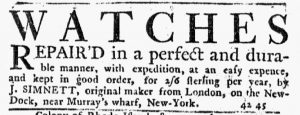
“WATCHES REPAIR’D by J. SIMNETT.”

Near the end of the summer of 1770, watchmaker John Simnet went quiet in the pages of the New-Hampshire Gazette.  In late June and early July, he placed a series of advertisements attacking his competitor and rival Nathaniel Sheaff Griffith.  That other watchmaker sometimes responded to Simnet’s taunts in the public prints, but he chose to leave the most recent tirade unanswered.  It seemed that Simnet had the last word in the New-Hampshire Gazette.

A very public feud that played out in a series of advertisements over the course of a year and a half in the New-Hampshire Gazette came to an end when Simnet relocated to New York and began placing advertisements for his services there.  His first advertisement in his new city ran in the August 23, 1770, edition of the New-York Journal.  In the largest font that appeared anywhere in the issue (including the masthead) he called attention to the “WATCHES” that he “REPAIR’D in a perfect and durable manner, with expedition, at an easy expence, and kept in good order, for 2s6 sterling per year.”

Simnet also gave his current location and described himself as an “original maker from London,” attempting to take advantage of the cachet associated with training and working in the largest city in the empire.  He did not mention that he had not arrived directly from London but had instead spent the last eighteen months in New Hampshire, nor did he proclaim that his skills were superior to those of any of his competitors in New York.  He frequently made such pronouncements in the New-Hampshire Gazette, targeting watchmakers in that colony in particular.  If prospective customers wished to assume that Simnet was indeed more skilled because he was “an original maker from London,” they were free to do so, but perhaps the sharp-tongued Simnet had learned a lesson during his interactions with Griffith in New Hampshire and opted to cultivate a different persona in the public prints in New York.  Only time would tell.  After all, his advertisements in the New-Hampshire Gazette initially took a neutral tone but became increasingly abusive toward another watchmaker over time.

Slavery Advertisements Published August 23, 1770

The Slavery Adverts 250 Project chronicles the role of newspaper advertising in perpetuating slavery in the era of the American Revolution. The project seeks to reveal the ubiquity of slavery in eighteenth-century life from New England to Georgia by republishing advertisements for slaves – for sale, wanted to purchase, runaways, captured fugitives – in daily digests on this site as well as in real time via the @SlaveAdverts250 Twitter feed, utilizing twenty-first-century media to stand in for the print media of the eighteenth century.

The project aims to provide modern audiences with a sense of just how often colonists encountered these advertisements in their daily lives. Enslaved men, women, and children appeared in print somewhere in the colonies almost every single day. Those advertisements served as a constant backdrop for social, cultural, economic, and political life in colonial and revolutionary America. Colonists who did not own slaves were still confronted with slavery as well as invited to maintain the system by purchasing slaves or assisting in the capture of runaways. The frequency of these newspaper advertisements suggests just how embedded slavery was in colonial and revolutionary American culture in everyday interactions beyond the printed page.

These advertisements also testify to the experiences of enslaved men, women, and children, though readers must consider that those experiences have been remediated through descriptions offered by slaveholders rather than the slaves themselves. Often unnamed in the advertisements, enslaved men, women, and children were not invisible or unimportant in early America.

These advertisements appeared in colonial American newspapers 250 years ago today.

Aug 23 1770 - Maryland Gazette Slavery 1
Maryland Gazette (August 23, 1770).

**********

Aug 23 1770 - Maryland Gazette Slavery 2
Maryland Gazette (August 23, 1770).

**********

Aug 23 1770 - Maryland Gazette Slavery 3
Maryland Gazette (August 23, 1770).

**********

Aug 23 1770 - Maryland Gazette Slavery 4
Maryland Gazette (August 23, 1770).

**********

Aug 23 1770 - Massachusetts Gazette and Boston Weekly News-Letter Slavery 1
Massachusetts Gazette and Boston Weekly News-Letter (August 23, 1770).

**********

Aug 23 1770 - Massachusetts Gazette and Boston Weekly News-Letter Slavery 2
Massachusetts Gazette and Boston Weekly News-Letter (August 23, 1770).

**********

Aug 23 1770 - Massachusetts Gazette and Boston Weekly News-Letter Slavery 3
Massachusetts Gazette and Boston Weekly News-Letter (August 23, 1770).

**********

Aug 23 1770 - New-York Journal Slavery 1
New-York Journal (August 23, 1770).

**********

Aug 23 1770 - New-York Journal Slavery 2
New-York Journal (August 23, 1770).

**********

Aug 23 1770 - Pennsylvania Gazette Supplement Slavery 1
Supplement to the Pennsylvania Gazette (August 23, 1770).

**********

Aug 23 1770 - Pennsylvania Journal Slavery 1
Pennsylvania Journal (August 23, 1770).

**********

Aug 23 1770 - Pennsylvania Journal Slavery 2
Pennsylvania Journal (August 23, 1770).

**********

Aug 23 1770 - Pennsylvania Journal Slavery 3
Pennsylvania Journal (August 23, 1770).

**********

Aug 23 1770 - South-Carolina Gazette Continuation Slavery 1
Continuation to the South-Carolina Gazette (August 23, 1770).

**********

Aug 23 1770 - South-Carolina Gazette Continuation Slavery 2
Continuation to the South-Carolina Gazette (August 23, 1770).

**********

Aug 23 1770 - South-Carolina Gazette Continuation Slavery 3
Continuation to the South-Carolina Gazette (August 23, 1770).

**********

Aug 23 1770 - South-Carolina Gazette Continuation Slavery 4
Continuation to the South-Carolina Gazette (August 23, 1770).

**********

Aug 23 1770 - South-Carolina Gazette Continuation Slavery 5
Continuation to the South-Carolina Gazette (August 23, 1770).

**********

Aug 23 1770 - South-Carolina Gazette Continuation Slavery 6
Continuation to the South-Carolina Gazette (August 23, 1770).

**********

Aug 23 1770 - South-Carolina Gazette Continuation Slavery 7
Continuation to the South-Carolina Gazette (August 23, 1770).

**********

Aug 23 1770 - South-Carolina Gazette Continuation Slavery 8
Continuation to the South-Carolina Gazette (August 23, 1770).

**********

Aug 23 1770 - South-Carolina Gazette Slavery 1
South-Carolina Gazette (August 23, 1770).

**********

Aug 23 1770 - South-Carolina Gazette Slavery 2
South-Carolina Gazette (August 23, 1770).

**********

Aug 23 1770 - Virginia Gazette Rind Slavery 1
Virginia Gazette [Rind] (August 23, 1770).

**********

Aug 23 1770 - Virginia Gazette Rind Slavery 2
Virginia Gazette [Rind] (August 23, 1770).

**********

Aug 23 1770 - Virginia Gazette Rind Slavery 3
Virginia Gazette [Rind] (August 23, 1770).

**********

Aug 23 1770 - Virginia Gazette Rind Slavery 4
Virginia Gazette [Rind] (August 23, 1770).

**********

Aug 23 1770 - Virginia Gazette Rind Slavery 5
Virginia Gazette [Rind] (August 23, 1770).

**********

Aug 23 1770 - Virginia Gazette Rind Slavery 6
Virginia Gazette [Rind] (August 23, 1770).

**********

Aug 23 1770 - Virginia Gazette Rind Slavery 7
Virginia Gazette [Rind] (August 23, 1770).

August 22

What was advertised in a colonial American newspaper 250 years ago this week?

Aug 22 - 8:16:20:1770South-Carolina Gazette Supplement
Note the holes on the right, left when removing a binding. Those holes are an important clue for correctly dating this page from an eighteenth-century newspaper. Continuation of the South-Carolina Gazette (August 16, 1770).

“ALL the STOCK of GOODS.”

Most advertisements in eighteenth-century newspapers ran multiple times.  Compositors set the type once and then used it over and over, often moving advertisements around the page in order to make them fit with each other and the news, editorials, and other content that comprised the rest of the issue.  This streamlined the production of colonial newspapers since compositors did not have to set type for every item that appeared in every issue.

When I did the initial research to select an advertisement to feature today, I decided on an entire page rather than a single advertisement.  Why?  The entire page consisted of advertising reprinted in its entirety from a previous issue.  While compositors reused individual advertisements in practically every issue, reprinting an entire page was exceptionally unusual.  I cannot recall having seen an example of this in all of the eighteenth-century newspapers I have examined over the course of nearly two decades.

Alas, on closer examination I discovered that what I thought had happened did not actually happen.  An entire page of advertising was not reprinted, despite initial appearances.  Here’s what did happen.  Peter Timothy published a new edition of the South-Carolina Gazette on August 16, 1770.  That happened to be a Thursday, his usual day for distributing a new issue.  It was a standard four-page issue created by printing two pages on each side of a broadsheet and then folding it in half.  Timothy had too much content to fit everything into those four pages, likely because he had to resort to smaller sheets than usual, so he published four-page Continuation of the South-Carolina Gazette on the same day.  Issuing some sort of “supplement,” “postscript”, or “continuation” was standard practice, especially for newspapers published in the largest port cities.  Prior to the American Revolution, most newspaper printers produced one issue per week, sometimes accompanied by a supplement.  On rare occasions, they distributed a supplement in the middle of the week.  Timothy did so in August 1770, printing a Supplement to the South-Carolina Gazette on Monday, August 20, four days after the regular issue and its Continuation.

Here’s what I initially thought happened, but eventually discovered did not actually happen.  The Supplement published on August 20 included an entire page of advertising reprinted from the Continuation of August 16.  When I looked more closely, however, I noticed that the Supplement consisted of three pages.  That was extremely unlikely.  Eighteenth-century printers almost never released standard editions or supplements with an odd number of pages.  Doing so meant blank pages, a waste of precious paper.  I originally assumed that the reprinted page had resulted from the compositor using it as filler in order to avoid circulating a blank page when the news that merited a midweek supplement fell short of filling an entire broadsheet.  In that case, the reprinted page should brought the number of pages to two or four, but not three.  A supplement consisting of three pages, with the reprinted page as the second page, did not make much sense, especially since the sentence from the bottom of the first page continued at the top of the third page.

When I looked more closely at the images of the original page in the Continuation from August 16 and the Supplement from August 20, I noticed that not only did all of the advertisements appear in the same order but the edges of the paper and holes left from binding that had been undone were identical.  These were not two separate pages.  Instead, they were digital images of the same page!

I recently examined another page of a newspaper published in Charleston, South Carolina, in August 1770 that had been mistakenly included as part of another issue (and another newspaper) in the production of a database of digitized images of eighteenth-century newspapers.  In both cases, the digital archive provided enough clues that I eventually realized something did not match the usual practices of eighteenth-century printers.  Especially in this instance, however, the error was not readily apparent.  I discovered it only because I decided to work so intensively with a particular page of the South-Carolina Gazette.  Others who consulted the same digital resource, even experienced researchers, might not have noticed the discrepancy if they did not happen to be specialists in eighteenth-century print culture, particularly newspaper production.

This is an error that would not have happened when consulting the original documents.  The fourth page of the Continuation would have been on the other side of the third page of the Continuation.  It would not have been possible to view it as somehow appearing between the first page of the Supplement and the supposed third page of the Supplement (actually the second page on the other side of the sheet for the first page).  Digital images of individual pages untether them from the rest of the issue in which they appeared.  Digital archives increase access to primary sources.  The Adverts 250 Project and the Slavery Adverts 250 Project would not be possible without the several databases of digitized newspapers that remediate eighteenth-century sources for wider dissemination.  Yet readers need to be savvy when they consult such databases since digital renditions, such as images of individual pages, become subject to errors not possible when consulting original documents.

Aug 20 1770 - South-Carolina Gazette Supplement Page 2
This page mistakenly appears as the second page of the Supplement to the South-Carolina Gazette (August 20, 1770) in Accessible Archives’s collection of South Carolina Newspapers.  It also correctly appears as the fourth page of the Continuation of the South-Carolina Gazette (August 16, 1770).

August 21

What was advertised in a colonial American newspaper 250 years ago today?

Aug 21 - 8:21:1770 Massachusetts Spy
Massachusetts Spy (August 21, 1770).

“A General Assortment of GROCERIES.”

Isaiah Thomas launched the Massachusetts Spy on July 17, 1770, with an issue that included the “PROPOSALS for printing by Subscription, A New PAPER of INTELLIGENCE” as well as several news items.  The “PROPOSALS” served as an advertisement for the newspaper, the only advertisement that appeared in “NUMB. I,” that first issue.  Thomas stated that he would publish the next issue two weeks later (but three times a week after that) and invited subscribers and advertisers to contact him.  Three weeks elapsed before the printer distributed the next edition, but after that he kept to the schedule he outlined in the “PROPOSALS.”

The first several issues, however, did not include advertisements.  Thomas and the Massachusetts Spy competed with four other newspapers published in Boston, all of them established years earlier and familiar to the readers in the city and its hinterlands.  Prospective advertisers quite likely did not wish to invest in placing notices in the Massachusetts Spy until they saw what kind of reception it received among the public and got a better sense of its circulation.  It was not until “NUMB. 8,” the eighth issue, that advertisements other than the “PROPOSALS” ran in the Massachusetts Spy.  More than a month after Thomas solicited advertisements in the first issue, four of them ran on August 21, 1770.  Alexander Chamberlain, Jr., advertised groceries and housewares, while two citrus sellers at “the sign of the Dish of Lemons, in Marlborough-street” and “the Sign of the Basket of Lemons … in Middle-Street” competed for customers.  An anonymous “WET NURSE” offered her services, instructing prospective clients to “Enquire at the New Printing-Office, in Union-Street.”  Like other printers, Thomas disseminated additional information to readers who followed up on advertisements that ran in his newspaper.

In the colophon on the final page, Thomas reminded readers that he accepted “Subscriptions, Articles of Intelligence, and Advertisements, &c. for this Paper.”  Having finally published these advertisements, he likely hoped that they would encourage more colonists to insert their own notices in his newspaper.  After all, advertising represented an important revenue stream for any printer.  Paid notices often made the difference between newspapers successfully turning a profit or not having sufficient resources to continue publication.

Slavery Advertisements Published August 21, 1770

The Slavery Adverts 250 Project chronicles the role of newspaper advertising in perpetuating slavery in the era of the American Revolution. The project seeks to reveal the ubiquity of slavery in eighteenth-century life from New England to Georgia by republishing advertisements for slaves – for sale, wanted to purchase, runaways, captured fugitives – in daily digests on this site as well as in real time via the @SlaveAdverts250 Twitter feed, utilizing twenty-first-century media to stand in for the print media of the eighteenth century.

The project aims to provide modern audiences with a sense of just how often colonists encountered these advertisements in their daily lives. Enslaved men, women, and children appeared in print somewhere in the colonies almost every single day. Those advertisements served as a constant backdrop for social, cultural, economic, and political life in colonial and revolutionary America. Colonists who did not own slaves were still confronted with slavery as well as invited to maintain the system by purchasing slaves or assisting in the capture of runaways. The frequency of these newspaper advertisements suggests just how embedded slavery was in colonial and revolutionary American culture in everyday interactions beyond the printed page.

These advertisements also testify to the experiences of enslaved men, women, and children, though readers must consider that those experiences have been remediated through descriptions offered by slaveholders rather than the slaves themselves. Often unnamed in the advertisements, enslaved men, women, and children were not invisible or unimportant in early America.

These advertisements appeared in colonial American newspapers 250 years ago today.

Aug 21 1770 - Essex Gazette Slavery 1
Essex Gazette (August 21, 1770).

**********

Aug 21 1770 - Essex Gazette Slavery 2
Essex Gazette (August 21, 1770).

**********

Aug 21 1770 - Essex Gazette Slavery 3
Essex Gazette (August 21, 1770).

**********

Aug 21 1770 - South-Carolina Gazette and Country Journal Slavery 1
South-Carolina Gazette and Country Journal (August 21, 1770).

**********

Aug 21 1770 - South-Carolina Gazette and Country Journal Slavery 2
South-Carolina Gazette and Country Journal (August 21, 1770).

**********

Aug 21 1770 - South-Carolina Gazette and Country Journal Slavery 3
South-Carolina Gazette and Country Journal (August 21, 1770).

**********

Aug 21 1770 - South-Carolina Gazette and Country Journal Slavery 4
South-Carolina Gazette and Country Journal (August 21, 1770).

**********

Aug 21 1770 - South-Carolina Gazette and Country Journal Slavery 5
South-Carolina Gazette and Country Journal (August 21, 1770).

**********

Aug 21 1770 - South-Carolina Gazette and Country Journal Slavery 6
South-Carolina Gazette and Country Journal (August 21, 1770).

**********

Aug 21 1770 - South-Carolina Gazette and Country Journal Slavery 7
South-Carolina Gazette and Country Journal (August 21, 1770).

**********

Aug 21 1770 - South-Carolina Gazette and Country Journal Slavery 8
South-Carolina Gazette and Country Journal (August 21, 1770).

**********

Aug 21 1770 - South-Carolina Gazette and Country Journal Slavery 9
South-Carolina Gazette and Country Journal (August 21, 1770).

**********

Aug 21 1770 - South-Carolina Gazette and Country Journal Slavery 10
South-Carolina Gazette and Country Journal (August 21, 1770).