August 20

What was advertised in a colonial American newspaper 250 years ago today?

Aug 20 - 8:20:1770 Boston-Gazette
Boston-Gazette (August 20, 1770).

“Doctor’s Boxes … are carefully prepared.”

Peter Roberts advertised “An Assortment of the best DRUGS and MEDICINES” as well as other medical supplies, including “Surgeons Instruments,” “Iron and Marble Mortars and Pestles,” and “a great Variety of Smelling Bottles” in the August 20, 1770, edition of the Boston-Gazette.  In addition to listing his wares, he adopted two other marketing strategies commonly deployed by apothecaries and others who sold medicines.  In both, he emphasized convenience as an important part of the customer service he provided.

Roberts informed prospective customers that “Doctor’s Boxes of various Prices, with proper Directions, are carefully prepared and put up for Ships or private Families.”  He produced an eighteenth-century version of a first aid kit, packaging together several useful items that buyers did not need at the moment but would likely find useful when need did arise.  Even if the purchasers never used some of those items but merely had them on hand out of caution, Roberts still generated revenue for each item included in those “Doctor’s Boxes.”  At the same time, he sold a sense of security to those who felt better prepared for illnesses, injuries, and emergencies because they had a variety of medical supplies on hand.  To enhance that sense of security, Roberts included “proper Directions” in each box he prepared.  Buyers benefited from the convenience of having medicines, medical supplies, and directions easily accessible in those “Doctor’s Boxes.”

Roberts also offered medical professionals the convenience of placing their orders through the post or messenger rather than visiting his shop “opposite the West Door of the Town-House, BOSTON.”  He advised that “Practitioners in Town and Country may depend on being as well used by Letter as if present themselves.”  Roberts likely hoped to increase his share of the market by assuring prospective customers who could not come to his shop because they were too busy or because they resided too far away that he would not provide second-rate service.  He underscored that their business was important to him.

Roberts made clear in his advertisement that he did more than merely dispense drugs and sell medical equipment.  He aimed to provide a level of service and convenience that added value to the merchandise he offered for sale.  He intended that such marketing strategies would attract customers choosing among the many purveyors of patent medicines and other medical supplies in colonial Boston.

Slavery Advertisements Published August 20, 1770

The Slavery Adverts 250 Project chronicles the role of newspaper advertising in perpetuating slavery in the era of the American Revolution. The project seeks to reveal the ubiquity of slavery in eighteenth-century life from New England to Georgia by republishing advertisements for slaves – for sale, wanted to purchase, runaways, captured fugitives – in daily digests on this site as well as in real time via the @SlaveAdverts250 Twitter feed, utilizing twenty-first-century media to stand in for the print media of the eighteenth century.

The project aims to provide modern audiences with a sense of just how often colonists encountered these advertisements in their daily lives. Enslaved men, women, and children appeared in print somewhere in the colonies almost every single day. Those advertisements served as a constant backdrop for social, cultural, economic, and political life in colonial and revolutionary America. Colonists who did not own slaves were still confronted with slavery as well as invited to maintain the system by purchasing slaves or assisting in the capture of runaways. The frequency of these newspaper advertisements suggests just how embedded slavery was in colonial and revolutionary American culture in everyday interactions beyond the printed page.

These advertisements also testify to the experiences of enslaved men, women, and children, though readers must consider that those experiences have been remediated through descriptions offered by slaveholders rather than the slaves themselves. Often unnamed in the advertisements, enslaved men, women, and children were not invisible or unimportant in early America.

These advertisements appeared in colonial American newspapers 250 years ago today.

Aug 20 1770 - Boston Evening-Post Slavery 1
Boston Evening-Post (August 20, 1770).

**********

Aug 20 1770 - Boston-Gazette Slavery 1
Boston-Gazette (August 20, 1770).

**********

Aug 20 1770 - Boston-Gazette Slavery 2
Boston-Gazette (August 20, 1770).

**********

Aug 20 1770 - Boston-Gazette Slavery 3
Boston-Gazette (August 20, 1770).

**********

Aug 20 1770 - Boston-Gazette Slavery 4
Boston-Gazette (August 20, 1770).

**********

Aug 20 1770 - Connecticut Courant Slavery 1
Connecticut Courant (August 20, 1770).

**********

Aug 20 1770 - New-York Gazette and Weekly Mercury Slavery 1
New-York Gazette and Weekly Mercury (August 20, 1770).

**********

Aug 20 1770 - New-York Gazette and Weekly Mercury Slavery 2
New-York Gazette and Weekly Mercury (August 20, 1770).

**********

Aug 20 1770 - New-York Gazette or Weekly Post-Boy Slavery 1
New-York Gazette or Weekly Post-Boy (August 20, 1770).

**********

Aug 20 1770 - Newport Mercury Slavery 1
Newport Mercury (August 20, 1770).

**********

Aug 20 1770 - South-Carolina and American General Gazette Slavery 1
South-Carolina and American General Gazette (August 20, 1770).

**********

Aug 20 1770 - South-Carolina and American General Gazette Slavery 2
South-Carolina and American General Gazette (August 20, 1770).

**********

Aug 20 1770 - South-Carolina and American General Gazette Slavery 3
South-Carolina and American General Gazette (August 20, 1770).

**********

Aug 20 1770 - South-Carolina and American General Gazette Slavery 4
South-Carolina and American General Gazette (August 20, 1770).

**********

Aug 20 1770 - South-Carolina and American General Gazette Slavery 5
South-Carolina and American General Gazette (August 20, 1770).

**********

Aug 20 1770 - South-Carolina Gazette Supplement Slavery 1
Supplement to the South-Carolina Gazette (August 20, 1770).

**********

Aug 20 1770 - South-Carolina Gazette Supplement Slavery 2
Supplement to the South-Carolina Gazette (August 20, 1770).

**********

Aug 20 1770 - South-Carolina Gazette Supplement Slavery 3
Supplement to the South-Carolina Gazette (August 20, 1770).

**********

Aug 20 1770 - South-Carolina Gazette Supplement Slavery 4
Supplement to the South-Carolina Gazette (August 20, 1770).

**********

Aug 20 1770 - South-Carolina Gazette Supplement Slavery 5
Supplement to the South-Carolina Gazette (August 20, 1770).

**********

Aug 20 1770 - South-Carolina Gazette Supplement Slavery 6
Supplement to the South-Carolina Gazette (August 20, 1770).

**********

Aug 20 1770 - South-Carolina Gazette Supplement Slavery 7
Supplement to the South-Carolina Gazette (August 20, 1770).

August 19

What was advertised in a colonial American newspaper 250 years ago this week?

Aug 19 1770 - 8:16:1770 Pennsylvania Gazette
Pennsylvania Gazette (August 16, 1770).

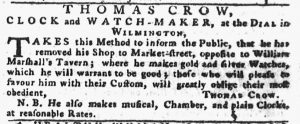
“CLOCK and WATCH-MAKER, at the DIAL in WILMINGTON.”

Two clock- and watchmakers advertised in the August 16, 1770, edition of the Pennsylvania Gazette, but they likely did not consider each other competitors.  John Wood promoted a “PARCEL of neat Philadelphia made WATCHES” available at his shop “at the Corner of Front and Chestnut-streets” in Philadelphia.  Thomas Crow advised prospective customers that he made “gold and silver Watches” as well as “musical, Chamber, and plain Clocks.”  He also noted he had “removed his Shop to Market-street, opposite to William Marshall’s Tavern,” but he did not mean the Market Street in Philadelphia that would have put him in close proximity to Wood’s shop.  Instead, his advertisement identified Crow as a “CLOCK and WATCH-MAKER, at the DIAL in WILMINGTON,” Delaware, thirty miles down the Delaware River.  The two advertisers addressed different markets in their efforts to attract consumers.

Although Wood expected the majority of his customers to come from Philadelphia and its environs and Crow expected most of his customers to come from Wilmington and the surrounding area, they participated in a single media market.  Wilmington did not have its own newspaper in 1770.  Indeed, no printers published newspapers in Delaware during the colonial period.  Only after the American Revolution, in 1785, did Jacob Killen commence publication of the Delaware Gazette, the state’s first newspaper, in Wilmington.  In 1770, the Pennsylvania Gazette served as a regional newspaper for readers and advertisers in Pennsylvania, Delaware, and portions of Maryland and New Jersey.  The Pennsylvania Chronicle and the Pennsylvania Journal did as well, though the Gazette had been in print for much longer and had larger circulation numbers.
Merchants, shopkeepers, and artisans placed most of the advertisements for consumer goods and services that appeared in the newspapers published in Philadelphia, but not all of them.  Advertisers from Wilmington, Delaware; Burlington, New Jersey; Baltimore, Maryland; Lancaster, Pennsylvania; and other towns in the region also treated those publications as their local newspapers.  When Thomas Crow inserted his advertisement in the Pennsylvania Gazette, he expected that prospective customers in and near his town would see it and respond.

August 18

What was advertised in a colonial American newspaper 250 years ago today?

Aug 18 - 8:18:1770 Providence Gazette
Providence Gazette (August 18, 1770).

“Said Negroes are supposed to have Passes.”

In eighteenth-century newspapers, advertisements often served as a supplemental source of news.  Paid notices delivered information about current events that editors did not necessarily select for inclusion among the news articles and editorials that appeared elsewhere in the newspaper.  Advertisements about “runaways,” enslaved people who liberated themselves, fit into this category of paid notices that delivered the news.

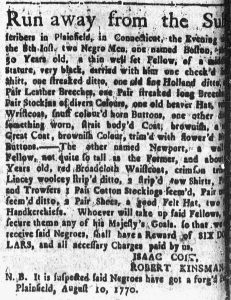
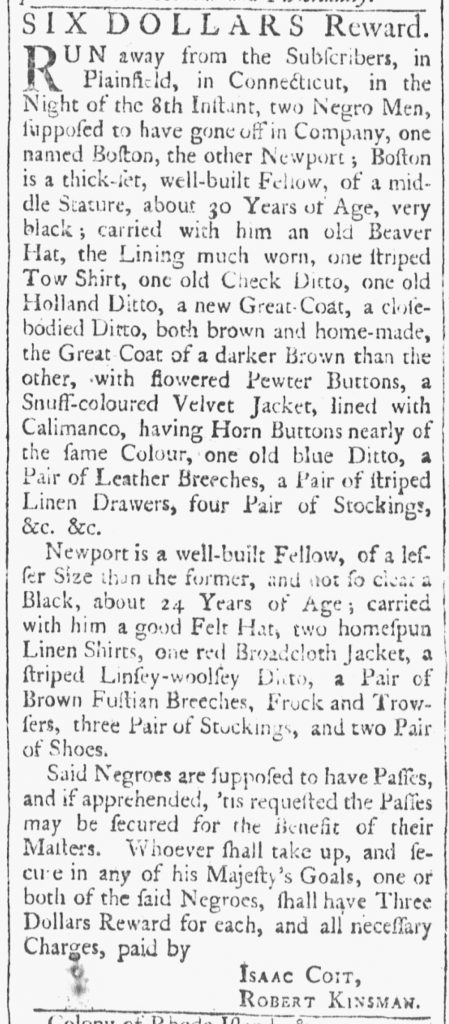
Consider an advertisement concerning “two Negro Men,” Boston and Newport, “supposed to have gone off in Company” with each other that ran in the August 18 1770, edition of the Providence Gazette.  The enslavers who placed the advertisement, Isaac Coit and Robert Kinsman of Plainsfield, Connecticut, provided lengthy descriptions of Boston, “a thick-set, well-built Fellow, of a middle Stature, about 30 Years of Age very black,” and Newport, “a well-built Fellow, of a lesser Size than the former, and not so clear a Black, about 24 Years of Age.”  In addition to these physical descriptions, Coit and Kinsman listed all of the clothing that Boston and Newport took with them, hoping that “a Snuff-coloured Velvet Jacket, lined with Calimanco, having Horn Buttons nearly of the same Colour” would help vigilant colonists recognize Boston or that “a Pair of Brown Fustian Breeches” would aid in identifying Newport.  The enslavers also suspected that Boston and Newport “have Passes,” though they did not elaborate on how the enslaved men had acquired those passes, whether they were literate enough to forge passes for themselves or if an accomplice provided them.  Coit and Kinsman may not have known; they “requested the Passes may be secured for the Benefit of their Masters,” perhaps in hopes of examining them to determine their origins and prevent Boston, Newport, and other enslaved people from making use of other passes in subsequent attempts to liberate themselves.

Placed for the purpose of capturing Boston and Newport in order to return them to bondage, this advertisement operated as a news report that supplemented the other contents of the Providence Gazette.  As readers perused the paid notices in the August 18, 1770, edition, they learned of impoverished colonists seeking “the Benefit of an Act … for the Relief of insolvent Debtors,” a burglary in Middletown, Connecticut, a variety of goods “STOPPED” because they were “Supposed to have been stolen,” and the efforts of Boston and Newport to seize their own liberty.  Since printers often focused on reprinting news from faraway places, local news appeared among the advertisements.

Slavery Advertisements Published August 18, 1770

The Slavery Adverts 250 Project chronicles the role of newspaper advertising in perpetuating slavery in the era of the American Revolution. The project seeks to reveal the ubiquity of slavery in eighteenth-century life from New England to Georgia by republishing advertisements for slaves – for sale, wanted to purchase, runaways, captured fugitives – in daily digests on this site as well as in real time via the @SlaveAdverts250 Twitter feed, utilizing twenty-first-century media to stand in for the print media of the eighteenth century.

The project aims to provide modern audiences with a sense of just how often colonists encountered these advertisements in their daily lives. Enslaved men, women, and children appeared in print somewhere in the colonies almost every single day. Those advertisements served as a constant backdrop for social, cultural, economic, and political life in colonial and revolutionary America. Colonists who did not own slaves were still confronted with slavery as well as invited to maintain the system by purchasing slaves or assisting in the capture of runaways. The frequency of these newspaper advertisements suggests just how embedded slavery was in colonial and revolutionary American culture in everyday interactions beyond the printed page.

These advertisements also testify to the experiences of enslaved men, women, and children, though readers must consider that those experiences have been remediated through descriptions offered by slaveholders rather than the slaves themselves. Often unnamed in the advertisements, enslaved men, women, and children were not invisible or unimportant in early America.

These advertisements appeared in colonial American newspapers 250 years ago today.

Aug 18 1770 - Providence Gazette Slavery 1
Providence Gazette (August 18, 1770).

**********

Aug 18 1770 - Providence Gazette Slavery 2
Providence Gazette (August 18, 1770).

**********

Aug 18 1770 - Providence Gazette Slavery 3
Providence Gazette (August 18, 1770).

August 17

What was advertised in a colonial American newspaper 250 years ago today?

Aug 17 - 8:17:1770 New-Hampshire Gazette
New-Hampshire Gazette (August 17, 1770).

“To Ride as Carrier … in order to carry News Papers.”

The first two advertisements in the August 17, 1770, edition of the New-Hampshire Gazette concerned the operations of the newspaper.  Quite likely, the printers exercised their control of the press to give those notices a privileged place.  The first advertisement, repeated from the previous issue, acknowledged the upcoming fourteenth anniversary of the newspaper and contained Daniel Fowle and Robert Fowle’s call on subscribers, advertisers, and others who owed debts to settle accounts or face legal action.

James Templeton addressed the residents of Amherst, Wilton, Temple, Petersborough, New Dublin, Marlborough, Keen, Walpole, Charlestown, Chesterfield, Westmoreland, Hinsdale, Winchester, Swansey, and other town in “the extreme Parts of the Province” to offer his services to “Ride as Carrier or Post … in order to carry News Papers.”  He promised to be “punctual and faithful” in his delivery even as he endeavored to get the newspapers to subscribers “as cheap as possible at that great Distance.”

While not overseen directly by the Fowles, Templeton’s enterprise stood to benefit them as proprietors of the New-Hampshire Gazette through maintaining or even increasing readership.  Templeton also revealed how quickly readers in “the extreme Parts of the Province” received their newspapers.  He proposed meeting the rider from Portsmouth who carried the newspapers as far as Amherst on Mondays.  The Fowles published the New-Hampshire Gazette on Fridays.  That meant that half a week elapsed before each new edition made it to the carrier who delivered the newspaper to the more remote towns in the colony.  Even more time passed as Templeton rode his circuit through the various towns.

Printers and their associates frequently commented on the production and distribution of the news in the advertisements they inserted in eighteenth-century newspapers.  It seems unlikely that it was a coincidence that Templeton’s advertisement immediately followed the Fowles’s advertisement.  The printers sought to facilitate distribution of their publication even as they also attempted to collect on debts owed to the printing office.

Slavery Advertisements Published August 17, 1770

The Slavery Adverts 250 Project chronicles the role of newspaper advertising in perpetuating slavery in the era of the American Revolution. The project seeks to reveal the ubiquity of slavery in eighteenth-century life from New England to Georgia by republishing advertisements for slaves – for sale, wanted to purchase, runaways, captured fugitives – in daily digests on this site as well as in real time via the @SlaveAdverts250 Twitter feed, utilizing twenty-first-century media to stand in for the print media of the eighteenth century.

The project aims to provide modern audiences with a sense of just how often colonists encountered these advertisements in their daily lives. Enslaved men, women, and children appeared in print somewhere in the colonies almost every single day. Those advertisements served as a constant backdrop for social, cultural, economic, and political life in colonial and revolutionary America. Colonists who did not own slaves were still confronted with slavery as well as invited to maintain the system by purchasing slaves or assisting in the capture of runaways. The frequency of these newspaper advertisements suggests just how embedded slavery was in colonial and revolutionary American culture in everyday interactions beyond the printed page.

These advertisements also testify to the experiences of enslaved men, women, and children, though readers must consider that those experiences have been remediated through descriptions offered by slaveholders rather than the slaves themselves. Often unnamed in the advertisements, enslaved men, women, and children were not invisible or unimportant in early America.

These advertisements appeared in colonial American newspapers 250 years ago today.

Aug 17 1770 - New-London Gazette Slavery 1
New-London Gazette (August 17, 1770).

August 16

What was advertised in a colonial American newspaper 250 years ago today?

Aug 16 - 8:16:1770 Massachusetts Gazette and Boston Weekly News-Letter
Massachusetts Gazette and Boston Weekly News-Letter (August 16, 1770).

“Orders having been left with Mr. Jennings for that purpose.”

Advertisements for lost, missing, and stolen items frequently appeared in newspapers from New England to Georgia in the eighteenth century.  For lost and missing items, advertisers often offered rewards to those who returned them.  For stolen items, advertisers usually offered rewards not only for the return of their items but also for information about the thieves and burglars who had taken them.

An advertisement in the August 16, 1770, edition of the Massachusetts Gazette and Boston Weekly News-Letter took a different approach.  The advertiser noted that on August 6 “a Man’s HAT was taken out of the House of William Sheaffe, Esq; in Queen-street.”  The hat may have belonged to Sheaffe or to a visitor; the remainder of the advertisement never specified who owned the hat or made the offer that followed.  Rather than expressing anger about the theft, the “Owner of [the hat] would charitably suppose that the Person who took it away was under a pressing Necessity for a little Money, or much in want of a Hat.”  The anonymous advertiser acknowledged that some colonists participated in the consumer revolution through informal means, wearing stolen apparel or selling stolen goods.  Having chosen to take a charitable approach, the advertiser informed whoever had his hat that “if he will return it to Mr. Levi Jennings, Hatter, in King-Street, he shall receive a New One in Lieu thereof.”  The advertiser also offered assurances of “Orders having been left with Mr. Jennings for that purpose.”  Instead of calling for the arrest and punishment of whoever took the hat, the advertiser made a bargain to purchase a new hat in return for the old, perhaps because it held sentimental value.

Whoever took that hat was not the only one who stood to come out ahead.  Jennings, the hatter, benefited from the compassionate approach taken by the anonymous advertiser.  Not only did he sell a hat, he also saw his business promoted in the public prints in connection to an interesting story.  The advertisement did not include the usual hallmarks of how artisans promoted their wares, but it did make Jennings part of a narrative that readers were likely to remember.

Slavery Advertisements Published August 16, 1770

The Slavery Adverts 250 Project chronicles the role of newspaper advertising in perpetuating slavery in the era of the American Revolution. The project seeks to reveal the ubiquity of slavery in eighteenth-century life from New England to Georgia by republishing advertisements for slaves – for sale, wanted to purchase, runaways, captured fugitives – in daily digests on this site as well as in real time via the @SlaveAdverts250 Twitter feed, utilizing twenty-first-century media to stand in for the print media of the eighteenth century.

The project aims to provide modern audiences with a sense of just how often colonists encountered these advertisements in their daily lives. Enslaved men, women, and children appeared in print somewhere in the colonies almost every single day. Those advertisements served as a constant backdrop for social, cultural, economic, and political life in colonial and revolutionary America. Colonists who did not own slaves were still confronted with slavery as well as invited to maintain the system by purchasing slaves or assisting in the capture of runaways. The frequency of these newspaper advertisements suggests just how embedded slavery was in colonial and revolutionary American culture in everyday interactions beyond the printed page.

These advertisements also testify to the experiences of enslaved men, women, and children, though readers must consider that those experiences have been remediated through descriptions offered by slaveholders rather than the slaves themselves. Often unnamed in the advertisements, enslaved men, women, and children were not invisible or unimportant in early America.

These advertisements appeared in colonial American newspapers 250 years ago today.

Aug 16 1770 - Maryland Gazette Slavery 1
Maryland Gazette (August 16, 1770).

**********

Aug 16 1770 - Massachusetts Gazette and Boston Weekly News-Letter Slavery 1
Massachusetts Gazette and Boston Weekly News-Letter (August 16, 1770).

**********

Aug 16 1770 - Massachusetts Gazette and Boston Weekly News-Letter Slavery 2
Massachusetts Gazette and Boston Weekly News-Letter (August 16, 1770).

**********

Aug 16 1770 - Massachusetts Gazette and Boston Weekly News-Letter Slavery 3
Massachusetts Gazette and Boston Weekly News-Letter (August 16, 1770).

**********

Aug 16 1770 - Massachusetts Gazette and Boston Weekly News-Letter Slavery 4
Massachusetts Gazette and Boston Weekly News-Letter (August 16, 1770).

**********

Aug 16 1770 - New-York Journal Slavery 1
New-York Journal (August 16, 1770).

**********

Aug 16 1770 - New-York Journal Slavery 2
New-York Journal (August 16, 1770).

**********

Aug 16 1770 - New-York Journal Slavery 3
New-York Journal (August 16, 1770).

**********

Aug 16 1770 - Pennsylvania Gazette Slavery 1
Pennsylvania Gazette (August 16, 1770).

**********

Aug 16 1770 - Pennsylvania Gazette Slavery 2
Pennsylvania Gazette (August 16, 1770).

**********

Aug 16 1770 - Pennsylvania Gazette Slavery 3
Pennsylvania Gazette (August 16, 1770).

**********

Aug 16 1770 - Pennsylvania Journal Slavery 1
Pennsylvania Journal (August 16, 1770).

**********

Aug 16 1770 - South-Carolina Gazette Slavery 1
South-Carolina Gazette (August 16, 1770).

**********

Aug 16 1770 - South-Carolina Gazette Slavery 2
Continuation of the South-Carolina Gazette (August 16, 1770).

**********

Aug 16 1770 - South-Carolina Gazette Slavery 3
Continuation of the South-Carolina Gazette (August 16, 1770).

**********

Aug 16 1770 - South-Carolina Gazette Slavery 4
Continuation of the South-Carolina Gazette (August 16, 1770).

**********

Aug 16 1770 - South-Carolina Gazette Slavery 5
Continuation of the South-Carolina Gazette (August 16, 1770).

**********

Aug 16 1770 - South-Carolina Gazette Slavery 6
Continuation of the South-Carolina Gazette (August 16, 1770).

**********

Aug 16 1770 - Virginia Gazette Purdie & Dixon Slavery 1
Virginia Gazette [Purdie and Dixon] (August 16, 1770).

**********

Aug 16 1770 - Virginia Gazette Purdie & Dixon Slavery 2
Virginia Gazette [Purdie and Dixon] (August 16, 1770).

**********

Aug 16 1770 - Virginia Gazette Purdie & Dixon Slavery 3
Virginia Gazette [Purdie and Dixon] (August 16, 1770).

**********

Aug 16 1770 - Virginia Gazette Purdie & Dixon Slavery 4
Virginia Gazette [Purdie and Dixon] (August 16, 1770).

**********

Aug 16 1770 - Virginia Gazette Purdie & Dixon Slavery 5
Virginia Gazette [Purdie and Dixon] (August 16, 1770).

**********

Aug 16 1770 - Virginia Gazette Purdie & Dixon Slavery 6
Virginia Gazette [Purdie and Dixon] (August 16, 1770).

**********

Aug 16 1770 - Virginia Gazette Purdie & Dixon Slavery 7
Virginia Gazette [Purdie and Dixon] (August 16, 1770).

**********

Aug 16 1770 - Virginia Gazette Purdie & Dixon Slavery 8
Virginia Gazette [Purdie and Dixon] (August 16, 1770).

**********

Aug 16 1770 - Virginia Gazette Purdie & Dixon Slavery 9
Virginia Gazette [Purdie and Dixon] (August 16, 1770).

**********

Aug 16 1770 - Virginia Gazette Purdie & Dixon Slavery 10
Virginia Gazette [Purdie and Dixon] (August 16, 1770).

August 15

What was advertised in a colonial American newspaper 250 years ago this week?

Aug 15 - 8:13:1770 New-York Gazette and Weekly Mercury
New-York Gazette and Weekly Mercury (August 13, 1770).

“Coopers Bung borers, adzes, howells, compasses, crozes, bitts and rivets.”

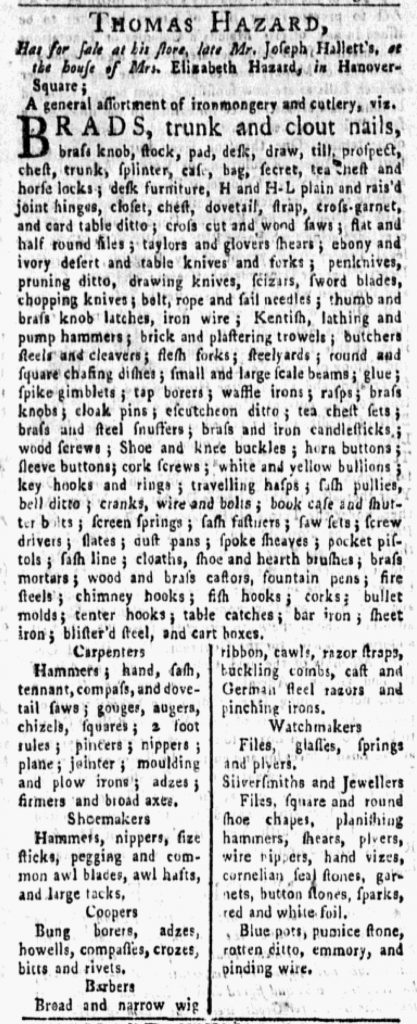
In the 1770s, when merchants and shopkeepers enumerated the “general assortment” of goods they offered for sale, their advertisements usually followed one of two formats.  Most listed their merchandise in a dense paragraph of text that extended anywhere from a few lines to half a column or more.  As an alternative, others created more white space and made their advertisements easier to read by including only one item per line or organizing their wares into columns.  Adopting such methods meant that advertisers could name fewer items in the same amount of space as their competitors who chose paragraphs of text with no white space.

Both sorts of advertisements regularly appeared in the New-York Gazette and Weekly Mercury, but occasionally advertisers (perhaps in consultation with printers and compositors) added variations and innovations.  Such was the case with Thomas Hazard’s advertisement for ironmongery and cutlery in the August 13, 1770, edition.  Hazard began with a dense paragraph that included “H and H-L plain and rais’d joint hinges,” “brass and iron candlesticks,” and “sword blades.”  In addition, he divided a portion of his advertisement into two columns.  Within those columns, he resorted to short paragraphs of text rather than listing only one or two items per line, but those paragraphs were brief and likely easier for eighteenth-century consumers to navigate than the dense paragraph of text that constituted the bulk of the advertisement.  Furthermore, Hazard inserted headers for each of those shorter paragraphs:  “Carpenters,” “Shoemakers,” “Coopers,” “Barbers,” “Watchmakers,” and “Silversmiths and Jewellers.”  Each paragraph listed tools used in a particular trade.  In this manner, Hazard targeted specific consumers and aided artisans in finding the items of greatest interest to them.

Prior to the American Revolution, merchants and shopkeepers published undifferentiated lists of goods in their advertisements, but occasionally some attempted to impose more order and make their notices easier for prospective customers to navigate.  Thomas Hazard did so by grouping together tools used by various sorts of artisans, setting them apart in columns, and using headers to draw attention to them.  Carpenters or watchmakers who might have overlooked items when skimming dense paragraphs of text instead had a beacon that called their attention to the tolls of their trades.