October 20

What was advertised in a colonial American newspaper 250 years ago today?

Providence Gazette (October 20, 1770).

“The Subscriber proposes undertaking the Practice of the Law.”

In the fall of 1770, John Cole took to the pages of the Providence Gazette to advertise his services as an attorney.  In introducing himself to prospective clients, Cole noted that “several Gentlemen of the LAW have lately removed from Providence.”  Furthermore, there was “another Vacancy at the Bar” caused by the death of “the late worthy and ingenious Oliver Arnold, Esq.”  As a result, residents of Providence and nearby towns and villages no longer had access to as many attorneys.  Cole sought to fill that gap in the market.

When he informed the public that he “proposes undertaking the Practice of the Law,” Cole asserted that he had been “brought up” to the business, though he did not provide additional details about his training and credentials.  Instead, he focused on his demeanor, assuring prospective clients that he would serve them “with the utmost Fidelity, Dispatch and Punctuality.”  Advertisers of all sorts made such promises, whether attorneys or artisans, but an emphasis on fidelity had a different resonance when invoked by those practicing the law.  It implied both confidentiality and consistently working in the best interests of clients, two aspects of the profession that some attorneys more explicitly highlighted in their advertisements.  Cole made more general commitments that his clients would be satisfied with his services.

He also cast his net widely for clients, seeking them in Providence and “the neighbouring Towns or Governments.”  The Providence Gazette served much of Rhode Island as well as portions of Massachusetts and Connecticut.  For instance, Joseph Jewet and Darius Adams’s advertisement on the same page as Cole’s notice in the October 20, 1770, edition addressed readers in several towns in Connecticut who might wish to engage them as postriders to deliver their newspapers.  Jewet and Adams also promised fidelity, but in their case they meant that patrons would receive their newspapers rather than have them go missing.

With the departure of several attorneys and the death of another, Cole sought to establish himself as an attorney in Providence.  To attract clients, he not only announced that he opened an office but also suggested that he had some sort of training and offered assurances that he would be trustworthy and competent in delivering his services.  Compared to modern advertising for legal services, Cole was considerably less bombastic.  He aimed to earn the confidence of prospective clients, not attract them with spectacle.

Slavery Advertisements Published October 20, 1770

GUEST CURATOR:  Bryant Halpin

The Slavery Adverts 250 Project chronicles the role of newspaper advertising in perpetuating slavery in the era of the American Revolution. The project seeks to reveal the ubiquity of slavery in eighteenth-century life from New England to Georgia by republishing advertisements for slaves – for sale, wanted to purchase, runaways, captured fugitives – in daily digests on this site as well as in real time via the @SlaveAdverts250 Twitter feed, utilizing twenty-first-century media to stand in for the print media of the eighteenth century.

The project aims to provide modern audiences with a sense of just how often colonists encountered these advertisements in their daily lives. Enslaved men, women, and children appeared in print somewhere in the colonies almost every single day. Those advertisements served as a constant backdrop for social, cultural, economic, and political life in colonial and revolutionary America. Colonists who did not own slaves were still confronted with slavery as well as invited to maintain the system by purchasing slaves or assisting in the capture of runaways. The frequency of these newspaper advertisements suggests just how embedded slavery was in colonial and revolutionary American culture in everyday interactions beyond the printed page.

These advertisements also testify to the experiences of enslaved men, women, and children, though readers must consider that those experiences have been remediated through descriptions offered by slaveholders rather than the slaves themselves. Often unnamed in the advertisements, enslaved men, women, and children were not invisible or unimportant in early America.

These advertisements appeared in colonial American newspapers 250 years ago today.

Oct 20 1770 - Providence Gazette Slavery 1
Providence Gazette (October 20, 1770).

October 19

What was advertised in a colonial American newspaper 250 years ago today?

New-Hampshire Gazette (October 19, 1770).

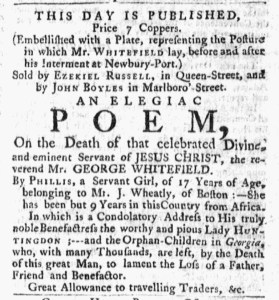
“An Elegiac Poem, On the Death of … GEORGE WHITEFIELD.”

The Boston Massacre and the death of George Whitefield both occurred in 1770, separated by almost six months. News of both events quickly spread via the colonial press with coverage commencing in Boston’s newspapers and then radiating out to other newspapers in other towns in New England and beyond.  In both instances, simultaneous acts of commemoration and commodification quickly followed.  Paul Revere and Henry Pelham marketed prints depicting the “Bloody Massacre” just weeks after British soldiers fired on a crowd in Boston, killing several people.  The commodification of Whitefield’s death happened more quickly and more extensively.  The Boston Massacre may be better remembered today as a result of the war for independence that it helped to inspire, but in 1770 it was the death of one of the most prominent ministers associated with the religious revivals now known as the Great Awakening that captured far more attention when it came to creating and selling commemorative items.

Within a couple of weeks of Whitefield’s death on September 30, all five newspapers published in Boston printed advertisements for at least one commemorative item that colonists could purchase.  This commodification also found its way into the Essex Gazette, published in Salem, and the New-Hampshire Gazette, published in Portsmouth.  Daniel Fowle and Robert Fowle, the printers of the New-Hampshire Gazette, provided extensive coverage of Whitefield’s death and public reaction to it, devoting a significant amount of space to it.  Between news articles, verses in memory of the minister, and advertisements for commemorative items, contents about Whitefield accounted for more than ten percent of the column inches in the October 19 edition of the New-Hampshire Gazette, as they had in each issue since the minister’s death.  The Fowles ran a new article that proclaimed Whitefield’s “PATRIOTISM.”  For a second time, they inserted an advertisement for two broadsides for sale at the printing office.  They devoted an entire column, complete with mourning bands at top and bottom, to two poems reprinted from other newspapers and a new advertisement for yet another broadside.

That advertisement promoted the “Elegiac Poem … By Phillis, a Servant Girl.”  That “Servant Girl” was Phillis Wheatley, the enslaved poet who became one of the most influential poets in eighteenth-century American literature.  This broadside had already been advertised widely in Boston’s newspapers and the Essex Gazette.  In selling it in New Hampshire, the Fowles enlarged the community of commemoration that consumed the same items.  Just as they read the same news items and verses reprinted from newspaper to newspaper, colonists purchased, read, and displayed the same memorabilia from town to town, creating a more unified experience despite the distance that separated them.  The Fowles suggested that Wheatley’s poem “ought to be preserved” – not just purchased – “for two good Reasons.”  The first was “in Remembrance of that great and good man, Mr. Whitefield.”  In addition, customers should acquire a copy “on Account of its being w[ro]te by a Native of Africa, and yet would have done Honor to a Pope or Shakespere.”  The Fowles traded on the novelty of an enslaved poet who “had been but nine Years in this Country from Africa,” hoping that would incite greater demand for this commemorative item.

The Adverts 250 Project has featured advertisements related to the commodification of Whitefield’s death several times in recent weeks.  While many other kinds of advertisements appeared in the colonial press, this repetition is meant to demonstrate how widely printers and others marketed Whitefield memorabilia following his death.  The minister’s passing was a major news story, but one that also lent itself to widespread commemoration through commodification as printers sought to give consumers opportunities to express their grief and feel connected to the departed minister.

Slavery Advertisements Published October 19, 1770

GUEST CURATOR:  Bryant Halpin

The Slavery Adverts 250 Project chronicles the role of newspaper advertising in perpetuating slavery in the era of the American Revolution. The project seeks to reveal the ubiquity of slavery in eighteenth-century life from New England to Georgia by republishing advertisements for slaves – for sale, wanted to purchase, runaways, captured fugitives – in daily digests on this site as well as in real time via the @SlaveAdverts250 Twitter feed, utilizing twenty-first-century media to stand in for the print media of the eighteenth century.

The project aims to provide modern audiences with a sense of just how often colonists encountered these advertisements in their daily lives. Enslaved men, women, and children appeared in print somewhere in the colonies almost every single day. Those advertisements served as a constant backdrop for social, cultural, economic, and political life in colonial and revolutionary America. Colonists who did not own slaves were still confronted with slavery as well as invited to maintain the system by purchasing slaves or assisting in the capture of runaways. The frequency of these newspaper advertisements suggests just how embedded slavery was in colonial and revolutionary American culture in everyday interactions beyond the printed page.

These advertisements also testify to the experiences of enslaved men, women, and children, though readers must consider that those experiences have been remediated through descriptions offered by slaveholders rather than the slaves themselves. Often unnamed in the advertisements, enslaved men, women, and children were not invisible or unimportant in early America.

These advertisements appeared in colonial American newspapers 250 years ago today.

Oct 19 1770 - New-Hampshire Gazette Slavery 1
New-Hampshire Gazette (October 19, 1770).

**********

Oct 19 1770 - New-Hampshire Gazette Slavery 2
New-Hampshire Gazette (October 19, 1770).

**********

Oct 19 1770 - New-London Gazette Slavery 1
New-London Gazette (October 19, 1770).

October 18

What was advertised in a colonial American newspaper 250 years ago today?

“FOR SALE, THE FOLLOWING VALUABLE TRACTS OF LAND.”

South-Carolina Gazette (October 18, 1770).

This advertisement for “VALUABLE TRACTS OF LAND” offered for sale in South Carolina raises questions about its production and distribution.  Accessible Archives includes it as the fifth page of the October 18, 1770, edition of the South-Carolina Gazette.  Like most colonial newspapers, the South-Carolina Gazette consisted of four pages created by printing two pages on each side of a broadsheet and then folding it in half.  Peter Timothy, the printer, distributed one new issue each week, occasionally printing a supplement to accompany the standard four-page issue when he had sufficient content to justify doing so.

This advertisement deviates from several common elements of newspaper publication familiar to historians of eighteenth-century print culture.  Even though printers sometimes circulated supplements, they rarely distributed one-page supplements.  Instead, they created two-page or four-page supplements by printing on both sides of a sheet.  On rare instances did they print one-page supplements, an expensive venture given that paper was such a valuable commodity.  Blank space that could have been filled with news or, even better, advertising that generated revenues was wasteful.  Timothy included a short note on the final page of the October 18 edition that “ADVERTISEMENTS omitted this Week, will be in our next.”  It seems that he had additional content that could have been printed on the other side of the sheet promoting tracts of land for sale.

This suggests that Timothy did not consider the advertisement on the additional sheet part of the issue he published and distributed that week.  Like most newspaper printers, he did job printing as an additional revenue stream.  Orders included broadside advertisements, today known as posters, that could be handed out or hung up around town.  This advertisement was most likely a broadside printed separately.  How did it get associated with the October 18 edition of the South-Carolina Gazette?  It is possible that the advertisers made a deal with Timothy to distribute the broadside with the standard issue, though that was not a common practice.  More likely, at some point someone who acquired the newspaper and the broadside put them together.  Whether that person was a reader, collector, or librarian, their association of the two items took hold.  Accessible Archives replicated it when producing the digitized database of extant issues of the South-Carolina Gazette.

That is the most likely scenario, but certainly not a definitive answer.  The broadside’s inclusion with the October 18, 1770, edition of the South-Carolina Gazette in the digital archive suggests that it could have been part of that issue from the very start.  If so, that raises questions about innovation on the part of both the printer and the advertisers who deviated from standard practices.  It also raises questions about negotiations between the printer and the advertisers, especially in terms of cost and format.  That the broadside is now treated as the fifth page of the newspapers may be the result of an error introduced sometime after the two were printed.  Alternately, this may be evidence of creativity and innovation in the production and distribution of advertising in eighteenth-century America.

Slavery Advertisements Published October 18, 1770

GUEST CURATOR:  Bryant Halpin

The Slavery Adverts 250 Project chronicles the role of newspaper advertising in perpetuating slavery in the era of the American Revolution. The project seeks to reveal the ubiquity of slavery in eighteenth-century life from New England to Georgia by republishing advertisements for slaves – for sale, wanted to purchase, runaways, captured fugitives – in daily digests on this site as well as in real time via the @SlaveAdverts250 Twitter feed, utilizing twenty-first-century media to stand in for the print media of the eighteenth century.

The project aims to provide modern audiences with a sense of just how often colonists encountered these advertisements in their daily lives. Enslaved men, women, and children appeared in print somewhere in the colonies almost every single day. Those advertisements served as a constant backdrop for social, cultural, economic, and political life in colonial and revolutionary America. Colonists who did not own slaves were still confronted with slavery as well as invited to maintain the system by purchasing slaves or assisting in the capture of runaways. The frequency of these newspaper advertisements suggests just how embedded slavery was in colonial and revolutionary American culture in everyday interactions beyond the printed page.

These advertisements also testify to the experiences of enslaved men, women, and children, though readers must consider that those experiences have been remediated through descriptions offered by slaveholders rather than the slaves themselves. Often unnamed in the advertisements, enslaved men, women, and children were not invisible or unimportant in early America.

These advertisements appeared in colonial American newspapers 250 years ago today.

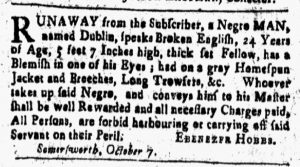
Oct 18 1770 - Maryland Gazette Slavery 1
Maryland Gazette (October 18, 1770).

**********

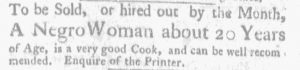
Oct 18 1770 - Maryland Gazette Slavery 2
Maryland Gazette (October 18, 1770).

**********

Oct 18 1770 - Massachusetts Gazette and Boston Weekly News-Letter Slavery 1
Massachusetts Gazette and Boston Weekly Mercury (October 18, 1770).

**********

Oct 18 1770 - Massachusetts Gazette and Boston Weekly News-Letter Slavery 2
Massachusetts Gazette and Boston Weekly News-Letter (October 18, 1770).

**********

Massachusetts Gazette and Boston Weekly News-Letter (October 18, 1770).

**********

Oct 18 1770 - Massachusetts Gazette and Boston Weekly News-Letter Supplement Slavery 1
Supplement to the Massachusetts Gazette and Boston News-Letter (October 18, 1770).

**********

Oct 18 1770 - Massachusetts Gazette and Boston Weekly News-Letter Supplement Slavery 2
Supplement to the Massachusetts Gazette and Boston News-Letter (October 18, 1770).

**********

Oct 18 1770 - Massachusetts Gazette and Boston Weekly News-Letter Supplement Slavery 3
Supplement to the Massachusetts Gazette and Boston News-Letter (October 18, 1770).

**********

Oct 18 1770 - Massachusetts Spy Slavery 1
Massachusetts Spy (October 18, 1770).

**********

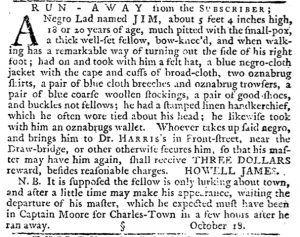
Oct 18 1770 - New-York Journal Slavery 1
New-York Journal (October 18, 1770).

**********

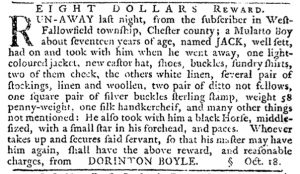
Oct 18 1770 - Pennsylvania Gazette Slavery 1
Pennsylvania Gazette (October 18, 1770).

**********

Oct 18 1770 - Pennsylvania Gazette Slavery 2
Pennsylvania Gazette (October 18, 1770).

**********

Oct 18 1770 - Pennsylvania Journal Slavery 1
Pennsylvania Journal (October 18, 1770).

**********

Oct 18 1770 - Pennsylvania Journal Slavery 2
Pennsylvania Journal (October 18, 1770).

**********

Oct 18 1770 - South-Carolina Gazette Slavery 1
South-Carolina Gazette (October 18, 1770).

**********

Oct 18 1770 - South-Carolina Gazette Slavery 2
South-Carolina Gazette (October 18, 1770).

**********

Oct 18 1770 - South-Carolina Gazette Slavery 3
South-Carolina Gazette (October 18, 1770).

**********

Oct 18 1770 - South-Carolina Gazette Slavery 4
South-Carolina Gazette (October 18, 1770).

**********

Oct 18 1770 - South-Carolina Gazette Slavery 5
South-Carolina Gazette (October 18, 1770).

**********

Oct 18 1770 - South-Carolina Gazette Slavery 6
South-Carolina Gazette (October 18, 1770).

**********

Oct 18 1770 - South-Carolina Gazette Slavery 7
South-Carolina Gazette (October 18, 1770).

**********

Oct 18 1770 - South-Carolina Gazette Slavery 8
South-Carolina Gazette (October 18, 1770).

**********

Oct 18 1770 - South-Carolina Gazette Slavery 9
South-Carolina Gazette (October 18, 1770).

**********

Oct 18 1770 - South-Carolina Gazette Slavery 10
South-Carolina Gazette (October 18, 1770).

**********

Oct 18 1770 - Virginia Gazette Purdie & Dixon Slavery 1
Virginia Gazette [Purdie and Dixon] (October 18, 1770).

**********

Oct 18 1770 - Virginia Gazette Purdie & Dixon Slavery 2
Virginia Gazette [Purdie and Dixon] (October 18, 1770).

**********

Oct 18 1770 - Virginia Gazette Purdie & Dixon Slavery 3
Virginia Gazette [Purdie and Dixon] (October 18, 1770).

**********

Oct 18 1770 - Virginia Gazette Purdie & Dixon Slavery 4
Virginia Gazette [Purdie and Dixon] (October 18, 1770).

**********

Oct 18 1770 - Virginia Gazette Purdie & Dixon Supplement Slavery 1
Supplement to the Virginia Gazette [Purdie and Dixon] (October 18, 1770).

**********

Oct 18 1770 - Virginia Gazette Rind Slavery 1
Virginia Gazette [Rind] (October 18, 1770).

**********

Oct 18 1770 - Virginia Gazette Rind Slavery 2
Virginia Gazette [Rind] (October 18, 1770).

**********

Oct 18 1770 - Virginia Gazette Rind Slavery 3
Virginia Gazette [Rind] (October 18, 1770).

**********

Oct 18 1770 - Virginia Gazette Rind Slavery 4
Virginia Gazette [Rind] (October 18, 1770).

Welcome Back, Guest Curator Bryant Halpin

Bryant Halpin is a senior at Assumption University in Worcester, Massachusetts.  He is majoring in History with a minor in Education with plans to become a high school history teacher.  His home town is Valatie, New York.  Bryant participates in the university’s Ultimate Frisbee program and is the co-captain of the team.  He has previously served as guest curator for the Adverts 250 Project and the Slavery Adverts 250 Project when he enrolled in HIS 359 – Revolutionary America in Spring 2019. He conducted the research for his current contributions as guest curator for the Slavery Adverts 250 Project when he was enrolled in HIS 400 – Research Methods: Vast Early America in Spring 2020.

Welcome, guest curator Bryant Halpin.

October 17

What was advertised in a colonial American newspaper 250 years ago this week?

Massachusetts Gazette and Boston Post-Boy (October 15, 1770).

“Great Allowance to travelling Traders, &c.”

Following the death of George Whitefield, one of the most prominent ministers associated with the eighteenth-century religious revivals now known as the Great Awakening, on September 30, 1770, colonial printers quickly engaged in simultaneous acts of commemoration and commodification.  Radiating out from Boston, newspapers provided extensive coverage of Whitefield’s passing, in news articles reprinted from one newspaper to another, in verses dedicated to the minister, and in a hymn composed by Whitefield himself in anticipation of it one day being sung at his funeral.  In addition to widespread and widely reprinted commemorations of Whitefield, printers also hawked memorabilia that commodified his death.

The first instance appeared in the October 4 edition of the Massachusetts Gazette and Boston Weekly News-Letter, just days after residents of Boston received the news that Whitefield died at Newburyport.  The news coverage included an announcement of “A FUNERAL HYMN, wrote by the Rev’d Mr, Whitefield … Sold at Green & Russells.”  Within two weeks, every newspaper published in Massachusetts as well as the New-Hampshire Gazette published at least one freestanding advertisement that promoted a broadside that commemorated the minister.  Printers and others made available several broadsides for consumers, some of that memorabilia featuring the funeral hymn and others featuring poems dedicated to Whitefield.

The advertisements for those broadsides initially addressed individual consumers, but on October 15 the advertisements for the “ELEGIAC POEM” by Phillis Wheatley, the enslaved poet, in both the Boston-Gazette and the Massachusetts Gazette and Boston Post-Boy included a new note at the end: “Great Allowance to travelling Traders, &c.”  Ezekiel Russell and John Boyles offered discounts to peddlers, shopkeepers, and anyone else who would purchase in bulk and then retail the broadside beyond Boston.  Just as news of Whitefield’s death spread through printing and reprinting of articles, verses, and hymns in newspapers that were distributed far beyond the towns in which they were published, the opportunities to engage in commemoration through commodification also widened.  Newspapers in Boston, Salem, and Portsmouth all ran advertisements for Whitefield memorabilia.  The producers of that memorabilia expected and encouraged further distribution into villages, offering discounts to facilitate the further dissemination of their product.

October 16

What was advertised in a colonial American newspaper 250 years ago today?

Connecticut Courant (October 16, 1770).

They have a Number of Pairs of Breeches already made.”

In the fall of 1770, the partnership of Converse and Stone, “Breeches Makers, at the Sign of the Breeches in Hartford,” took to the pages of the Connecticut Courant to inform “Gentlemen” that they had set up shop.  They told prospective clients that pursued “the Business of Breeches Making in all its Branches,” intending for that short phrase to provide assurances that they possessed all of the necessary skills of the trade and that they could construct breeches in a variety of styles according to the tastes and budgets of their customers.

In a nota bene, Converse and Stone asked potential clients to take note that they “have a Number of Pairs of Breechesalready made, together with skins of the neatest Kind, so that Gentlemen may suit themselves.”  The breeches makers catered to their customers.  Although they could measure clients and construct new garments for those who desired such services, Converse and Stone also offered the convenience of an eighteenth-century version of buying off the rack.  They already made and had on hand an inventory of breeches for men who wished to acquire them in a single visit to the shop. They adopted business practices and a marketing strategy similar to those that Thomas Hewitt, a wigmaker in Annapolis, described in his advertisement running in the Maryland Gazette at the same time.  Hewitt also promoted both custom-made items and “ready made” alternatives.

For those gentlemen who preferred custom-made breeches, Converse and Stone had “Skins of the neatest Kind” that they could examine and choose what suited them when they came to the shop for measurements.  In that case, their breeches were tailor-made in a collaboration between the breeches makers and individual patrons.  The clients expressed their tastes and preferences and Converse and Stone supplied the skill to create the garments envisioned and commissioned by their customers.  In their advertisement, the breeches makers balanced consumer choice and convenience against their abilities and expertise in their trade.

Slavery Advertisements Published October 16, 1770

GUEST CURATOR:  Joseph Facteau

The Slavery Adverts 250 Project chronicles the role of newspaper advertising in perpetuating slavery in the era of the American Revolution. The project seeks to reveal the ubiquity of slavery in eighteenth-century life from New England to Georgia by republishing advertisements for slaves – for sale, wanted to purchase, runaways, captured fugitives – in daily digests on this site as well as in real time via the @SlaveAdverts250 Twitter feed, utilizing twenty-first-century media to stand in for the print media of the eighteenth century.

The project aims to provide modern audiences with a sense of just how often colonists encountered these advertisements in their daily lives. Enslaved men, women, and children appeared in print somewhere in the colonies almost every single day. Those advertisements served as a constant backdrop for social, cultural, economic, and political life in colonial and revolutionary America. Colonists who did not own slaves were still confronted with slavery as well as invited to maintain the system by purchasing slaves or assisting in the capture of runaways. The frequency of these newspaper advertisements suggests just how embedded slavery was in colonial and revolutionary American culture in everyday interactions beyond the printed page.

These advertisements also testify to the experiences of enslaved men, women, and children, though readers must consider that those experiences have been remediated through descriptions offered by slaveholders rather than the slaves themselves. Often unnamed in the advertisements, enslaved men, women, and children were not invisible or unimportant in early America.

These advertisements appeared in colonial American newspapers 250 years ago today.

Oct 16 1770 - Essex Gazette Slavery 1
Essex Gazette (October 16, 1770).

**********

Oct 16 1770 - Essex Gazette Slavery 2
Essex Gazette (October 16, 1770).

**********

Oct 16 1770 - South-Carolina Gazette and Country Journal Slavery 1
South-Carolina Gazette and Country Journal (October 16, 1770).

**********

Oct 16 1770 - South-Carolina Gazette and Country Journal Slavery 2
South-Carolina Gazette and Country Journal (October 16, 1770).

**********

Oct 16 1770 - South-Carolina Gazette and Country Journal Slavery 3
South-Carolina Gazette and Country Journal (October 16, 1770).

**********

Oct 16 1770 - South-Carolina Gazette and Country Journal Slavery 4
South-Carolina Gazette and Country Journal (October 16, 1770).

**********

Oct 16 1770 - South-Carolina Gazette and Country Journal Slavery 5
South-Carolina Gazette and Country Journal (October 16, 1770).

**********

Oct 16 1770 - South-Carolina Gazette and Country Journal Slavery 6
South-Carolina Gazette and Country Journal (October 16, 1770).

**********

Oct 16 1770 - South-Carolina Gazette and Country Journal Slavery 7
South-Carolina Gazette and Country Journal (October 16, 1770).

**********

Oct 16 1770 - South-Carolina Gazette and Country Journal Slavery 8
South-Carolina Gazette and Country Journal (October 16, 1770).

**********

Oct 16 1770 - South-Carolina Gazette and Country Journal Slavery 9
South-Carolina Gazette and Country Journal (October 16, 1770).

**********

Oct 16 1770 - South-Carolina Gazette and Country Journal Slavery 10
South-Carolina Gazette and Country Journal (October 16, 1770).

**********

Oct 16 1770 - South-Carolina Gazette and Country Journal Slavery 11
South-Carolina Gazette and Country Journal (October 16, 1770).

**********

Oct 16 1770 - South-Carolina Gazette and Country Journal Slavery 12
South-Carolina Gazette and Country Journal (October 16, 1770).

**********

Oct 16 1770 - South-Carolina Gazette and Country Journal Slavery 13
South-Carolina Gazette and Country Journal (October 16, 1770).