October 15

What was advertised in a colonial American newspaper 250 years ago today?

New-York Gazette and Weekly Mercury (October 15, 1770).

“Hutchin’s Improved:  BEING AN ALMANACK … For the Year of our LORD 1771.”

By the middle of October 1770, advertisements for almanacs for 1771 began appearing in newspapers throughout the colonies.  Such notices were a familiar sight to readers of the public prints who encountered them every fall.  Just like the changing of the seasons, the appearance of advertisements for almanacs followed a similar pattern from year to year.  In the late summer and early fall printers first announced that they would soon publish almanacs for the coming year.  Those were usually short notices that listed little more than the titles that would soon become available.  As fall continues, the number and frequency of advertisements for almanacs increased, as did the length of advertisements for particular titles.  This continued into the new year before the advertisements tapered off in late January and early February.

Hugh Gaine’s advertisement for Hutchin’s Improved Almanack in the October 15, 1770, edition of the New-York Gazette and Weekly Mercury was one of the first of the lengthy notices in the fall of 1770.  It extended more than half a column, making it the longest advertisement in that issue.  In promoting the almanac, Gaine proclaimed that the “usual Astronomical Calculations” had been “laid down with as great Accuracy as in any Almanack in America.”  In addition, Hutchin’s Improved Almanack contained a variety of other useful items, including a calendar of “Court Terms,” a guide to “Post Roads and Stages through every Settled Part of the Continent,” and instructions for remedies “to preserve Health” and “to cure Disorders incident to the Human Body.”  Gaine devoted most of the advertisement to short descriptions of twenty “select Pieces, instructing and entertaining” that ranged from “Moral Reflections” to “Historical Remarks” to “entertaining Anecdotes, Similies, Aphorisms, [and] Epitaphs.”  Among the “Moral Reflections,” readers would find “Rules for preserving HEALTH in eating and drinking.”  Gaine opined that “An Observance of these Rules will bring us to Temperance.”  The “Historical Remarks” included “An Extract from Mr. Anderson’s History of the Rise and Progress of Commerce,” while the “entertaining Anecdotes” featured “A diverting Tale” of “The Sausage Maker raised to a Prime Minister” and “the Pastor and his Flock; a droll, but True Story.”

Almanacs accounted for a significant portion of popular print culture in eighteenth-century America.  Consumers from the most humble households to the most grand acquired almanacs each year.  Printers competed with each other for their share of the market, aggressively advertising their titles in newspapers.  In doing so, they sought to distinguish their almanacs from others and convince prospective customers that their version included the most extensive, most useful, and most entertaining contents.

Slavery Advertisements Published October 15, 1770

GUEST CURATOR:  Joseph Facteau

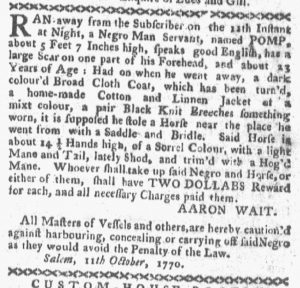
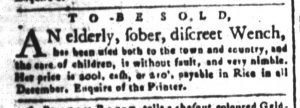
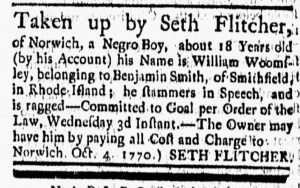
The Slavery Adverts 250 Project chronicles the role of newspaper advertising in perpetuating slavery in the era of the American Revolution. The project seeks to reveal the ubiquity of slavery in eighteenth-century life from New England to Georgia by republishing advertisements for slaves – for sale, wanted to purchase, runaways, captured fugitives – in daily digests on this site as well as in real time via the @SlaveAdverts250 Twitter feed, utilizing twenty-first-century media to stand in for the print media of the eighteenth century.

The project aims to provide modern audiences with a sense of just how often colonists encountered these advertisements in their daily lives. Enslaved men, women, and children appeared in print somewhere in the colonies almost every single day. Those advertisements served as a constant backdrop for social, cultural, economic, and political life in colonial and revolutionary America. Colonists who did not own slaves were still confronted with slavery as well as invited to maintain the system by purchasing slaves or assisting in the capture of runaways. The frequency of these newspaper advertisements suggests just how embedded slavery was in colonial and revolutionary American culture in everyday interactions beyond the printed page.

These advertisements also testify to the experiences of enslaved men, women, and children, though readers must consider that those experiences have been remediated through descriptions offered by slaveholders rather than the slaves themselves. Often unnamed in the advertisements, enslaved men, women, and children were not invisible or unimportant in early America.

These advertisements appeared in colonial American newspapers 250 years ago today.

Oct 15 1770 - Boston Evening-Post Slavery 1
Boston Evening-Post (October 15, 1770).

**********

Oct 15 1770 - Boston-Gazette Slavery 1
Boston-Gazette (October 15, 1770).

**********

Oct 15 1770 - Boston-Gazette Slavery 2
Boston-Gazette (October 15, 1770).

**********

Oct 15 1770 - Boston-Gazette Slavery 3
Boston-Gazette (October 15, 1770).

**********

Oct 15 1770 - Boston-Gazette Slavery 4
Boston-Gazette (October 15, 1770).

**********

Oct 15 1770 - Massachusetts Gazette and Boston Post-Boy Slavery 1
Massachusetts Gazette and Boston Post-Boy (October 15, 1770).

**********

Oct 15 1770 - Massachusetts Gazette and Boston Post-Boy Slavery 2
Massachusetts Gazette and Boston Post-Boy (October 15, 1770).

**********

Oct 15 1770 - Massachusetts Gazette and Boston Post-Boy Slavery 3
Massachusetts Gazette and Boston Post-Boy (October 15, 1770).

**********

Oct 15 1770 - Massachusetts Gazette and Boston Post-Boy Slavery 4
Massachusetts Gazette and Boston Post-Boy (October 15, 1770).

**********

Oct 15 1770 - Massachusetts Gazette and Boston Post-Boy Slavery 5
Massachusetts Gazette and Boston Post-Boy (October 15, 1770).

**********

Oct 15 1770 - New-York Gazette and Weekly Mercury Slavery 1
New-York Gazette and Weekly Mercury (October 15, 1770).

**********

Oct 15 1770 - New-York Gazette and Weekly Mercury Slavery 2
New-York Gazette and Weekly Mercury (October 15, 1770).

**********

Oct 15 1770 - New-York Gazette and Weekly Mercury Slavery 3
New-York Gazette and Weekly Mercury (October 15, 1770).

**********

Oct 15 1770 - New-York Gazette and Weekly Mercury Slavery 4
New-York Gazette and Weekly Mercury (October 15, 1770).

**********

Oct 15 1770 - New-York Gazette and Weekly Mercury Slavery 5
New-York Gazette and Weekly Mercury (October 15, 1770).

**********

Oct 15 1770 - New-York Gazette or Weekly Post-Boy Slavery 1
New-York Gazette or Weekly Post-Boy (October 15, 1770).

**********

Oct 15 1770 - Pennsylvania Chronicle Slavery 1
Pennsylvania Chronicle (October 15, 1770).

**********

Oct 15 1770 - Pennsylvania Chronicle Slavery 2
Pennsylvania Chronicle (October 15, 1770).

**********

Oct 15 1770 - Pennsylvania Chronicle Slavery 3
Pennsylvania Chronicle (October 15, 1770).

**********

Oct 15 1770 - South-Carolina and American General Gazette Slavery 1
South-Carolina and American General Gazette (October 15, 1770).

**********

Oct 15 1770 - South-Carolina and American General Gazette Slavery 2
South-Carolina and American General Gazette (October 15, 1770).

**********

Oct 15 1770 - South-Carolina and American General Gazette Slavery 3
South-Carolina and American General Gazette (October 15, 1770).

**********

Oct 15 1770 - South-Carolina and American General Gazette Slavery 4
South-Carolina and American General Gazette (October 15, 1770).

**********

Oct 15 1770 - South-Carolina and American General Gazette Slavery 5
South-Carolina and American General Gazette (October 15, 1770).

**********

Oct 15 1770 - South-Carolina and American General Gazette Slavery 6
South-Carolina and American General Gazette (October 15, 1770).

**********

Oct 15 1770 - South-Carolina and American General Gazette Slavery 7
South-Carolina and American General Gazette (October 15, 1770).

**********

Oct 15 1770 - South-Carolina and American General Gazette Slavery 8
South-Carolina and American General Gazette (October 15, 1770).

October 14

What was advertised in a colonial American newspaper 250 years ago this week?

Maryland Gazette (October 11, 1770).

“From the Clergymens and Counsellors full Dress Wigs, down to the common cut Bob.”

In the late summer and early fall of 1770, Thomas Hewitt, a perukemaker in Annapolis, advertised wigs for gentlemen in the Maryland Gazette.  He carried a full inventory of “all Sorts of Wigs, made in the newest and most approved Fashions.”  He had everything from “Clergymens and Counsellors full Dress Wigs, down to the most common cut Bob” as well as “Dress Bag Wigs, Half Dress, and Scratch Cut Wigs.”  The distinctions may seem obscure to most modern readers, but eighteenth-century gentlemen who read Hewitt’s advertisement recognized the differences.  Hewitt concluded the list of wigs he made and sold with “&c. &c.” (an abbreviation for et cetera) to indicate an even greater variety available at his shop.

Hewitt aimed to make each prospective customer feel as though he was the wigmaker’s most important client.  He pledged that they “may depend on having their Wigs well made, and of the best Hair,” which he had recently imported along with other materials necessary for carrying on his business.  His clients could depend on their wigs being “as neatly and faithfully executed, as if each had been made for his best and most particular Customer.”  This was an appeal to quality, but it was also an appeal to customer satisfaction and consumer discernment.  Hewitt did not cut corners but instead crafted each wig with care and attention.  His clients would note that when they examined his wigs, as would their friends and acquaintances when Hewitt’s customers wore the wigs he crafted.

The wigmaker also served a market that extended beyond Annapolis.  He addressed “those Gentlemen who reside in the remote Parts of the Province, where they cannot be supplied with Wigs by Post” or a local wigmaker that he kept an extensive inventory on hand for their convenience when they visited Annapolis.  They did not need to make multiple trips to his shop over the course of days or weeks, first for measurements and placing an order and later to pick up wigs once Hewitt had a chance to make them.  Instead, they could select a wig on their initial visit to Hewitt’s shop and depart Annapolis when it suited them.  That was another reason for the perukemaker to emphasize the care that went into each and every one of the wigs he constructed.  He offered reassurances to those gentlemen who chose to purchase “off the rack” for convenience.

Hewitt deployed several appeals to incite demand for his wigs, from the materials that went into their construction and the quality of his work to his extensive inventory and the convenience it afforded to prospective clients who lived at a distance.  He did more than merely announce that he had wigs for sale.  Instead, he sought to convince consumers that they purchase their wigs from him.


October 13

What was advertised in a colonial American newspaper 250 years ago today?

Massachusetts Spy (October 13, 1770).

“Printed and sold by Z. FOWLE and I. THOMAS, at the new Printing Office.”

In the middle of July 1770, Isaiah Thomas distributed a preliminary issue of the Massachusetts Spy to announce that he would commence publishing that new newspaper in two weeks.  He sought subscribers and advertisers to make it a viable endeavor.  Three weeks passed before the next issue appeared, but after that Thomas distributed new editions of the newspaper three times a week.  Many factors could have accounted for the slight delay; attracting a sufficient number of subscribers may have been one of them.  The Massachusetts Spy continued on its thrice weekly publication schedule for just three months before Thomas scaled it back to only twice a week for three months and finally to once a week, the same schedule as most newspapers published in colonial America.

Thomas and the Massachusetts Spy competed with several other printers and their newspapers for readers in Boston and its hinterlands, including Thomas Fleet and John Fleet’s Boston Evening-Post, Benjamin Edes and John Gill’s Boston-Gazette, John Green and Joseph Russell’s Massachusetts Gazette and Boston Post-Boy, and Richard Draper’s Massachusetts Gazette and Boston Weekly News-Letter.  Each of those publications had served readers for many years, perhaps making it difficult for Thomas to convince subscribers and advertisers to take a chance on his new publication.  Throughout the first couple of months, few advertisements ran in the pages of the Massachusetts Spy.

In October 1770, however, more began to appear, though still a small number compared to how many advertisements filled the pages of other newspapers printed in Boston.  The October 13 edition, for instance, included four advertisements.  Gillam Bass advised the public that his shop had been “broke open … by some evil minded person or persons” who had stolen several items earlier in the week.  He offered a reward for information or the capture of the perpetrators.  Ezekiel Russell and John Boyles once again inserted their advertisement for “AN Elegiac POEM, on the Death of … GEORGE WHITEFIELD” written by Phillis Wheatley, the enslaved poet.  Another advertisement sought an apprentice “to a genteel business,” but did not provide much more information.  Anyone wishing to know more needed to “Enquire at the New Printing-Office.”  If Thomas had not placed this notice himself then he served as an information broker on behalf of the advertiser, not unlike newspaper printers throughout the colonies who frequently published advertisements that instructed interested parties to contact them to learn more.  Thomas and his partner, Zechariah Fowle, certainly placed the final advertisement for a religious tract that they printed and sold.  In addition to potentially yielding customers, this notice enlarged the advertising section of the Massachusetts Spy and may have made it seem more vibrant and robust to prospective advertisers contemplating whether placing a notice in that newspaper was a sound investment.

Thomas took advantage of his access to the press to run a newspaper advertisement for another branch of his printing business, a strategy frequently adopted by early American printers who published newspapers, sold books and pamphlets, did job printing, sold blanks, and pursued a variety of other related tasks in their printing offices.

Slavery Advertisements Published October 13, 1770

GUEST CURATOR:  Joseph Facteau

The Slavery Adverts 250 Project chronicles the role of newspaper advertising in perpetuating slavery in the era of the American Revolution. The project seeks to reveal the ubiquity of slavery in eighteenth-century life from New England to Georgia by republishing advertisements for slaves – for sale, wanted to purchase, runaways, captured fugitives – in daily digests on this site as well as in real time via the @SlaveAdverts250 Twitter feed, utilizing twenty-first-century media to stand in for the print media of the eighteenth century.

The project aims to provide modern audiences with a sense of just how often colonists encountered these advertisements in their daily lives. Enslaved men, women, and children appeared in print somewhere in the colonies almost every single day. Those advertisements served as a constant backdrop for social, cultural, economic, and political life in colonial and revolutionary America. Colonists who did not own slaves were still confronted with slavery as well as invited to maintain the system by purchasing slaves or assisting in the capture of runaways. The frequency of these newspaper advertisements suggests just how embedded slavery was in colonial and revolutionary American culture in everyday interactions beyond the printed page.

These advertisements also testify to the experiences of enslaved men, women, and children, though readers must consider that those experiences have been remediated through descriptions offered by slaveholders rather than the slaves themselves. Often unnamed in the advertisements, enslaved men, women, and children were not invisible or unimportant in early America.

These advertisements appeared in colonial American newspapers 250 years ago today.

Oct 13 1770 - Massachusetts Spy Slavery 1
Massachusetts Gazette (October 13, 1770).

October 12

What was advertised in a colonial American newspaper 250 years ago today?

New-Hampshire Gazette (October 12, 1770).

“The Character of … George Whitefield … worthy a place in every House.”

By October 12, 1770, newspapers published in Boston and Salem, Massachusetts; Portsmouth, Rhode Island; Newport and Providence, Rhode Island; Hartford, New Haven, and New London, Connecticut; New York; and Philadelphia, Pennsylvania informed readers of the death of minister George Whitefield at Newburyport, Massachusetts, on September 30, 1770.  Coverage originated in Boston on the day after Whitefield’s death and then radiated outward as other newspapers published their own articles but mostly reprinted items that originally ran in one of the five newspapers printed in Boston.

It did not take long for commemoration to turn to commodification inspired by the influential minister’s death.  Almost immediately, printers notified the grieving public that they intended to publish Whitefield memorabilia.  Whether or not they had heard Whitefield preach while he was still alive, consumers could purchase broadsides that featured his words or documented his life and good works.  Through the marketplace they could acquire a connection to one of the most prominent ministers associated with the religious revivals of the Great Awakening.

Such advertisements continued to supplement news coverage in the October 12, 1770, edition of the New-Hampshire Gazette.  Between news items, poetry honoring the preacher, and advertisements for memorabilia, Daniel Fowle and Robert Fowle devoted an entire column to Whitefield, out of only twelve columns over four pages that comprised the entire issue.  The Fowles inserted three items reprinted from the October 8 edition of the Massachusetts Gazette and Boston Post-Boy.  A longer news article, a poem dedicated to Whitefield, and a shorter news article all ran in the order that they appeared in the Boston newspaper.  The Fowles included another poem, that one taken from the October 4 edition of the Massachusetts Gazette and Boston Weekly News-Letter.

Immediately following those items, they ran an advertisement for two commemorative broadsides.  One featured “A Hymn composed by the Rev. Mr. WHITEFIELD, and intended to be sung over his Corps.”  Printers in Boston and Salem had already advertised a similar piece of memorabilia.  The Fowles also advertised an item that had not yet been marketed in the public prints, a broadside about “The Character of the late worthy, pious, learned and Reverend George Whitefield.”  The Fowles stressed that this memorial was “properly put in mourning,” meaning that thick black borders enclosed the text and separated the columns.  It also featured an image of Whitefield’s coffin with “the Names of the Bearers, placed on each side of it.”  (Examine the Library of Congress’s copy of this broadside.)  In an effort to incite demand and increase sales, the Fowles proclaimed that this broadside in memory of Whitefield was “worthy a place in every House.”  Consumers could demonstrate their rectitude and continue to be instructed by the minister and his good example after his death.

Like other printers who produced and marketed similar broadsides, the Fowles participated in the commodification of Whitefield’s death.  Such a significant event presented an opportunity to increase revenues in their printing office by publishing and selling commemorative items.

Slavery Advertisements Published October 12, 1770

GUEST CURATOR:  Joseph Facteau

The Slavery Adverts 250 Project chronicles the role of newspaper advertising in perpetuating slavery in the era of the American Revolution. The project seeks to reveal the ubiquity of slavery in eighteenth-century life from New England to Georgia by republishing advertisements for slaves – for sale, wanted to purchase, runaways, captured fugitives – in daily digests on this site as well as in real time via the @SlaveAdverts250 Twitter feed, utilizing twenty-first-century media to stand in for the print media of the eighteenth century.

The project aims to provide modern audiences with a sense of just how often colonists encountered these advertisements in their daily lives. Enslaved men, women, and children appeared in print somewhere in the colonies almost every single day. Those advertisements served as a constant backdrop for social, cultural, economic, and political life in colonial and revolutionary America. Colonists who did not own slaves were still confronted with slavery as well as invited to maintain the system by purchasing slaves or assisting in the capture of runaways. The frequency of these newspaper advertisements suggests just how embedded slavery was in colonial and revolutionary American culture in everyday interactions beyond the printed page.

These advertisements also testify to the experiences of enslaved men, women, and children, though readers must consider that those experiences have been remediated through descriptions offered by slaveholders rather than the slaves themselves. Often unnamed in the advertisements, enslaved men, women, and children were not invisible or unimportant in early America.

These advertisements appeared in colonial American newspapers 250 years ago today.

Oct 12 1770 - New-London Gazette Slavery 1
New-London Gazette (October 12, 1770).

October 11

What was advertised in a colonial American newspaper 250 years ago today?

Massachusetts Spy (October 11, 1770).

“AN Elegiac POEM, on the Death of … GEORGE WHITEFIELD … By PHILLIS.”

On October 11, 1770, coverage of George Whitefield’s death on September 30 continued to radiate out from Boston with news appearing in the New-York Journal, the Pennsylvania Gazette, and the Pennsylvania Journal.  The commodification of Whitefield’s death intensified as well.  Both newspapers printed in Boston on that day, the Massachusetts Gazette and Boston Weekly Mercury and the Massachusetts Spy, carried advertisements for “AN Elegiac POEM, on the Death of that celebrated Divine, and eminent servant of Jesus Christ, the reverend and learned GEORGE WHITEFIELD.”

Phillis Wheatley, now recognized as one of the most significant poets in eighteenth-century America, composed the poem, though in the advertisements she was known as “PHILLIS, A servant girl of seventeen years of age, belonging to Mr. J. Wheatley, of Boston.”  Referring to the young woman as a “servant girl” obscured the fact that she was enslaved by the Wheatley family.  The advertisements further explained that she “has been but nine years in this country from Africa.”  This event brought together Whitefield, the influential minister following his death, and Wheatley, the young poet near the beginning of her literary career.  Although both are well known to historians and others today, much of Wheatley’s acclaim came after her death at the age of thirty-one in 1784.  Arguably, Wheatley is more famous than Whitefield in twenty-first-century America, reversing their relative status compared to the eighteenth century.

In addition to the novelty of an African poet, Ezekiel Russell and John Boyles also promoted the image that adorned the broadside, proclaiming that it was “Embellished with a plate, representing the posture in which the Rev. Mr. Whitefield lay before and after his interment at Newbury-Port.”  Examine the Library Company of Philadelphia’s copy of Wheatley’s “Elegiac Poem,” including an introduction that doubled as the copy for the advertisement in the Massachusetts Spy, the woodcut depicting Whitefield, and black borders that symbolized mourning in the eighteenth century.

Massachusetts Gazette and Boston Weekly News-Letter (October 11, 1770).

Wheatley’s poem sold by Russell and Boyles was not the only one advertised on October 11.  In a notice in the Massachusetts Gazette and Boston Weekly Mercury, Richard Draper announced that he published “An Elegy to the Memory of that pious and eminent Servant of JESUS CHRIST The Rev. Mr. GEORGE WHITEFIELD.”  Exercising he prerogative as printer of that newspaper, Draper placed his advertisement before the one for the broadside with Wheatley’s poem and the woodcut of Whitefield.

Both poems celebrated Whitefield’s life and ministry.  Both gave colonial consumers an opportunity to mourn for Whitefield and feel better connected to his ministry, even if they had never had the chance to hear him preach.  Especially for those who had not witnessed Whitefield deliver a sermon, purchasing one of these broadsides allowed them to have an experience closely associated with Whitefield’s life by commemorating his death.  The printers who produced, marketed, and sold these broadsides simultaneously honored Whitefield’s memory and commodified his death, merging mourning and making money.

Slavery Advertisements Published October 11, 1770

GUEST CURATOR:  Joseph Facteau

The Slavery Adverts 250 Project chronicles the role of newspaper advertising in perpetuating slavery in the era of the American Revolution. The project seeks to reveal the ubiquity of slavery in eighteenth-century life from New England to Georgia by republishing advertisements for slaves – for sale, wanted to purchase, runaways, captured fugitives – in daily digests on this site as well as in real time via the @SlaveAdverts250 Twitter feed, utilizing twenty-first-century media to stand in for the print media of the eighteenth century.

The project aims to provide modern audiences with a sense of just how often colonists encountered these advertisements in their daily lives. Enslaved men, women, and children appeared in print somewhere in the colonies almost every single day. Those advertisements served as a constant backdrop for social, cultural, economic, and political life in colonial and revolutionary America. Colonists who did not own slaves were still confronted with slavery as well as invited to maintain the system by purchasing slaves or assisting in the capture of runaways. The frequency of these newspaper advertisements suggests just how embedded slavery was in colonial and revolutionary American culture in everyday interactions beyond the printed page.

These advertisements also testify to the experiences of enslaved men, women, and children, though readers must consider that those experiences have been remediated through descriptions offered by slaveholders rather than the slaves themselves. Often unnamed in the advertisements, enslaved men, women, and children were not invisible or unimportant in early America.

These advertisements appeared in colonial American newspapers 250 years ago today.

Oct 11 1770 - Maryland Gazette Slavery 1
Maryland Gazette (October 11, 1770).

**********

Oct 11 1770 - Maryland Gazette Slavery 2
Maryland Gazette (October 11, 1770).

**********

Oct 11 1770 - Massachusetts Spy Slavery 1
Massachusetts Spy (October 11, 1770).

**********

Oct 11 1770 - New-York Journal Slavery 1
New-York Journal (October 11, 1770).

**********

Oct 11 1770 - Pennsylvania Gazette Slavery 1
Pennsylvania Gazette (October 11, 1770).

**********

Oct 11 1770 - Pennsylvania Gazette Slavery 2
Pennsylvania Gazette (October 11, 1770).

**********

Oct 11 1770 - Pennsylvania Gazette Slavery 3
Pennsylvania Gazette (October 11, 1770).

**********

Oct 11 1770 - Pennsylvania Gazette Slavery 4
Pennsylvania Gazette (October 11, 1770).

**********

Oct 11 1770 - Pennsylvania Journal Slavery 1
Pennsylvania Journal (October 11, 1770).

**********

Oct 11 1770 - South-Carolina Gazette Slavery 1
South-Carolina Gazette (October 11, 1770).

**********

Oct 11 1770 - South-Carolina Gazette Slavery 2
South-Carolina Gazette (October 11, 1770).

**********

Oct 11 1770 - South-Carolina Gazette Slavery 3
South-Carolina Gazette (October 11, 1770).

**********

Oct 11 1770 - South-Carolina Gazette Slavery 4
South-Carolina Gazette (October 11, 1770).

**********

Oct 11 1770 - South-Carolina Gazette Slavery 5
South-Carolina Gazette (October 11, 1770).

**********

Oct 11 1770 - South-Carolina Gazette Slavery 6
South-Carolina Gazette (October 11, 1770).

**********

Oct 11 1770 - South-Carolina Gazette Slavery 7
South-Carolina Gazette (October 11, 1770).

**********

Oct 11 1770 - South-Carolina Gazette Slavery 8
South-Carolina Gazette (October 11, 1770).

**********

Oct 11 1770 - South-Carolina Gazette Slavery 9
South-Carolina Gazette (October 11, 1770).

**********

Oct 11 1770 - South-Carolina Gazette Slavery 10
South-Carolina Gazette (October 11, 1770).

**********

Oct 11 1770 - South-Carolina Gazette Supplement Extraordinary Slavery 1
Supplement Extraordinary to the South-Carolina Gazette (October 11, 1770).

**********

Oct 11 1770 - Virginia Gazette Rind Slavery 1
Virginia Gazette [Rind] (October 11, 1770).

**********

Oct 11 1770 - Virginia Gazette Rind Slavery 2
Virginia Gazette [Rind] (October 11, 1770).

**********

Oct 11 1770 - Virginia Gazette Rind Slavery 3
Virginia Gazette [Rind] (October 11, 1770).

Welcome, Guest Curator Joseph Facteau

Joseph Facteau, a senior, is a double major in History and Education major at Assumption University in Worcester, Massachusetts. Joe is very passionate about military history from 1850 to the present. He specializes in the World War II era and does historical reenacting across New England as an 82nd Airborne Division member of the 504th Parachute Infantry Regiment. You may have seen him in documentaries or at events such as the Collings Foundation’s Battle for the Airfield in October in recent years. Joe is also an active member of the Civil Air Patrol, the U.S. Air Force Auxiliary, as one of its historians. Joe’s dream is to become a middle school history teacher. He conducted the research for his current contributions as guest curator for the Slavery Adverts 250 Project when he was enrolled in HIS 400 – Research Methods: Vast Early America in Spring 2020.

Welcome, guest curator Joe Facteau.