March 15

What was advertised in a colonial American newspaper 250 years ago this week?

Maryland Gazette (March 12, 1772).

“All Persons may be supplied with this GAZETTE, at 12s. 6d. a Year.”

Advertisements usually filled the final page of the Maryland Gazette in the early 1770s.  In addition, a colophon appeared at the bottom of the page.  Rather than merely announcing the names of the printers and place of publication, “ANNAPOLIS: Printed by ANNE CATHARINE GREEN and SON, at the PRINTING-OFFICE,” the lengthy colophon served as an advertisement for various goods and services.  Not all colonial printers used the colophon for such purposes, but a significant number did so.

Most commonly, printers promoted their newspapers – subscriptions, advertisements, or both – when they published extended colophons.  Green and Son informed prospective subscribers that they “may be supplied with this GAZETTE, at 12s. 6d. a Year.”  In addition, “ADVERTISEMENTS, of a moderate Length, are inserted the First Time, for 5s. and 1s. for each Week’s Continuance.”  Advertisers received a significant discount for running their notices more than once, but the higher fee for the initial insertion also covered setting type and bookkeeping.  Green and Son did not define what constituted a “moderate Length” for advertisements, but did state that they charged fees for “Long Ones in Proportion to their Number of Lines.”  Advertisements generated significant revenue for most colonial printers.

Green and Son also used the colophon to hawk blanks or printed forms for commercial and legal transactions.  They had in stock, “ready Printed, most kinds of BLANKS,” including “COMMON and BAIL BONDS; TESTAMENTARY LETTERS of all Sorts, with their proper BONDS annexed; and BILLS of EXCHANGE; SHIPPING-BILLS, &c. &c.”  Repeating the abbreviation for et cetera underscored the range of blanks available at the printing office.  Finally, Green and Son did job printing, including broadsides and handbills, when colonizers placed orders.  They declared, “All Manner of PRINTING-WORK performed in the neatest and most expeditious Manner,” emphasizing skill and efficiency.

Once readers perused the paid notices that ran in the Maryland Gazette they encountered a final advertisement at the bottom of the last page.  Green and Son transformed the colophon into a marketing mechanism that remained consistent from issue to issue even as the other contents changed.  They listed many of the goods and services available at printing offices throughout the colonies, while also specifying the subscription and advertising fees for their own newspaper.

March 14

What was advertised in a colonial American newspaper 250 years ago today?

Postscript to the Censor (March 14, 1772).

“WILLIAM WINGFIELD, At his Shop in Union-Street, BOSTON.”

Like many advertisers who resided in town with more than newspaper, shopkeeper William Wingfield attempted to capture a larger share of the market by inserting notices into multiple newspapers.  On Monday, March 9, 1772, he ran an advertisement for a “General Assortment” of textiles and “all sorts of Goods suitable for all seasons” in the Massachusetts Gazette and Boston Post-Boy.  On Thursday, March 12, he placed the same advertisement in the Massachusetts Gazette and Boston Weekly News-Letter.  By then, his advertisement ran in both newspapers for several weeks.  Wingfield ended the week with the same advertisement in the Postscript to the Censor on Saturday, March 14.  Ezekiel Russell, the printer of The Censor, had only recently expanded that magazine of political essays to include a half sheet supplement that featured news and advertising.  Wingfield was among the first colonizers to place an advertisement in that supplement.

What prompted Wingfield to make that decision?  Russell had not established an extensive circulation for The Censor and its supplement.  Indeed, the publication folded just two months later because Russell could not find sufficient readers in Boston who appreciated the Tory perspective promoted in his magazine.  If Wingfield wanted to place his advertisement before greater numbers of readers and prospective customers, then he would have been better served by placing it in the Boston Evening-Post or the Massachusetts Spy, two other newspapers published in Boston at the time.  Politics did not seem to be the defining factor.  The Massachusetts Gazette and Boston Post-Boy and the Massachusetts Gazette and Boston Weekly News-Letter were friendly to the British government, suggesting that Wingfield may have made a political decision when expanding his advertising campaign to the Postscript to the Censor.  However, he had also been publishing his advertisement in the Boston-Gazette.  Benjamin Edes and John Gill, the printers of that newspaper, consistently advocated the patriot cause, making the Boston-Gazette as much of a nuisance to colonial officials as Isaiah Thomas’s Massachusetts Spy.  Before inserting advertisements in the Postscript to the Censor became an option, Wingfield already distributed his advertisements among newspapers that took various political positions.  Choosing to advertise in the Postscript to the Censor neither bolstered his affiliation with publications that expressed Tory views nor diversified his outreach to consumers according to the politics of the publications they read.  What else might have explained his decision to start advertising in the Postscript to the Censor but not the Boston Evening-Post or the Massachusetts Spy?  Perhaps Russell, the printer, offered good deals on advertising in his attempts to cultivate a new clientele.  In his advertisement, Wingfield noted that he carried “too many [goods] to enumerate in an Advertisement,” suggesting a certain frugality compared to competitors who published much longer lists of their merchandise.  If Russell offered bargains on advertising, then Wingfield might have seized the opportunity.  Whatever his reasons for advertising in the Postscript to the Censor, Wingfield expanded his advertising campaign from three of the six weekly publications in Boston to four of the six in March 1772.
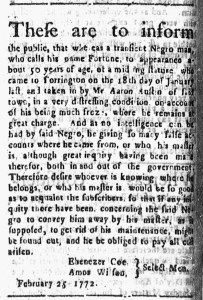
Slavery Advertisements Published March 14, 1772

GUEST CURATOR: Matthew Holbrook

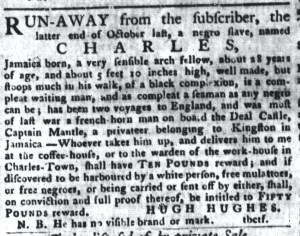
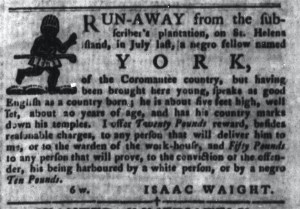
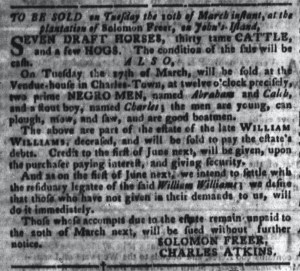
The Slavery Adverts 250 Project chronicles the role of newspaper advertising in perpetuating slavery in the era of the American Revolution. The project seeks to reveal the ubiquity of slavery in eighteenth-century life from New England to Georgia by republishing advertisements about enslaved people – for sale as individuals or in groups, wanted to purchase or for hire for short periods, runaways who liberated themselves, and those who were subsequently captured and confined in jails and workhouses – in daily digests on this site as well as in real time via the @SlaveAdverts250 Twitter feed, utilizing twenty-first-century media to stand in for the print media of the eighteenth century.

The project aims to provide modern audiences with a sense of just how often colonizers encountered these advertisements in their daily lives. Enslaved men, women, and children appeared in print somewhere in the colonies almost every single day. Those advertisements served as a constant backdrop for social, cultural, economic, and political life in colonial and revolutionary America. Colonizers who did not purport to own enslaved people were still confronted with slavery as well as invited to maintain the system by purchasing enslaved men, women, and children or assisting in the capture of so-called “runaways” who sought to free themselves from bondage. The frequency of these newspaper advertisements suggests just how embedded slavery was in colonial and revolutionary American culture in everyday interactions beyond the printed page.

These advertisements also testify to the experiences of enslaved men, women, and children, though readers must consider that those experiences have been remediated through descriptions offered by enslavers rather than enslaved people themselves. Often unnamed in the advertisements, enslaved men, women, and children were not invisible or unimportant in early America.

These advertisements appeared in colonial American newspapers 250 years ago today.

Providence Gazette (March 14, 1772).

**********

Censor (March 14, 1772).

March 13

What was advertised in a colonial American newspaper 250 years ago today?

New-Hampshire Gazette (March 13, 1772).

Choice Bohea TEA.”

When Stephen Hardy, a tailor, placed an advertisement in the March 13, 1772, edition of the New-Hampshire Gazette, his name served as the headline.  Such was the case in many advertisements for consumer goods and services in newspapers published throughout the colonies.  The names of the purveyors appeared first or appeared in larger font than the goods and services offered for sale or both.  As a result, colonizers skimming advertisements encountered a litany of names of merchants, shopkeepers, and artisans rather than products.

On occasion, however, headlines for advertisements did identify products.  In that same issue of the New-Hampshire Gazette, one advertisement promoted “Choice Bohea TEA TO BE SOLD BY DANIEL PEIRCE, junr.”  The body of the advertisement listed other items for sale as well, but the headline, “Choice Bohea TEA,” appeared in the same size font as “Stephen Hardy” elsewhere on the page, making those two headlines the most noticeable content on the page.  Although Peirce’s name ran in all capital letters, the font size did not distinguish it from the rest of the content of his advertisement.  Indeed, the decision to also print “ENGLISH, & WEST INDIA GOODS,” “GROCERIES, NAILS, GLASS,” “PEPPER,” “GINGER,” and “SHOES” in all capital letters of the same size as “DANIEL PEIRCE” made it harder to spot the name of the advertiser.  “Choice Bohea TEA” was the focal point of Peirce’s advertisement, just as “Stephen Hardy” was the focal point of the tailor’s advertisement.

Other advertisements deployed a similar strategy.  Gilliam Butler’s advertisement for “ENGLISH and WEST INDIA GOODS” also used “Choice Bohea TEA” in a larger font as its headline.  Peter Pearse’s advertisement promoted “Shushong, Hyson, Congo, and Bohea TEA,” with “Sushong, Hyson” in a larger font, occupying the first line, and operating as an abbreviated headline.  Neal McIntire’s advertisement had a similar structure: “Tar, Pitch” led a list of commodities for sale, appeared in a larger font on the first line, and displaced the seller’s name as a headline.  In an advertisement for textiles, “Russia Duck” instead of “THOMAS MARTIN” served as the headline.

Why did so many advertisements in that issue deviate from using the name of the advertiser as the headline?  Did purveyors of goods and services who placed notices in the New-Hampshire Gazette adopt different standards for writing copy than advertisers in other towns?  That may have been the case, especially if they consulted advertisements that previously ran in the New-Hampshire Gazette when writing their own notices.  The printers, Daniel Fowle and Robert Fowle, may have also played a role.  On occasion, printers noted that they aided in composing advertisements.  Perhaps Peirce, Butler, Pearse, McIntire, and Martin received advice from the Fowles, encouragement to place their products first and their names later in their advertisements.  Whatever the explanation, the advertising pages of the New-Hampshire Gazette often had a distinctive look in the early 1770s because the headlines name products instead of purveyors.

Slavery Advertisements Published March 13, 1772

GUEST CURATOR: Matthew Holbrook

The Slavery Adverts 250 Project chronicles the role of newspaper advertising in perpetuating slavery in the era of the American Revolution. The project seeks to reveal the ubiquity of slavery in eighteenth-century life from New England to Georgia by republishing advertisements about enslaved people – for sale as individuals or in groups, wanted to purchase or for hire for short periods, runaways who liberated themselves, and those who were subsequently captured and confined in jails and workhouses – in daily digests on this site as well as in real time via the @SlaveAdverts250 Twitter feed, utilizing twenty-first-century media to stand in for the print media of the eighteenth century.

The project aims to provide modern audiences with a sense of just how often colonizers encountered these advertisements in their daily lives. Enslaved men, women, and children appeared in print somewhere in the colonies almost every single day. Those advertisements served as a constant backdrop for social, cultural, economic, and political life in colonial and revolutionary America. Colonizers who did not purport to own enslaved people were still confronted with slavery as well as invited to maintain the system by purchasing enslaved men, women, and children or assisting in the capture of so-called “runaways” who sought to free themselves from bondage. The frequency of these newspaper advertisements suggests just how embedded slavery was in colonial and revolutionary American culture in everyday interactions beyond the printed page.

These advertisements also testify to the experiences of enslaved men, women, and children, though readers must consider that those experiences have been remediated through descriptions offered by enslavers rather than enslaved people themselves. Often unnamed in the advertisements, enslaved men, women, and children were not invisible or unimportant in early America.

These advertisements appeared in colonial American newspapers 250 years ago today.

Connecticut Journal (March 13, 1772).

March 12

What was advertised in a colonial American newspaper 250 years ago today?

Pennsylvania Gazette (March 12, 1772).

The case and cure of Thomas Hewitt, sent to the Proprietor.”

An advertisement for Maredant’s Drops, a patent medicine, in the March 12, 1772, edition of the Pennsylvania Gazetteconsisted almost entirely of testimonials from patients who claimed that it cured impurities of the blood, scurvy, ulcers, “long continued inflammations of the eyes,” and a variety of other maladies.  Nicholas Brooks sold Maredant’s Drops at his shop on Market Street in Philadelphia.  In his advertisement, he directed prospective customers to visit in order to examine “the cases of the following persons, and many others, cured by Maredant’s drops.”  He listed several individuals, including “Joseph Feyrac, Esq; lately Lieutenant-Colonel in the 18th regiment of foot,” “Mr. Stoddard, brewer, Mr. Thomas Forrest, Attorney,” and “John Good, late surgeon to his Majesty’s sloop Ferrit.”  Brooks anticipated that the volume of testimonials would convince colonizers to take a chance on the patent medicines to see if they would benefit from similar results.

The shopkeeper noted that the patent medicine “may be taken in any season, without the least inconvenience or hindrance from business.”  In addition, this nostrum would “perfect digestion, and amazingly create an appetite.”  He did not say much else about Maredant’s Drops, but instead relied on two testimonials inserted in the advertisement.  In the first, dated “Kilkenny, June 25, 1771,” Thomas Hewitt explained that twenty years earlier he “was afflicted with a most violent scurvy” in his arms that eventually led to “large ulcers and blotches” on his face.  He consulted “several eminent physicians, and tried various medicines, prescribed by them, to little or no effect.”  Other residents of Kilkenny, where Hewitt lived for more than thirty years, could confirm that was the case.  Eventually, Hewitt saw Maredant’s Drops advertised by a printer in Kilkenny.  He purchased four bottles.  The medicine “quite restored” his appetite and the scurvy “gradually left [his] face, and all parts of [his] body.”  Hewitt declared himself “perfectly cured.”  The mayor of Kilkenny co-signed Hewitt’s testimonial to “certify the above case to be a fact.”

In another testimonial, Charles Ashley, an innkeeper, described the misfortunes of his son, afflicted with “the King’s evil” (scrofula, a form of tuberculosis) after surviving smallpox.  His son “was in so much misery, and without hopes of recovery” that Ashley “despaired of his life.”  When Ashley’s son recovered upon taking the “most excellent drops,” the innkeeper felt such “gratitude for so extraordinary a cure” that he “desired this to be made public.”  Furthermore, he invited readers to call at his house, “the Talbot inn, in the Strand,” to learn more and “see the child” for themselves.  Brooks apparently believed that he did not need to say more about Maredant’s Drops.  He depended on the testimonials to do all the necessary marketing.

Slavery Advertisements Published March 12, 1772

The Slavery Adverts 250 Project chronicles the role of newspaper advertising in perpetuating slavery in the era of the American Revolution. The project seeks to reveal the ubiquity of slavery in eighteenth-century life from New England to Georgia by republishing advertisements about enslaved people – for sale as individuals or in groups, wanted to purchase or for hire for short periods, runaways who liberated themselves, and those who were subsequently captured and confined in jails and workhouses – in daily digests on this site as well as in real time via the @SlaveAdverts250 Twitter feed, utilizing twenty-first-century media to stand in for the print media of the eighteenth century.

The project aims to provide modern audiences with a sense of just how often colonizers encountered these advertisements in their daily lives. Enslaved men, women, and children appeared in print somewhere in the colonies almost every single day. Those advertisements served as a constant backdrop for social, cultural, economic, and political life in colonial and revolutionary America. Colonizers who did not purport to own enslaved people were still confronted with slavery as well as invited to maintain the system by purchasing enslaved men, women, and children or assisting in the capture of so-called “runaways” who sought to free themselves from bondage. The frequency of these newspaper advertisements suggests just how embedded slavery was in colonial and revolutionary American culture in everyday interactions beyond the printed page.

These advertisements also testify to the experiences of enslaved men, women, and children, though readers must consider that those experiences have been remediated through descriptions offered by enslavers rather than enslaved people themselves. Often unnamed in the advertisements, enslaved men, women, and children were not invisible or unimportant in early America.

These advertisements appeared in colonial American newspapers 250 years ago today.

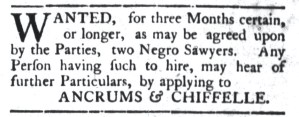
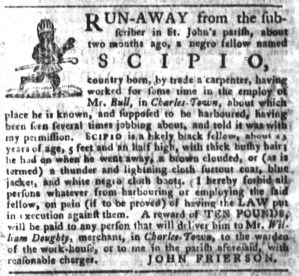
Maryland Gazette (March 12, 1772).

**********

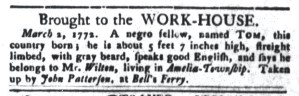
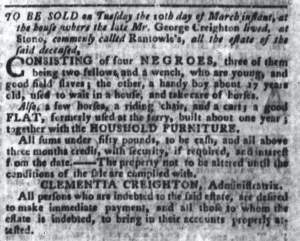
Maryland Gazette (March 12, 1772).

**********

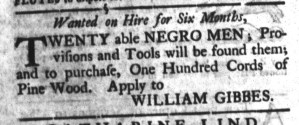
Maryland Gazette (March 12, 1772).

**********

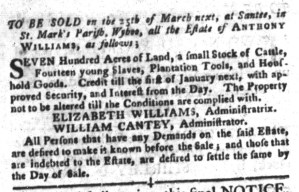
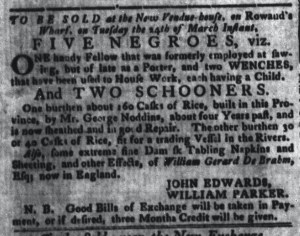
Maryland Gazette (March 12, 1772).

**********

Massachusetts Gazette and Boston Weekly News-Letter (March 12, 1772).

**********

Virginia Gazette [Purdie and Dixon] (March 12, 1772).

**********

Virginia Gazette [Purdie and Dixon] (March 12, 1772).

**********

Virginia Gazette [Purdie and Dixon] (March 12, 1772).

**********

Virginia Gazette [Purdie and Dixon] (March 12, 1772).

**********

Virginia Gazette [Purdie and Dixon] (March 12, 1772).

**********

Virginia Gazette [Purdie and Dixon] (March 12, 1772).

**********

Virginia Gazette [Purdie and Dixon] (March 12, 1772).

**********

Virginia Gazette [Purdie and Dixon] (March 12, 1772).

**********

Virginia Gazette [Purdie and Dixon] (March 12, 1772).

**********

Virginia Gazette [Purdie and Dixon] (March 12, 1772).

**********

Virginia Gazette [Purdie and Dixon] (March 12, 1772).

**********

Virginia Gazette [Purdie and Dixon] (March 12, 1772).

**********

Virginia Gazette [Purdie and Dixon] (March 12, 1772).

**********

Virginia Gazette [Purdie and Dixon] (March 12, 1772).

**********

Virginia Gazette [Rind] (March 12, 1772).

**********

Virginia Gazette [Rind] (March 12, 1772).

**********

Virginia Gazette [Rind] (March 12, 1772).

**********

Virginia Gazette [Rind] (March 12, 1772).

**********

Virginia Gazette [Rind] (March 12, 1772).

**********

Virginia Gazette [Rind] (March 12, 1772).

**********

Virginia Gazette [Rind] (March 12, 1772).

**********

Virginia Gazette [Rind] (March 12, 1772).

**********

Virginia Gazette [Rind] (March 12, 1772).

**********

Virginia Gazette [Rind] (March 12, 1772).

March 11

What was advertised in a colonial American newspaper 250 years ago this week?

Pennsylvania Packet (March 9, 1772).

“Said EVITT prints Advertisements.”

In the early 1770s, William Evitt regularly placed advertisements in several newspapers published in Philadelphia to announce that he “PERFORMS PRINTING IN ALL ITS BRANCHES, With the utmost CARE and EXPEDITION.”  He did not provide much more detail in an advertisement in the March 9, 1772, edition of the Pennsylvania Packet, though he did include a nota bene about one of the “BRANCHES” of the printing business.  “Said EVITT,” he explained, “prints Advertisements, &c. at two hours notice, as usual.”  The “&c.” (an eighteenth-century abbreviation for et cetera) likely referred to printed blanks such as indentures, bills of lading, and other forms for legal agreements and commercial transactions.

Evitt did not print a newspaper, but he assisted colonizers in disseminating other kinds of advertising media.  The advertisements he printed “at two hours notice” probably included handbills, broadsides (or posters), trade cards (a combination of a handbill and business card), and billheads (a trade card with space for writing receipts by hand).  Each of those items consisted of a single sheet.  At the direction of his customers, Evitt may have embellished the advertising copy with ornamental type of the sort that ran across the top of his newspaper notice or woodcuts with visual images that he supplied.  To produce advertisements in such a short time, he quickly set the type and then worked with employees in operating a manual press.

In declaring that he printed advertisements “as usual,” Evitt suggested that handbills, broadsides, trade cards, billheads, and other items constituted a regular part of his business.  Marketing materials flowed off of his press into the hands of advertisers and, eventually, to colonizers in Philadelphia and beyond.  Compared to eighteenth-century newspapers and the advertisements that appeared in them, however, relatively few handbills, broadsides, trade cards, and billheads survive today.  I believe that historians have underestimated the extent that advertising media circulated in early America, especially in bustling port cities, as a result.  Evitt’s advertisement about printing advertisements suggests that colonizers encountered an array of marketing media on a daily basis.

March 10

What was advertised in a colonial American newspaper 250 years ago today?

Essex Gazette (March 10, 1772).

“The Preservation of these Papers for the Benefit of Posterity.”

A subscription notice for a “second Volume of Collection of Papers relative to the History of Massachusetts-Bay” ran in several newspapers in New England in 1772.  The version that appeared in the March 10 edition of the Essex Gazette carried a familiar appeal, asserting that “most of these Papers will, probably, be irrevocably lost in a few Years, unless preserved by Printing” so many copies that “the Public” would always have access to important documents about the history of the colony.  Prospective subscribers, the advertisement argued, had a duty to assist in “the Preservation of these Papers for the Benefit of Posterity.”

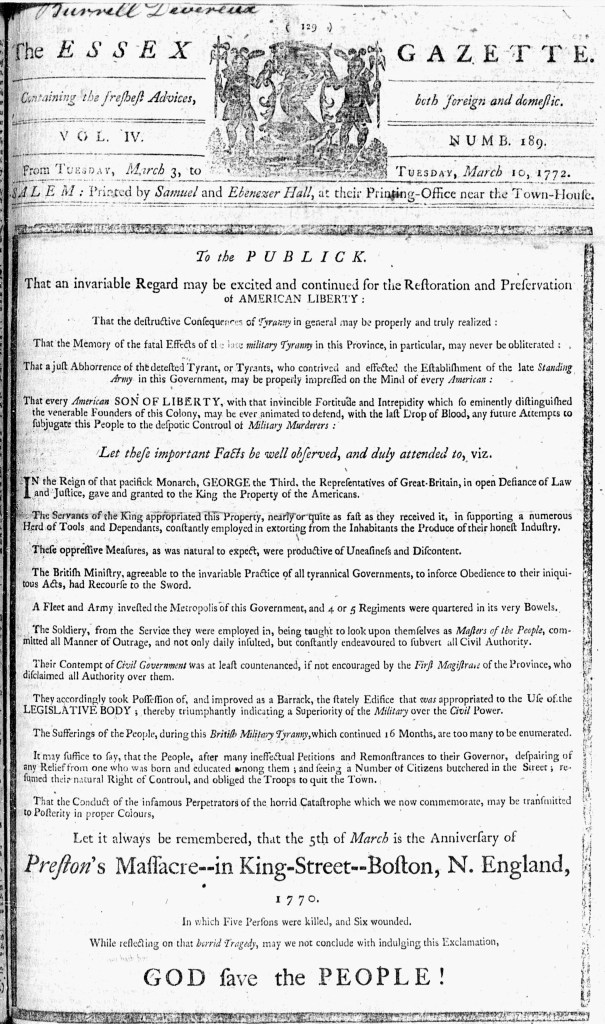
Readers of the Essex Gazette encountered this subscription notice in the context of commemorating recent history, “Preston’s Massacre–in King-Street–Boston” on March 5, 1770.  Samuel Hall and Ebenezer Hall, printers of the Essex Gazette, devoted the entire first page of the March 10 edition to commemorations marking the second anniversary of the Boston Massacre.  They enclosed a lengthy memorial within thick mourning borders, a convention usually reserved for death notices but frequently deployed for political purposes during the imperial crisis that culminated in the American Revolution.

In the memorial, the Halls called on the public to seek “the Restoration and Preservation of AMERICAN LIBERTY,” advocating that “the destructive Consequences of Tyranny in general may be properly and truly realized” and that “the Memory of the fatal Effects of the late military Tyranny in this Province, in Particular, may never be obliterated.”  They invoked “that invincible Fortitude and Intrepidity which so eminently distinguished the venerable Founders of this Colony” as they encouraged “every American SON OF LIBERTY … to defend, with the last Drop of Blood, any future Attempts to subjugate this people to the despotic Controul of Military Murderers.”  As they commemorated the second anniversary of the Boston Massacre, the Halls encouraged colonizers to consider 150 years of history and their role in shaping events.  They rehearsed recent events in a list of grievances against “Servants of the King,” the “British Ministry,” and the “Soldiery … taught to look upon themselves as Masters of the People.”  Those grievances had greater impact when considered in relation to the founding of the colony and subsequent events chronicled in the proposed volume of “Papers relative to the History of Massachusetts-Bay” advertised on another page.  The advertisement listed the Halls as local agents who accepted subscriptions for the project.  Between the memorial on the first page and the subscription notice on the final page, they tended to the recent and distant past by presenting readers with opportunities to prevent “the Memory” of significant events from being “obliterated” but instead “transmitted to Posterity.”

Essex Gazette (March 10, 1772).

Slavery Advertisements Published March 10, 1772

The Slavery Adverts 250 Project chronicles the role of newspaper advertising in perpetuating slavery in the era of the American Revolution. The project seeks to reveal the ubiquity of slavery in eighteenth-century life from New England to Georgia by republishing advertisements about enslaved people – for sale as individuals or in groups, wanted to purchase or for hire for short periods, runaways who liberated themselves, and those who were subsequently captured and confined in jails and workhouses – in daily digests on this site as well as in real time via the @SlaveAdverts250 Twitter feed, utilizing twenty-first-century media to stand in for the print media of the eighteenth century.

The project aims to provide modern audiences with a sense of just how often colonizers encountered these advertisements in their daily lives. Enslaved men, women, and children appeared in print somewhere in the colonies almost every single day. Those advertisements served as a constant backdrop for social, cultural, economic, and political life in colonial and revolutionary America. Colonizers who did not purport to own enslaved people were still confronted with slavery as well as invited to maintain the system by purchasing enslaved men, women, and children or assisting in the capture of so-called “runaways” who sought to free themselves from bondage. The frequency of these newspaper advertisements suggests just how embedded slavery was in colonial and revolutionary American culture in everyday interactions beyond the printed page.

These advertisements also testify to the experiences of enslaved men, women, and children, though readers must consider that those experiences have been remediated through descriptions offered by enslavers rather than enslaved people themselves. Often unnamed in the advertisements, enslaved men, women, and children were not invisible or unimportant in early America.

These advertisements appeared in colonial American newspapers 250 years ago today.

Connecticut Courant (March 10, 1772).

**********

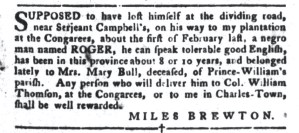
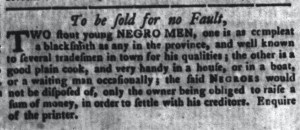
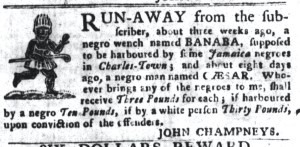
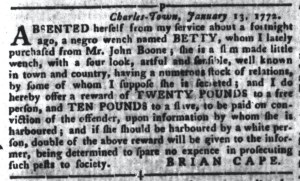
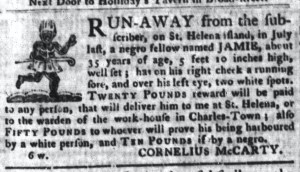
South-Carolina Gazette and Country Journal (March 10, 1772).

**********

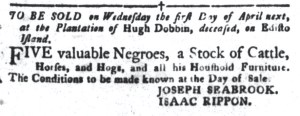
South-Carolina Gazette and Country Journal (March 10, 1772).

**********

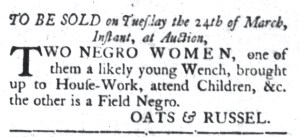
South-Carolina Gazette and Country Journal (March 10, 1772).

**********

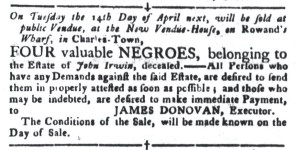
South-Carolina Gazette and Country Journal (March 10, 1772).

**********

South-Carolina Gazette and Country Journal (March 10, 1772).

**********

South-Carolina Gazette and Country Journal (March 10, 1772).

**********

South-Carolina Gazette and Country Journal (March 10, 1772).

**********

South-Carolina Gazette and Country Journal (March 10, 1772).

**********

South-Carolina Gazette and Country Journal (March 10, 1772).

**********

South-Carolina Gazette and Country Journal (March 10, 1772).

**********

South-Carolina Gazette and Country Journal (March 10, 1772).

**********

South-Carolina Gazette and Country Journal (March 10, 1772).

**********

South-Carolina Gazette and Country Journal (March 10, 1772).

**********

South-Carolina Gazette and Country Journal (March 10, 1772).

**********

South-Carolina Gazette and Country Journal (March 10, 1772).

**********

South-Carolina Gazette and Country Journal (March 10, 1772).

**********

South-Carolina Gazette and Country Journal (March 10, 1772).

**********

Supplement to the South-Carolina Gazette and Country Journal (March 10, 1772).

**********

Supplement to the South-Carolina Gazette and Country Journal (March 10, 1772).

**********

Supplement to the South-Carolina Gazette and Country Journal (March 10, 1772).

**********

Supplement to the South-Carolina Gazette and Country Journal (March 10, 1772).

**********

Supplement to the South-Carolina Gazette and Country Journal (March 10, 1772).

**********

Supplement to the South-Carolina Gazette and Country Journal (March 10, 1772).

**********

Supplement to the South-Carolina Gazette and Country Journal (March 10, 1772).

**********

Supplement to the South-Carolina Gazette and Country Journal (March 10, 1772).

**********

Supplement to the South-Carolina Gazette and Country Journal (March 10, 1772).

**********

Supplement to the South-Carolina Gazette and Country Journal (March 10, 1772).

**********

Supplement to the South-Carolina Gazette and Country Journal (March 10, 1772).

**********

Supplement to the South-Carolina Gazette and Country Journal (March 10, 1772).

**********

Supplement to the South-Carolina Gazette and Country Journal (March 10, 1772).

**********

Supplement to the South-Carolina Gazette and Country Journal (March 10, 1772).

**********

Supplement to the South-Carolina Gazette and Country Journal (March 10, 1772).

**********

Supplement to the South-Carolina Gazette and Country Journal (March 10, 1772).

**********

Supplement to the South-Carolina Gazette and Country Journal (March 10, 1772).

**********

Supplement to the South-Carolina Gazette and Country Journal (March 10, 1772).

**********

Supplement to the South-Carolina Gazette and Country Journal (March 10, 1772).