April 1

What was advertised in a revolutionary American newspaper 250 years ago today?
Boston-Gazette (April 1, 1776).

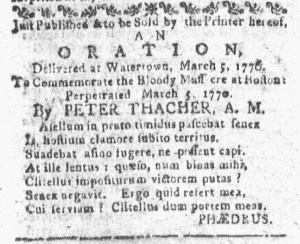
“AN ORATION … To Commemorate the Bloody Massacre at Boston: Perpetrated March 5, 1770.”

The annual tradition continued during the first year of the Revolutionary War.  Each year since the Boston Massacre, residents of the city gathered to mark the anniversary, honor the men who died when British regulars fired into a crowd of protestors, and hear an oration about the dangers of a standing army stationed in an urban port during times of peace.  James Lovell delivered the address in 1771, followed by Joseph Warren in 1772, Benjamin Church in 1773, and John Hancock in 1774.  In March 1775, Joseph Warren gave the last oration before the Revolutionary War commenced with the battles at Lexington and Concord on April 19.  Three months later, he was killed in action at the Battle of Bunker Hill.

Patriots made adjustments to the ritual in 1776.  The British occupation of Boston continued.  The Continental Army, commanded by George Washington, continued the siege of the city.  The Massachusetts Provincial Congress met at Watertown.  It was from there that William Cooper, the “Town Clerk of Boston” in exile, announced that according to a “vote in a town-meeting legally assembled” on March 5, 1775, “an ORATION will be delivered at the meeting-house, in Watertown, on the 5th of March next, … to commemorate the horrid Massacre perpetrated in Boston, on the evening of the 5th of March, 1770, by a party of Soldiers of the 29th Regiment, under the command of Capt. Thomas Preston.”  Refugees from Boston and the inhabitants of Watertown and other nearby towns gathered in Watertown for the annual oration about “the ruinous tendency of Standing armies being placed in large and populous cities, in time of peace.”  It was also a rally for asserting “the necessity of such exertions as the inhabitants of Boston then manifested, whereby the designs of the conspirators against the public safety, have been frustrated.”

Although circumstances forced those “who were inhabitants of Boston” to shift the location for the annual commemoration, other aspects remained constant, including the printing, marketing, and dissemination of the oration a few weeks after the gathering occurred.  This time, Peter Thacher delivered “AN ORATION … To Commemorate the Bloody Massacre at Boston: Perpetrated March 5, 1770.”  Benjamin Edes, who had relocated the Boston-Gazette from Boston to Watertown, printed the pamphlet and sold it at his printing office.  As had been the case with previous orations, this gave those who had been present an opportunity to experience Thacher’s address again and as many times as they wished to read it.  The pamphlet also gave those who had not attended a chance to read what Thacher said and imbibe the arguments made in support of the American cause.  Gathering for the oration was an important civic act, yet the circulation of the oration in print may have had an impact just as significant.
February 16

What was advertised in a revolutionary American newspaper 250 years ago today?

Thomas’s Massachusetts Spy (February 16, 1776).

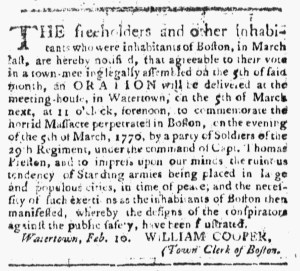
“An ORATION will be delivered … to commemorate the horrid Massacre perpetrated in Boston.”

It was an annual tradition that commenced the year after the Boston Massacre.  The residents of the town gathered for an oration that commemorated the event.  James Lovell spoke in 1771, Joseph Warren in 1772, Benjamin Church in 1773, and John Hancock in 1774Joseph Warren once again delivered the oration in 1775, about six weeks before the imperial crisis became an armed conflict at the battles at Lexington and Concord and just three months before Warren, a major general in the colony’s militia, was killed during the Battle of Bunker Hill.  As the siege of Boston continued in 1776, the tradition continued, though in Watertown where the Massachusetts Provincial Congress met rather than in occupied Boston

About three weeks in advance, Thomas’ Massachusetts Spy, which had relocated to Worcester from Boston just as hostilities commenced, carried a notice for the “freeholders and other inhabitants who were inhabitants of Boston, in March last.”  It advised that “agreeable to their vote in a town-meeting legally assembled on the 5th of said month,” the fifth anniversary of the Boston Massacre, “an ORATION will be delivered at the meeting-house, in Watertown, on the 5th of March next … to commemorate the horrid Massacre perpetrated in Boston … by a party of Soldiers of the 29th Regiment, under the command of Capt. Thomas Preston.”  As usual, the oration would not merely honor those who died when British soldiers fired into a crowd of protestors; the speaker would also “impress upon our minds the ruinous tendency of Standing armies being placed in large and populous cities, in time of peace.”  The presence of British soldiers in Boston led to what colonizers often called the “bloody Tragedy.”  The oration was also a call to action, asserting “the necessity of such exertions as the inhabitants of Boston then manifested, whereby the designs of the conspirators against the public safety, have been frustrated.”  The annual gathering had even greater significance now that colonizers were fighting a war against British troops and many of them increasingly contemplated declaring independence rather than seeking redress of their grievances within the imperial system.  With an advertisement in the public prints, the organizers hoped to draw crowds for the oration and, in turn, strengthen the resolve of those who attended.

November 11

What was advertised in a revolutionary American newspaper 250 years ago today?

Pennsylvania Ledger (November 11, 1775).

“AN ORATION … to Commemorate the Bloody Tragedy … By the Hon. JOHN HANCOCK.”

In addition to printing The Prussian Evolutions for Thomas Hanson in the fall of 1775, John Douglass McDougall published and sold “AN ORATION, Delivered March 6, 1774, at the Request of the Inhabitants of the Town of Boston, to Commemorate the Bloody Tragedy of the fifth of March, 1770.  By the Hon. JOHN HANCOCK, Esquire.”  The bookbinder, bookseller, and stationer had only recently added printer to the occupations he pursued at his shop in Philadelphia.  For his first forays, he focused on works supporting the American cause, either because doing so aligned with his political principles or because he spotted an opportunity to enhance his earnings.  Such motivations were not necessarily mutually exclusive.

In 1771, the residents of Boston marked the first anniversary of the “Bloody Tragedy,” now known as the Boston Massacre, with an oration delivered by James Lovell.  It did not take long for local printers to market copies.  So began an annual tradition.  Each year, a prominent figure delivered an “ORATION” and printers published and marketed those addresses.  Following Lovell, Joseph Warren spoke in 1772, Benjamin Church in 1773, John Hancock in 1774, and Joseph Warren again in 1775, just a few months before being killed in action at the Battle of Bunker Hill.  The annual oration became a ritual in Boston, as did the marketing of copies of the latest address in Boston’s newspapers each spring.  Printers outside of Boston, however, did not publish local editions, nor did booksellers outside of New England advertise copies they acquired from Boston.  The “Bloody Tragedy” and the trials of the soldiers involved had certainly been reported far and wide in newspapers throughout the colonies, but the subsequent commemorations did not receive as much notice, at least not in terms advertisements encouraging consumers beyond New England to purchase their own copies of the most recent oration.

That made McDougall’s new edition of Hancock’s oration from 1774 an innovation in the local market.  Why did he opt to publish Hancock’s address rather than the one more recently delivered by Warren?  As president of the Second Continental Congress, Hancock achieved recognition throughout the colonies, whereas Warren, even though he had died for the American cause, may have been considered a figure associated primarily with Massachusetts and thus not having the same appeal in Philadelphia, where the Second Continental Congress met and McDougall printed and advertised Hancock’s oration.  Whatever the reason, the publication and marketing of Hancock’s oration in Pennsylvania testified to a transition taking place throughout the colonies in the wake of the Coercive Acts and the battles at Lexington and Concord.  More colonizers began to think of themselves as sharing a common cause rather than having interests aligned with their own province.  They began to think of themselves as an imagined community of Americans despite the local and regional differences that distinguished each colony from the others.

March 29

What was advertised in a colonial American newspaper 250 years ago today?

Essex Journal (March 29, 1775).

“A DISCOURSE … Preached … In Cammemoration of the MASSACRE at BOSTON.”

In March 1775, residents of Boston once again participated in an annual commemoration of the Boston Massacre, marking its fifth anniversary.  Joseph Warren delivered the oration, just as he had done three years earlier.  As had been the case in years past, local printers published and marketed copies of the address.  Printers in other towns also produced and advertised their own editions of Warren’s oration, helping to keep its memory alive as colonizers dealt with the effects of the Coercive Acts that Parliament imposed in retaliation for the Boston Tea Party.

Colonizers in other towns joined in commemorating the Boston Massacre and critiquing Parliament.  Oliver Noble, “Pastor of a Church in NEWBURY,” delivered a sermon that did so, “PREACH[ING] AT THE REQUEST of a Number of Respectable Gentlemen of said Town.”  In turn, Noble partnered with Ezra Lunt and Henry-Walter Tinges, the printers of the Essex Journal, to publish the sermon “at the General Desire of the Hearers.”  The extensive title, which doubled as the advertising copy, gave an overview of its contents and purpose: “SOME STRICTURES upon the sacred Story recorded in the Book of ESTHER, shewing the Power and Oppression of State Ministers, tending to the Ruin and Destruction of GOD’s People:– And the remarkable Interpositions of Divine Providence in Favour of the Oppressed; IN A Discourse … In Cammemoration of the MASSACRE at BOSTON.”  An advertisement ran in the March 29 edition of the Essex Journal, encouraging colonizers to acquire their own copies.  Those who had heard Noble preach could experience the sermon again every time they read it, remembering how the minister delivered each “STRICTURE” and how other “Hearers” reacted.  Others who had not been fortunate to be present for the commemoration did not have to miss it entirely if they purchased and read Noble’s Discourse.

Relations between the colonies and Britain had deteriorated to the worst point yet during the imperial crisis.  Although they did not know it, a war would start within weeks of Noble preaching his sermon in commemoration of the Boston Massacre and advertising it in the Essex Journal, a war that began because colonizers wanted redress of their grievances and eventually became a war for independence.  Commemoration and commodification of the events that were part of that conflict began before the fighting started.

March 27

What was advertised in a colonial American newspaper 250 years ago today?

Newport Mercury (March 27, 1775).

“Worth the Perusal of each TRUE SON OF LIBERTY.”

In the years after British soldiers fired into a crowd of protestors and killed several colonizers on March 5, 1770, the residents of Boston staged an annual commemoration of the “horrid MASSACRE.”  They called on a prominent patriot to give an “ORATION” about what occurred and the dangers of having British soldiers quartered in urban ports during times of peace.  Colonizers did not need to be present for the oration to experience it for themselves.  Each year, printers published and marketed the oration, commodifying an event that played an important role in the imperial crisis becoming a revolution.

New-York Gazette and Weekly Mercury (March 27, 1775).

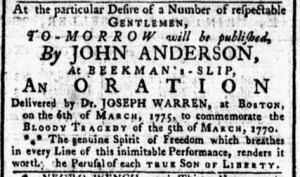
In the first several years, printers in Boston published the oration and newspapers in Massachusetts carried advertisements for it.  In 1775, however, printers in other colonies produced their own editions of Joseph Warren’s oration commemorating the fifth anniversary of the Boston Massacre.  Benjamin Edes and John Gill, the printers of the Boston-Gazette, and Joseph Greenleaf, the publisher of the Royal American Magazine, partnered in printing and advertising a Boston edition.  Not long after, Solomon Southwick, the printer of the Newport Mercury, advertised his own edition, giving the notice a privileged place as the first item in the first column on the first page of the March 27 edition of his newspaper.  On that same day, John Anderson inserted a notice in the New-York Gazette and Weekly Mercury to alert readers of the imminent publication of a local edition undertaken “At the particular Desire of a Number of respectable GENTLEMEN.”  Patriots expressed intertest in obtaining their own copies of Warren’s oration; in turn, printers believed they could generate even greater demand.  To that end, Anderson declared, “The genuine Spirit of Freedom which breathes in every Line of this inimitable Performance, renders it worth the Perusal of each TRUE SON OF LIBERTY.”

The political climate had shifted since printers in Boston disseminated John Hancock’s oration commemorating the fourth anniversary of the Boston Massacre.  Since then, colonizers experienced how Parliament reacted to the destruction of tea during what has become known as the Boston Tea Party.  The Coercive Acts, including the Boston Port Act that closed the harbor until residents paid restitution, prompted delegates from throughout the colonies to gather in Philadelphia for the First Continental Congress in the fall of 1774.  They adopted a nonimportation agreement, the Continental Association, that remained in effect in the spring of 1775.  Given the events that transpired in 1774 and early 1775, it made sense that the anniversary of the “BLOODY TRAGEDY of the 5th of MARCH, 1770” garnered greater attention beyond Massachusetts.

March 17

What was advertised in a colonial American newspaper 250 years ago today?

Massachusetts Gazette and Boston Weekly News-Letter (March 17, 1775).

“AN ORATION … to commemorate the bloody Tragedy of March 5th 1770.”

In the spring of 1771, patriots marked the first anniversary of the “BLOODY TRAGEDY” now known as the Boston Massacre with “AN ORATION Delivered … at the Request of the Inhabitants of the Town of Boston … By JAMES LOVELL.”  That started an annual tradition, with Joseph Warren giving the oration in 1772, Benjamin Church in 1773, and John Hancock in 1774.  Gathering for the oration became an annual ritual.  So did publishing and marketing it.

For the fifth anniversary, the “ORATION … to commemorate the bloody Tragedy of March 5th 1770” was once again “delivered by JOSEPH WARREN.”  Less than two weeks later, advertisements in the March 17 edition of the Massachusetts Gazette and Boston Weekly News-Letter informed readers where they could acquire copies.  One indicated that Benjamin Edes and John Gill, the printers of the Boston-Gazette, sold the oration, implying that they also published it.  According to the imprint, Edes and Gill printed the address in partnership with Joseph Greenleaf, the proprietor of the Royal American Magazine.

Another advertisement gave readers another option: “In the MASSACHUSETTS SPY, of this Day is published, the WHOLE of the ORATION, delivered by JOSEPH WARREN, Esq; on March 6th , 1775, to commemorate the bloody Tragedy of March 5th, 1770.”  Isaiah Thomas, the printer of the Massachusetts Spy, did indeed devote three of the four columns of the third page of his newspaper to Warren’s oration.  In an introduction, he reported that it was “this day published, in a pamphlet” and available for sale in addition to appearing in the newspaper.  The printer offered multiple ways for readers to engage with the oration.  He (and Edes and Gill and Greenleaf) also offered consumers an opportunity to purchase a commemorative item.  Readers who previously purchased the orations by Lovell, Warren, Church, and Hancock on previous anniversaries may have been motivated to add to their collections.

The printer of the Massachusetts Gazette and Boston Weekly News-Letter gave the advertisements a privileged place, likely intended to increase the chances that readers took note of them.  They appeared one after the other immediately after the weekly account of local marriages and deaths.  That meant that the advertisements served as a transition between news items and paid notices.  Readers who perused the news yet merely glanced through the advertisements may have been more likely to take note of these first notices as they realized that the remainder of the page featured advertising.  A manicule also helped call attention to them, signaling their importance in a town experiencing the distresses of the Boston Port Act and the other Coercive Acts.

April 11

What was advertised in a colonial American newspaper 250 years ago today?

Boston-Gazette (April 11, 1774).

“The SECOND EDITION of Mr. HANCOCK’S ORATION.”

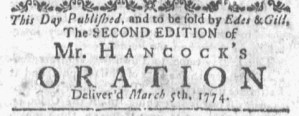
Benjamin Edes and John Gill, printers of the Boston-Gazette, gave their advertisement for the “SECOND EDITION of Mr. HANCOCK’S ORATION Deliver’d March 5th” a privileged place in their newspaper.  Readers did not need further explanation to understand that “March 5th” referred to the date of the Boston Massacre and that Hancock had been selected to give the annual address that memorialized the victims and raised an alarm about the danger of quartering an army in an urban center, like Boston, during times of peace.

Still, Edes and Gill, who printed the “ORATION” as well as the newspaper, did what they could to draw attention to the second edition.  The first time they announced it was “This Day Published,” in the April 4, 1774, edition of the Boston-Gazette, they ran the notice immediately below news and editorials.  Even if readers chose not to peruse other advertisements closely once they realized they had finished the news, they likely took note of the advertisement for the “ORATION” in its place of transition from one kind of content to another.  In the next issue of the weekly newspaper, the notice ran at the bottom of the last column on the first page, the only advertisement on that page.  Once again, the patriot printers increased the likelihood that readers would spot that advertisement and accept an invitation to demonstrate their own commitment to the patriot cause by purchasing copies for themselves.

That Edes and Gill published a “SECOND EDITION” testified to the demand for the first edition.  It sold well enough to justify another printing.  Edes and Gill took it to press just a few months after the Boston Tea Party and just a few weeks after another destruction of tea.  Although that second Boston Tea Party is not nearly as well known today, it was certainly among the current events that would have been on the minds of colonizers as they participated in commemorating the fourth anniversary of the Boston Massacre, discussed the politics of tea, and decried various abuses perpetrated by Parliament.  Purchasing and reading Hancock’s “ORATION” was part of the growing resistance to British rule in the colonies, a means for consumers to practice politics in the marketplace and imbibe the rhetoric of a noted patriot long after the Boston Massacre’s annual commemorative events concluded.

April 5

What advertised in a colonial American newspaper 250 years ago today?

Essex Gazette (April 5, 1774).

To be sold by the Printers hereof, Mr. Hancock’s ORATION, On the Fifth of March.”

Immediately above the record of ships “Entered-In,” “Outward-Bound,” and “Cleared-Out” from the customs house in Boston in the April 5, 1774, edition of the Essex Gazette, Samuel Hall and Ebenezer Hall, the printers, inserted a brief notice, just three lines, alerting readers that they sold “Mr. Hancock’s ORATION, On the Fifth of March.”  The Halls did not need to provide further elaboration for readers to understand the announcement.  For colonizers in New England in the 1770s, the phrase “Fifth of March” conjured images like the phrase “Boston Massacre” evokes today.  They needed no explanation that the advertisement referred to John Hancock delivering the annual address to commemorate the event, to honor those killed when British soldiers from the 29th Regiment under the command of Captain Thomas Preston fired into a crowd of protesters, to condemn quartering troops in colonial cities during times of peace, and to advocate for American liberties.

As had become customary by the fourth anniversary of the Boston Massacre, the town voted to have the oration published and advertisements appeared in newspapers printed in Boston.  Yet they did not appear solely in newspapers in that town.  Other newspapers in New England sometimes carried them as well, none more often that the Essex Gazette, published in nearby Salem.  Samuel Hall had a long history of publishing news and opinion that favored sentiments expressed by Patriots.  On the first anniversary of the Boston Massacre, for instance, he included thick black mourning borders on the first page of his newspaper and published “a solemn and perpetual MEMORIAL Of the Tyranny of the British Administration of Government in the Years 1768, 1769, and 1770,” especially “THE FIFTH OF MARCH, … the Anniversary of Preston’s Massacre–in King-Street–Boston, N. England–1770.”  When Benjamin Edes and John Gill, among the most ardent of Patriots among the printers in Boston, published Hancock’s oration in 1774, the Halls acquired copies to disseminate in Salem and beyond.  In so doing, they participated in the commodification of the Boston Massacre while simultaneously commemorating it and encouraging others to side with the Patriots as relations with Parliament further deteriorated following the Boston Tea Party the previous December.

March 21

What was advertised in a colonial American newspaper 250 years ago today?

Boston-Gazette (March 21, 1774).

“THE ORATION DELIVER’D BY THE Hon. JOHN HANCOCK, Esq; Will be PUBLISHED.”

Many colonizers commemorated events that were part of the American Revolution before the Revolutionary War began.  For instance, residents of Boston acknowledged the anniversary of the “horrid Massacre on the 5th of March 1770” each year.  That description of the Boston Massacre came from coverage of the fourth anniversary commemorations in the March 7, 1774, edition of the Boston-Gazette.  Benjamin Edes and John Gill, the printers, reported that “the Freeholders and other Inhabitants of this Town met at Faneuil-Hall.”  They selected Samuel Adams as moderator for the meeting.  Adams, in turn, recognized John Hancock to deliver “an ORATION, on the dangerous Tendency of Standing Armies being placed in free and populous Cities” and sought to “perpetuate the Memory of the horrid Massacre … by a Party of Soldiers belonging to the 29th Regiment, commanded by Capt. Thomas Preston.”

According to the printers, a “prodigious Crowd of People attended to hear the Oration, which was received with universal applause.”  In turn, two committees were appointed, one to select a speaker to deliver the oration the following year and the other “to return the Orator the Thanks of the Town for his elegant and spirited Oration, and also to request a Copy of it for the Press.”  Already, the annual commemoration including publishing the oration for further dissemination throughout the city and beyond.  Edes and Gill further reported that the anniversary occurred on Saturday, “the Evening of which is considered by many Persons as the Commencement of the Sabbath,” so the display of the “Exhibition Portraits of the Murderers, and the slaughtered Citizens” was delayed until Monday evening, the same day the printers distributed that issue of the Boston-Gazette.

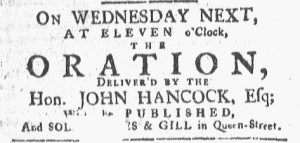
Two weeks later, on March 21, Edes and Gill ran a notice in their own newspaper to alert readers that “ON WEDNESDAY NEXT … THE ORATION DELIVER’D BY THE Hon. JOHN HANCOCK, Esq; Will be PUBLISHED” at their printing office.  They even specified the time, “ELEVEN o’Clock,” so prospective customers would know exactly when they could obtain their copies.  The printers staged an eighteenth-century precursor to a release party.  In hopes of inciting greater demand and gaining even more attention for Hancock’s arguments about the rights of colonizers, Edes and Gill also ran advertisements in the Boston Evening-Post and the Massachusetts Gazette and Boston Post-Boy on March 21.  The next issue of the Massachusetts Gazette and Boston Weekly News-Letter carried a notice that the oration had been published and was available from “EDES & GILL in Queen-Street.”  Each year, printers published the oration marking the anniversary of the Boston Massacre and advertised it widely.  Commodification of the event went hand in hand with commemoration.

April 6

What was advertised in a colonial American newspaper 250 years ago today?

Essex Gazette (April 6, 1773).

An ORATION … to COMMEMORATE THE BLODDY TRAGEDY of the FIFTH of MARCH, 1770.”

On the occasion of the third anniversary of the Boston Massacre, Dr. Benjamin Church delivered an address “upon the dangerous Tendency of Standing Armies, and in Commemoration of the horrid Massacre perpetrated by a Party of the 29th Regiment on the Fifth of March 1770.”  According to coverage in the Boston Evening-Post and the Boston-Gazette on March 8 and reprinted in the Essex Gazette the next day, Church “had the universal Applause of his Audience; and his Fellow Citizens voted him their Thanks, and unanimously requested a Copy of his Oration for the Press.”  John Greenleaf quickly printed Church’s Oration, followed by Benjamin Edes and John Gill, printers of the Boston-Gazette, promoting a “THIRD EDITION, corrected by the AUTHOR.”  Commodification of the Boston Massacre occurred simultaneously with commemoration of it, as had been the case with the first and second anniversaries.

Samuel Hall and Ebenezer Hall, printers of the Essex Gazette in Salem, participated in both the commemoration and the commodification of the Boston Massacre.  In addition to reprinting coverage of the events that marked the anniversary in Boston, they ran an editorial from Marblehead in the March 23 edition.  “THE respectable metropolis of this province,” the anonymous author began, “has certainly acted worthy of itself in establishing, as a monument against ‘the foul oppression of quartering troops in populous cities, in times of peace,’ the MASSACRE ANNIVERSARY.  It must ever do it honour, and serve to convince relentless oppressors, that such measures will produce disgrace to themselves, as well as distress to an injured people.”  The author concluded with a call for colonizers beyond Boston to commemorate the Boston Massacre and remember its significance.  “And while the city solemnizes the fifth of Marchwith its yearly oration,” the author asserted, “may every town in the province observe it in some suitable way; and by keeping up a memento of measures the most cruel and oppressive, be ever guarding its inhabitants against the intriguing designs of Pensioners, Despots, and Tyrants.”

Elsewhere on the same page, the Halls presented an opportunity for consumers to do their part in guarding against “cruel and oppressive” measures by doing their part to commemorate the Boston Massacre through purchasing Church’s Oration.  They apparently sold the correct edition printed by Edes and Gill, declaring that “To-Morrow Morning will be published, and sold by the Printers hereof, An ORATION … to COMMEMORATE THE BLODDY TRAGEDY of the FIFTH of MARCH, 1770.  By DR. BENJAMIN CHURCH.”  The anonymous author from Marblehead gave an endorsement for Church’s Oration as well as the addresses delivered in 1771 and 1772 in the editorial.  “The Gentlemen who exhibited on the two first of these anniversaries,” the author noted, “gave great satisfaction to their hearers, as was evident from the applause they received; and the last performance [by Church] expresses so much true sense, and this conceived in such a delicate stile, that no one can read it without respect for the celebrated author.”  The editorialist from Marblehead likely had a copy of Church’s Oration printed by Greenleaf, allowing for extensive quotations and reflections on how they accurately described the crisis the colonies faced.

That editorial bolstered the advertisement for Church’s Oration that the Halls inserted in that issue and subsequent advertisements that appeared in the next three issues of the Essex Gazette.  More than a month after the anniversary, the Halls continued to hawk the pamphlet, extending the commemoration and helping to keep the dangers of quartering soldiers in Boston visible to their readers who resided outside that city.