What was advertised in a colonial American newspaper 250 years ago today?
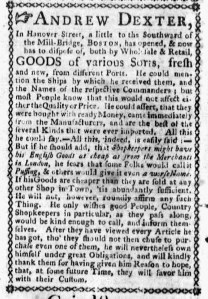
“He fears that some Folks would call it Puffing.”
Recently the Adverts 250 Project featured Andrew Dexter’s advertisement to examine the type seemingly set in one printing office and transferred to others, but the copy merits attention as well. Dexter attempted to entice prospective customers into his shop with a notice that mocked and dismissed many of the most popular marketing strategies of the period.
He began by stating that he sold ‘GOODS of various Sorts, fresh and new, from different Ports, but then refused to give details or elaborate. Many merchants and shopkeepers gave that information. Dexter critiqued the practice, proclaiming that he could mention the Ships by which he received them, and the Names of the respective Commanders; but most People know that this would not affect either the Quality or Price.”
Dexter then turned to other common elements of advertisements for imported goods. “He could assert, that they were bought with ready Money, came immediately from the Manufacturers, and are the best of the several Kinds that were ever imported.” Wanting it both ways, he implied that all of that was the case, but then called into question all of the advertisements that deployed such strategies. “All of this he could say.– All of this, indeed, is easily said.” He then leveled his most trenchant critique of a popular marketing strategy. “But if he should add, that Shopkeepers might have his English Goods as cheap as from the Merchants in London, he fears that some Folks would call it Puffing, & others would give it even a worse Name.”
He continued to imply that he offered bargain prices without stating that he did so. “If his Goods are cheaper than they are sold at any other Shop in Town, ‘tis abundantly sufficient. He will not, however, roundly affirm any such Thing.” Only after deriding the appeals made by his competitors in their advertisements did Dexter definitively present a reason for readers to visit his shop. “He only wishes good People, Country Shopkeepers in particular, as they pass along, would be kind enough to call, and inform themselves.” Figuring prospective customers engaged in comparison shopping, he acknowledged that they ultimately made decisions based on the information they gathered, no matter how much “Puffing” he included in his advertisements.
Ultimately, Dexter sought to build relationships with prospective customers, whether or not they bought anything the first time they visited his shop. “After they have viewed every Article he has got, tho’ they should not then chuse to purchase even one of them,” he confided, “he will nevertheless own himself under great Obligations, and will kindly thank them for having given him Reason to hope, that, at some future Time, they will favor him with their Custom.” Dexter prioritized prospective customers giving him the opportunity to serve them, now or in the future, over any of the usual appeals merchants and shopkeepers made about imported goods. To underscore his intention, he jeered at the claims made in other advertisements, though he never denied that they also applied to his own merchandise. He encouraged prospective customers to decide for themselves.