Slavery Advertisements Published June 8, 1772

GUEST CURATOR: Molly Torres

The Slavery Adverts 250 Project chronicles the role of newspaper advertising in perpetuating slavery in the era of the American Revolution. The project seeks to reveal the ubiquity of slavery in eighteenth-century life from New England to Georgia by republishing advertisements about enslaved people – for sale as individuals or in groups, wanted to purchase or for hire for short periods, runaways who liberated themselves, and those who were subsequently captured and confined in jails and workhouses – in daily digests on this site as well as in real time via the @SlaveAdverts250 Twitter feed, utilizing twenty-first-century media to stand in for the print media of the eighteenth century.

The project aims to provide modern audiences with a sense of just how often colonizers encountered these advertisements in their daily lives. Enslaved men, women, and children appeared in print somewhere in the colonies almost every single day. Those advertisements served as a constant backdrop for social, cultural, economic, and political life in colonial and revolutionary America. Colonizers who did not purport to own enslaved people were still confronted with slavery as well as invited to maintain the system by purchasing enslaved men, women, and children or assisting in the capture of so-called “runaways” who sought to free themselves from bondage. The frequency of these newspaper advertisements suggests just how embedded slavery was in colonial and revolutionary American culture in everyday interactions beyond the printed page.

These advertisements also testify to the experiences of enslaved men, women, and children, though readers must consider that those experiences have been remediated through descriptions offered by enslavers rather than enslaved people themselves. Often unnamed in the advertisements, enslaved men, women, and children were not invisible or unimportant in early America.

These advertisements appeared in colonial American newspapers 250 years ago today.

Boston-Gazette (June 8, 1772).

**********

Boston-Gazette (June 8, 1772).

**********

Massachusetts Gazette and Boston Post-Boy (June 8, 1772).

**********

New-York Gazette and Weekly Mercury (June 8, 1772).

**********

New-York Gazette and Weekly Mercury (June 8, 1772).

**********

New-York Gazette and Weekly Mercury (June 8, 1772).

**********

Supplement to the New-York Gazette and Weekly Mercury (June 8, 1772).

**********

Supplement to the New-York Gazette and Weekly Mercury (June 8, 1772).

**********

Pennsylvania Chronicle (June 8, 1772).

**********

Pennsylvania Chronicle (June 8, 1772).

**********

Pennsylvania Packet (June 8, 1772).

**********

Supplement to the Pennsylvania Packet (June 8, 1772).

**********

Supplement to the Pennsylvania Packet (June 8, 1772).

**********

Supplement to the Pennsylvania Packet (June 8, 1772).

June 7

What was advertised in a colonial American newspaper 250 years ago this week?

New-Hampshires Gazette (June 5, 1772).

“This EVENING … will be Exhibited several serious and comic Pieces of Oratory.”

Newspaper advertisements testify to the entertainment and popular culture enjoyed in the colonies in the eighteenth century.  A notice in the June 5, 1772, edition of the New-Hampshire Gazette informed the public that they could attend “several serious and comic Pieces of Oratory, intersper’d with Music and Singing” at the “new Assembly-Room” in Portsmouth that evening.  The sponsors created a network for distributing tickets.  Those interested in the performance could purchase tickets in advance “at the Printing-Office, at Mr. Appleton’s Book-Store, and at Mr. Stavers’s Tavern.” The sponsors also included a nota bene to address potential concerns about the content of the performance: “the Public may be assured, that nothing will be delivered in the above Exhibition, but what is conducive to, and consistent with Politeness and Morality.”  Neither the “comic Pieces” nor the songs would be ribald or bawdy.

The design of the advertisement increased the chances that readers would take note of it, especially important for an “Exhibition” of oratory and music scheduled for the same day the newspaper that carried the advertisement was published.  The first line operated as a headline, announcing “This EVENING” in a font larger than any in the rest of the notice.  In addition, a decorative border, comprised of printing ornaments, encircled the advertisement, setting it apart from other content.  It was the only item in that issue, whether or news or advertising, that featured a border.  Furthermore, the printers rarely used borders in the New-Hampshire Gazette, making this advertisement even more noteworthy to regular readers.  Its placement on the page also encouraged attention.  It ran in the upper left column, the first item on the third page.  With limited time to sell tickets and attract an audience for the performance, the sponsors depended on both copy and innovative graphic design in their marketing efforts.

June 6

What was advertised in a colonial American newspaper 250 years ago today?

Providence Gazette (June 6, 1772).

“HE doubts not of giving Satisfaction to such persons as may please him with their Custom.”

Among the various marketing appeals in their newspaper advertisements, merchants and shopkeepers often vowed to provide exemplary customer service.  Several who placed notices in the June 6, 1772, edition of the Providence Gazettedid so.  Edward Thurber, for instance, declared that “Whoever pleases to favour him with their Custom may depend upon the utmost Fidelity, and on having their Business executed with Dispatch.”  An extensive catalog of the “fine Assortment of Grocery, Hard-Ware, and Piece GOODS” for sale at his store “at the Sign of the BRAZEN LION” in the “North End of Providence” comprised most of his advertisement, but he did not intend for that testimonial to consumer choice to eclipse his commitment to customer service.  Gabriel Allen and William Allen also stocked a “compleat Assortment of English, India, and Hard-Ware GOODS” at their shop “on the West Side of the GREAT BRIDGE.”  They enhanced their allusion to so many choices with a promise that “Ladies and Gentlemen that are pleased to favour them with their Custom, may depend on the best Treatment.”

Artisans and others who provided services also incorporated customer service into their marketing efforts.  Benjamin Bagnall, Jr., informed the public that he “Carefully CLEANED and MENDED” clocks and watches at his shop, confidently stating that he “doubts not of giving Satisfaction to such Persons as may please to favour him with their Custom.”  In this case, “giving Satisfaction” had more than one meaning.  It implied that Bagnall extended good customer service to his clients, but it also signaled quality and skill, two appeals that artisans often included in their advertisements.  In addition, convenience was an element of the customer service that Bagnall provided.  He claimed that “Watches have been frequently sent to adjacent Places to repair,” presumably because colonizers believed that artisans in Providence did not possess the same skills as their counterparts in Boston and New York.  Such inconvenience was not necessary, Bagnall contended, since he “will endeavour to convince his Employers that there is no Occasion to send [watches] out of the Town.”  In making that pledge, Bagnall brought together customer service, skill, and quality in a single appeal to prospective customers.

June 5

What was advertised in a colonial American newspaper 250 years ago today?

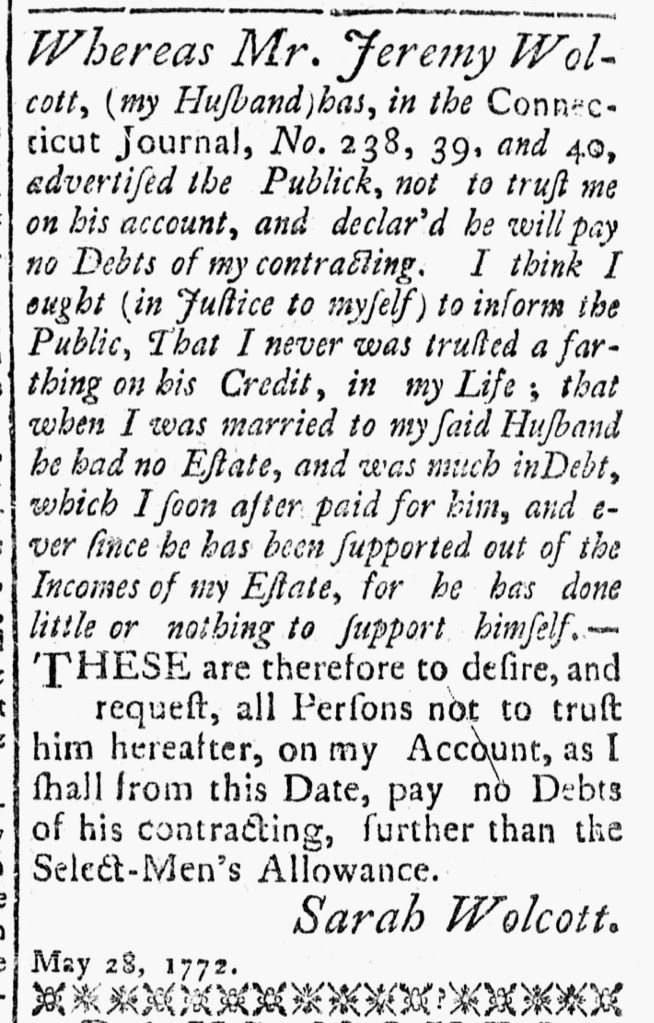
Connecticut Journal (June 5, 1772).

“I shall from this Date, pay no Debts of his contracting.”

Advertisements that ran in the Connecticut Journal and New-Haven Post-Boy in the spring of 1772 testified to marital discord in the Wolcott household.  In the May 8 edition, Jeremy Wolcott inserted a notice informing the public that “My wife SARAH, and MYSELF, being unhappy in the Marriage State !! which had subjected me to great anxiety; and for Reasons, I hereby forbid any Person trusting her on my Account, for I will not pay any Debts by her contracted, after this Date.”  It was one of dozens of similar advertisements placed by anxious patriarchs in newspapers published in New England that year.  Throughout the colonies, aggrieved husbands ran similar notices in their attempts to assert control over wives they claimed did not obey their commands.  Jeremy’s advertisement appeared in the next two issues as well.

When it concluded its run, something unusual happened.  Sarah inserted her own advertisement in response, a rare instance of a wife answering her husband’s charges in print.  Not surprisingly, Sarah told a very different story than the one rehearsed by Jeremy, one that likely humiliated him even more than placing his own advertisement that implicitly confessed his inability to exercise proper authority within his household.  In a notice that first appeared in the May 29 edition, Sarah referred to Jeremy’s notices “in the Connecticut Journal, No. 238, 39, and 40” that advised “the Publick, not to trust me on his account, and declar’d he will pay no Debts of my contracting.”  Given the actual state of affairs, according to Sarah, that advertisement misrepresented Jeremy’s record of providing for his wife.  “I think I ought (in Justice to myself),” she proclaimed, “inform the Public, That I never was trusted a farthing on his Credit, in my Life.” Furthermore, “when I was married to my said Husband, he had no Estate, and was much in Debt, which I soon after paid for him, and ever since he has been supported out of the Incomes of my Estate, for he has done little or nothing to support himself.”  In Sarah’s version, Jeremy had never fulfilled his responsibilities as husband and head of household.

She then turned the tables on him, issuing similar directions “not to trust him hereafter, on my Account, as I shall from this Date, pay no Debts of his contracting, further than the Select-Men’s Allowance.”  Sarah paid taxes legitimately levied by locally elected representatives, but she asserted that she did not want the resources she brought to the marriage used by Jeremy for any other purposes.  That must have resulted in further embarrassment for Jeremy, especially since the vast majority of women targeted in the sort of advertisement that he placed did not have the means to offer any sort of rebuttal in print.  Most of the time, husbands exercised exclusive access to the power of the press.  On occasions, however, women like Sarah Wolcott published forceful responses that may have caused their husbands to wish that they have never gotten the printing office involved at all.

Slavery Advertisements Published June 5, 1772

GUEST CURATOR: Molly Torres

The Slavery Adverts 250 Project chronicles the role of newspaper advertising in perpetuating slavery in the era of the American Revolution. The project seeks to reveal the ubiquity of slavery in eighteenth-century life from New England to Georgia by republishing advertisements about enslaved people – for sale as individuals or in groups, wanted to purchase or for hire for short periods, runaways who liberated themselves, and those who were subsequently captured and confined in jails and workhouses – in daily digests on this site as well as in real time via the @SlaveAdverts250 Twitter feed, utilizing twenty-first-century media to stand in for the print media of the eighteenth century.

The project aims to provide modern audiences with a sense of just how often colonizers encountered these advertisements in their daily lives. Enslaved men, women, and children appeared in print somewhere in the colonies almost every single day. Those advertisements served as a constant backdrop for social, cultural, economic, and political life in colonial and revolutionary America. Colonizers who did not purport to own enslaved people were still confronted with slavery as well as invited to maintain the system by purchasing enslaved men, women, and children or assisting in the capture of so-called “runaways” who sought to free themselves from bondage. The frequency of these newspaper advertisements suggests just how embedded slavery was in colonial and revolutionary American culture in everyday interactions beyond the printed page.

These advertisements also testify to the experiences of enslaved men, women, and children, though readers must consider that those experiences have been remediated through descriptions offered by enslavers rather than enslaved people themselves. Often unnamed in the advertisements, enslaved men, women, and children were not invisible or unimportant in early America.

These advertisements appeared in colonial American newspapers 250 years ago today.

New-Hampshire Gazette (June 5, 1772).

**********

New-Hampshire Gazette (June 5, 1772).

June 4

What was advertised in a colonial American newspaper 250 years ago today?

Pennsylvania Gazette (June 4, 1772).

“At the Sign of the Scythe and Sickle.”

William Dawson advertised “A LARGE Quantity of SCYTHES and SICKLES, prepared for the ensuing Harvest” in a brief notice in the June 4, 1772, edition of the Pennsylvania Gazette.  His advertisement likely attracted less notice than those placed by other cutlers who marketed their goods and services in the same issue.  Dawson’s competitors in Philadelphia used images to enhance their advertisements.

James Hendricks adorned his advertisement with a woodcut depicting a sickle.  Her announced that he had “ONE HUNDRED and Twenty DOZEN” sickles crafted “with the utmost care, and sold at the lowest Rates, and ensured to be good.”  It was not the first time that he incorporated that image into one of his advertisements.  Two years earlier, it ran in an advertisement that stated that the cutler had a workshop “at the Sign of the Sickle” on Market Street.

Benjamin Humphreys advertised both “SAW-MILL SAWS, And a large QUANTITY of SICKLES.”  An image of a saw occupied the upper third of his notice.  The cutler clearly commissioned the woodcut for his exclusive use.  No other advertiser could use it because the name “B. HUMPHREYS” appeared on the saw.  Like Hendricks, Humphreys incorporated his woodcut into a previous advertisement.  The repetition helped to create a visual identity for his business.  In another advertisement, placed in collaboration with Stephen Paschall in 1768, Humphreys used another woodcut.  That one depicted a scythe and sickle, both of them bearing his last name.

By 1772, Humphreys and Paschall advertised separately, perhaps as a result of the Paschall forming a partnership with his son.  The Paschalls determined that they also needed an image to make their advertisements memorable.  Their woodcut depicted several tools, including a scythe, a sickle, and mechanisms for gristmills, that they made and sold “at the sign of the Scythe and Sickle” on Market Street.  They also had the image personalized for their exclusive use, the initials “SP” on one of the tools. Paschall previously noted that he marked his work with “S. PASCHALL.”

Dawson offered the same merchandise as Hendricks, Humphreys, and Paschall and Paschall, but he might have experienced more difficulty attracting customers to his shop.  His competitors made their advertisements easier to spot in the newspaper as well as more memorable.  Did the images matter?  Were they effective?  Several cutlers in Philadelphia considered it worth the expense to commission their own woodcuts and pay for additional space to include them in their newspaper advertisements.

Slavery Advertisements Published June 4, 1772

GUEST CURATOR: Julia Tardugno

The Slavery Adverts 250 Project chronicles the role of newspaper advertising in perpetuating slavery in the era of the American Revolution. The project seeks to reveal the ubiquity of slavery in eighteenth-century life from New England to Georgia by republishing advertisements about enslaved people – for sale as individuals or in groups, wanted to purchase or for hire for short periods, runaways who liberated themselves, and those who were subsequently captured and confined in jails and workhouses – in daily digests on this site as well as in real time via the @SlaveAdverts250 Twitter feed, utilizing twenty-first-century media to stand in for the print media of the eighteenth century.

The project aims to provide modern audiences with a sense of just how often colonizers encountered these advertisements in their daily lives. Enslaved men, women, and children appeared in print somewhere in the colonies almost every single day. Those advertisements served as a constant backdrop for social, cultural, economic, and political life in colonial and revolutionary America. Colonizers who did not purport to own enslaved people were still confronted with slavery as well as invited to maintain the system by purchasing enslaved men, women, and children or assisting in the capture of so-called “runaways” who sought to free themselves from bondage. The frequency of these newspaper advertisements suggests just how embedded slavery was in colonial and revolutionary American culture in everyday interactions beyond the printed page.

These advertisements also testify to the experiences of enslaved men, women, and children, though readers must consider that those experiences have been remediated through descriptions offered by enslavers rather than enslaved people themselves. Often unnamed in the advertisements, enslaved men, women, and children were not invisible or unimportant in early America.

These advertisements appeared in colonial American newspapers 250 years ago today.

Maryland Gazette (June 4, 1772).

**********

Maryland Gazette (June 4, 1772).

**********

Maryland Gazette (June 4, 1772).

**********

New-York Journal (June 4, 1772).

**********

Pennsylvania Journal (June 4, 1772).

**********

South-Carolina Gazette (June 4, 1772).

**********

South-Carolina Gazette (June 4, 1772).

**********

South-Carolina Gazette (June 4, 1772).

**********

South-Carolina Gazette (June 4, 1772).

**********

South-Carolina Gazette (June 4, 1772).

**********

South-Carolina Gazette (June 4, 1772).

**********

South-Carolina Gazette (June 4, 1772).

**********

South-Carolina Gazette (June 4, 1772).

**********

South-Carolina Gazette (June 4, 1772).

**********

Supplement to the South-Carolina Gazette (June 4, 1772).

**********

Supplement to the South-Carolina Gazette (June 4, 1772).

**********

Supplement to the South-Carolina Gazette (June 4, 1772).

**********

Supplement to the South-Carolina Gazette (June 4, 1772).

**********

Supplement to the South-Carolina Gazette (June 4, 1772).

**********

Virginia Gazette [Purdie and Dixon] (June 4, 1772).

**********

Virginia Gazette [Purdie and Dixon] (June 4, 1772).

**********

Virginia Gazette [Purdie and Dixon] (June 4, 1772).

**********

Virginia Gazette [Purdie and Dixon] (June 4, 1772).

**********

Virginia Gazette [Purdie and Dixon] (June 4, 1772).

**********

Virginia Gazette [Purdie and Dixon] (June 4, 1772).

**********

Virginia Gazette [Purdie and Dixon] (June 4, 1772).

**********

Virginia Gazette [Purdie and Dixon] (June 4, 1772).

June 3

What was advertised in a colonial American newspaper 250 years ago this week?

Pennsylvania Packet (June 3, 1772).

“FOR KINGSTON, IN JAMAICA, THE SHIP POLLY AND PEGGY.”

Readers frequently encountered advertising on the front page of eighteenth-century newspapers.  Printers did not relegate that content to other sections.  Some filled all or most of the front page with advertising, as Hugh Gaine did in the June 1, 1772, edition of the New-York Gazette and Weekly Mercury.  Others divided the space between advertising and news. William Goddard devoted the first two columns of the June 1 edition of the Pennsylvania Chronicle to advertisements, reserving the third column for news.  John Dunlap, on the other hand, gave priority to news on the front page of the Pennsylvania Packet published that day, but that did not prevent him from including some advertisements.  The first two and a half columns contained news.  Four advertisements filled the remainder of the final column.

Those advertisements delivered news of a different sort.  One notice informed the public that the Polly and Peggy sought passengers and freight for a voyage to Jamaica.  Another let travelers know that Martin Delany opened a tavern “at Appiquimany Bridge (commonly called Cantwell’s Bridge) on the great road from Philadelphia to Dover.”  He encouraged them to lodge there, promising “the best usage,” “a variety of the first wines, [and] spirits,” and “completely refitted” stables.  In another advertisement, Robert Mack called on “James Pearce, of George-Town” and “David Foset of Snowhill” to “pay charges” and “take away” Jack and Charles, enslaved men in his custody at the jail in New Castle.  In addition, White and Montgomery reported that “just opened [a] store on the north side of Market-street wharf.”  A note at the bottom of the column advised, “FOR MORE NEW ADVERTISEMENTS SEE THE FOURTH PAGE.”  Dunlap suggested that readers would be just as interested in the information relayed in the paid notices that appeared on the last page as the news from Europe, the shipping news from the custom house, and the prices current in Philadelphia on the second and third pages.

Printers did not adopt uniform practices about where advertisements should appear in relation to other content, though they usually reserved some or all of the final page for paid notices.  Advertisements could appear just about anywhere in the newspaper, including on the front page, with the arrangement within any newspaper changing from week to week. Printers did not classify advertisements as content that could not appear on the front page.  As a result, advertisements often accounted for some of the first news or information that readers encountered when they perused eighteenth-century newspapers.

June 2

What was advertised in a colonial American newspaper 250 years ago today?

South-Carolina Gazette and Country Journal (June 2, 1772).

“A Great Variety of {IRISH Linens, printed Linen …} of all Widths and Prices.”

When Wakefield, a merchant who went solely by his last name in the public prints, placed an advertisement in the June 2, 1772, edition of the South-Carolina Gazette and Country Journal he relied on design elements to draw attention.  Like many other advertisers, he demonstrated the choices available to consumers by providing a list, but he did not resort to a dense paragraph of text (the format selected by Edwards, Fisher, and Company) or side-by-side columns with only one item on each line (the option favored by Daniel Hall and Stephen Smith).  Instead, he clustered his goods together in the center of the advertisement with decorative brackets pointing to descriptions on either side.

For instance, Wakefield listed “IRISH Linens, printed Linen, Chintz, Calicoes, Cotton, Diaper, Huckaback, Lawns, Cambricks, &c. &c.”  That list extended five lines, occupying the center third of the column.  Brackets enclosed the list on both sides.  An introductory phrase ran on the left, “A great Variety of,” to let readers know that Wakefield stocked an even more extensive inventory of those textiles.  To underscore the point, the phrase to the right promised “all Widths and Prices.”  Similarly, a shorter list of other fabrics extended three lines with brackets enclosing both sides.  Commentary to the left indicated that Wakefield had “An Assortment of” those items.  The rest of the advertisement reverted to standard paragraphs, but the unique format for the lists of textiles created enough visual interest that readers likely took note.

Creating this advertisement required some level of collaboration with the compositor.  When he submitted the copy, Wakefield may have arranged the lists as he intended for them to appear, but the compositor was ultimately responsible for setting type in a manner that honored any instructions or requests.  For instance, Wakefield probably did not devise a line break that divided “Calicoes” between two lines.  Instead, a compositor would have relied on experience and experimentation in determining the final appearance of the advertisement.  No matter how closely he worked with the compositor, Wakefield likely took greater interest in designing a distinctive advertisement than Edwards, Fisher, and Company or Hall and Smith or any other advertisers whose notices featured standard formats.

Slavery Advertisements Published June 2, 1772

GUEST CURATOR: Julia Tardugno

The Slavery Adverts 250 Project chronicles the role of newspaper advertising in perpetuating slavery in the era of the American Revolution. The project seeks to reveal the ubiquity of slavery in eighteenth-century life from New England to Georgia by republishing advertisements about enslaved people – for sale as individuals or in groups, wanted to purchase or for hire for short periods, runaways who liberated themselves, and those who were subsequently captured and confined in jails and workhouses – in daily digests on this site as well as in real time via the @SlaveAdverts250 Twitter feed, utilizing twenty-first-century media to stand in for the print media of the eighteenth century.

The project aims to provide modern audiences with a sense of just how often colonizers encountered these advertisements in their daily lives. Enslaved men, women, and children appeared in print somewhere in the colonies almost every single day. Those advertisements served as a constant backdrop for social, cultural, economic, and political life in colonial and revolutionary America. Colonizers who did not purport to own enslaved people were still confronted with slavery as well as invited to maintain the system by purchasing enslaved men, women, and children or assisting in the capture of so-called “runaways” who sought to free themselves from bondage. The frequency of these newspaper advertisements suggests just how embedded slavery was in colonial and revolutionary American culture in everyday interactions beyond the printed page.

These advertisements also testify to the experiences of enslaved men, women, and children, though readers must consider that those experiences have been remediated through descriptions offered by enslavers rather than enslaved people themselves. Often unnamed in the advertisements, enslaved men, women, and children were not invisible or unimportant in early America.

These advertisements appeared in colonial American newspapers 250 years ago today.

Connecticut Courant (June 2, 1772).

**********

Essex Gazette (June 2, 1772).

**********

Essex Gazette (June 2, 1772).

**********

Addition to the South-Carolina Gazette and Country Journal (June 2, 1772).

**********

Addition to the South-Carolina Gazette and Country Journal (June 2, 1772).

**********

Addition to the South-Carolina Gazette and Country Journal (June 2, 1772).

**********

Addition to the South-Carolina Gazette and Country Journal (June 2, 1772).

**********

South-Carolina Gazette and Country Journal (June 2, 1772).

**********

South-Carolina Gazette and Country Journal (June 2, 1772).

**********

South-Carolina Gazette and Country Journal (June 2, 1772).

**********

South-Carolina Gazette and Country Journal (June 2, 1772).

**********

South-Carolina Gazette and Country Journal (June 2, 1772).

**********

South-Carolina Gazette and Country Journal (June 2, 1772).

**********

South-Carolina Gazette and Country Journal (June 2, 1772).

**********

South-Carolina Gazette and Country Journal (June 2, 1772).

**********

South-Carolina Gazette and Country Journal (June 2, 1772).

**********

South-Carolina Gazette and Country Journal (June 2, 1772).

**********

South-Carolina Gazette and Country Journal (June 2, 1772).

**********

South-Carolina Gazette and Country Journal (June 2, 1772).

**********

South-Carolina Gazette and Country Journal (June 2, 1772).

**********

Supplement to the South-Carolina Gazette and Country Journal (June 2, 1772).

**********

Supplement to the South-Carolina Gazette and Country Journal (June 2, 1772).

**********

Supplement to the South-Carolina Gazette and Country Journal (June 2, 1772).

**********

Supplement to the South-Carolina Gazette and Country Journal (June 2, 1772).

**********

Supplement to the South-Carolina Gazette and Country Journal (June 2, 1772).

**********

Supplement to the South-Carolina Gazette and Country Journal (June 2, 1772).

**********

Supplement to the South-Carolina Gazette and Country Journal (June 2, 1772).

**********

Supplement to the South-Carolina Gazette and Country Journal (June 2, 1772).

**********

Supplement to the South-Carolina Gazette and Country Journal (June 2, 1772).