
What was advertised in a colonial American newspaper 250 years ago today?
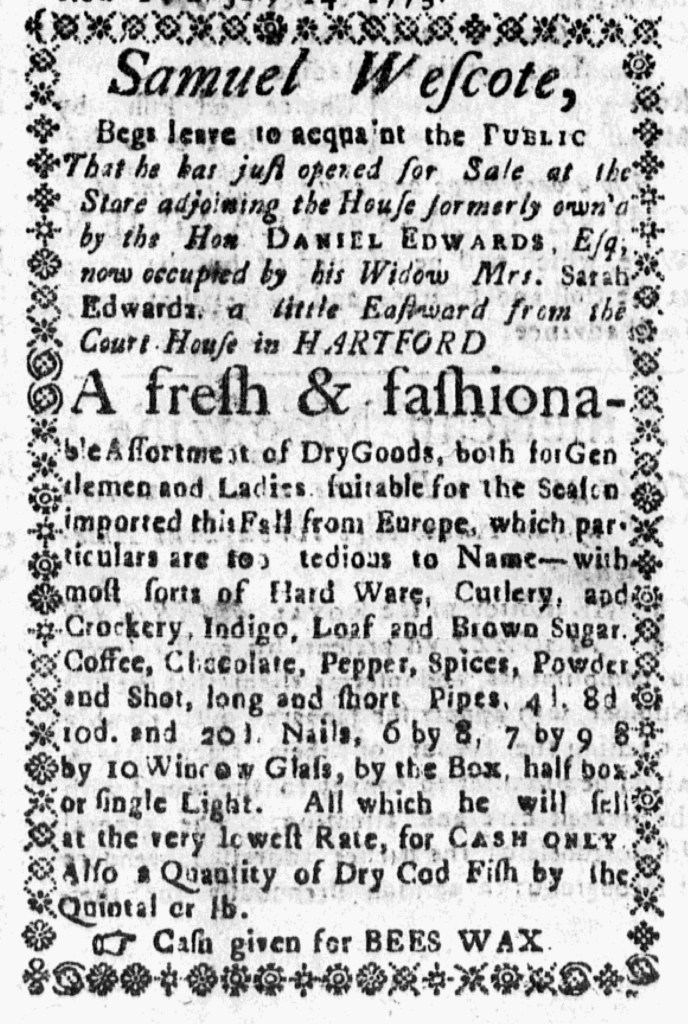
“Loaf and Brown Sugar, Coffee, Chocolate, Peeper, Spices.”
In the fall of 1773 and into the winter of 1774, Samuel Wescote ran advertisements in the Connecticut Courant to promote a “fresh & fashionable Assortment of Dry Goods, both for Gentlemen and Ladies.” He gave directions to his store “a little Eastward from the Court-House in HARTFORD,” informed the public that he had recently imported his inventory from Europe, and insisted that he offered such a selection that the “particulars are too tedious to Name” in a newspaper notice. Prospective customers needed to visit his store to see for themselves! In addition to dry goods, he stocked “most sorts of Hard Ware, Cutlery, and Crockery” as well as sugar, coffee, and spices. Wescote pledged to sell his wares “at the very lowest Rate,” but he did not extend credit. “CASH ONLY,” he advised.
The contents of Wescote’s advertisement replicated what appeared in others that ran in the Connecticut Courant and newspapers throughout the colonies during the era of the American Revolution. Its format, however, differed from most others. A border comprised of a variety of printing ornaments surrounded the notice. The compositor did not choose a single decoration but instead incorporated many in a seemingly random order. Most other advertisements did not feature a border, though William Beadle of Wethersfield did opt for a border around his advertisement for a “good Assortment of GOODS suitable for the present Season” that ran in some of the same issues as Wescote’s advertisement. Where did Beadle and Wescote get the idea to request borders for their advertisements? Maybe they noticed the borders around Caleb Bull’s advertisements when they perused the Connecticut Courant … or perhaps all of those advertisers took inspiration from another newspaper that circulated in the colony, Rivington’s New-York Gazetteer, or the Connecticut, New-Jersey, Hudson’s-River, and Quebec Weekly Advertiser. In the summer and fall of 1773, decorative borders became a signature feature of advertisements in that newspaper. Rivington and others who labored in his printing office certainly did not invent that particular style, but they utilized to an extent previously unknown in colonial American newspapers. As advertisements with borders increased in number and frequency in Rivington’s New-York Gazetteer they also became more common in many newspapers printed in the region served by that newspaper. Printers, compositors, and advertisers in towns beyond New York seemed to take note of a format that became popular in Rivington’s New-York Gazetteer.