October 2

What was advertised in a colonial American newspaper 250 years ago this week?
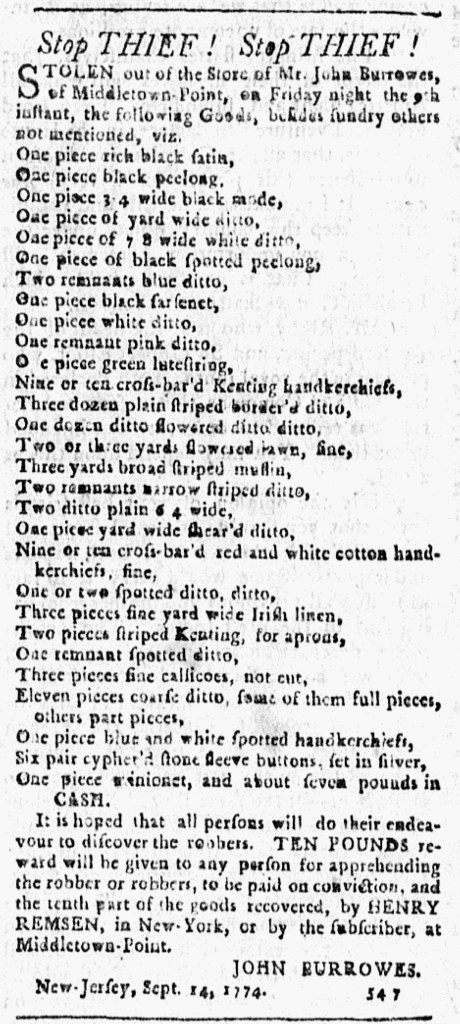
New-York Journal (September 29, 1774).

Stop THIEF!  Stop THIEF!

The headline attracted attention: “Stop THIEF!  Stop THIEF!”  John Burrowes of Middletown Point, New Jersey, was the victim of a crime, one that occurred on the night of September 9, 1774.  A “robber or robbers” stole a variety of goods from his store, including “One piece rich black satin,” “Nine or ten cross-bar’d red and white cotton handkerchiefs, fine,” “Eleven pieces coarse [calico], some of them full pieces, others part pieces,” and “Six pair cypher’d stone sleeve buttons, set in silver.”  In addition, they made off with “sundry others not mentioned.”

A few days after the theft, Burrowes dispatched messages to two printing offices in New York, the nearest town with one or more newspapers.  Advertisements featuring identical copy, but very different formats, soon appeared in the New-York Gazette and Weekly Mercury and the New-York Journal.  Despite the differences in their layouts, both proclaimed ““Stop THIEF!  Stop THIEF!”  That suggests that Burrowes had been quite specific in his instructions about the headline even as he left the rest of the design to the discretion of the compositors who set type for the two newspapers.

The shopkeeper realized that the robbers would likely attempt to sell some or all the stolen merchandise rather than keep it for their own use.  By publishing notices, he alerted readers in New York and far beyond to be wary if offered any of the items he listed.  He sought to enlist their help in capturing the culprits and, if possible, recovering the stolen goods.  To that end, he designated a local agent, Henry Remsen, in New York to represent him should the robbers and the goods turn up there, while also directing readers to contact him in Middletown Point if the robbers were apprehended in the area.

Burrowes’s advertisement appeared in the New-York Journal at the same time that John Holt, the printer, published accounts of the Suffolk County Resolves from Massachusetts.  Those measures called for a boycott of goods imported from Britain until Parliament repealed the Boston Port Act and the other Coercive Acts.  Holt ran other news about the imperial crisis under a masthead that included the “UNITE OR DIE” political cartoon that encouraged resistance to the various abuses perpetrated by Parliament.  Whatever else happened to be taking place in terms of current events, however, Burrowes likely considered the contents of his advertisement, a form of local reporting from his small town, among the most important news in the New-York Journal.  Advertisements often served as mechanisms for disseminating news that did not appear elsewhere in colonial newspapers.

October 1

What was advertised in a colonial American newspaper 250 years ago today?

Providence Gazette (October 1, 1774).

SCHEME of a LOTTERY … for rebuilding Holden’s Grist-Mill.”

Regular visitors to the Adverts 250 Project know that I have incorporated both the Adverts 250 Project and the Slavery Adverts 250 Project into my upper-level courses, including Colonial America, Revolutionary America, Slavery and Freedom in America, Public History and Public Debate, and Research Methods.  Students in those courses serve as guest curators for the projects, generating their own miniature archives of digitized copies of eighteenth-century newspapers, selecting advertisements to feature and examine for the Adverts 250 Project, and identifying advertisements about enslaved people and composing posts for the Slavery Adverts 250 Project.  This requires working intensively with early American newspapers.

This semester I decided to experiment with designing an assignment involving those newspapers into my introductory survey of American history that begins with Indigenous America and concludes with Reconstruction.  I gave each student a packet of newspapers published during a single week in 1774 so they could develop their own sense of what was happening in the colonies 250 years ago.  I asked them to craft three short articles, 300 words each, that delivered news in modern English that an average reader today would understand.  Realizing that advertisements contained newsworthy content and that many of them would be more accessible than the articles and editorials in early American newspapers, I encouraged students to examine those and “translate” them for modern audiences, being sure to include the essential who, what, when, where, and how.  In addition, they need to reflect on why, both why something happened in 1774 and why it is important in helping us understand some aspect of the past.  In the past, I’ve found that students often struggle with articulating even basic details from primary sources.  For a survey course, this seemed like a good opportunity to practice that skill while, hopefully, removing some of the pressure of writing a formal essay.  In addition, most students in upper-level courses have been very curious when looking through an entire week’s worth of colonial newspapers, generating all sorts of questions about life in early America.  Their sense of wonder guided classroom discussions, so I hoped to create a similar experience for students in my survey course.

We devoted an entire week, two seventy-five-minute classes, to “history labs” that introduced students to early American newspapers.  On the first day, I presented an overview that included examining a framed original newspaper from May 1787 that usually hangs in my office before giving them time to browse the newspapers on their own and discuss with their peers.  We then convened as an entire class for discussion and questions.  We devoted the entire second day to a workshop intended to prepare students to write their articles about news from early America.  Rather than expect them to complete an unfamiliar assignment on their own away from class, I wanted them to have an opportunity to get started, ask questions, and seek clarifications.  I knew that some students would eventually visit during office hours for assistance, but for many that would be our only chance for one-on-one conversations about how they approached the assignment.  I proved them with worksheets for outlining their articles, including topic, citations to newspapers, and who, what, when, where, how, and why.

During that workshop, I discovered that many students felt uncertain about the expectations for the assignment, including the intended format.  In turn, I decided to provide an example that they could use as a model, one that demonstrated that the project was not as complicated as some of them imagined.  I selected an advertisement that outlined a “SCHEME of a LOTTERY” for the purposes of raising funds “for rebuilding Holden’s Grist-Mill” in East Greenwich, Rhode Island, from the Providence Gazette.  It lent itself well to identifying who, what, when, where, how, and why, allowing me to provide students with an example of how to recognize the important details and organize them in a manner that makes sense to modern readers.  Was that example helpful for students?  I’ll find out later today when the assignment is due.  For now, I’m excited to see what kinds of news my students will report based on what they found interesting among the articles, editorials, and advertisements that ran in newspapers 250 years ago.