February 28

What was advertised in a colonial American newspaper 250 years ago today?
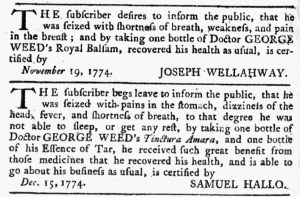
Pennsylvania Evening Post (February 28, 1775).

“By taking one bottle of Doctor GEORGE WEED’s Royal Balsam, recovered his health.”

A notice signed by Joseph Wellahway appeared in the February 28, 1774, edition of the Pennsylvania Ledger for the purpose of “inform[ing] the public, that he was seized with shortness of breath, weakness, and pain in the breast; and by taking one bottle of Doctor GEORGE WEED’s Royal Balsam, recovered his health as usual.”  Wellahway “certified” that testimonial on November 19, 1774.  Immediately below, Samuel Hallo offered a more elaborate endorsement, signed on December 15, 1774.  He recounted that he “was seized with pains in the stomach, dizziness of the head, fever, and shortness of breath, to that degree he was not able to sleep, or get any rest.”  He finally found relief “by taking one bottle of Doctor GEORGE WEED’s Tinctura Amara, and one bottle of his Essence of Tar.”  When he did that, “he received such great benefit from those medicines that,” like Wellahway, “he recovered his health, and is able to go about his business as usual.”

Weed, who regularly placed advertisements in Philadelphia’s newspapers, did not supplement these testimonials with a notice of his own, not even to direct prospective patients to his shop.  He likely believed that he had established such a reputation in the city that he did not need to do so.  It was not the first time he adopted that strategy.  An advertisement in the Pennsylvania Chronicle five years earlier featured testimonials from Jacob Burroughs, Margaret Lee, Tabitha Wayne, and Elizabeth Beach.  Each of those names may have seemed more plausible to skeptical readers than Joseph Wellahway and Samuel Hallo.  In December 1772, Weed concluded an advertisement with a note from a minister to certify that he “was under the Instructions and Directions of a judicious Practitioner of Physic, in New-England, from some Years,” though that missive was dated almost two decades earlier.  Some or all these endorsements may have been genuine, yet Weed might have manufactured some of them to market his remedies.  Prospective patients, then as now, likely embraced the veneer of authenticity in hopes that the medicines would indeed deliver the promised results.

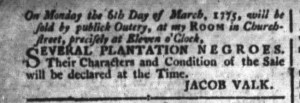
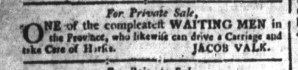
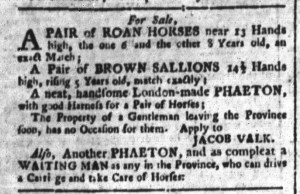
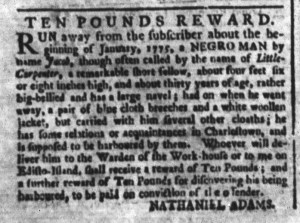
Slavery Advertisements Published February 28, 1775

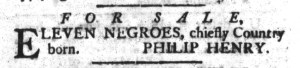
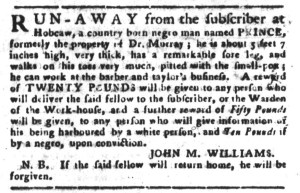
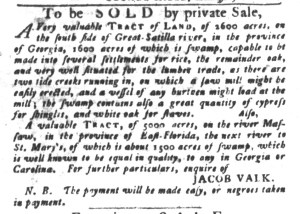
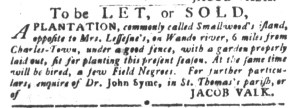
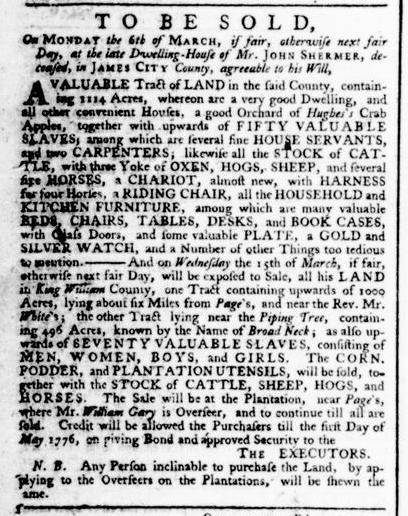
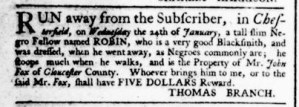
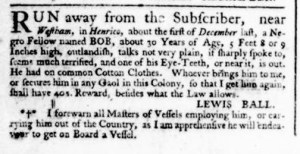
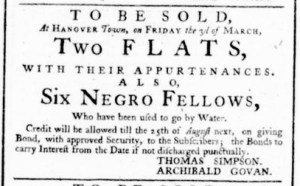
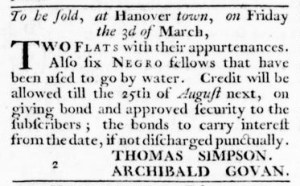
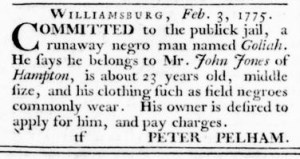
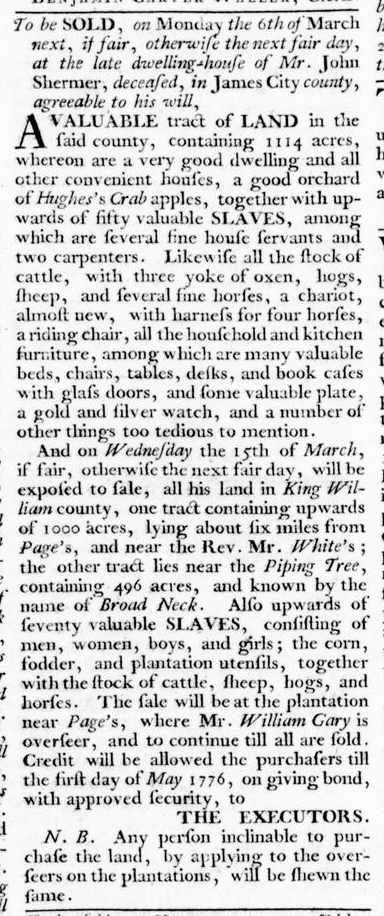
The Slavery Adverts 250 Project chronicles the role of newspaper advertising in perpetuating slavery in the era of the American Revolution. The project seeks to reveal the ubiquity of slavery in eighteenth-century life from New England to Georgia by republishing advertisements about enslaved people – for sale as individuals or in groups, wanted to purchase or for hire for short periods, runaways who liberated themselves, and those who were subsequently captured and confined in jails and workhouses – in daily digests on this site as well as in real time via the @SlaveAdverts250 Twitter feed, utilizing twenty-first-century media to stand in for the print media of the eighteenth century.

The project aims to provide modern audiences with a sense of just how often colonizers encountered these advertisements in their daily lives. Enslaved men, women, and children appeared in print somewhere in the colonies almost every single day. Those advertisements served as a constant backdrop for social, cultural, economic, and political life in colonial and revolutionary America. Colonizers who did not purport to own enslaved people were still confronted with slavery as well as invited to maintain the system by purchasing enslaved men, women, and children or assisting in the capture of so-called “runaways” who sought to free themselves from bondage. The frequency of these newspaper advertisements suggests just how embedded slavery was in colonial and revolutionary American culture in everyday interactions beyond the printed page.

These advertisements also testify to the experiences of enslaved men, women, and children, though readers must consider that those experiences have been remediated through descriptions offered by enslavers rather than enslaved people themselves. Often unnamed in the advertisements, enslaved men, women, and children were not invisible or unimportant in early America.

These advertisements appeared in colonial American newspapers 250 years ago today.

Essex Gazette (February 28, 1775).

**********

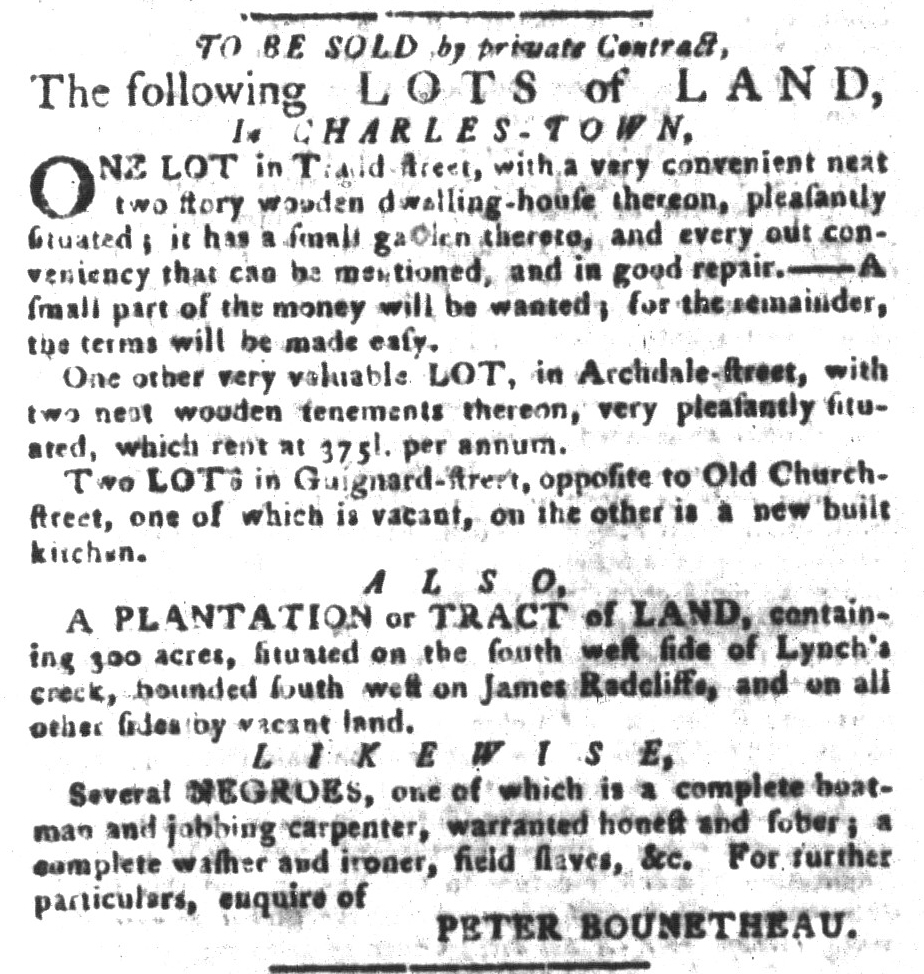
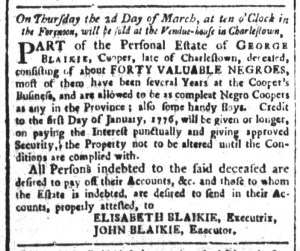
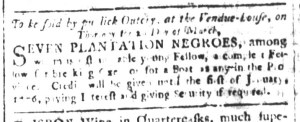
South-Carolina Gazette and Country Journal (February 28, 1775).

**********

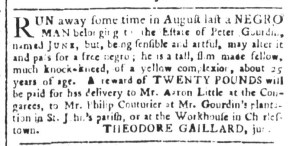
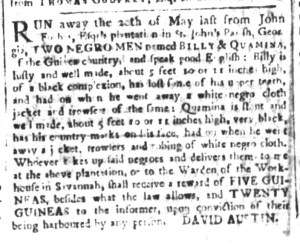
South-Carolina Gazette and Country Journal (February 28, 1775).

**********

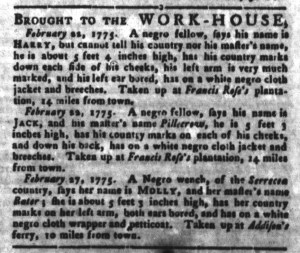
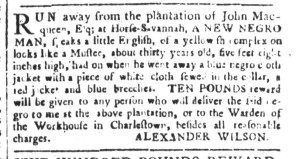
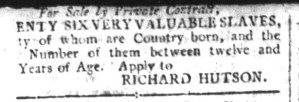
South-Carolina Gazette and Country Journal (February 28, 1775).

**********

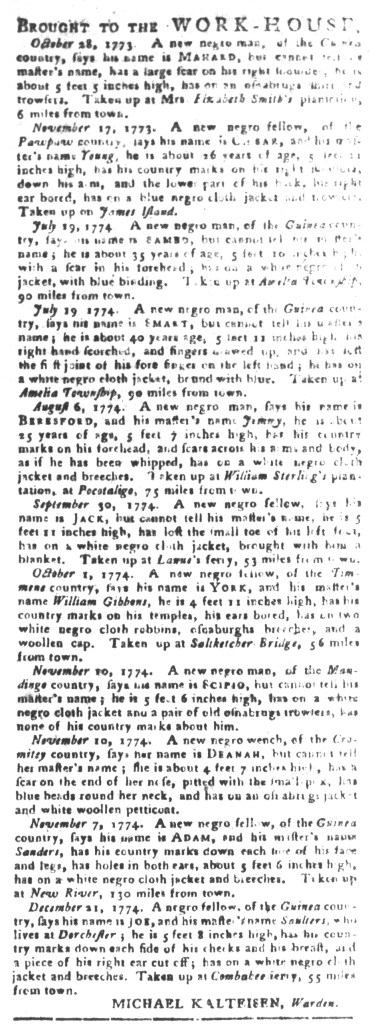
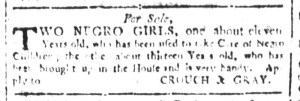
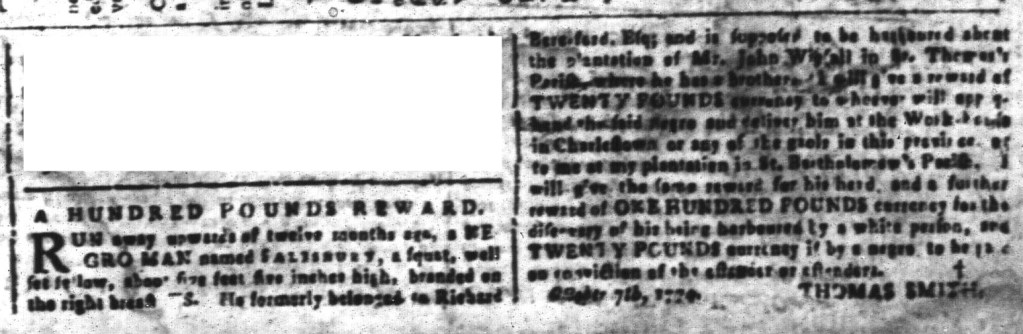
South-Carolina Gazette and Country Journal (February 28, 1775).

**********

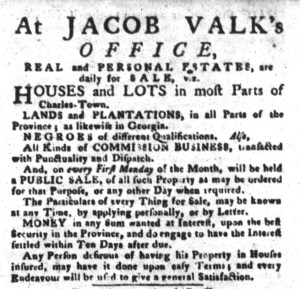
South-Carolina Gazette and Country Journal (February 28, 1775).

**********

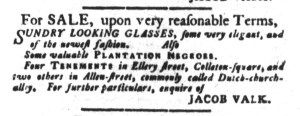
South-Carolina Gazette and Country Journal (February 28, 1775).

**********

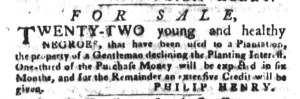
South-Carolina Gazette and Country Journal (February 28, 1775).

**********

South-Carolina Gazette and Country Journal (February 28, 1775).

**********

South-Carolina Gazette and Country Journal (February 28, 1775).

**********

South-Carolina Gazette and Country Journal (February 28, 1775).

**********

South-Carolina Gazette and Country Journal (February 28, 1775).

**********

South-Carolina Gazette and Country Journal (February 28, 1775).

**********

South-Carolina Gazette and Country Journal (February 28, 1775).

**********

South-Carolina Gazette and Country Journal (February 28, 1775).

**********

South-Carolina Gazette and Country Journal (February 28, 1775).

**********

South-Carolina Gazette and Country Journal (February 28, 1775).

**********

South-Carolina Gazette and Country Journal (February 28, 1775).

February 27

GUEST CURATOR:  Kamryn Vasselin

What was advertised in a colonial American newspaper 250 years ago today?

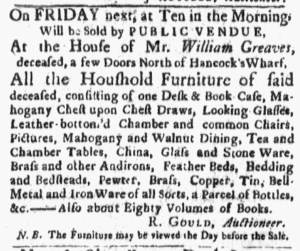
Boston Evening-Post (February 27, 1775).

“Will be Sold … Brass and other Andirons, Feather Beds.”

This advertisement features a variety of household goods sold at an auction held by R. Gould after the death of William Greaves. What caught my eye about this advertisement was some of the items being sold, like andirons and feather beds. I was not familiar with these items before reading this advertisement.

Andirons are a pair of brass or iron bracket supports used to hold up logs in an open fireplace. Andirons allow for better burning and less smoke due to the air circulation underneath the wood. In 1775, most homes used wood-burning fireplaces to keep warm, especially during cold winters. The use of andirons was widespread during this time.

The other item that caught my eye was featherbeds. According to art historians interviewed by Sunny Sea Gold, many people slept on beds of several different layers during this time. She reports, “At the bottom was a simple, firm mattress pad or cushion filled with corn husks or horsehair. Next came a big featherbed for comfort.” We would equate these to mattresses today, just instead filled with feathers. These featherbeds often sagged and caused problems when people laid flat on them. Wealthier colonists could buy professionally made featherbeds, while those less fortunate usually made their own out of goose or duck feathers.

Goods being sold at an auction as part of an estate sale generally cost less than when bought new. For those who may have needed a pair of andirons but were unwilling or unable to spend much, seeing this advertisement would have likely drawn them to the auction to get a good deal. The same goes for the featherbed, even a used one. An opportunity to increase the comfort of their bed at a cheap price would have provoked the interest of many people.

**********

ADDITIONAL COMMENTARY:  Carl Robert Keyes

When I invite students to serve as guest curators for the Adverts 250 Project, I do so in hopes that they will immerse themselves in eighteenth-century life and culture in new ways.  I assign both primary sources and secondary sources for our classes, yet I want my students to examine some aspect of life in early America even more intensively.  That begins with compiling a digital archive of newspapers published during a particular week during the era of the American Revolution and continues with searching through those newspapers to select advertisements that interest them.

Seeing why different advertisements spark interest for different students is always an interesting and illustrative part of working on this project together.  I learn from my students, especially when they explain what they see in their advertisements as they work with early American newspapers for the first time compared to the assumptions that I make after reading those newspapers for years.  I appreciate how Kamryn took an advertisement that would have appeared plain and ordinary to eighteenth-century readers familiar with the material culture of the period and demonstrated that some of the everyday items that colonizers purchased and used are no longer everyday items in the twenty-first century.  As a result, they require some explanation to understand their purpose and significance in the eighteenth century.

I also appreciate that Kamryn commented on auctions as the way that consumers sometimes acquired those objects of everyday life.  R. Gould, one of several auctioneers in Boston, oversaw an estate sale at the home of William Greaves.  The advertisement for that auction appeared between notices for upcoming sales at “RUSSELL’s Auction Room in Queen street” and William Hunter’s “New Auction-Room, Dock-Square.”  Some of the items for sale at “Hunter’sAuction-Room” were certainly secondhand goods, like at the estate sale, being the “Property of a Gentleman leaving the Province,” yet others, as far as the advertisements revealed, were new.  As Kamryn notes, auctions offered bargains to consumers, whether they purchased new or used goods.

Slavery Advertisements Published February 27, 1775

The Slavery Adverts 250 Project chronicles the role of newspaper advertising in perpetuating slavery in the era of the American Revolution. The project seeks to reveal the ubiquity of slavery in eighteenth-century life from New England to Georgia by republishing advertisements about enslaved people – for sale as individuals or in groups, wanted to purchase or for hire for short periods, runaways who liberated themselves, and those who were subsequently captured and confined in jails and workhouses – in daily digests on this site as well as in real time via the @SlaveAdverts250 Twitter feed, utilizing twenty-first-century media to stand in for the print media of the eighteenth century.

The project aims to provide modern audiences with a sense of just how often colonizers encountered these advertisements in their daily lives. Enslaved men, women, and children appeared in print somewhere in the colonies almost every single day. Those advertisements served as a constant backdrop for social, cultural, economic, and political life in colonial and revolutionary America. Colonizers who did not purport to own enslaved people were still confronted with slavery as well as invited to maintain the system by purchasing enslaved men, women, and children or assisting in the capture of so-called “runaways” who sought to free themselves from bondage. The frequency of these newspaper advertisements suggests just how embedded slavery was in colonial and revolutionary American culture in everyday interactions beyond the printed page.

These advertisements also testify to the experiences of enslaved men, women, and children, though readers must consider that those experiences have been remediated through descriptions offered by enslavers rather than enslaved people themselves. Often unnamed in the advertisements, enslaved men, women, and children were not invisible or unimportant in early America.

These advertisements appeared in colonial American newspapers 250 years ago today.

Boston Evening-Post (February 27, 1775).

**********

Boston Evening-Post (February 27, 1775).

**********

Boston Evening-Post (February 27, 1775).

**********

Boston-Gazette (February 27, 1775).

**********

Boston-Gazette (February 27, 1775).

**********

Boston-Gazette (February 27, 1775).

**********

Dunlap’s Pennsylvania Packet (February 27, 1775).

**********

Dunlap’s Pennsylvania Packet (February 27, 1775).

**********

Newport Mercury (February 27, 1775).

**********

Newport Mercury (February 27, 1775).

**********

Newport Mercury (February 27, 1775).

**********

New-York Gazette and Weekly Mercury (February 27, 1775).

**********

New-York Gazette and Weekly Mercury (February 27, 1775).

**********

New-York Gazette and Weekly Mercury (February 27, 1775).

**********

New-York Gazette and Weekly Mercury (February 27, 1775).

**********

New-York Gazette and Weekly Mercury (February 27, 1775).

**********

New-York Gazette and Weekly Mercury (February 27, 1775).

**********

South-Carolina Gazette (February 27, 1775).

**********

South-Carolina Gazette (February 27, 1775).

**********

South-Carolina Gazette (February 27, 1775).

**********

South-Carolina Gazette (February 27, 1775).

February 26

What was advertised in a colonial American newspaper 250 years ago today?

Massachusetts Gazette and Boston Weekly News-Letter (February 26, 1775).

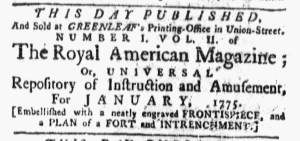
“The Royal American Magazine … For JANUARY, 1775.”

When Joseph Greenleaf acquired the Royal American Magazine from Isaiah Thomas, the original printer, near the end of the summer of 1774, the magazine had fallen two months behind, largely due to the hardships caused by the Boston Port Act.  Over the next several months, Greenleaf worked diligently to return the magazine to its publication schedule, achieving that goal with publication of the December 1774 issue during the first week of January 1775.  While that may seem late by twenty-first century standards, magazines bore the date of the previous month, not the upcoming month, in the eighteenth century.  Subscribers anticipated receiving that month’s issue at the very end of the month or the beginning of the next month.

Although Greenleaf managed to get the magazine back on schedule at the beginning of the new year, that did not last long.  The January issue, anticipated around the first of February, was not available until nearly the end of the month.  On February 20, a notice in the Boston Evening-Post announced, “THIS DAY PUBLISHED … The Royal American Magazine … For JANUARY, 1775.”  It was the first advertisement that mentioned the magazine in February, except for the final appearance of Henry Christian Geyer’s notice that critiqued the Royal American Magazine because it “was not printed with his Ink” that he “manufactured” in Boston.  Greenleaf’s progress may have been stalled, in part, by producing a supplement to the first volume of the magazine during January.  That supplement included a title page for the entire volume to insert if subscribers had all the issue bound together, an address to subscribers, and an index.  It also delivered an installment of Thomas Hutchinson’s History of Massachusetts-Bay, a premium offered to subscribers when Thomas circulated subscription proposals.

Boston Evening-Post (February 20, 1775).

Greenleaf published only two advertisements for the Royal American Magazine in February 1775.  His notice that first appeared in the Boston Evening-Post on February 20 ran three days later in the Massachusetts Gazette and Boston Weekly News-LetterAs had been the case in January, it seems that the printing offices shared type that had been set in one location and transferred to the other.

The January 1775 issue turned out to be one of the last issues of the Royal American Magazine, despite the plans for improvement that Greenleaf sketched in the address to subscribers in the supplement.  The printer could not contend with the circumstances in Boston as the political situation worsened.  Although Greenleaf and the subscribers did not know it at the time, the first battles of the Revolutionary War would take place within a couple of months.  In their wake, some newspapers printed in Boston suspended publication and others ceased publication.  The Royal American Magazine was not the only periodical that became a casualty of the imperial crisis.

This entry continues an ongoing series in which the Adverts 250 Project has tracked advertisements for the Royal American Magazine from Thomas’s first notice, in May 1773, that he planned to distribute subscription proposals to newspapers advertisements in JuneJulyAugustSeptemberOctoberNovember, and December 1773 and JanuaryFebruaryMarchAprilMay, and June 1774.  No magazine appeared in July 1774 because of the “Distresses,” yet they resumed in AugustSeptemberOctoberNovember, and December 1774 and January 1775.

**********

“Royal American Magazine, was not printed with his Ink”

  • February 6 – Massachusetts Gazette and Boston Post-Boy (third appearance)

“THIS DAY PUBLISHED … NUMBER I. VOL. II. … For JANUARY, 1775”

  • February 20 – Boston Evening-Post (first appearance)
  • February 23 – Massachusetts Gazette and Boston Weekly News-Letter (first appearance)

February 25

Who was the subject of an advertisement in a colonial American newspaper 250 years ago today?

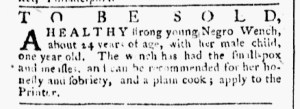
Pennsylvania Ledger (February 25, 1775).

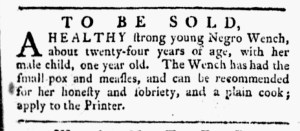
“A HEALTHY strong young Negro [Woman] … with her male child, one year old.”

Five issues.  It took only five issues for an advertisement offering enslaved people for sale to appear in the Pennsylvania Ledger.  James Humphreys, Jr., launched the newspaper on January 28, 1775.  Four weeks later, he printed an advertisement about a “HEALTHY strong young Negro [Woman], about twenty-four years of age,” to be sold “with her male child, one year old.”  The Pennsylvania Ledger was still such a new publication when it carried this advertisement that the proposals and conditions for subscribing appeared as the first item in the first column on the first page.  An advertisement for a political pamphlet ran immediately below the proposals, followed by the advertisement for the enslaved young woman and her child.  Readers encountered them before news reprinted from the Maryland Gazette or any of the other content in that issue.

Humphreys did not merely print and disseminate the advertisement.  He also acted as a broker in the sale.  The notice instructed interested parties to “apply to the Printer.”  What role Humphreys would play when someone did “apply” to him was not apparent in the advertisement.  He may have referred prospective buyers to the advertiser, he may have provided more details about the sale, including price and credit, or he may have been empowered to agree to a sale should a buyer meet the terms specified by the enslaver who offered the woman and child for sale.  Whatever role he played, Humphreys was actively involved in the sale beyond printing the advertisement in his newspaper.

He may have even consulted with the advertiser in composing the advertisement, though it was formulaic enough that an enslaver looking to sell human property likely did not need such assistance.  After all, such “enquire of the printer” advertisements appeared regularly in newspapers published during the era of the American Revolution.  The anonymous advertiser noted that the enslaved woman “has had the small-pox and measles,” a guarantee of her health in the future since she would not contract those diseases again, and “can be well recommended fort her honesty and sobriety.”  In addition, she was a “plain cook.”  Such language was just as common in advertisements for enslaved people as directions to “apply to the Printer” who would act as a broker in the sale.

For more on such advertisements, see Jordan Taylor’s “Enquire of the Printer: The Slave Trade and Early American Newspaper Advertising.”

Slavery Advertisements Published February 25, 1775

The Slavery Adverts 250 Project chronicles the role of newspaper advertising in perpetuating slavery in the era of the American Revolution. The project seeks to reveal the ubiquity of slavery in eighteenth-century life from New England to Georgia by republishing advertisements about enslaved people – for sale as individuals or in groups, wanted to purchase or for hire for short periods, runaways who liberated themselves, and those who were subsequently captured and confined in jails and workhouses – in daily digests on this site as well as in real time via the @SlaveAdverts250 Twitter feed, utilizing twenty-first-century media to stand in for the print media of the eighteenth century.

The project aims to provide modern audiences with a sense of just how often colonizers encountered these advertisements in their daily lives. Enslaved men, women, and children appeared in print somewhere in the colonies almost every single day. Those advertisements served as a constant backdrop for social, cultural, economic, and political life in colonial and revolutionary America. Colonizers who did not purport to own enslaved people were still confronted with slavery as well as invited to maintain the system by purchasing enslaved men, women, and children or assisting in the capture of so-called “runaways” who sought to free themselves from bondage. The frequency of these newspaper advertisements suggests just how embedded slavery was in colonial and revolutionary American culture in everyday interactions beyond the printed page.

These advertisements also testify to the experiences of enslaved men, women, and children, though readers must consider that those experiences have been remediated through descriptions offered by enslavers rather than enslaved people themselves. Often unnamed in the advertisements, enslaved men, women, and children were not invisible or unimportant in early America.

These advertisements appeared in colonial American newspapers 250 years ago today.

Pennsylvania Ledger (February 25, 1775).

**********

Virginia Gazette [Dixon and Hunter] (February 25, 1775).

**********

Virginia Gazette [Dixon and Hunter] (February 25, 1775).

**********

Virginia Gazette [Dixon and Hunter] (February 25, 1775).

**********

Virginia Gazette [Dixon and Hunter] (February 25, 1775).

**********

Virginia Gazette [Dixon and Hunter] (February 25, 1775).

**********

Virginia Gazette [Dixon and Hunter] (February 25, 1775).

**********

Virginia Gazette [Dixon and Hunter] (February 25, 1775).

**********

Virginia Gazette [Dixon and Hunter] (February 25, 1775).

**********

Virginia Gazette [Dixon and Hunter] (February 25, 1775).

**********

Virginia Gazette [Dixon and Hunter] (February 25, 1775).

**********

Virginia Gazette [Dixon and Hunter] (February 25, 1775).

**********

Virginia Gazette [Dixon and Hunter] (February 25, 1775).

**********

Virginia Gazette [Dixon and Hunter] (February 25, 1775).

February 24

What was advertised in a colonial American newspaper 250 years ago today?

New-Hampshire Gazette (February 24, 1775).

“All which were imported before the 1st Day of December.”

As February 1775 came to a close, Richard Wibirt Penhallow took to the pages of the New-Hampshire Gazette to advertise a variety of items he offered for sale “at the Warehouse on Long-Wharfe, (lately occupied by Mr. Jacob Sheafe jun.)” in Portsmouth.  He had nails, sugar, frying pans, blankets, twine, and fishing hooks, “together with many other Articles.”  Penhallow concluded his notice by informing readers that all his wares “were imported before the 1st Day of December.”

Why would prospective customers, readers of the New-Hampshire Gazette, or the public care when Penhallow imported the goods that he sold in February 1775?  In clarifying when he received his merchandise, Penhallow acknowledged current events, including the Continental Association that went into effect on December 1 and the imperial crisis that intensified as Parliament passed and enforced the Coercive Acts in response to the Boston Tea Party.  The Continental Association, a nonimportation, nonconsumption, and nonexportation agreement devised by the First Continental Congress and adopted throughout the colonies, called for boycotting imported goods until Parliament repealed the Coercive Acts.  Colonizers attempted to use economic means to achieve political ends.
Not wishing to run afoul of the local Committee of Inspection, Penhallow emphasized when he received the goods that he advertised.  He also indicated that he sold then “cheap for CASH only.”  In addition to alerting prospective customers that he would not extend credit in those troubling times, he also signaled that he abided by the provision of the Continental Association that prohibited merchants, shopkeepers, and others from engaging in price gouging.  “Venders of Goods or Merchandise,” the ninth article specified, “will not take Advantage of the Scarcity of Goods that may be occasioned by this Association, but will sell the same at the Rates we have been respectively accustomed to do for twelve Months last past.”  Those who did jack up their prices could expect consequences.  Supporters of the Association would not “deal with any such Person … at any Time thereafter, for any Commodity whatever.”
With a few carefully selected words in his advertisement, Penhallow communicated that he understood and abided by the Continental Association.  In turn, prospective customers could acquire merchandise from him without worrying that they violated the pact.  Similarly, he could remain in good standing in his community.

Slavery Advertisements Published February 24, 1775

The Slavery Adverts 250 Project chronicles the role of newspaper advertising in perpetuating slavery in the era of the American Revolution. The project seeks to reveal the ubiquity of slavery in eighteenth-century life from New England to Georgia by republishing advertisements about enslaved people – for sale as individuals or in groups, wanted to purchase or for hire for short periods, runaways who liberated themselves, and those who were subsequently captured and confined in jails and workhouses – in daily digests on this site as well as in real time via the @SlaveAdverts250 Twitter feed, utilizing twenty-first-century media to stand in for the print media of the eighteenth century.

The project aims to provide modern audiences with a sense of just how often colonizers encountered these advertisements in their daily lives. Enslaved men, women, and children appeared in print somewhere in the colonies almost every single day. Those advertisements served as a constant backdrop for social, cultural, economic, and political life in colonial and revolutionary America. Colonizers who did not purport to own enslaved people were still confronted with slavery as well as invited to maintain the system by purchasing enslaved men, women, and children or assisting in the capture of so-called “runaways” who sought to free themselves from bondage. The frequency of these newspaper advertisements suggests just how embedded slavery was in colonial and revolutionary American culture in everyday interactions beyond the printed page.

These advertisements also testify to the experiences of enslaved men, women, and children, though readers must consider that those experiences have been remediated through descriptions offered by enslavers rather than enslaved people themselves. Often unnamed in the advertisements, enslaved men, women, and children were not invisible or unimportant in early America.

These advertisements appeared in colonial American newspapers 250 years ago today.

Connecticut Gazette (February 24, 1775).

**********

South-Carolina and American General Gazette (February 24, 1775).

**********

South-Carolina and American General Gazette (February 24, 1775).

**********

South-Carolina and American General Gazette (February 24, 1775).

**********

South-Carolina and American General Gazette (February 24, 1775).

**********

South-Carolina and American General Gazette (February 24, 1775).

**********

South-Carolina and American General Gazette (February 24, 1775).

**********

South-Carolina and American General Gazette (February 24, 1775).

**********

South-Carolina and American General Gazette (February 24, 1775).

**********

South-Carolina and American General Gazette (February 24, 1775).

**********

South-Carolina and American General Gazette (February 24, 1775).

**********

South-Carolina and American General Gazette (February 24, 1775).

**********

South-Carolina and American General Gazette (February 24, 1775).

**********

South-Carolina and American General Gazette (February 24, 1775).

**********

South-Carolina and American General Gazette (February 24, 1775).

**********

South-Carolina and American General Gazette (February 24, 1775).

**********

South-Carolina and American General Gazette (February 24, 1775).

**********

South-Carolina and American General Gazette (February 24, 1775).

**********

South-Carolina and American General Gazette (February 24, 1775).

**********

South-Carolina and American General Gazette (February 24, 1775).

**********

South-Carolina and American General Gazette (February 24, 1775).

**********

South-Carolina and American General Gazette (February 24, 1775).

**********

South-Carolina and American General Gazette (February 24, 1775).

**********

South-Carolina and American General Gazette (February 24, 1775).

**********

South-Carolina and American General Gazette (February 24, 1775).

**********

South-Carolina and American General Gazette (February 24, 1775).

**********

South-Carolina and American General Gazette (February 24, 1775).

**********

South-Carolina and American General Gazette (February 24, 1775).

**********

South-Carolina and American General Gazette (February 24, 1775).

**********

Virginia Gazette [Purdie] (February 24, 1775).

**********

Virginia Gazette [Purdie] (February 24, 1775).

**********

Virginia Gazette [Purdie] (February 24, 1775).

February 23

What was advertised in a colonial American newspaper 250 years ago today?

Massachusetts Spy (February 23, 1775).

“A New Weekly NEWS-PAPER … The WORCESTER GAZETTE; OR, AMERICAN ORACLE of LIBERTY.”

Among the advertisements in the February 23, 1775, edition of the Massachusetts Spy appeared “PROPOSALS For … A New Weekly NEWS-PAPER … To be entitled, The WORCESTER GAZETTE; OR, AMERICAN ORACLE of LIBERTY.”  That newspaper would commence publication in Worcester, about forty miles west of Boston, “as soon as Seven Hundred Subscribers have entered their names.”  It would be the first newspaper published in that town, giving residents greater access to “the most early and authentic Intelligence, and such Political Essays, as are worthy of Public notice, with other matters interesting and entertaining.”

In his History of Printing in America (1810), Isaiah Thomas explained, “In 1774, a number of gentlemen in the county of Worcester, zealously engaged in the cause of the country, were from the then appearance of public affairs, desirous to have a press established in Worcester.”  In other words, supporters of the patriot cause wanted a local newspaper instead of relying on newspapers published in Boston, Salem, Newburyport, Providence, Portsmouth, Norwich, and Hartford.  Although newspapers from each of those towns served readers in larger, overlapping regions, Patriots in Worcester believed that a local newspaper would both serve their community and strengthen their position.  By the time they “applied to a printer in Boston” in December 1774, the “Worcester Revolution” had already closed the courts and removed British authority from that town.  Thomas, that printer in Boston, “engaged to open a printing house, and to publish a newspaper there, in the course of the ensuing spring.”  He initially intended to follow a model like the one for establishing the Essex Journal in partnership with Henry-Walter Tinges in Newburyport.  Tinges, the junior partner, managed the printing office there while Thomas remained in Boston.  As part of his preparations, Thomas published the proposals for the Worcester Gazette as he worked on recruiting “a suitable person to manage the concerns of it.” However, when the Revolutionary War began with the Battles of Lexington and Concord on April 19, Thomas “was obliged to leave Boston, and came himself to Worcester” and became the city’s first printer.[1]

When Thomas disseminated the first issue on May3, he combined the name of the newspaper he published in Boston for several years, the Massachusetts Spy, and the intended name for the new newspaper, calling it the Massachusetts Spy or American Oracle of Liberty.  As outlined in the proposals from February, he published the newspaper “every WEDNESDAY Morning, as early as possible” so it could be “delivered to the Subscribers in Worcester at their houses, and sent by the first opportunity to such as are at a greater distance.”  The annual subscription fee in the colophon matched the proposals, “Six Shillings and Eight Pence per annum, the same as the Boston news-papers.”  The colophon did not list rates for advertising, though the proposals stated that they would be “inserted in a neat and conspicuous [manner], at the same rates as they are in Boston.”  Little did Thomas know when he published the “PROPOSALS [for] The WORCESTER GAZETTE” in February 1775 that he would soon relocate to that town and become one of its most prominent residents, establishing the first printing office and, eventually, founding the American Antiquarian Society in 1812.

**********

[1] Isaiah Thomas, The History of Printing in America: With a Biography of Printers and an Account of Newspapers (1810; New York: Weathervane Books, 1970), 180-181.