August 31

What was advertised in a revolutionary American newspaper 250 years ago today?

Virginia Gazette [Pinkney] (August 31, 1775).

“She intends to open a DANCING SCHOOL … for young ladies.”

The new term had commenced, yet Sarah Hallam continued advertising her “DANCING SCHOOL” in Williamsburg in the August 31, 1775, edition of John Pinkney’s Virginia Gazette.  She first promoted the school in the public prints on August 17, announcing that she “intends to open a DANCING SCHOOL, on Friday the 25th instant, for young ladies.  That gave prospective pupils and their parents just over a week to enroll.  Hallam advertised a second time on the eve of opening her school and again a week later to give stragglers a chance to join.  She apparently considered advertising worth the investment.  The advertisement continued in four more issues, through the end of September.  According to the rates in the newspaper’s masthead, Pinkney charged three shillings for the first insertion (to cover setting type and space in the newspaper) and two shilling for each additional insertion (for the space once the type was set).  That meant that Hallam spent fifteen shillings on advertisements in Pinkney’s Virginia Gazette.  She charged twenty shillings as an entrance fee and then four pounds per year for each student.  That meant that the entrance fee for just one student covered her advertising expenses.

Hallam certainly made choices about her marketing campaign, choices not limited to how long it lasted.  Williamsburg had three newspapers at the time.  John Dixon and William Hunter published their own Virginia Gazette, as did Alexander Purdie.  Yet Hallam opted not to place notices in either of the other newspapers even though the printers charged the same rates.  She had a limit to how much she would spend on recruiting new students.  She apparently decided that a longer campaign in a single newspaper would be more effective than a shorter campaign in several newspapers.  She may have reasoned that each Virginia Gazette circulated so widely in Williamsburg that inserting an advertisement in Dixon and Hunter’s Virginia Gazette or Purdie’s Virginia Gazette would be superfluous after running it in Pinkney’s Virginia Gazette.  Why choose Pinkney’s newspaper over the others?  Perhaps she appreciated that Pinkney had printed the Virginia Gazette “FOR THE BENEFIT OF CLEMENTINA RIND’s CHILDREN” after the former printer’s death in September 1774.  For six months, the masthead made that proclamation immediately above the advertising rates.  As a female entrepreneur, Hallam may have found meaning in choosing the newspaper formerly printed by a woman and then printed to support her children following her death.
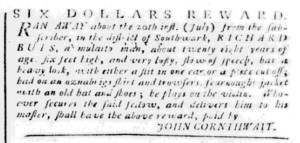
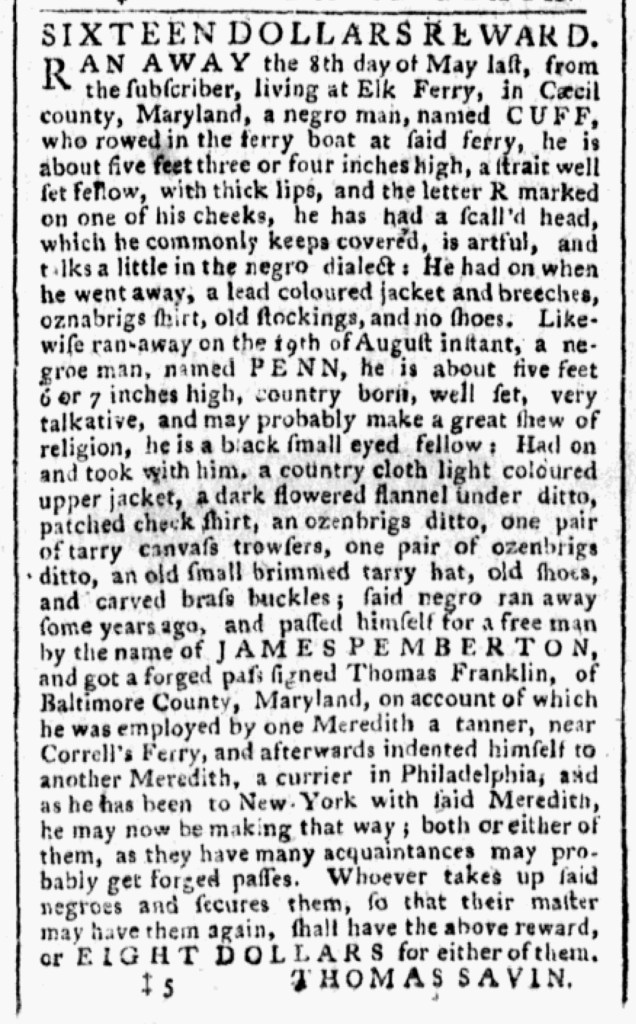
Slavery Advertisements Published August 31, 1775

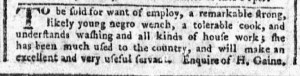
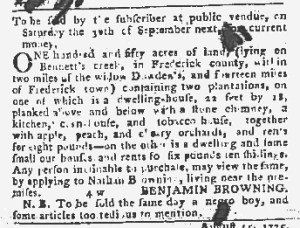
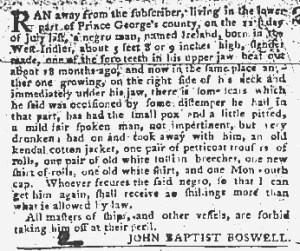
The Slavery Adverts 250 Project chronicles the role of newspaper advertising in perpetuating slavery in the era of the American Revolution. The project seeks to reveal the ubiquity of slavery in eighteenth-century life from New England to Georgia by republishing advertisements about enslaved people – for sale as individuals or in groups, wanted to purchase or for hire for short periods, runaways who liberated themselves, and those who were subsequently captured and confined in jails and workhouses – in daily digests on this site as well as in real time via the @SlaveAdverts250 Twitter feed, utilizing twenty-first-century media to stand in for the print media of the eighteenth century.

The project aims to provide modern audiences with a sense of just how often colonizers encountered these advertisements in their daily lives. Enslaved men, women, and children appeared in print somewhere in the colonies almost every single day. Those advertisements served as a constant backdrop for social, cultural, economic, and political life in colonial and revolutionary America. Colonizers who did not purport to own enslaved people were still confronted with slavery as well as invited to maintain the system by purchasing enslaved men, women, and children or assisting in the capture of so-called “runaways” who sought to free themselves from bondage. The frequency of these newspaper advertisements suggests just how embedded slavery was in colonial and revolutionary American culture in everyday interactions beyond the printed page.

These advertisements also testify to the experiences of enslaved men, women, and children, though readers must consider that those experiences have been remediated through descriptions offered by enslavers rather than enslaved people themselves. Often unnamed in the advertisements, enslaved men, women, and children were not invisible or unimportant in early America.

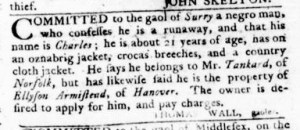
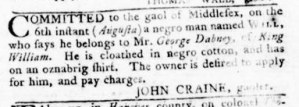
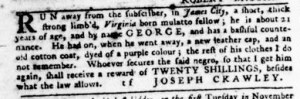
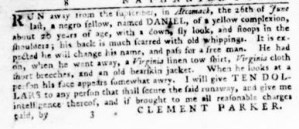
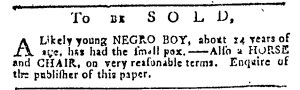
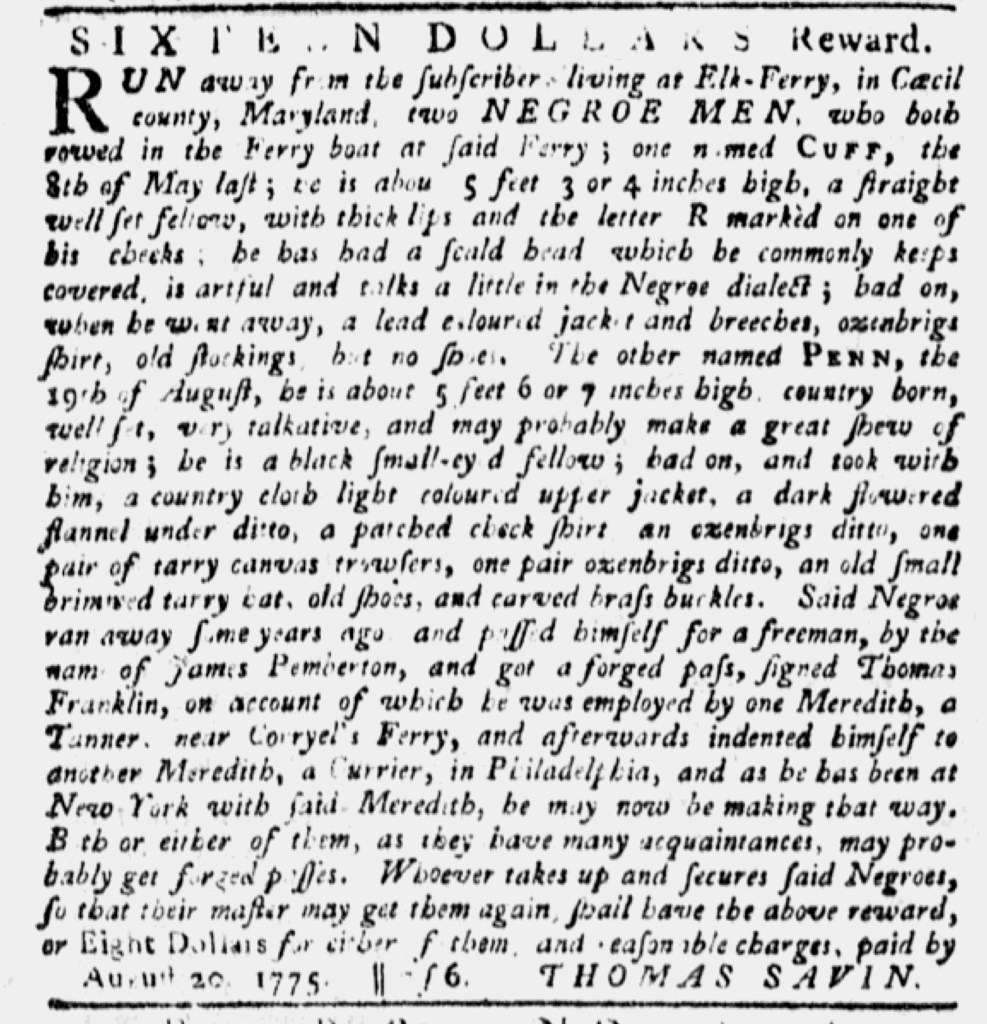
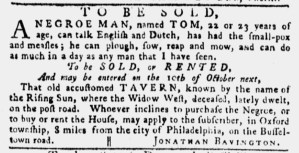
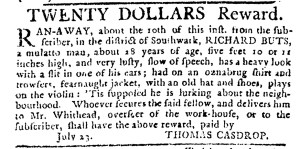
These advertisements appeared in colonial American newspapers 250 years ago today.

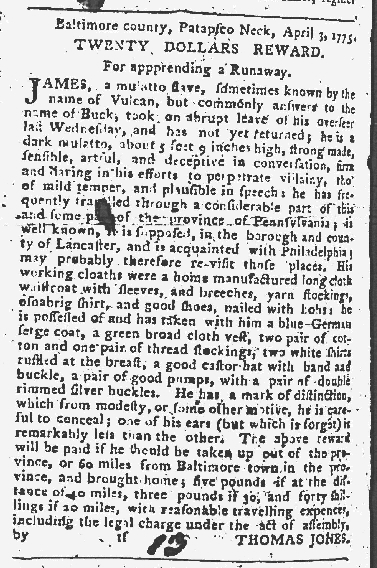
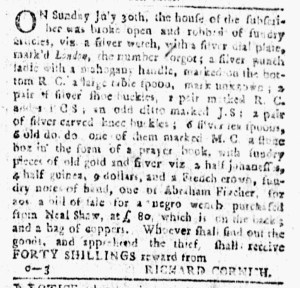
Maryland Gazette (August 31, 1775).

**********

Maryland Gazette (August 31, 1775).

**********

Maryland Gazette (August 31, 1775).

**********

Maryland Gazette (August 31, 1775).

**********

Massachusetts Gazette and Boston Weekly News-Letter (August 31, 1775).

**********

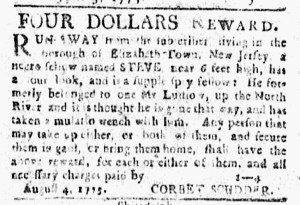
New-York Journal (August 31, 1775).

**********

New-York Journal (August 31, 1775).

**********

Pennsylvania Evening Post (August 31, 1775).

**********

Rivington’s New-York Gazetteer (August 31, 1775).

**********

Rivington’s New-York Gazetteer (August 31, 1775).

**********

Rivington’s New-York Gazetteer (August 31, 1775).

**********

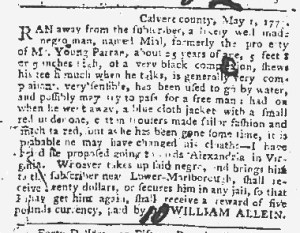
Virginia Gazette [Pinkney] (August 31, 1775).

**********

Virginia Gazette [Pinkney] (August 31, 1775).

**********

Virginia Gazette [Pinkney] (August 31, 1775).

**********

Virginia Gazette [Pinkney] (August 31, 1775).

**********

Virginia Gazette [Pinkney] (August 31, 1775).

**********

Virginia Gazette [Pinkney] (August 31, 1775).

**********

Virginia Gazette [Pinkney] (August 31, 1775).

**********

Virginia Gazette [Pinkney] (August 31, 1775).

August 30

What was advertised in a revolutionary American newspaper 250 years ago today?

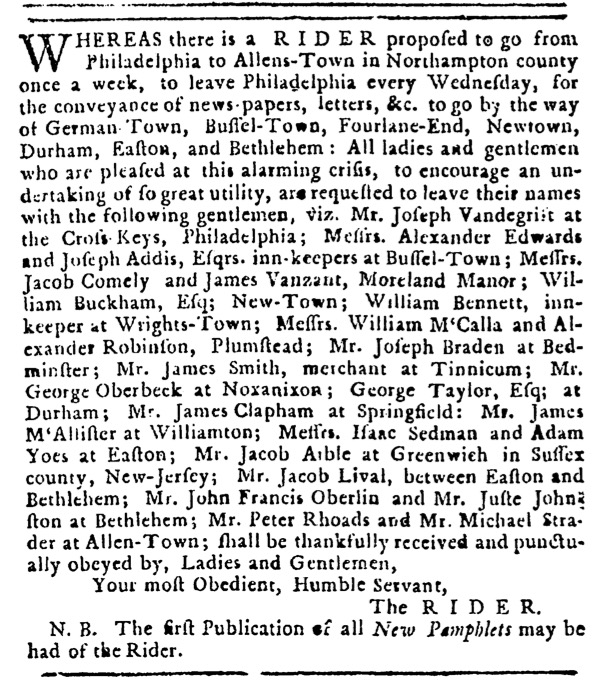
Pennsylvania Journal (August 30, 1775).

“The first Publication of all New Pamphlets may be had of the Rider.”

An anonymous post rider advertised his services in the August 30, 1775, edition of the Pennsylvania Journal, stating that the “Proposed to go from Philadelphia to Allens-Town in Northampton county once a week.”  He intended to depart from Philadelphia each Wednesday, the same day that a new issue of the Pennsylvania Journal, a weekly publication, hit the streets.  Subscribers to that newspaper along his route would benefit from the quickest possible access to the news in the latest edition.  Although “The RIDER” did not give details about collecting fees, he likely envisioned providing his services via subscription, similar to the plan that Thomas Sculley outlined in an advertisement for his route between Philadelphia and Lewes, Delaware, in the Pennsylvania Ledger a month earlier.  Both post riders contributed to an expanding communication infrastructure.  The same issue of the Pennsylvania Journal that carried the anonymous rider’s advertisement also featured a notice that gave the days the new Constitutional Post departed Philadelphia to carry letters to “New-York, Connecticut, Rhode-Island, Massachusetts-Bay, [and] New-Hampshire.”

The rider framed carrying “news-papers, letters, &c.” as a public service at an important moment, instructing “ladies and gentlemen who are pleased at this alarming crisis, to encourage an undertaking of so great utility … to leave their names with the following gentlemen.”  He then listed twenty-three associates in sixteen towns, demonstrating that he had already devoted significant effort to establishing a network for transmitting information.  The outbreak of hostilities in Massachusetts, the “alarming crisis,” made it more important than ever that colonizers residing in smaller towns gained regular access to newspapers and correspondence.  Some were so eager to read the latest news that they may have been stealing copies of Dunlap’s Maryland Gazette.  The rider aimed to keep colonizers along his route well informed.  “The first Publication of all New Pamphlets,” he stated in a nota bene, “may be had of the Rider.”  The “&c.” (or etc.) in “news-papers, letters, &c.” included the political pamphlets and sermons about current events so often advertised in the Pennsylvania Journal and other newspapers printed in Philadelphia.  Post riders in New England had sometimes acted as local agents for disseminating political pamphlets earlier during the imperial crisis.  The anonymous rider joined their ranks, delivering “news-papers, letters, &c.” with a purpose beyond merely earning his own livelihood.

Slavery Advertisements Published August 30, 1775

GUEST CURATORS:  Tiana Jreij and Arianna Langford

The Slavery Adverts 250 Project chronicles the role of newspaper advertising in perpetuating slavery in the era of the American Revolution. The project seeks to reveal the ubiquity of slavery in eighteenth-century life from New England to Georgia by republishing advertisements about enslaved people – for sale as individuals or in groups, wanted to purchase or for hire for short periods, runaways who liberated themselves, and those who were subsequently captured and confined in jails and workhouses – in daily digests on this site as well as in real time via the @SlaveAdverts250 Twitter feed, utilizing twenty-first-century media to stand in for the print media of the eighteenth century.

The project aims to provide modern audiences with a sense of just how often colonizers encountered these advertisements in their daily lives. Enslaved men, women, and children appeared in print somewhere in the colonies almost every single day. Those advertisements served as a constant backdrop for social, cultural, economic, and political life in colonial and revolutionary America. Colonizers who did not purport to own enslaved people were still confronted with slavery as well as invited to maintain the system by purchasing enslaved men, women, and children or assisting in the capture of so-called “runaways” who sought to free themselves from bondage. The frequency of these newspaper advertisements suggests just how embedded slavery was in colonial and revolutionary American culture in everyday interactions beyond the printed page.

These advertisements also testify to the experiences of enslaved men, women, and children, though readers must consider that those experiences have been remediated through descriptions offered by enslavers rather than enslaved people themselves. Often unnamed in the advertisements, enslaved men, women, and children were not invisible or unimportant in early America.

These advertisements appeared in colonial American newspapers 250 years ago today.

Maryland Journal (August 30, 1775).

**********

Pennsylvania Gazette (August 30, 1775).

**********

Pennsylvania Gazette (August 30, 1775).

**********

Pennsylvania Journal (August 30, 1775).

August 29

What was advertised in a revolutionary American newspaper 250 years ago today?

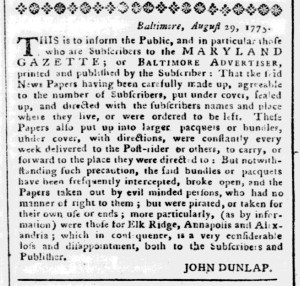
Dunlap’s Maryland Gazette (August 29, 1775).

“The Papers taken out by evil minded persons, who had no manner of right to them.”

Something went wrong.  John Dunlap, the printer of Dunlap’s Maryland Gazette, had a system for delivering his newspaper to subscribers who lived outside of Baltimore, but “evil minded persons” interfered with it.  In particular, disruptions occurred in Annapolis and Elk Ridge, both in Maryland, and Alexandria, Virginia.  That prompted Dunlap to run a notice in the August 29, 1775, edition, placing it immediately after local news and first among the advertisements to increase the likelihood that readers would see it.

The exasperated printer went into great detail about his delivery infrastructure, hoping to convince “the Public, and in particular those who are Subscribers” that he made every effort to follow through on his obligation to deliver the newspaper.  The correct number of copies had been “carefully made up, agreeable to the number of Subscribers, put under covers, sealed up, and directed with the subscribers names and place where they live, or were ordered to be left.”  Then, those newspapers were “also put up into larger pacquets or bundles, under cover, with directions” and “constantly every week delivered to the Post-rider or other, to carry, or forward to the place they were directed to.”  Despite such careful attention and “notwithstanding such precaution, the said bundles or pacquets have been frequently intercepted, broke open, and the Papers taken out by evil minded persons, who had no manner of right to them.”  Dunlap called this “a very considerable loss and disappointment, both to the Subscribers and Publisher.”  Advertisers may have also been frustrated upon learning that the notices they paid to insert in Dunlap’s Maryland Gazette did not circulate as widely as they expected.  The printer likely realized that could have an impact on revenue as well.

Dunlap declared that the missing newspapers “were pirated, or taken for their own use or ends” by the thieves.  Despite the consequences for subscribers, advertisers, and the printer, the motivation for taking the newspapers may not have been completely nefarious.  In the wake of recent events – the battles at Lexington and Concord, the Battle of Bunker Hill, the Second Continental Congress meeting in Philadelphia, colonial assemblies holding their own meetings, George Washington assuming command of the Continental Army as it besieged Boston – colonizers were eager for news.  Some may have resorted to unsavory means of getting the latest updates, taking newspapers that did not belong to them.  That did not justify what they did, but it does testify to the role of the early American press in disseminating information about the imperial crisis and the Revolutionary War.  Some colonizers became better informed because of the theft, while subscribers to Dunlap’s Maryland Gazette had to seek out other newspapers or rely on conversations and correspondence to learn the latest updates.

Slavery Advertisements Published August 29, 1775

GUEST CURATORS:  Tiana Jreij and Arianna Langford

The Slavery Adverts 250 Project chronicles the role of newspaper advertising in perpetuating slavery in the era of the American Revolution. The project seeks to reveal the ubiquity of slavery in eighteenth-century life from New England to Georgia by republishing advertisements about enslaved people – for sale as individuals or in groups, wanted to purchase or for hire for short periods, runaways who liberated themselves, and those who were subsequently captured and confined in jails and workhouses – in daily digests on this site as well as in real time via the @SlaveAdverts250 Twitter feed, utilizing twenty-first-century media to stand in for the print media of the eighteenth century.

The project aims to provide modern audiences with a sense of just how often colonizers encountered these advertisements in their daily lives. Enslaved men, women, and children appeared in print somewhere in the colonies almost every single day. Those advertisements served as a constant backdrop for social, cultural, economic, and political life in colonial and revolutionary America. Colonizers who did not purport to own enslaved people were still confronted with slavery as well as invited to maintain the system by purchasing enslaved men, women, and children or assisting in the capture of so-called “runaways” who sought to free themselves from bondage. The frequency of these newspaper advertisements suggests just how embedded slavery was in colonial and revolutionary American culture in everyday interactions beyond the printed page.

These advertisements also testify to the experiences of enslaved men, women, and children, though readers must consider that those experiences have been remediated through descriptions offered by enslavers rather than enslaved people themselves. Often unnamed in the advertisements, enslaved men, women, and children were not invisible or unimportant in early America.

These advertisements appeared in colonial American newspapers 250 years ago today.

Dunlap’s Maryland Gazette (August 29, 1775).

August 28

What was advertised in a revolutionary American newspaper 250 years ago today?

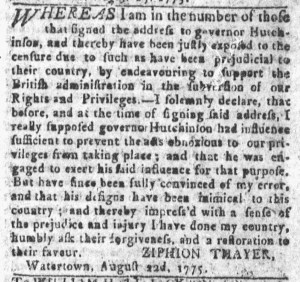
Boston-Gazette (August 28, 1775).

“Impress’d with a sense of the prejudice and injury I have done my country, humbly ask their forgiveness.”

It was yet another apology for signing an address to Thomas Hutchison when General Thomas Gage replaced him as governor of Massachusetts and he departed for England.  This time Ziphion Thayer lamented his error in an advertisement in the August 28, 1775, edition of the Boston-Gazette, published in Watertown as the siege of Boston continued.  Thayer acknowledged that he signed the address and “thereby have been justly exposed to the censure due to such as have been prejudicial to their country, by endeavouring to support the British administration in the subversion of our Rights and Privileges.”  As others indicated in their own apology-advertisements, signing the address came with consequences.  The “censure” that Thayer experienced likely included other colonizers refusing to engage with him socially or in business.

For a time, many signatories who published apology-advertisements claimed that they had affixed their names in haste without reading carefully or fully considering the full implications of the address.  More recently, however, others explained that they signed because they thought at the time that Hutchinson had the power to protect them from the “Vengeance of the British Ministry” and an inclination to advocate for American liberties.  “I solemnly declare, that before, and at the time of signing said address,” Thayer claimed, “I really supposed governor Hutchinson had influence sufficient to prevent the acts obnoxious to our privileges from taking place; and that he was engaged to exert his said influence for that purpose.”

Things certainly did not work out that way, leading Thayer to declare that he had “since been fully convinced of my error” and now realized that Hutchinson’s designs “have been inimical to this country.”  Did Thayer have an authentic conversion?  Or did he merely say what others wanted to hear so he could return to his former standing in his community?  William Huntting Howell contends that the authenticity of such apology-advertisements mattered much less to Patriots than the “rote expression of allegiance” in the public prints.[1]  Thayer asserted that he became “impress’d with a sense of the prejudice and injury I have done my country” and, accordingly, he “humbly ask[ed] their forgiveness, and a restoration to their favour.”  Whether or not Thayer truly believed the former, he wanted the latter and likely believed that his apology-advertisement would help convince others to overlook what he had done.

**********

[1] William Huntting Howell, “Entering the Lists: The Politics of Ephemera in Eastern Massachusetts, 1774,” Early American Studies 9, no. 1 (Winter 2011): 215-6.

Slavery Advertisements Published August 28, 1775

GUEST CURATORS:  Tiana Jreij and Arianna Langford

The Slavery Adverts 250 Project chronicles the role of newspaper advertising in perpetuating slavery in the era of the American Revolution. The project seeks to reveal the ubiquity of slavery in eighteenth-century life from New England to Georgia by republishing advertisements about enslaved people – for sale as individuals or in groups, wanted to purchase or for hire for short periods, runaways who liberated themselves, and those who were subsequently captured and confined in jails and workhouses – in daily digests on this site as well as in real time via the @SlaveAdverts250 Twitter feed, utilizing twenty-first-century media to stand in for the print media of the eighteenth century.

The project aims to provide modern audiences with a sense of just how often colonizers encountered these advertisements in their daily lives. Enslaved men, women, and children appeared in print somewhere in the colonies almost every single day. Those advertisements served as a constant backdrop for social, cultural, economic, and political life in colonial and revolutionary America. Colonizers who did not purport to own enslaved people were still confronted with slavery as well as invited to maintain the system by purchasing enslaved men, women, and children or assisting in the capture of so-called “runaways” who sought to free themselves from bondage. The frequency of these newspaper advertisements suggests just how embedded slavery was in colonial and revolutionary American culture in everyday interactions beyond the printed page.

These advertisements also testify to the experiences of enslaved men, women, and children, though readers must consider that those experiences have been remediated through descriptions offered by enslavers rather than enslaved people themselves. Often unnamed in the advertisements, enslaved men, women, and children were not invisible or unimportant in early America.

These advertisements appeared in colonial American newspapers 250 years ago today.

Dunlap’s Pennsylvania Packet (August 28, 1775).

**********

Dunlap’s Pennsylvania Packet (August 28, 1775).

**********

Dunlap’s Pennsylvania Packet (August 28, 1775).

**********

Dunlap’s Pennsylvania Packet (August 28, 1775).

**********

New-York Gazette and Weekly Mercury (August 28, 1775).

**********

New-York Gazette and Weekly Mercury (August 28, 1775).

August 27

What was advertised in a revolutionary American newspaper 250 years ago this week?

Pennsylvania Ledger (August 26, 1775).

“ALL sorts of PLANES … as compleat as any made in London.”

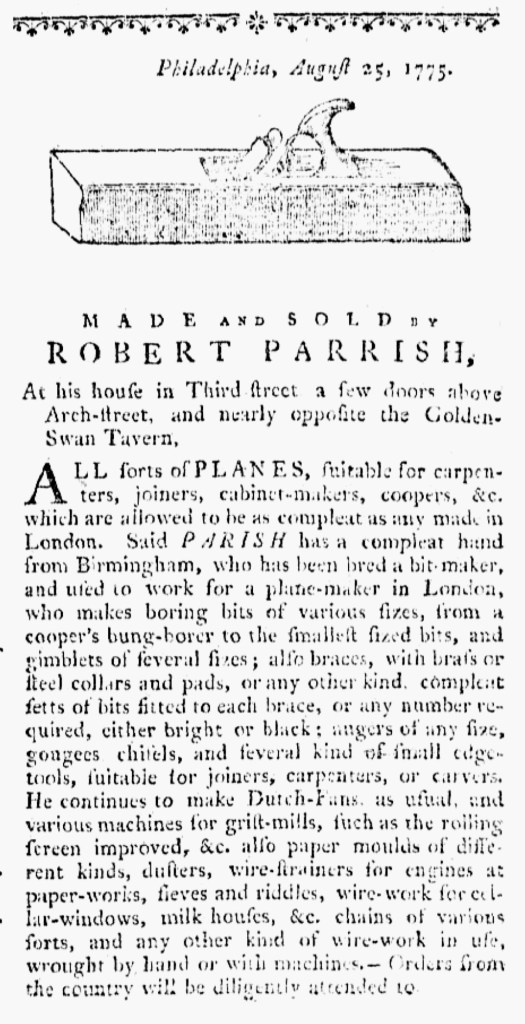
Robert Parrish inserted an advertisement in the August 26, 1775, edition of the Pennsylvania Ledger to advise the public that he made and sold “ALL sorts of PLANES, suitable for carpenters, joiners, cabinet-makers, coopers,” and other artisans at “his house in Third-street, a few doors above Arch-street, and nearly opposite the Golden-Swan Tavern” in Philadelphia.  Parrish was no stranger to advertising in the public prints.  He previously ran an advertisement for “DUTCH FANS” and “ROLLING SCREENS,” both used for separating wheat from chaff, in the Pennsylvania Chronicle.

That notice featured two images, one of each kind of equipment that Parrish made and sold.  A woodcut also accompanied his new advertisement, this one depicting a carpentry plane.  It almost certainly drew attention to his advertisement since it was the only image of any sort, except for the coat of arms of Great Britain that always appeared in the masthead, in that issue of the Pennsylvania Ledger.  Parrish stated that “continues to make Dutch-Fans, as usual, and various machines for grist-mills, such as the rolling screen improved,” yet he did not include either of the images that accompanied his previous advertisement.  Perhaps he never reclaimed them from the printing office when William Goddard ceased publishing the Pennsylvania Chronicle in 1774 … or maybe he considered it too expensive to purchase the necessary space to feature two images.  His copy, after all, was significantly longer than in that earlier advertisement.

Parrish insisted that the planes made and sold at his shop were “as compleat as any made in London,” an assurance that the quality of construction matched imported tools.  American artisans frequently made such claims, though such promises had even greater significance with the Continental Association in effect.  The First Continental Congress devised that nonimportation and nonconsumption agreement in response to the Coercive Acts.  It also called for producers and consumers to support domestic manufactures, goods produced in the colonies, as alternatives to imported items.  Parrish signaled that he did his part to support the American cause by supplying carpenters, joiners, cabinetmakers, and coopers with the tools they needed to earn their livelihoods.

August 26

What was advertised in a revolutionary American newspaper 250 years ago today?

Constitutional Gazette (August 26, 1775).

“He proposes to continue his business of pickling oysters and lobsters.”

John Anderson’s effort to solicit advertisements in the August 23, 1775, edition of the Constitutional Gazette yielded results.  When he published the next issue three days later, the final page carried four advertisements.  The printer was responsible for two of them, one for a pamphlet, “Defensive War in a Just Cause Sinless,” and the other for “All sorts of Blanks used in this Province,” children’s books, and “New Pamphlets.”  Another advertisement hawked “JOYCE’s Grand American Balsam,” a patent medicine sometimes advertised in other newspapers.  Customers could acquire the medicine and directions from “Mrs. Joyce, at Brookland Ferry” and from “Messrs. Anderson, Gaine, and Rivington, Printers in New-York.”  Although Edward Joyce’s widow or the other two printers may have played a role in placing the advertisement, Anderson certainly had a hand in publishing it.

One advertisement, however, had not connection to the printer of the Constitutional Gazette.  Abraham Delanoy placed a notice “to inform his customers, and the public in general, THAT … he proposes to continue his business of pickling oysters and lobsters; and also puts up fired oysters so as to keep a long time even in a hot climate.”  His advertisement featured a woodcut depicting a lobster trap and an oyster cage, accounting for half the space and attracting attention in a newspaper that did not have any other visual images.  That woodcut previously accompanied Delanoy’s advertisement in Rivington’s New-York Gazetteer.  He either retrieved it from another printing office to deliver to Anderson or carefully stored it in anticipation of using it again.  Delanoy also replicated much of the copy from that previous advertisement. The similarities suggest that he either copied directly from it, making minor revisions as he went, or indicated changes directly on a clipping of the advertisement.  Some readers likely recognized Delanoy’s advertisement, but this time it generated revenue for John Anderson and the Constitutional Gazette.  The printer must have been pleased that Delanoy set an example for others to advertise in this new publication.