Slavery Advertisements Published August 26, 1775

GUEST CURATORS:  Tiana Jreij and Arianna Langford

The Slavery Adverts 250 Project chronicles the role of newspaper advertising in perpetuating slavery in the era of the American Revolution. The project seeks to reveal the ubiquity of slavery in eighteenth-century life from New England to Georgia by republishing advertisements about enslaved people – for sale as individuals or in groups, wanted to purchase or for hire for short periods, runaways who liberated themselves, and those who were subsequently captured and confined in jails and workhouses – in daily digests on this site as well as in real time via the @SlaveAdverts250 Twitter feed, utilizing twenty-first-century media to stand in for the print media of the eighteenth century.

The project aims to provide modern audiences with a sense of just how often colonizers encountered these advertisements in their daily lives. Enslaved men, women, and children appeared in print somewhere in the colonies almost every single day. Those advertisements served as a constant backdrop for social, cultural, economic, and political life in colonial and revolutionary America. Colonizers who did not purport to own enslaved people were still confronted with slavery as well as invited to maintain the system by purchasing enslaved men, women, and children or assisting in the capture of so-called “runaways” who sought to free themselves from bondage. The frequency of these newspaper advertisements suggests just how embedded slavery was in colonial and revolutionary American culture in everyday interactions beyond the printed page.

These advertisements also testify to the experiences of enslaved men, women, and children, though readers must consider that those experiences have been remediated through descriptions offered by enslavers rather than enslaved people themselves. Often unnamed in the advertisements, enslaved men, women, and children were not invisible or unimportant in early America.

These advertisements appeared in colonial American newspapers 250 years ago today.
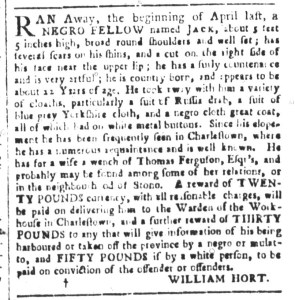
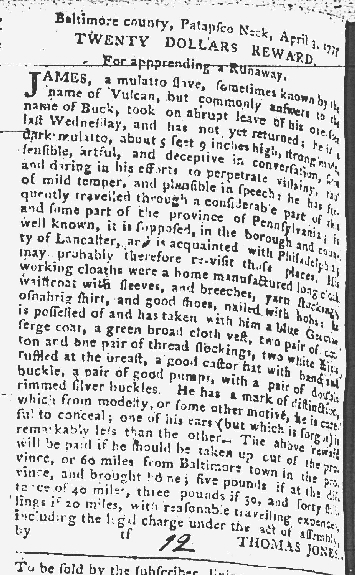
Virginia Gazette [Dixon and Hunter] (August 26, 1775).

**********
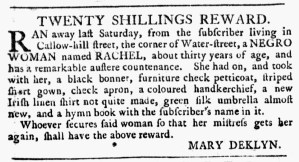
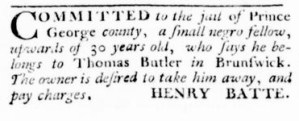
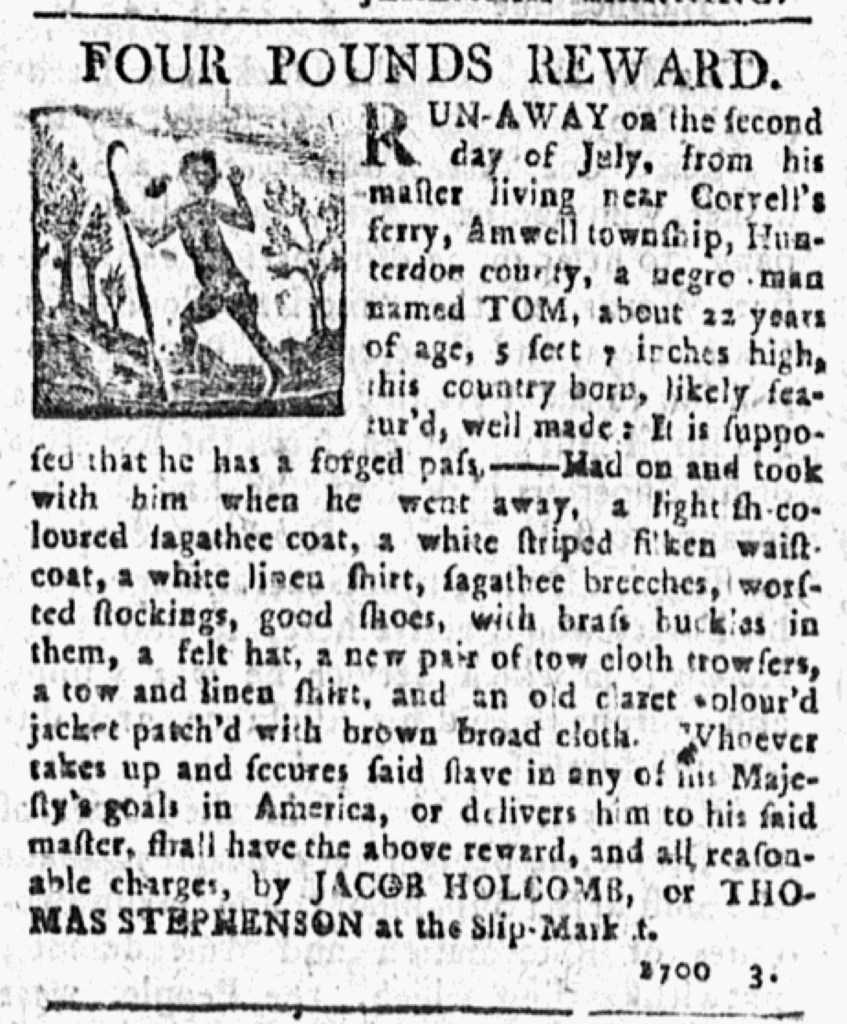
Virginia Gazette [Dixon and Hunter] (August 26, 1775).

August 25

What was advertised in a revolutionary American newspaper 250 years ago today?

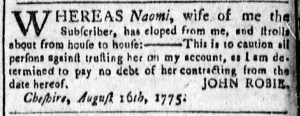
Essex Journal (August 25, 1775).

“This is to caution all persons against trusting her on my account.”

It was a familiar sight.  Advertisements about runaway wives peppered the pages of early American newspapers.  Husbands, like John Robie, took to the public prints to warn that since their wives, in this case Naomi Robie, “eloped” from them that those women no longer had access to credit.  “This is to caution all persons against trusting [Naomi] on my account,” John proclaimed, “as I am determined to pay no debt of her contracting from the date hereof.”  He presented himself as the aggrieved husband, yet his wife likely had her own version of the origins of their marital discord.  Running away may have been the best option to remove her from a bad situation.

When John placed his advertisement about Naomi in the August 25, 1775, edition of the Essex Journal, it ran immediately after a petition from “The FEMALE SUPPORTERS of LIBERTY” reprinted from the Newport Mercury.  “WHEREAS our country has long groaned under the oppression of a tyrannical ministry; and has lately been invaded by our enemies, who stained the land with the blood of our dear brethren,” the petition began, “THEREFORE we, the subscribers, are determined to defend our liberties, both civil and religious, to do the utmost that lies in our power.”  These women took a stand to defend their “liberties” in a manner considered acceptable, while Naomi had asserted her liberty in an inappropriate manner.  “We do not mean to take up arms,” the petitioners continued, “for that does not become our sex.”  They affirmed that they knew their proper place, unlike Naomi who departed from John’s household “and strolls from house to house.”  The petitions vowed to “put our hands to the plough, hoe and rake, and till the ground, for our men to go to the assistance of our distressed brethren, there to conquer our enemies or die in the attempt.”  Those women faced uncertain futures, realizing that the deaths of husbands, fathers, and brothers would be sacrifices that affected them and their families.  They also pledged to “forsake the gaieties of the world,” such as abiding by nonimportation and nonconsumption agreements, “before we will give up our country’s liberties and religion.”

The petition ended with a vow of mutual support: “Our company is to consist of as many true daughters of liberty as will undertake the noble cause.”  Furthermore, “No one to be admitted who retains any of the tory principles.”  Women (and men) recognized legitimate ways for women to participate in politics and advocate for their own interests, but only to any extent.  In this instance, advocacy extended to words and deeds that supported women (and their country) collectively, defending their “liberties and religion,” but not to condoning individual acts of resistance like Naomi Robie’s plan for self-determination when they ran counter to her husband’s wishes.  Many of the women who signed the petition may have privately sympathized with Naomi, but the press carried nothing but condemnations of her actions even as it celebrated the “FEMALE SUPPORTERS of LIBERTY” and their commitment to the American cause.

Slavery Advertisements Published August 25, 1775

GUEST CURATORS:  Tiana Jreij and Arianna Langford

The Slavery Adverts 250 Project chronicles the role of newspaper advertising in perpetuating slavery in the era of the American Revolution. The project seeks to reveal the ubiquity of slavery in eighteenth-century life from New England to Georgia by republishing advertisements about enslaved people – for sale as individuals or in groups, wanted to purchase or for hire for short periods, runaways who liberated themselves, and those who were subsequently captured and confined in jails and workhouses – in daily digests on this site as well as in real time via the @SlaveAdverts250 Twitter feed, utilizing twenty-first-century media to stand in for the print media of the eighteenth century.

The project aims to provide modern audiences with a sense of just how often colonizers encountered these advertisements in their daily lives. Enslaved men, women, and children appeared in print somewhere in the colonies almost every single day. Those advertisements served as a constant backdrop for social, cultural, economic, and political life in colonial and revolutionary America. Colonizers who did not purport to own enslaved people were still confronted with slavery as well as invited to maintain the system by purchasing enslaved men, women, and children or assisting in the capture of so-called “runaways” who sought to free themselves from bondage. The frequency of these newspaper advertisements suggests just how embedded slavery was in colonial and revolutionary American culture in everyday interactions beyond the printed page.

These advertisements also testify to the experiences of enslaved men, women, and children, though readers must consider that those experiences have been remediated through descriptions offered by enslavers rather than enslaved people themselves. Often unnamed in the advertisements, enslaved men, women, and children were not invisible or unimportant in early America.

These advertisements appeared in colonial American newspapers 250 years ago today.

South-Carolina and American General Gazette (August 25, 1775).

**********
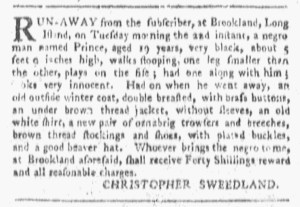
South-Carolina and American General Gazette (August 25, 1775).

**********
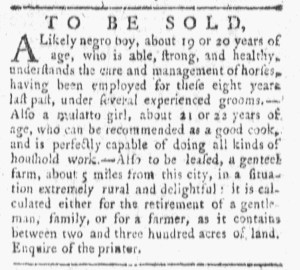
South-Carolina and American General Gazette (August 25, 1775).

**********
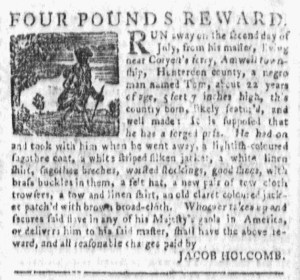
South-Carolina and American General Gazette (August 25, 1775).

**********
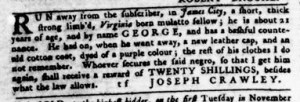
South-Carolina and American General Gazette (August 25, 1775).

**********
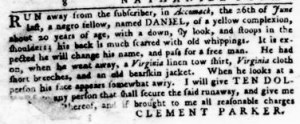
South-Carolina and American General Gazette (August 25, 1775).

**********

South-Carolina and American General Gazette (August 25, 1775).

**********
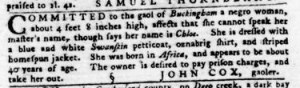
South-Carolina and American General Gazette (August 25, 1775).

**********
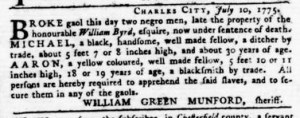
Story and Humphreys’s Pennsylvania Mercury (August 25, 1775).

**********

Virginia Gazette [Purdie] (August 25, 1775).

**********
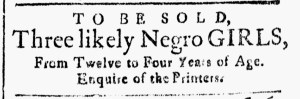
Virginia Gazette [Purdie] (August 25, 1775).

**********

Virginia Gazette [Purdie] (August 25, 1775).

**********

Virginia Gazette [Purdie] (August 25, 1775).

**********

Virginia Gazette [Purdie] (August 25, 1775).

**********

Virginia Gazette [Purdie] (August 25, 1775).

August 24

What was advertised in a revolutionary American newspaper 250 years ago today?

Pennsylvania Evening Post (August 24, 1775).

“A dictionary, explaining the most difficult terms made use of in fortification, gunnery, and the whole compass of the military art.”

It was one of the first mentions of an almanac for 1776 in an American newspaper.  The initial notices usually began appearing sometime in August, scattered here and there in different newspapers, and then more printers advertised almanacs for the coming year during the fall.  The number and frequency of advertisements accelerated each year as printers engaged in fierce competition to market and sell the popular reference manuals.

Benjamin Towne, the printer of the Pennsylvania Evening Post, inserted a notice about an almanac for 1776 in the August 24, 1775, edition of his newspaper, making him one of the first that year.  “In the press, and shortly will be published, by the Printer of this paper,” he announced, “The CONSTITUTIONAL ALMANACK.”  The notice appeared immediately after news from the Second Continental Congress, but without the usual line to separate it from other content.  An advertisement offering a reward for a runaway indenture servant ran below the notice about the almanac, a horizontal line demarcating where one ended and the other began.  Similar lines separated the advertisements on the final page of that edition.  Towne resorted to a tactic sometimes deployed by printers when they promoted their own work, placing his notice ahead of any of the paid advertisements and adopting a format that made it look like a news item.  Even if readers did not peruse all the advertisements, they likely read Towne’s notice about his almanac and then realized that they had reached the end of the news.

The printer’s notice included information that he considered newsworthy.  “As a dictionary, explaining the most difficult terms made use of in fortification, gunnery, and the whole compass of the military art, will be subjoined,” Towne declared, “it is presumed this Almanack will be considered a valuable VADE MECUM at this important juncture.”  Prospective customers would benefit from treating the combined almanac and dictionary as a handbook kept constantly at the ready for consultation as more news about the siege of Boston reached them and especially if the news included accounts of new encounters between British regulars and American soldiers.  Following the battles at Lexington and Concord in April and the Battle of Bunker Hill in June, colonizers did not know when they might need to consult a dictionary of “fortification, gunnery, and the whole compass of the military art” to understand the news they read or heard.  The dictionary that accompanied it certainly distinguished Towne’s almanac from others published in the past.

Slavery Advertisements Published August 24, 1775

GUEST CURATORS:  Tiana Jreij and Arianna Langford

The Slavery Adverts 250 Project chronicles the role of newspaper advertising in perpetuating slavery in the era of the American Revolution. The project seeks to reveal the ubiquity of slavery in eighteenth-century life from New England to Georgia by republishing advertisements about enslaved people – for sale as individuals or in groups, wanted to purchase or for hire for short periods, runaways who liberated themselves, and those who were subsequently captured and confined in jails and workhouses – in daily digests on this site as well as in real time via the @SlaveAdverts250 Twitter feed, utilizing twenty-first-century media to stand in for the print media of the eighteenth century.

The project aims to provide modern audiences with a sense of just how often colonizers encountered these advertisements in their daily lives. Enslaved men, women, and children appeared in print somewhere in the colonies almost every single day. Those advertisements served as a constant backdrop for social, cultural, economic, and political life in colonial and revolutionary America. Colonizers who did not purport to own enslaved people were still confronted with slavery as well as invited to maintain the system by purchasing enslaved men, women, and children or assisting in the capture of so-called “runaways” who sought to free themselves from bondage. The frequency of these newspaper advertisements suggests just how embedded slavery was in colonial and revolutionary American culture in everyday interactions beyond the printed page.

These advertisements also testify to the experiences of enslaved men, women, and children, though readers must consider that those experiences have been remediated through descriptions offered by enslavers rather than enslaved people themselves. Often unnamed in the advertisements, enslaved men, women, and children were not invisible or unimportant in early America.

These advertisements appeared in colonial American newspapers 250 years ago today.

Maryland Gazette (August 24, 1775).

**********

Maryland Gazette (August 24, 1775).

**********

Maryland Gazette (August 24, 1775).

**********

New-York Journal (August 24, 1775).

**********

New-York Journal (August 24, 1775).

**********

New-York Journal (August 24, 1775).

**********

Supplement to the New-York Journal (August 24, 1775).

**********

Supplement to the New-York Journal (August 24, 1775).

**********

Supplement to the Pennsylvania Evening Post (August 24, 1775).

**********

Rivington’s New-York Gazetteer (August 24, 1775).

**********

Rivington’s New-York Gazetteer (August 24, 1775).

**********

Rivington’s New-York Gazetteer (August 24, 1775).

**********

Virginia Gazette [Pinkney] (August 24, 1775).

**********

Virginia Gazette [Pinkney] (August 24, 1775).

**********

Virginia Gazette [Pinkney] (August 24, 1775).

**********

Virginia Gazette [Pinkney] (August 24, 1775).

**********

Virginia Gazette [Pinkney] (August 24, 1775).

August 23

What was advertised in a revolutionary American newspaper 250 years ago today?

Constitutional Gazette (August 23, 1775).

The Public will easily perceive the advantage of advertising in the Constitutional Gazette.”

A new newspaper began circulating in New York at the beginning of August 1775.  John Anderson commenced publication of the Constitutional Gazette on August 2, judging from the date of the earliest known issue dated August 9.  Anderson published the broadsheet newspaper twice a week, on Wednesdays and Sundays.  It lasted a little more than a year.  Anderson distributed the last known issue on August 28, 1776.  As Clarence S. Brigham surmises, “the paper must have been soon discontinued, as the British entered New York in September, 1776.”[1]

On August 23, 1775, Anderson converted the seventh issue from a single leaf folio to a quarto of four pages.  At a glance, that would have been the most striking alteration to the format of the newspaper, but it was also the first issue to carry advertisements.  They ran on the final page.  One, placed by the printer himself, filled nearly an entire column.  In it, Anderson hawked pamphlets available at his printing office, including “Defensive War in a Just Cause Sinless,” a sermon by David Jones, “Self-Defensive War Lawful,” a sermon by John Carmichael, and a narrative of “Two Visits Made to some Nations of INDIANS, On the West Side of the River OHIO, In the Years 1772 and 1773,” drawn from Jones’s journal.  Another advertisement offered a reward for returning a lost pocketbook.  The anonymous advertisement instructed anyone who found the pocketbook to deliver it to the printer.  Beekman may have placed it himself or he may have manufactured it to suggest that others had sufficient confidence in the circulation of his newspaper to merit investing in advertising in it.

Another notice from the printer followed the advertisement about the lost pocketbook, this one soliciting more advertisements.  Anderson declared that he published advertisement “for half the price charged by others.”  In making his case, he insisted that the “Public will easily perceive the advantage of advertising in the Constitutional Gazette, when we positively assure them that near Two Thousand of this Gazette circulated twice a week through this City and its Environs.”  Furthermore, “a considerable number are sent to most of the country towns, in, and contiguous to this province.”  According to Anderson, the Constitutional Gazette quickly achieved an impressive circulation that rivaled other newspapers.  If prospective advertisers wanted to reach readers near and far, Anderson argued, then they should place their notices in his new newspaper.

**********

[1] Clarence S. Brigham, History and Bibliography of American Newspaper, 1690-1820 (Worcester, Massachusetts: American Antiquarian Society, 1947), 618.

Slavery Advertisements Published August 23, 1775

GUEST CURATORS:  Connor Harris, Chris Tocci, and Olivia Tocci

The Slavery Adverts 250 Project chronicles the role of newspaper advertising in perpetuating slavery in the era of the American Revolution. The project seeks to reveal the ubiquity of slavery in eighteenth-century life from New England to Georgia by republishing advertisements about enslaved people – for sale as individuals or in groups, wanted to purchase or for hire for short periods, runaways who liberated themselves, and those who were subsequently captured and confined in jails and workhouses – in daily digests on this site as well as in real time via the @SlaveAdverts250 Twitter feed, utilizing twenty-first-century media to stand in for the print media of the eighteenth century.

The project aims to provide modern audiences with a sense of just how often colonizers encountered these advertisements in their daily lives. Enslaved men, women, and children appeared in print somewhere in the colonies almost every single day. Those advertisements served as a constant backdrop for social, cultural, economic, and political life in colonial and revolutionary America. Colonizers who did not purport to own enslaved people were still confronted with slavery as well as invited to maintain the system by purchasing enslaved men, women, and children or assisting in the capture of so-called “runaways” who sought to free themselves from bondage. The frequency of these newspaper advertisements suggests just how embedded slavery was in colonial and revolutionary American culture in everyday interactions beyond the printed page.

These advertisements also testify to the experiences of enslaved men, women, and children, though readers must consider that those experiences have been remediated through descriptions offered by enslavers rather than enslaved people themselves. Often unnamed in the advertisements, enslaved men, women, and children were not invisible or unimportant in early America.

These advertisements appeared in colonial American newspapers 250 years ago today.

Connecticut Journal (August 23, 1775).

**********

Maryland Journal (August 23, 1775).

**********

Pennsylvania Gazette (August 23, 1775).

**********

Pennsylvania Journal (August 23, 1775).

August 22

What was advertised in a revolutionary American newspaper 250 years ago today?

Dunlap’s Maryland Gazette (August 22, 1775).

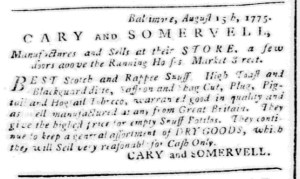
BEST Scotch and Rappee Snuff … warranted good in quality and as well manufactured as any from Great Britain.”

The partnership of Cary and Somervell stocked and sold “a general Assortment of DRY GOODS” at their store in Baltimore in the summer of 1775, but that was not their primary reason for running an advertisement in the August 22 edition of Dunlap’s Maryland Gazette.  Instead, they wished to advise the public that their firm “Manufactures and Sells … BEST Scotch and Rappee Snuff, High Toast and Blackguard [snuff], Saffron and Shag Cut, Plug, Pigtail and Hogtail Tobacco.”  Cary and Somervell offered tobacco users an array of choices of familiar products.  They also paid “the highest price for empty Snuff Bottles,” encouraging prospective customers to offset the cost of their purchases by trading in bottles that they no longer needed.

In promoting the tobacco products that they made in Baltimore, Cary and Somervell published promises about their wares: “warranted good in quality and as well manufactured as any from Great Britain.”  That was a familiar aspect of “Buy American” advertisements prior to the American Revolution, yet it had greater resonance once the Continental Association went into effect on December 1, 1774, and, especially, following the battles at Lexington and Concord on April 19, 1775.  The Continental Association, a nonimportation agreement devised by the First Continental Congress in response to the Coercive Acts, called for “encourag[ing] Frugality, Economy, and Industry; and promot[ing] Agriculture, Arts, and the Manufactures of this Country” as alternatives to imported goods.  Thus, the nonimportation agreement also outlined the responsibilities of both producers and consumers in the colonies.  Such civic duties gained even greater urgency in the wake of battles fought in Massachusetts.

Even without taking current events into consideration, Cary and Somervell issued a familiar challenge when they asserted that their tobacco products were as “good in quality and as well manufactured as any from Great Britain.”  How would consumers know unless they tested Cary and Somervell’s snuff and tobacco for themselves?  The partners used a bold assertion to entice prospective customers to sample their products and become the final arbiters of whether they, the consumers, agreed with the claims made in the newspaper advertisement.

August 21

What was advertised in a revolutionary American newspaper 250 years ago today?

New-York Gazette and Weekly Mercury (August 21, 1775).

“To the last Number for July, is affix’d a new and correct Plan of the TOWN of BOSTON, and PROVINCIAL CAMP.”

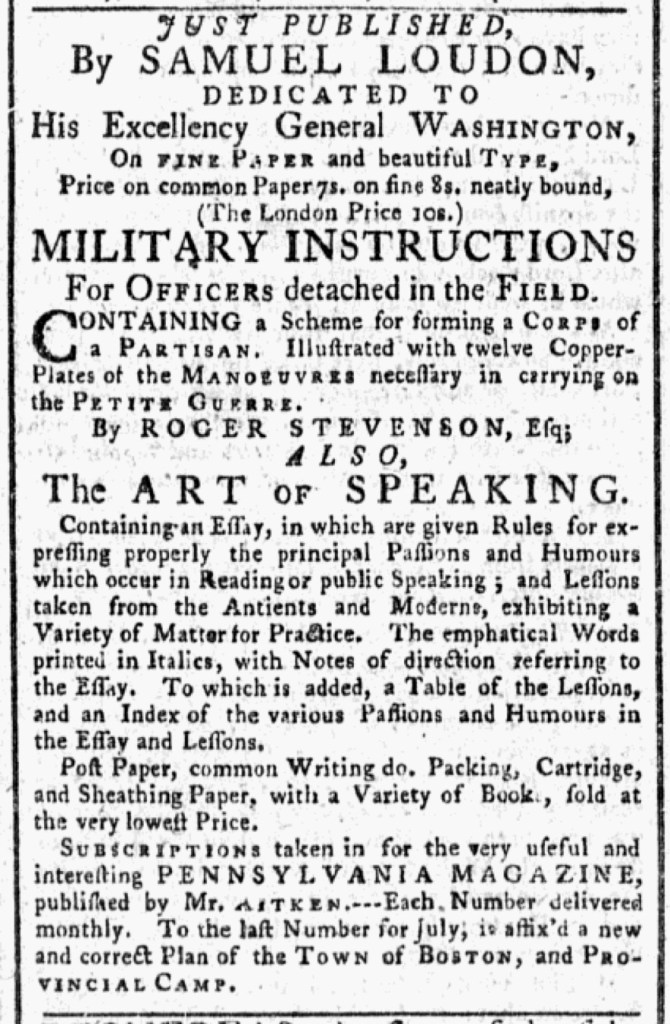
In the summer of 1775, Samuel Loudon, a bookseller in New York, stocked books printed by Robert Aitken in Philadelphia.  He advertised Military Instructions for Officers Detached in the Field, “DEDICATED TO His Excellency General Washington,” and The Art of Speaking in the August 21, 1775, edition of the New-York Gazette and Weekly Mercury.  He also noted that he stocked an assortment of paper and a “Variety of Books” that he “sold at the very lowest Price.”

Loudon concluded his advertisement by promoting another of Aitken’s projects.  The bookseller advised the public that he collected subscriptions “for that very useful and interesting “PENNSYLVANIA MAGAZINE, published by Mr. AITKEN.”  The Pennsylvania Magazine, or, American Monthly Museum commenced publication with its January 1775 issue, briefly overlapping with the Royal American Magazine.  Upon the demise of the latter, it became the only magazine published in the colonies.

To incite interest, Loudon noted that “the last Number for July” featured a “new and correct Plan of the TOWN of BOSTON, and PROVINCIAL CAMP.”  According to the Norman B. Leventhal Map and Education Center at the Boston Public Library, this map “was the earliest printed depiction of Boston after the battle of Bunker Hill, June 17, 1775.”  It includes an inset that “shows the location of the location of the battle, as well as provincial (American) lines in the communities surrounding Boston.”  This demonstrated “the commanding position enjoyed by the Continental Army.”

Getting a free map of Boston following the Battle of Bunker Hill was certainly an incentive to subscribe to the Pennsylvania Magazine!  But was it the first map of Boston created after that battle?  Perhaps, but it might better be described as one of the first depictions of Boston after the Battle of Bunker Hill.  A note in the Leventhal Center’s online catalog states, “This date is inferred,” likely because the map was “Engrav’d for the Pennsylva. Magazine” for July 1775.  Yet the assertion that it was the earliest printed depiction of Boston after the Battle of Bunker Hill may rely on an assumption that colonial printers published magazines at the beginning of the month when they instead issued monthly issues at the end of the month or early in the following month.  Thus, Aitken distributed the July 1775 issue of the Pennsylvania Magazine at the same time that he, Nicholas Brooks, and others advertised Bernard Romans’s map of Boston, a map that also featured an inset showing the “Provincial Lines” during the siege of the city and the site of the Battle of Bunker Hill.  Aitken may have consulted with Romans when preparing a map to accompany the magazine.  For prospective subscribers, it may not have mattered whether they acquired the first map of Boston published after the Battle of Bunker Hill, only that they had access to the map … and at a bargain price since it came as a premium with their subscription to the Pennsylvania Magazine rather than purchasing Romans’s map separately.

“A New and Correct Plan of the Town of Boston, and Provincial Camp” (1775). Courtesy Norman B. Leventhal Map and Education Center at the Boston Public Library.

Slavery Advertisements Published August 21, 1775

GUEST CURATORS:  Connor Harris, Chris Tocci, and Olivia Tocci

The Slavery Adverts 250 Project chronicles the role of newspaper advertising in perpetuating slavery in the era of the American Revolution. The project seeks to reveal the ubiquity of slavery in eighteenth-century life from New England to Georgia by republishing advertisements about enslaved people – for sale as individuals or in groups, wanted to purchase or for hire for short periods, runaways who liberated themselves, and those who were subsequently captured and confined in jails and workhouses – in daily digests on this site as well as in real time via the @SlaveAdverts250 Twitter feed, utilizing twenty-first-century media to stand in for the print media of the eighteenth century.

The project aims to provide modern audiences with a sense of just how often colonizers encountered these advertisements in their daily lives. Enslaved men, women, and children appeared in print somewhere in the colonies almost every single day. Those advertisements served as a constant backdrop for social, cultural, economic, and political life in colonial and revolutionary America. Colonizers who did not purport to own enslaved people were still confronted with slavery as well as invited to maintain the system by purchasing enslaved men, women, and children or assisting in the capture of so-called “runaways” who sought to free themselves from bondage. The frequency of these newspaper advertisements suggests just how embedded slavery was in colonial and revolutionary American culture in everyday interactions beyond the printed page.

These advertisements also testify to the experiences of enslaved men, women, and children, though readers must consider that those experiences have been remediated through descriptions offered by enslavers rather than enslaved people themselves. Often unnamed in the advertisements, enslaved men, women, and children were not invisible or unimportant in early America.

These advertisements appeared in colonial American newspapers 250 years ago today.

Dunlap’s Pennsylvania Packet (August 21, 1775).

**********

New-York Gazette and Weekly Mercury (August 21, 1775).

**********

New-York Gazette and Weekly Mercury (August 21, 1775).