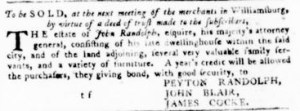
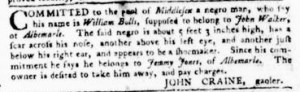
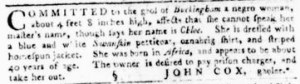
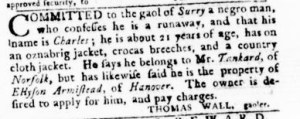
Slavery Advertisements Published October 26, 1775

GUEST CURATOR: Massimo Sgambati

The Slavery Adverts 250 Project chronicles the role of newspaper advertising in perpetuating slavery in the era of the American Revolution. The project seeks to reveal the ubiquity of slavery in eighteenth-century life from New England to Georgia by republishing advertisements about enslaved people – for sale as individuals or in groups, wanted to purchase or for hire for short periods, runaways who liberated themselves, and those who were subsequently captured and confined in jails and workhouses – in daily digests on this site as well as in real time via the @SlaveAdverts250 Twitter feed, utilizing twenty-first-century media to stand in for the print media of the eighteenth century.

The project aims to provide modern audiences with a sense of just how often colonizers encountered these advertisements in their daily lives. Enslaved men, women, and children appeared in print somewhere in the colonies almost every single day. Those advertisements served as a constant backdrop for social, cultural, economic, and political life in colonial and revolutionary America. Colonizers who did not purport to own enslaved people were still confronted with slavery as well as invited to maintain the system by purchasing enslaved men, women, and children or assisting in the capture of so-called “runaways” who sought to free themselves from bondage. The frequency of these newspaper advertisements suggests just how embedded slavery was in colonial and revolutionary American culture in everyday interactions beyond the printed page.

These advertisements also testify to the experiences of enslaved men, women, and children, though readers must consider that those experiences have been remediated through descriptions offered by enslavers rather than enslaved people themselves. Often unnamed in the advertisements, enslaved men, women, and children were not invisible or unimportant in early America.

From compiling an archive of digitized eighteenth-century newspapers to identifying advertisements about enslaved men, women, and children in those newspapers to preparing images of each advertisement to posting this daily digest, Massimo Sgambati served as guest curator for this entry. He completed this work as part of the Summer Scholars Program, funded by a fellowship from the D’Amour College of Liberal Arts and Sciences at Assumption University in Worcester, Massachusetts, in Summer 2025.

These advertisements appeared in colonial American newspapers 250 years ago today.
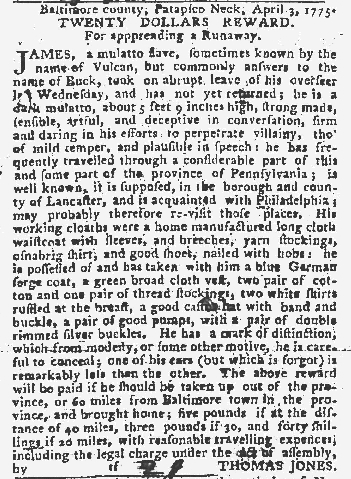
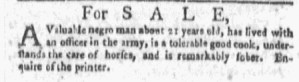
Maryland Gazette (October 26, 1775)

**********

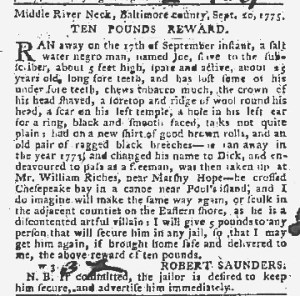
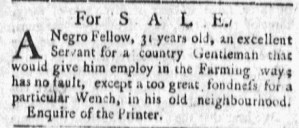
Maryland Gazette (October 26, 1775)

**********

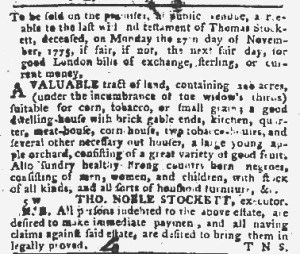
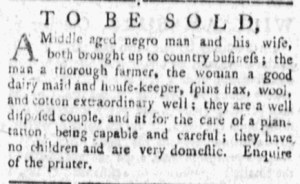
Maryland Gazette (October 26, 1775)

**********

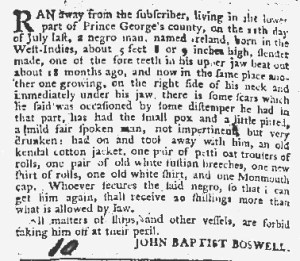
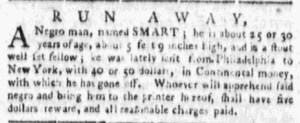
Maryland Gazette (October 26, 1775)

**********

Maryland Gazette (October 26, 1775)

**********

Maryland Gazette (October 26, 1775)

**********

Maryland Gazette (October 26, 1775)

**********

Maryland Gazette (October 26, 1775)

**********

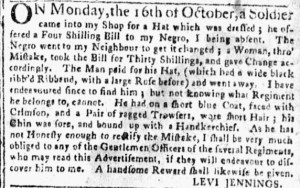
Massachusetts Gazette and Boston Weekly News (October 26, 1775)

**********

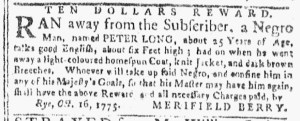
New-England Chronicle (October 26, 1775)

**********

New-England Chronicle (October 26, 1775)

**********

New-England Chronicle (October 26, 1775)

**********

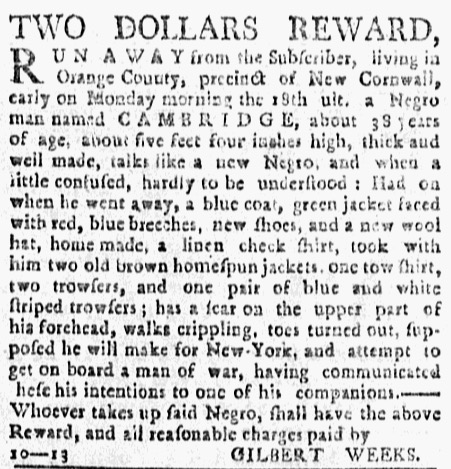
New-York Journal (October 26, 1775)

**********

New-York Journal (October 26, 1775)

**********

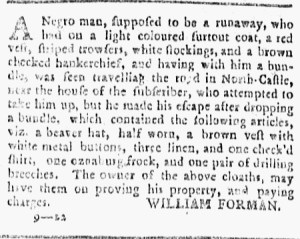
Rivington’s New-York Gazetteer (October 26, 1775)

**********

Rivington’s New-York Gazetteer (October 26, 1775)

**********

Rivington’s New-York Gazetteer (October 26, 1775)

**********

Rivington’s New-York Gazetteer (October 26, 1775)

**********

Virginia Gazette [Pinkney] (October 26, 1775)

**********

Virginia Gazette [Pinkney] (October 26, 1775)

**********

Virginia Gazette [Pinkney] (October 26, 1775)

**********

Virginia Gazette [Pinkney] (October 26, 1775)

**********

Virginia Gazette [Pinkney] (October 26, 1775)

**********

Virginia Gazette [Pinkney] (October 26, 1775)

**********

Virginia Gazette [Pinkney] (October 26, 1775)

**********

Virginia Gazette [Pinkney] (October 26, 1775)

**********

Virginia Gazette [Pinkney] (October 26, 1775)

October 25

Who was the subject of advertisements in a revolutionary American newspaper 250 years ago today?

Constitutional Gazette (October 25, 1775).

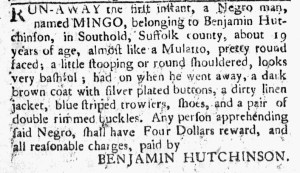
“RUN-AWAY … a Negro man, named MINGO.”

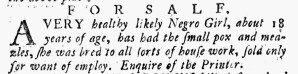
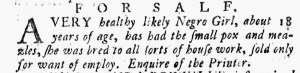
“FOR SALE, A VERY healthy Negro Girl.”

In the fall of 1775, John Anderson joined the ranks of newspaper printers who helped perpetuate slavery by disseminating advertisements about enslaved people in their publications.  In this case, one advertisement concerned “a Negro man, named MINGO,” who liberated himself from Benjamin Hutchinson by escaping from Hutchinson of Southold in Suffolk County on Long Island in early October.  The enslaver described the young man, both his physical features and his clothing, and offered a reward for his capture and return.  Another advertisement offered a “healthy Negro Girl, about 18 years of age,” for sale.  She was capable of “all sorts of house work” and sold “only for want of employ” rather than any deficiency.

Those advertisements first appeared in the October 25 edition of the Constitutional Gazette, a newspaper that commenced publication near the beginning of August.  The new publication initially did not carry advertisements, though Anderson began soliciting them by the end of the month.  Local entrepreneurs who had experience advertising in other newspapers, including goldsmith and jeweller Charles Oliver Bruff and Abraham Delanoy, who pickled lobsters and oysters, soon placed notices in the Constitutional Gazette.  Beyond marketing consumer goods and services, others ran advertisements for a variety of purposes, replicating the kinds of notices found in other newspapers of the period.

Constitutional Gazette (October 25, 1775).

That included advertisements about enslaved people.  Two months after first soliciting advertisements (and less than three months after publishing the inaugural issue), Anderson disseminated Hutchinson’s advertisement about Mingo’s escape from slavery and another notice offering an enslaved young woman for sale.  Like printers from New England to Georgia, he compartmentalized the contents of his newspaper, not devoting much thought to the juxtaposition of news and editorials advocating on behalf of the American cause and advertisements placed for the purpose of perpetuating slavery and the slave trade.

Even as Anderson used his newspaper to advocate for liberty for colonizers who endured the abuses perpetrated by Parliament, he used it to constrain the freedom of Black men, women, and children.  The advertisement about Mingo encouraged readers to engage in surveillance of Black men to determine if any they encountered matched his description.  In addition to publishing advertisements about enslaved people, Anderson also served as a broker.  The advertisement for the young enslaved woman whose name was once known instructed interested parties to “Enquire of the Printer.”  Anderson did more than merely disseminate information.  He actively participated in the sale of the young enslaved woman as one of the services he provided as printer.

Slavery Advertisements Published October 25, 1775

GUEST CURATOR: Massimo Sgambati

The Slavery Adverts 250 Project chronicles the role of newspaper advertising in perpetuating slavery in the era of the American Revolution. The project seeks to reveal the ubiquity of slavery in eighteenth-century life from New England to Georgia by republishing advertisements about enslaved people – for sale as individuals or in groups, wanted to purchase or for hire for short periods, runaways who liberated themselves, and those who were subsequently captured and confined in jails and workhouses – in daily digests on this site as well as in real time via the @SlaveAdverts250 Twitter feed, utilizing twenty-first-century media to stand in for the print media of the eighteenth century.

The project aims to provide modern audiences with a sense of just how often colonizers encountered these advertisements in their daily lives. Enslaved men, women, and children appeared in print somewhere in the colonies almost every single day. Those advertisements served as a constant backdrop for social, cultural, economic, and political life in colonial and revolutionary America. Colonizers who did not purport to own enslaved people were still confronted with slavery as well as invited to maintain the system by purchasing enslaved men, women, and children or assisting in the capture of so-called “runaways” who sought to free themselves from bondage. The frequency of these newspaper advertisements suggests just how embedded slavery was in colonial and revolutionary American culture in everyday interactions beyond the printed page.

These advertisements also testify to the experiences of enslaved men, women, and children, though readers must consider that those experiences have been remediated through descriptions offered by enslavers rather than enslaved people themselves. Often unnamed in the advertisements, enslaved men, women, and children were not invisible or unimportant in early America.

From compiling an archive of digitized eighteenth-century newspapers to identifying advertisements about enslaved men, women, and children in those newspapers to preparing images of each advertisement to posting this daily digest, Massimo Sgambati served as guest curator for this entry. He completed this work as part of the Summer Scholars Program, funded by a fellowship from the D’Amour College of Liberal Arts and Sciences at Assumption University in Worcester, Massachusetts, in Summer 2025.

These advertisements appeared in colonial American newspapers 250 years ago today.

Connecticut Journal (October 25, 1775)

**********

Constitutional Gazette (October 25, 1775)

**********

Constitutional Gazette (October 25, 1775)

**********

Pennsylvania Gazette (October 25, 1775)

**********

Pennsylvania Gazette (October 25, 1775)

**********

Pennsylvania Gazette (October 25, 1775)

October 24

What was advertised in a revolutionary American newspaper 250 years ago today?

Pennsylvania Evening Post (October 25, 1775).

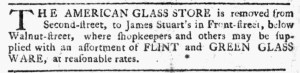
“THE AMERICAN GLASS STORE is removed from Second-street.”

The advertisement consisted of only five lines in the October 24, 1775, edition of the Pennsylvania Evening Post, yet it spoke volumes about the current events.  “THE AMERICAN GLASS STORE,” the notice informed the public, “is removed from Second-street, to James Stuart’s in Front-street, below Walnut-street, where shopkeepers and others may be supplied with an assortment of FLINT and GREEN GLASS WARE, at reasonable rates.”  It was one of many advertisements that presented opportunities for colonizers to “Buy American” during the imperial crisis that eventually became a war for independence.

On several occasions, supporters of the American cause participated in boycotts in hopes of using their participation in the marketplace as leverage to achieve political ends.  They organized nonimportation agreements in response to the Stamp Act in 1765 and in response to the duties levied on certain imported goods, including glass, in the Townshend Acts in the late 1760s.  Simultaneously, they called for “domestic manufactures” or goods produced in the colonies as alternatives to imported wares.  In August 1769, Richard Wistar advertised products from his “GLASS-WORKS,” items “of American manufactory” produced in Pennsylvania, “consequently clear of the duties the Americans so justly complain of.”  The most extensive and coordinated boycott, the Continental Association devised by the First Continental Congress in response to the Coercive Acts, went into effect on December 1, 1774.  Within a week, the “Proprietors of the GLASS HOUSE near this city,” Philadelphia, advertised “White and Green Glass Ware; Such as are usually imported from Great-Britain.”  The proprietors accepted orders from “store-keepers and others, both of town and country.”  As the imperial crisis intensified, savvy entrepreneurs opened an “AMERICAN GLASS STORE” in Philadelphia, an establishment that specialized in glassware produced locally.  The Continental Association specified that colonizers “will, in our several Stations, encourage Frugality, Economy, and Industry; and promote Agriculture, Arts, and the Manufactures of this Country.”  Local producers of glassware delivered, but they needed retailers and consumers to do their part as well.  The brief advertisement in the Pennsylvania Evening Post let shopkeepers and other customers, all of them very much aware of the events of the last decade, know where they could express their political principles by purchasing American glassware.

Slavery Advertisements Published October 24, 1775

GUEST CURATOR: Massimo Sgambati

The Slavery Adverts 250 Project chronicles the role of newspaper advertising in perpetuating slavery in the era of the American Revolution. The project seeks to reveal the ubiquity of slavery in eighteenth-century life from New England to Georgia by republishing advertisements about enslaved people – for sale as individuals or in groups, wanted to purchase or for hire for short periods, runaways who liberated themselves, and those who were subsequently captured and confined in jails and workhouses – in daily digests on this site as well as in real time via the @SlaveAdverts250 Twitter feed, utilizing twenty-first-century media to stand in for the print media of the eighteenth century.

The project aims to provide modern audiences with a sense of just how often colonizers encountered these advertisements in their daily lives. Enslaved men, women, and children appeared in print somewhere in the colonies almost every single day. Those advertisements served as a constant backdrop for social, cultural, economic, and political life in colonial and revolutionary America. Colonizers who did not purport to own enslaved people were still confronted with slavery as well as invited to maintain the system by purchasing enslaved men, women, and children or assisting in the capture of so-called “runaways” who sought to free themselves from bondage. The frequency of these newspaper advertisements suggests just how embedded slavery was in colonial and revolutionary American culture in everyday interactions beyond the printed page.

These advertisements also testify to the experiences of enslaved men, women, and children, though readers must consider that those experiences have been remediated through descriptions offered by enslavers rather than enslaved people themselves. Often unnamed in the advertisements, enslaved men, women, and children were not invisible or unimportant in early America.

From compiling an archive of digitized eighteenth-century newspapers to identifying advertisements about enslaved men, women, and children in those newspapers to preparing images of each advertisement to posting this daily digest, Massimo Sgambati served as guest curator for this entry. He completed this work as part of the Summer Scholars Program, funded by a fellowship from the D’Amour College of Liberal Arts and Sciences at Assumption University in Worcester, Massachusetts, in Summer 2025.

These advertisements appeared in colonial American newspapers 250 years ago today.

Dunlap’s Maryland Gazette (October 24, 1775)

**********

South-Carolina Gazette (October 24, 1775)

**********

South-Carolina Gazette (October 24, 1775)

**********

South-Carolina Gazette (October 24, 1775)

**********

South-Carolina Gazette (October 24, 1775)

**********

South-Carolina Gazette (October 24, 1775)

October 23

What was advertised in a revolutionary American newspaper 250 years ago today?

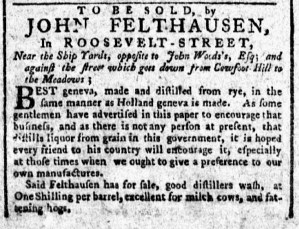
New-York Gazette and Weekly Mercury (October 23, 1775).

“BEST geneva, made and distilled from rye.”

When John Felthausen wanted the public to know about the “BEST geneva [or genever], made and distilled from rye,” that he produced, he placed an advertisement in the October 23, 1775, edition of the New-York Gazette and Weekly Mercury.  He declared that he distilled his spirits “in the same manner as Holland geneva is made,” assuring prospective customers of the quality and taste.  To entice readers to purchase his genever, Felthausen reported that “some gentlemen have advertised in this paper to encourage that business” because “there is not any person at present, that distills liquor from grain in this government” or colony.  In answer to colonizers who expressed a desire for someone to take responsibility for distilling genever and other spirits in New York, Felthausen suggested that they had a responsibility to support his business now that he accepted their charge to launch such an enterprise.

Yet Felthausen did not address solely those who had written of their desire to see genever produced locally.  Instead, he proclaimed that he “hoped every friend to his country” would buy his genever, “especially at those times when we ought to give a preference to our own manufactures.”  The distiller made a “Buy American” argument, confident that prospective customers knew all about the Continental Association, a nonimportation agreement devised by the First Continental Congress in response to the Coercive Acts.  The Continental Association also called on colonizers to promote “Agriculture, Arts, and the Manufactures of this Country” as alternatives to imported goods.  Throughout the colonies, supporters of the American cause mobilized around the choices that they made in the marketplace.  Many became even more determined to so after the battles at Lexington and Concord.  Entrepreneurs like Felthausen encouraged consumers to practice politics when they made purchases, presenting their decisions as civic duties for “every friend to his country.”

Slavery Advertisements Published October 23, 1775

GUEST CURATOR: Massimo Sgambati

The Slavery Adverts 250 Project chronicles the role of newspaper advertising in perpetuating slavery in the era of the American Revolution. The project seeks to reveal the ubiquity of slavery in eighteenth-century life from New England to Georgia by republishing advertisements about enslaved people – for sale as individuals or in groups, wanted to purchase or for hire for short periods, runaways who liberated themselves, and those who were subsequently captured and confined in jails and workhouses – in daily digests on this site as well as in real time via the @SlaveAdverts250 Twitter feed, utilizing twenty-first-century media to stand in for the print media of the eighteenth century.

The project aims to provide modern audiences with a sense of just how often colonizers encountered these advertisements in their daily lives. Enslaved men, women, and children appeared in print somewhere in the colonies almost every single day. Those advertisements served as a constant backdrop for social, cultural, economic, and political life in colonial and revolutionary America. Colonizers who did not purport to own enslaved people were still confronted with slavery as well as invited to maintain the system by purchasing enslaved men, women, and children or assisting in the capture of so-called “runaways” who sought to free themselves from bondage. The frequency of these newspaper advertisements suggests just how embedded slavery was in colonial and revolutionary American culture in everyday interactions beyond the printed page.

These advertisements also testify to the experiences of enslaved men, women, and children, though readers must consider that those experiences have been remediated through descriptions offered by enslavers rather than enslaved people themselves. Often unnamed in the advertisements, enslaved men, women, and children were not invisible or unimportant in early America.

From compiling an archive of digitized eighteenth-century newspapers to identifying advertisements about enslaved men, women, and children in those newspapers to preparing images of each advertisement to posting this daily digest, Massimo Sgambati served as guest curator for this entry. He completed this work as part of the Summer Scholars Program, funded by a fellowship from the D’Amour College of Liberal Arts and Sciences at Assumption University in Worcester, Massachusetts, in Summer 2025.

These advertisements appeared in colonial American newspapers 250 years ago today.

Boston Gazette (October 23, 1775)

**********

Dunlap’s Pennsylvania Packet (October 23, 1775)

**********

New-York Gazette and Weekly Mercury (October 23, 1775)

October 22

What was advertised in a revolutionary American newspaper 250 years ago this week?

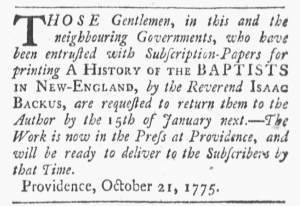
Providence Gazette (October 21, 1775).

“THOSE Gentlemen … who have been entrusted with Subscription-Papers … are requested to return them.”

Among the various advertisements in the October 21, 1775, edition of the Providence Gazette, one requested that “THOSE Gentlemen, in this and the neighbouring Governments [or colonies], who have been entrusted with Subscription-Papers for printing A HISTORY OF THE BAPTISTS IN NEW-ENGLAND … return them to the Author,” Isaac Backus, “by the 15th of January next.”  Backus, a Baptist minister, advocate for religious liberty, and one of the founders of Rhode Island College (now Brown University), previously announced this project in an advertisement in the Providence Gazette ten months earlier in December 1774.  At that time, he indicated that “Subscriptions are taken in by the Author, by Mr. Philip Freeman, in Union-street, Boston; by the Printer of this Paper, and by others who are furnished with Subscription Papers in Town and Country.”

Like many other authors and printers, neither Backus nor John Carter, the “Printer of this Paper” who apparently planned to publish the History, went to press without first having an idea how many copies to produce to make the venture viable.  They disseminated subscription proposals to garner interest, asking those who wished to reserve copies to sign the subscription papers entrusted to local agents in their towns.  The combination of subscription proposals and subscription papers served two important functions, inciting demand and gauging the market.  Despite that level of sophistication, Backus did not write directly to the local agents who oversaw the subscription papers “in Town and Country” but instead ran a newspaper advertisement and expected local agents to see it and respond according to the directions in the notice.

Backus originally instructed that prospective subscribers should “send in their Names” by February 1, 1775, “that it may be determined what Number to print,” but the project had stalled as the imperial crisis intensified.  His new advertisement extended the deadline by nearly a year, though this time he reported that the “Work is now in the Press at Providence, and will be ready to deliver to the Subscribers by that Time.”  That seems to have been another miscalculation since the first of three volumes did not appear until 1777, printed by Edward Draper in Boston rather than by Carter in Providence.  The book had a circuitous path to publication.  Backus attempted to use newspaper advertisements to keep subscribers informed, but factors beyond his control intervened.

October 21

What was advertised in a revolutionary American newspaper 250 years ago today?

Constitutional Gazette (October 21, 1775).

The Public are hereby informed, that the Constitutional Post, goes three times a week between this city and Philadelphia.”

It was yet another advertisement for the Constitutional Post, this time in the October 21, 1775, edition of the Constitutional Gazette, a newspaper printed by John Anderson in New York.  William Goddard, himself a printer, first envisioned the Constitutional Post as an alternative to the imperial postal system in 1773.  The Second Continental Congress adopted a modified version of Goddard’s plan in the summer of 1775 following the outbreak of hostilities at Lexington and Concord.  By then, some local branches of the Constitutional Post had already been established.  Under the direction of Benjamin Franklin, selected as Postmaster General even though Goddard desired the position, the system approved by the Second Continental Congress added new branches and integrated those already in operation to create a network for disseminating information in letters and newspapers from New England to Georgia.

In the fall of 1775, advertisements promoting the Constitutional Post proliferated in American newspapers, especially in those published in the Mid Atlantic.  On October 11, Mary Katharine Goddard, printer of the Maryland Journal in Baltimore, postmaster in that town, and sister of William Goddard, inserted a notice about the schedule for the “CONSTITUTIONAL POST-OFFICE.”  Two days later, Richard Bache, the postmaster in Philadelphia (and son-in-law of Benjamin Franklin), published a more extensive advertisement in Story and Humphreys’s Pennsylvania Mercury.  A little over a week later, Anderson inserted an unsigned notice about the Constitutional Post in the Constitutional Gazette, the newspaper he established in support of the American cause at the beginning of August.   The placement of the notice does not reveal whether Anderson considered it news like the items that appeared immediately above it or an advertisement like his own for “American made DRUMS” immediately below it and the paid notices that appeared on the next page.  For Anderson, that may have been a distinction without a difference.  What mattered was letting the public know that the Constitutional Post dispatched riders to and from Philadelphia three times a week and the system reached “as far as New-Hampshire” in the north and “as far as Savanna, in Georgia,” to the south.

Slavery Advertisements Published October 21, 1775

GUEST CURATOR: Massimo Sgambati

The Slavery Adverts 250 Project chronicles the role of newspaper advertising in perpetuating slavery in the era of the American Revolution. The project seeks to reveal the ubiquity of slavery in eighteenth-century life from New England to Georgia by republishing advertisements about enslaved people – for sale as individuals or in groups, wanted to purchase or for hire for short periods, runaways who liberated themselves, and those who were subsequently captured and confined in jails and workhouses – in daily digests on this site as well as in real time via the @SlaveAdverts250 Twitter feed, utilizing twenty-first-century media to stand in for the print media of the eighteenth century.

The project aims to provide modern audiences with a sense of just how often colonizers encountered these advertisements in their daily lives. Enslaved men, women, and children appeared in print somewhere in the colonies almost every single day. Those advertisements served as a constant backdrop for social, cultural, economic, and political life in colonial and revolutionary America. Colonizers who did not purport to own enslaved people were still confronted with slavery as well as invited to maintain the system by purchasing enslaved men, women, and children or assisting in the capture of so-called “runaways” who sought to free themselves from bondage. The frequency of these newspaper advertisements suggests just how embedded slavery was in colonial and revolutionary American culture in everyday interactions beyond the printed page.

These advertisements also testify to the experiences of enslaved men, women, and children, though readers must consider that those experiences have been remediated through descriptions offered by enslavers rather than enslaved people themselves. Often unnamed in the advertisements, enslaved men, women, and children were not invisible or unimportant in early America.

From compiling an archive of digitized eighteenth-century newspapers to identifying advertisements about enslaved men, women, and children in those newspapers to preparing images of each advertisement to posting this daily digest, Massimo Sgambati served as guest curator for this entry. He completed this work as part of the Summer Scholars Program, funded by a fellowship from the D’Amour College of Liberal Arts and Sciences at Assumption University in Worcester, Massachusetts, in Summer 2025.

These advertisements appeared in colonial American newspapers 250 years ago today.

Providence Gazette (October 21, 1775)

**********

Virginia Gazette [Dixon and Hunter] (October 21, 1775)

**********

Virginia Gazette [Dixon and Hunter] (October 21, 1775)

**********

Virginia Gazette [Dixon and Hunter] (October 21, 1775)