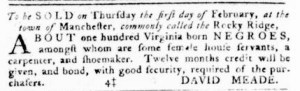
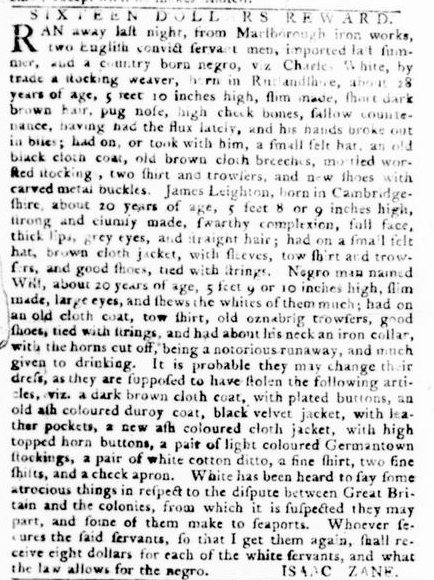
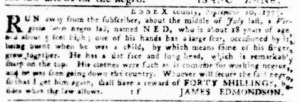
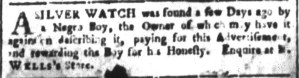
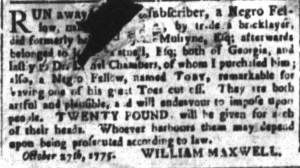
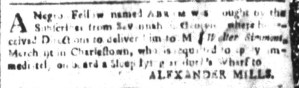
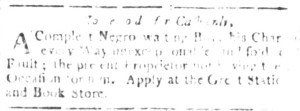
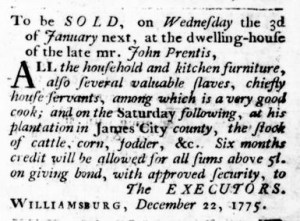
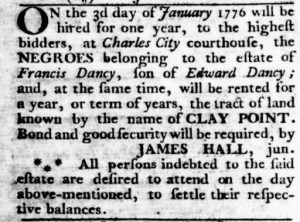
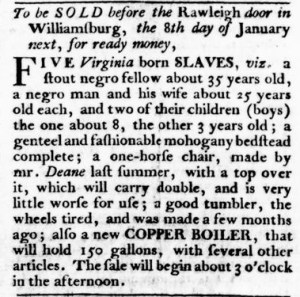
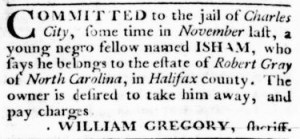
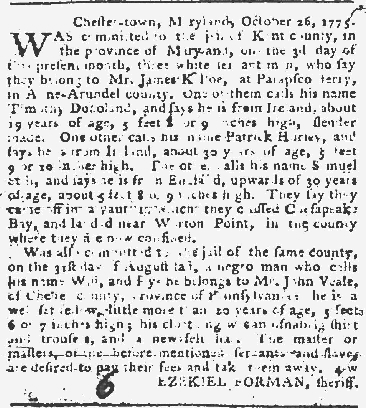
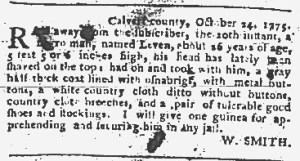
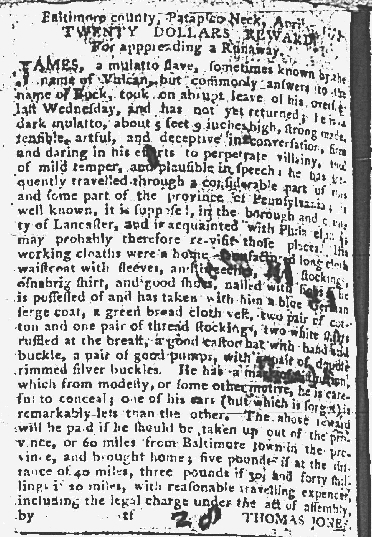
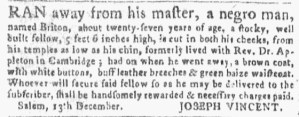
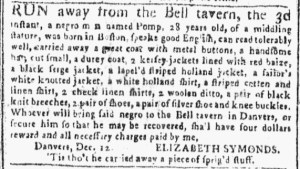
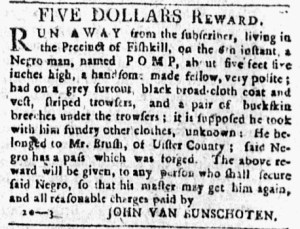
Slavery Advertisements Published December 26, 1775

GUEST CURATOR: Massimo Sgambati

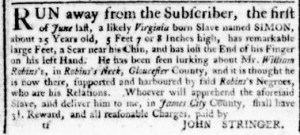
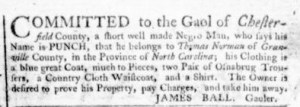
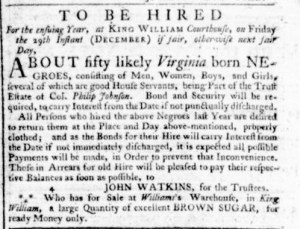
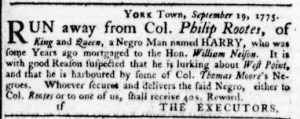
The Slavery Adverts 250 Project chronicles the role of newspaper advertising in perpetuating slavery in the era of the American Revolution. The project seeks to reveal the ubiquity of slavery in eighteenth-century life from New England to Georgia by republishing advertisements about enslaved people – for sale as individuals or in groups, wanted to purchase or for hire for short periods, runaways who liberated themselves, and those who were subsequently captured and confined in jails and workhouses – in daily digests on this site as well as in real time via the @SlaveAdverts250 Twitter feed, utilizing twenty-first-century media to stand in for the print media of the eighteenth century.

The project aims to provide modern audiences with a sense of just how often colonizers encountered these advertisements in their daily lives. Enslaved men, women, and children appeared in print somewhere in the colonies almost every single day. Those advertisements served as a constant backdrop for social, cultural, economic, and political life in colonial and revolutionary America. Colonizers who did not purport to own enslaved people were still confronted with slavery as well as invited to maintain the system by purchasing enslaved men, women, and children or assisting in the capture of so-called “runaways” who sought to free themselves from bondage. The frequency of these newspaper advertisements suggests just how embedded slavery was in colonial and revolutionary American culture in everyday interactions beyond the printed page.

These advertisements also testify to the experiences of enslaved men, women, and children, though readers must consider that those experiences have been remediated through descriptions offered by enslavers rather than enslaved people themselves. Often unnamed in the advertisements, enslaved men, women, and children were not invisible or unimportant in early America.

From compiling an archive of digitized eighteenth-century newspapers to identifying advertisements about enslaved men, women, and children in those newspapers to preparing images of each advertisement to posting this daily digest, Massimo Sgambati served as guest curator for this entry. He completed this work as part of the Summer Scholars Program, funded by a fellowship from the D’Amour College of Liberal Arts and Sciences at Assumption University in Worcester, Massachusetts, in Summer 2025.

These advertisements appeared in colonial American newspapers 250 years ago today.
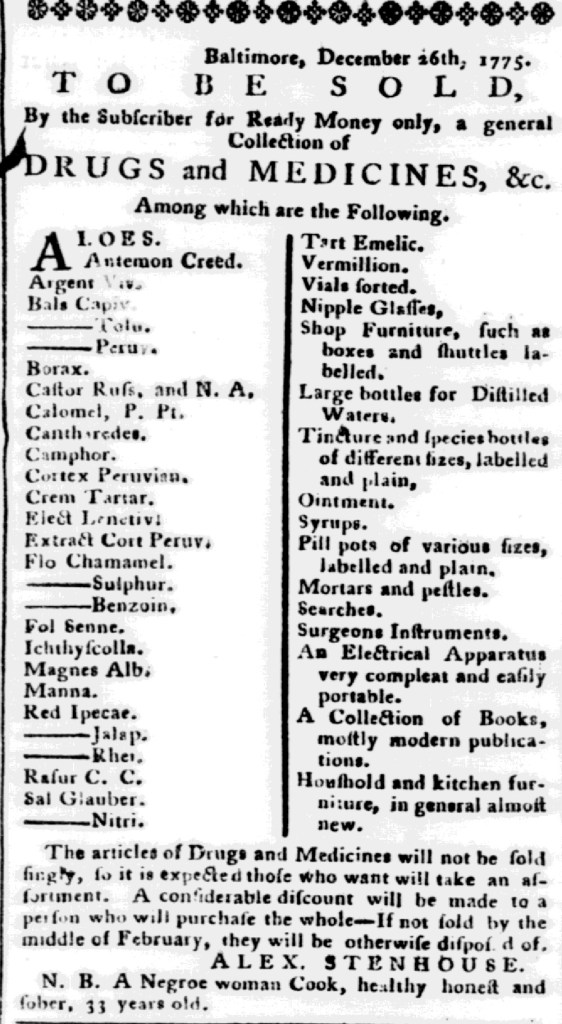
Dunlap’s Maryland Gazette (December 26, 1775)

December 25

What was advertised in a revolutionary American newspaper 250 years ago today?

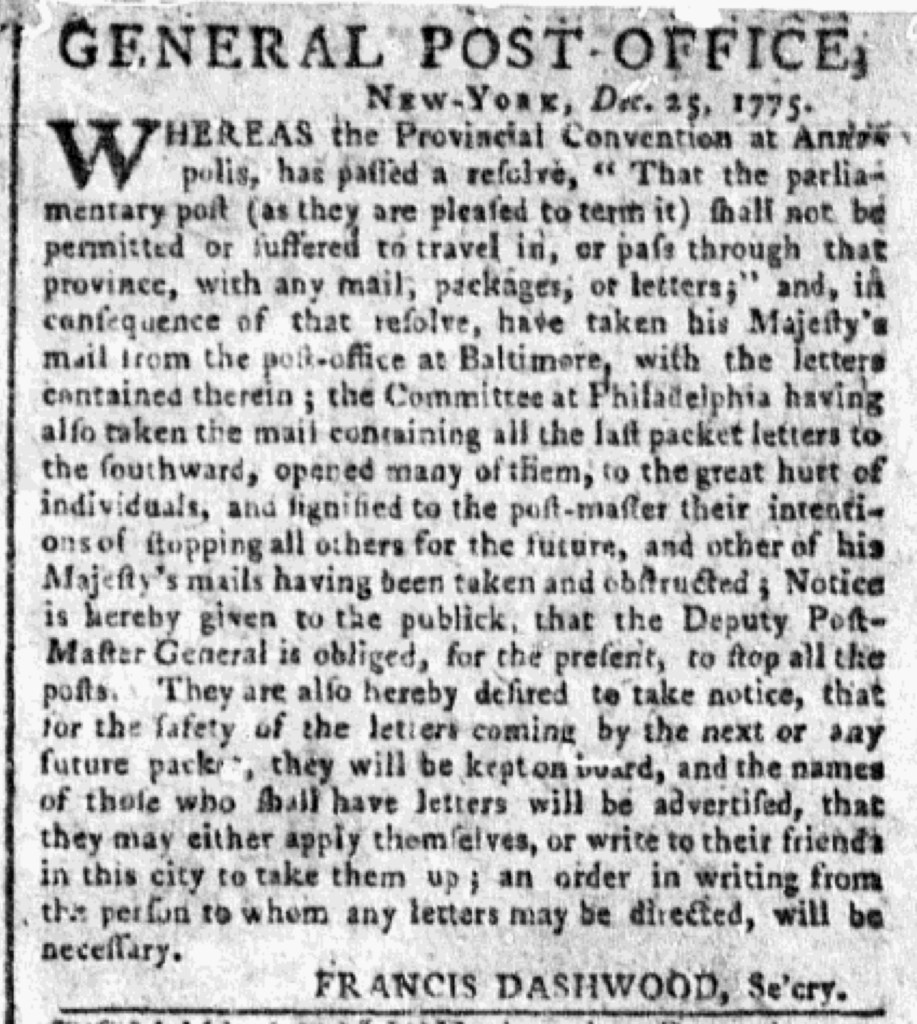
New-York Gazette and Weekly Mercury (December 25, 1775).

“The Deputy Post-Master General is obliged, for the present, to stop all the posts.”

In the summer and fall of 1775, advertisements for local Constitutional Post Offices, established by the Second Continental Congress as an alternative to the imperial system, appeared in newspapers printed in several colonies.  Postmasters provided schedules.  Post riders offered their services.  As winter arrived, the Deputy Postmaster General of the “parliamentary post (as [supporters of the American cause] are pleased to term it)” published an advertisement announcing that he “is obliged, for the present, to stop all the posts.”  He did not cite competition from the Constitutional Post.  Instead, he blamed the actions of provincial conventions meeting in some of the colonies and abuses by rogues who tampered with private letters.

In Maryland, for instance, one of those conventions passed a resolve that “the parliamentary post … shall not be permitted or suffered to travel in, or pass through, that province, with any mail, packages, or letters.”  In turn, they had confiscated “his Majesty’s mail from the post-office at Baltimore.”  Similarly, a committee in Philadelphia seized “the last packet letters to the southward … and signified to the post-master their intentions of stopping all others for the future.”  That was not all!  That committee also “opened many of [the letters], to the great hurt of individuals,” engaging in some of the same behavior that had caused William Goddard first to envision the Constitutional Post and then advocate that the Second Continental Congress officially endorse it.  The Deputy Postmaster General suggested that it was the Sons of Liberty and their supporters who had infringed on the liberties of others.

Yet this did not end the imperial postal system, though the procedures for delivering letters changed: “for the safety of the letters coming by the next or any future packet,” a ship that carried mail, “they will be kept onboard, and the names of those who shall have letters will be advertised.”  Even if Hugh Gaine, the printer of the New-York Gazette and Weekly Mercury who had recently published a local edition of the Journal of the Proceedings of the Continental Congress, did not care for every British policy, he almost certainly welcomed the advertising revenue for running this notice and the prospects for publishing lists of those who had letters waiting for them aboard packet ships in the harbor.  He was not a staunch patriot like John Holt, printer of the New-York Journal, and John Anderson, printer of the Constitutional Gazette, helping to explain why the advertisement concerning the “GENERAL POST-OFFICE” first appeared in his newspaper.

Slavery Advertisements Published December 25, 1775

GUEST CURATOR: Massimo Sgambati

The Slavery Adverts 250 Project chronicles the role of newspaper advertising in perpetuating slavery in the era of the American Revolution. The project seeks to reveal the ubiquity of slavery in eighteenth-century life from New England to Georgia by republishing advertisements about enslaved people – for sale as individuals or in groups, wanted to purchase or for hire for short periods, runaways who liberated themselves, and those who were subsequently captured and confined in jails and workhouses – in daily digests on this site as well as in real time via the @SlaveAdverts250 Twitter feed, utilizing twenty-first-century media to stand in for the print media of the eighteenth century.

The project aims to provide modern audiences with a sense of just how often colonizers encountered these advertisements in their daily lives. Enslaved men, women, and children appeared in print somewhere in the colonies almost every single day. Those advertisements served as a constant backdrop for social, cultural, economic, and political life in colonial and revolutionary America. Colonizers who did not purport to own enslaved people were still confronted with slavery as well as invited to maintain the system by purchasing enslaved men, women, and children or assisting in the capture of so-called “runaways” who sought to free themselves from bondage. The frequency of these newspaper advertisements suggests just how embedded slavery was in colonial and revolutionary American culture in everyday interactions beyond the printed page.

These advertisements also testify to the experiences of enslaved men, women, and children, though readers must consider that those experiences have been remediated through descriptions offered by enslavers rather than enslaved people themselves. Often unnamed in the advertisements, enslaved men, women, and children were not invisible or unimportant in early America.

From compiling an archive of digitized eighteenth-century newspapers to identifying advertisements about enslaved men, women, and children in those newspapers to preparing images of each advertisement to posting this daily digest, Massimo Sgambati served as guest curator for this entry. He completed this work as part of the Summer Scholars Program, funded by a fellowship from the D’Amour College of Liberal Arts and Sciences at Assumption University in Worcester, Massachusetts, in Summer 2025.

These advertisements appeared in colonial American newspapers 250 years ago today.
Dunlap’s Pennsylvania Packet (December 25, 1775)

**********

New-York Gazette and Weekly Mercury (December 25, 1775)

**********

New-York Gazette and Weekly Mercury (December 25, 1775)

December 24

What was advertised in a revolutionary American newspaper 250 years ago this week?

Connecticut Gazette (December 22, 1775).

“All kinds of Work both in the Plain and Regimental Way.”

When Edward Davis placed an advertisement in the Connecticut Gazette in December 1775, it looked much like advertisements that other tailors ran in newspapers throughout the colonies.  He stated that he “performs in the neatest and genteelest Manner, and at the most reasonable Prices, all kinds of Work.”  In just a few words, he emphasized his skill and made appeals to quality, fashion, and price.  “Any Gentlemen who are disposed to honour him with their Commands,” Davis declared, “he will faithfully serve and with the utmost Punctuality; and will with Gratitude acknowledge the smallest Favours conferr’d on their most obedient Servant.”  Those overtures promising exemplary customer service echoed advertisements placed by many other shopkeepers and artisans.

Yet Davis’s notice also contained some distinctive features that resonated with current events.  He introduced himself as a “TAYLOR from BOSTON” who “Has taken a Shop in the Parish of Scotland, in Windham, near the Meeting House.” Newcomers often used newspaper advertisements to introduce themselves when they moved to a new town, hoping to attract the attention of prospective customers.  At other times, Davis’s previous experience in Boston would have supported his claim to make garment in the “genteelest Manner,” bringing the styles of the bustling urban port to the countryside.  In this instance, however, noting that he came “from BOSTON” might have signaled that he was a refugee who departed the city during the exchange negotiated by General Thomas Gage and the Sons of Liberty after the battles at Lexington and Concord.  At the time Davis ran his advertisement, the siege continued.  In Connecticut and Rhode Island, the frequency of advertisers describing themselves as “from BOSTON” seemed to increase, likely reflecting decisions made by many residents to leave when they had the chance.  After all, they had already experienced the distresses that ensued when Parliament passed the Boston Port Act to close the harbor until colonizers made restitution for the tea destroyed in December 1773.  Davis made another nod to the war that began the previous April.  In addition to “Plain” clothing, he also made items in the “Regimental Way” to outfit soldiers and officers.  At a glance, his advertisement looked like so many others placed by tailors, but on closer inspection it testified to the times and the transition from imperial crisis to warfare.

December 23

What was advertised in a revolutionary American newspaper 250 years ago today?

Virginia Gazette [Dixon and Hunter] (December 23, 1775).

“A large and exact VIEW of the late BATTLE at CHARLESTOWN.”

Like other printers, John Dixon and William Hunter sold books, pamphlets, almanacs, stationery, and other merchandise to supplement the revenues they generated from newspaper subscriptions, advertisements, and job printing.  They frequently placed advertisements in their newspaper, the Virginia Gazette, to generate demand for those wares.  The December 23, 1775, edition, for instance, included three of their advertisements, one for “SONG BOOKS and SCHOOL BOOKS For SALE at this OFFICE” and another for the “Virginia ALMANACK” for 1776 with calculations “Fitting VIRGINIA, MARYLAND, [and] NORTH CAROLINA” by “the ingenious Mr. DAVID RITTENHOUSE of Philadelphia,” the same mathematician who did the calculations for Father Abraham’s Almanack marketed in Philadelphia and Baltimore.

Their third advertisement promoted memorabilia related to the hostilities that erupted at Lexington and Concord earlier in the year.  “Just come to Hand, and to be SOLD at this PRINTING-OFFICE,” Dixon and Hunter proclaimed, “A large and exact VIEW of the late BATTLE at CHARLESTOWN,” now known as the Battle of Bunker Hill.  The copies they stocked were “Elegantly coloured” and sold for “one Dollar.”  Dixon and Hunter apparently carried a print, “An Exact View,” engraved by Bernard Romans and published by Nicholas Brooks, rather than a striking similar (and perhaps pirated) print, “A Correct View,” that Robert Aitken included in a recent issue of the Pennsylvania Magazine, or American Monthly Museum and sold separately.  Romans and Brooks had advertised widely and designated local agents to accept subscriptions for the print.  Dixon and Hunter also advertised another collaboration between Romans and Brooks, “an accurate MAP of The present SEAT of CIVIL WAR, Taken by an able Draughtsman, who was on the Spot at the late Engagement.”  The map also sold for “one Dollar.”  Previous efforts to market the map included a broadside subscription proposal that listed local agents in various towns, including “Purdie and Dixon, Williamsburgh.”  Romans and Brooks apparently had not consulted with all the printers, booksellers, and other men they named as local agents when they drew up the list or else they would have known that Alexander Purdie and John Dixon had dissolved their partnership in December 1774.  Dixon took on Hunter as his new partner while Purdie set about publishing his own Virginia Gazette.  Those details may have mattered less to Romans and Brooks than their expectation that printers, booksellers, and others with reputations for supporting the American cause would indeed aid them in marketing and selling a map depicting the conflict underway in Massachusetts.  Whether or not Purdie or Dixon and Hunter collected subscriptions, local agents in Williamsburg did eventually sell the print and the map that supplemented newspaper accounts and encouraged feelings of patriotism among the consumers who purchased them.

Slavery Advertisements Published December 23, 1775

GUEST CURATOR: Massimo Sgambati

The Slavery Adverts 250 Project chronicles the role of newspaper advertising in perpetuating slavery in the era of the American Revolution. The project seeks to reveal the ubiquity of slavery in eighteenth-century life from New England to Georgia by republishing advertisements about enslaved people – for sale as individuals or in groups, wanted to purchase or for hire for short periods, runaways who liberated themselves, and those who were subsequently captured and confined in jails and workhouses – in daily digests on this site as well as in real time via the @SlaveAdverts250 Twitter feed, utilizing twenty-first-century media to stand in for the print media of the eighteenth century.

The project aims to provide modern audiences with a sense of just how often colonizers encountered these advertisements in their daily lives. Enslaved men, women, and children appeared in print somewhere in the colonies almost every single day. Those advertisements served as a constant backdrop for social, cultural, economic, and political life in colonial and revolutionary America. Colonizers who did not purport to own enslaved people were still confronted with slavery as well as invited to maintain the system by purchasing enslaved men, women, and children or assisting in the capture of so-called “runaways” who sought to free themselves from bondage. The frequency of these newspaper advertisements suggests just how embedded slavery was in colonial and revolutionary American culture in everyday interactions beyond the printed page.

These advertisements also testify to the experiences of enslaved men, women, and children, though readers must consider that those experiences have been remediated through descriptions offered by enslavers rather than enslaved people themselves. Often unnamed in the advertisements, enslaved men, women, and children were not invisible or unimportant in early America.

From compiling an archive of digitized eighteenth-century newspapers to identifying advertisements about enslaved men, women, and children in those newspapers to preparing images of each advertisement to posting this daily digest, Massimo Sgambati served as guest curator for this entry. He completed this work as part of the Summer Scholars Program, funded by a fellowship from the D’Amour College of Liberal Arts and Sciences at Assumption University in Worcester, Massachusetts, in Summer 2025.

These advertisements appeared in colonial American newspapers 250 years ago today.
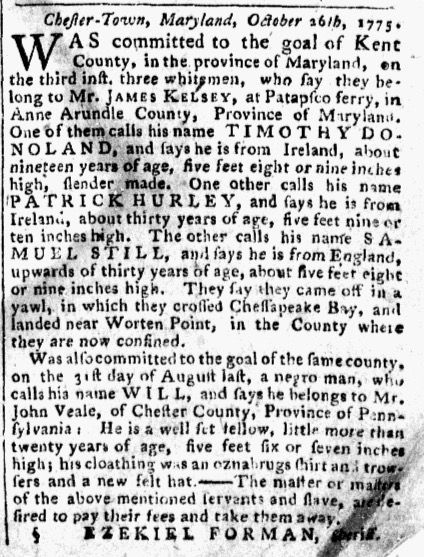
Pennsylvania Ledger (December 23, 1775)

**********

Providence Gazette (December 23, 1775)

**********

Virginia Gazette [Dixon and Hunter] (December 23, 1775)

**********

Virginia Gazette [Dixon and Hunter] (December 23, 1775)

**********

Virginia Gazette [Dixon and Hunter] (December 23, 1775)

**********

Virginia Gazette [Dixon and Hunter] (December 23, 1775)

**********

Virginia Gazette [Dixon and Hunter] (December 23, 1775)

**********

Virginia Gazette [Dixon and Hunter] (December 23, 1775)

**********

Virginia Gazette [Dixon and Hunter] (December 23, 1775)

**********

Virginia Gazette [Dixon and Hunter] (December 23, 1775)

**********

Virginia Gazette [Pinkney] (December 23, 1775)

**********

Virginia Gazette [Pinkney] (December 23, 1775)

**********

Virginia Gazette [Pinkney] (December 23, 1775)

December 22

What was advertised in a revolutionary American newspaper 250 years ago today?

South-Carolina and American General Gazette (December 22, 1775).

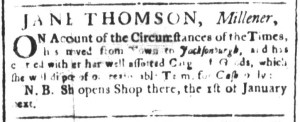
“JANE THOMSON, Millener, ON Account of the Circumstances of the Times, has moved from Town to Jacksonburgh.”

In December 1775, Jane Thomson, a milliner, had been running a shop in Charleston and occasionally placing newspaper advertisements for several years.  She likely followed news from Massachusetts about the hostilities that commenced at Lexington and Concord the previous April as well as updates from the meetings of the Second Continental Congress in Philadelphia.  She probably knew that residents of urban ports beyond New England felt anxious that the British would target their homes next, prompting some to move to the countryside for better security.  She apparently experienced the same anxiety and charted a new course accordingly.  In the December 22 edition of the South-Carolina and American General Gazette, the only newspaper still being published in the colony at the time, she announced that “ON Account of the Circumstances of the Times” she “has moved from Town [or Charleston] to Jacksonburgh,” nearly fifty miles to the west.  Thomson informed readers that she “has carried with her her well assorted [illegible] of Goods, which she will dispose of on reasonable Terms for Cash only.”  She planned to open her shop in her new location on January 1, 1776.

Thomson’s notice will be one of the last advertisements from the South-Carolina and American General Gazette featured on the Adverts 250 Project.  The newspaper continued publication until the end of February 1781, with some suspensions due to the Revolutionary War, and a complete run through December 1779 has been preserved buy the Charleston Library Society.  However, issues for 1776, 1777, 1778, and 1779 have not been digitized for greater accessibility.  In producing the Adverts 250 Project and the Slavery Adverts 250 Project, I have relied on the South Carolina Newspapers collection from Accessible Archives (now part of History Commons), yet that coverage ends with the issue for December 22, 1775.  Readex’s America’s Historical Newspapers has five more issues (September 4, 1776; April 10, 1777; February 19, June 4, and October 1, 1778) that I will incorporate into the project at the appropriate times, but the Adverts 250 Project and the Slavery Adverts 250 Project will not offer the same sustained look at advertising and the intersections of commerce, politics, and everyday life in Charleston during the Revolutionary War as I have attempted to provide for the period of the imperial crisis that ultimately led to that war.  The stories of that important urban port have always been truncated according to which advertisements I selected to feature.  Now they will be absent altogether.

Slavery Advertisements Published December 22, 1775

GUEST CURATOR: Massimo Sgambati

The Slavery Adverts 250 Project chronicles the role of newspaper advertising in perpetuating slavery in the era of the American Revolution. The project seeks to reveal the ubiquity of slavery in eighteenth-century life from New England to Georgia by republishing advertisements about enslaved people – for sale as individuals or in groups, wanted to purchase or for hire for short periods, runaways who liberated themselves, and those who were subsequently captured and confined in jails and workhouses – in daily digests on this site as well as in real time via the @SlaveAdverts250 Twitter feed, utilizing twenty-first-century media to stand in for the print media of the eighteenth century.

The project aims to provide modern audiences with a sense of just how often colonizers encountered these advertisements in their daily lives. Enslaved men, women, and children appeared in print somewhere in the colonies almost every single day. Those advertisements served as a constant backdrop for social, cultural, economic, and political life in colonial and revolutionary America. Colonizers who did not purport to own enslaved people were still confronted with slavery as well as invited to maintain the system by purchasing enslaved men, women, and children or assisting in the capture of so-called “runaways” who sought to free themselves from bondage. The frequency of these newspaper advertisements suggests just how embedded slavery was in colonial and revolutionary American culture in everyday interactions beyond the printed page.

These advertisements also testify to the experiences of enslaved men, women, and children, though readers must consider that those experiences have been remediated through descriptions offered by enslavers rather than enslaved people themselves. Often unnamed in the advertisements, enslaved men, women, and children were not invisible or unimportant in early America.

From compiling an archive of digitized eighteenth-century newspapers to identifying advertisements about enslaved men, women, and children in those newspapers to preparing images of each advertisement to posting this daily digest, Massimo Sgambati served as guest curator for this entry. He completed this work as part of the Summer Scholars Program, funded by a fellowship from the D’Amour College of Liberal Arts and Sciences at Assumption University in Worcester, Massachusetts, in Summer 2025.

These advertisements appeared in colonial American newspapers 250 years ago today.

South-Carolina and American General Gazette (December 22, 1775)

**********

South-Carolina and American General Gazette (December 22, 1775)

**********

South-Carolina and American General Gazette (December 22, 1775)

**********

South-Carolina and American General Gazette (December 22, 1775)

**********

South-Carolina and American General Gazette (December 22, 1775)

**********

South-Carolina and American General Gazette (December 22, 1775)

**********

South-Carolina and American General Gazette (December 22, 1775)

**********

South-Carolina and American General Gazette (December 22, 1775)

**********

South-Carolina and American General Gazette (December 22, 1775)

**********

South-Carolina and American General Gazette (December 22, 1775)

**********

South-Carolina and American General Gazette (December 22, 1775)

**********

Virginia Gazette [Purdie] (December 22, 1775)

**********

Virginia Gazette [Purdie] (December 22, 1775)

**********

Virginia Gazette [Purdie] (December 22, 1775)

**********

Virginia Gazette [Purdie] (December 22, 1775)

**********

Virginia Gazette [Purdie] (December 22, 1775)

**********

Virginia Gazette [Purdie] (December 22, 1775)

**********

Virginia Gazette [Purdie] (December 22, 1775)

**********

Virginia Gazette [Purdie] (December 22, 1775)

December 21

What was advertised in a revolutionary American newspaper 250 years ago today?

New-York Journal (December 21, 1775).

“WILL BE PUBLISHED … A JOURNAL OF THE PROCEEDINGS OF THE CONTINENTAL CONGRESS.”

On Thursday, December 21, 1775, John Anderson, the printer of the Constitutional Gazette, ran an advertisement in the New-York Journal to stimulate interest in one of his forthcoming projects.  “On SATURDAY NEXT,” he announced, “will be published, by JOHN ANDERSON … A JOURNAL OF THE PROCEEDINGS OF THE CONTINENTAL CONGRESS.”  Just two weeks earlier, William Bradford and Thomas Bradford, the printers of the Pennsylvania Journal, advertised that they would soon publish the “JOURNAL OF THE PROCEEDINGS OF THE CONGRESS, HELD AT PHILADELPHIA, May 10, 1775.”  It appears that Anderson quickly acquired a copy and set about printing a local edition for the New York market, making him the first printer outside of Philadelphia to publish an overview of the Second Continental Congress when it convened after the battles at Lexington and Concord.  The volume that Anderson published had a slightly different title than what appeared in the advertisement: Extracts from the Votes and Proceedings of the American Continental Congress: Held at Philadelphia, 10th May, 1775.  In the rush to take it to press, the compositor introduced several errors in the page numbers, according to the American Antiquarian Society’s catalog.

Neither the Bradfords nor Anderson merely printed these collections of records of the Second Continental Congress and then advertised them.  Instead, both encouraged readers to anticipate their publication, making the eventual announcements that they were available for purchase even more enticing and persuasive.  On Saturday, December 23, Anderson’s own newspaper featured an advertisement promising that “This Day will be published by the Printer.  A Journal of the Proceedings of the Continental Congress.”  Eager customers could visit his printing office “at Beekman’s-Slip” to see if copies were ready for purchase.  By December 27, they were certainly available.  In the issue of the Constitutional Gazette distributed that day, Anderson described the volume as “Just published by the Printer” and listed three local agents who also sold it.  An updated advertisement also appeared in the New-York Journal on December 28, nearly identical to the one from the previous issue with the first two lines replaced with a single line.  Anderson’s advertisement began, “Just published, and to be sold by” instead of “On SATURDAY NEXT / WILL BE PUBLISHED, by.”  Using a series of advertisements in two of New York’s newspapers, Anderson announced the forthcoming publication of a local edition of “THE PROCEEDINGS OF THE CONTINENTAL CONGRESS” and kept the public informed of its progress and availability.

Slavery Advertisements Published December 21, 1775

GUEST CURATOR: Massimo Sgambati

The Slavery Adverts 250 Project chronicles the role of newspaper advertising in perpetuating slavery in the era of the American Revolution. The project seeks to reveal the ubiquity of slavery in eighteenth-century life from New England to Georgia by republishing advertisements about enslaved people – for sale as individuals or in groups, wanted to purchase or for hire for short periods, runaways who liberated themselves, and those who were subsequently captured and confined in jails and workhouses – in daily digests on this site as well as in real time via the @SlaveAdverts250 Twitter feed, utilizing twenty-first-century media to stand in for the print media of the eighteenth century.

The project aims to provide modern audiences with a sense of just how often colonizers encountered these advertisements in their daily lives. Enslaved men, women, and children appeared in print somewhere in the colonies almost every single day. Those advertisements served as a constant backdrop for social, cultural, economic, and political life in colonial and revolutionary America. Colonizers who did not purport to own enslaved people were still confronted with slavery as well as invited to maintain the system by purchasing enslaved men, women, and children or assisting in the capture of so-called “runaways” who sought to free themselves from bondage. The frequency of these newspaper advertisements suggests just how embedded slavery was in colonial and revolutionary American culture in everyday interactions beyond the printed page.

These advertisements also testify to the experiences of enslaved men, women, and children, though readers must consider that those experiences have been remediated through descriptions offered by enslavers rather than enslaved people themselves. Often unnamed in the advertisements, enslaved men, women, and children were not invisible or unimportant in early America.

From compiling an archive of digitized eighteenth-century newspapers to identifying advertisements about enslaved men, women, and children in those newspapers to preparing images of each advertisement to posting this daily digest, Massimo Sgambati served as guest curator for this entry. He completed this work as part of the Summer Scholars Program, funded by a fellowship from the D’Amour College of Liberal Arts and Sciences at Assumption University in Worcester, Massachusetts, in Summer 2025.

These advertisements appeared in colonial American newspapers 250 years ago today.

Maryland Gazette (December 21, 1775)

**********

Maryland Gazette (December 21, 1775)

**********

Maryland Gazette (December 21, 1775)

**********

Maryland Gazette (December 21, 1775)

**********

Maryland Gazette (December 21, 1775)

**********

Maryland Gazette (December 21, 1775)

**********

Maryland Gazette (December 21, 1775)

**********

New-England Chronicle (December 21, 1775)

**********

New-England Chronicle (December 21, 1775)

**********

New-England Chronicle (December 21, 1775)

**********

New-York Journal (December 21, 1775)