Historians consider Thomas Paine’s Common Sense, published anonymously on January 9, 1776, the most influential political pamphlet that circulated in the colonies during the era of the American Revolution. Written in plain language accessible to readers of all backgrounds, the pamphlet made a bold case for declaring independence at a time that many colonizers still sought a redress their grievances by George III and Parliament. Paine’s pamphlet played a vital role in swaying public opinion in favor of declaring independence.
Common Sense was an eighteenth-century bestseller, though Paine wildly overestimated how many copies were published, claiming 150,000 circulated in 1776, and historians later made even more dubious claims that American printing presses produced as many as 500,000 copies. Contrary to those exaggerations, American printers most likely published between 35,000 and 50,000 copies in 1776. Scholars have identified twenty-five American editions, more than twice as many as any other American book or pamphlet published in the eighteenth century.
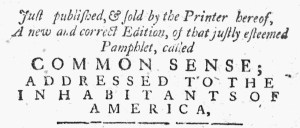
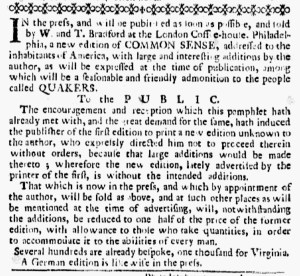
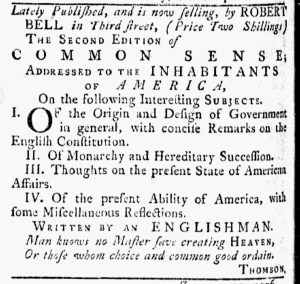
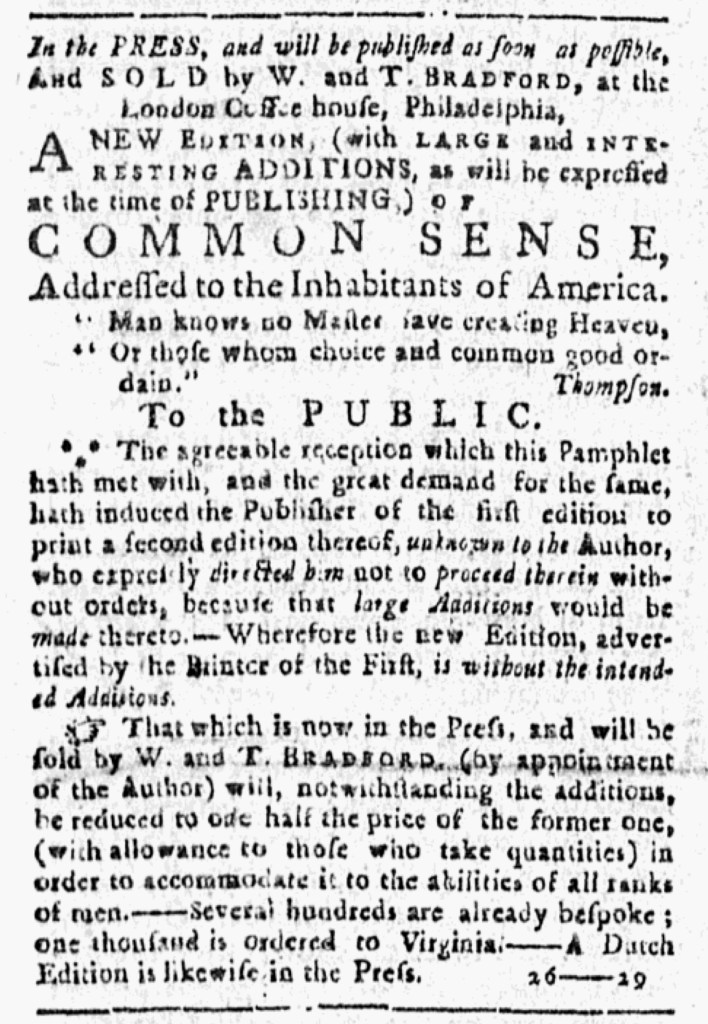
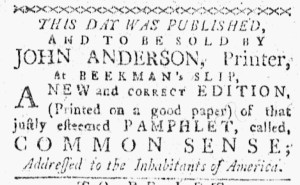
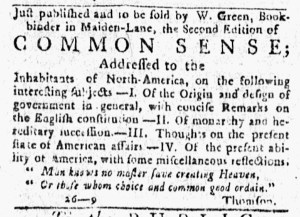
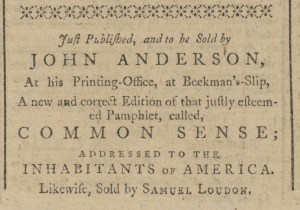
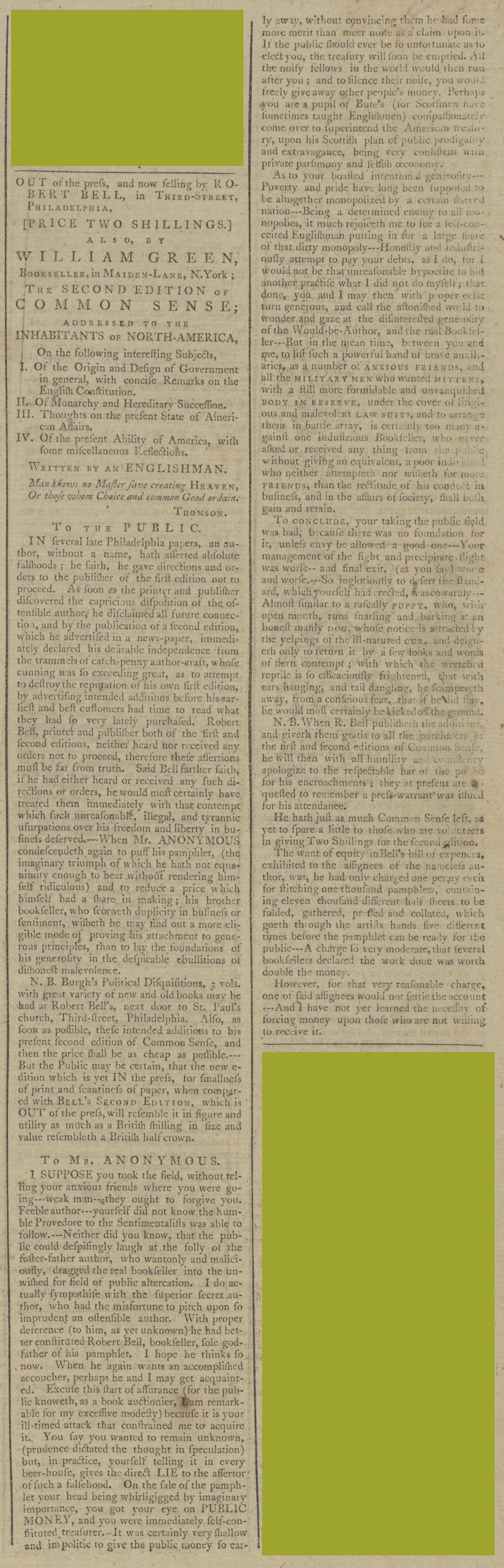
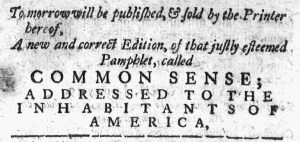
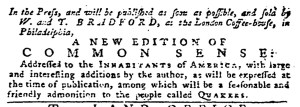
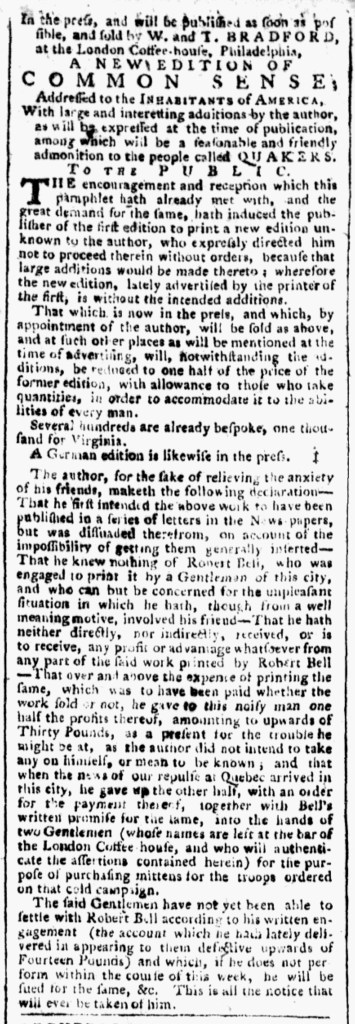
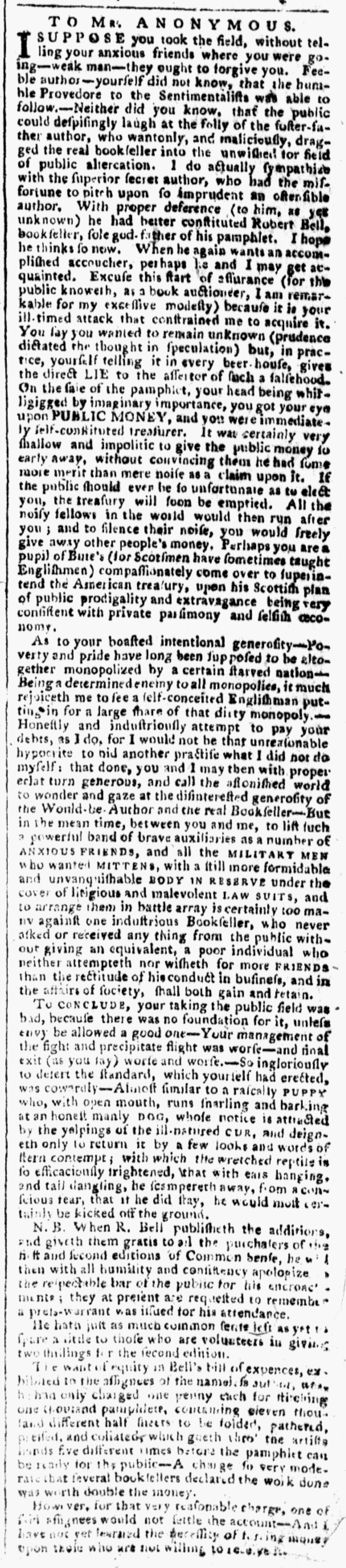
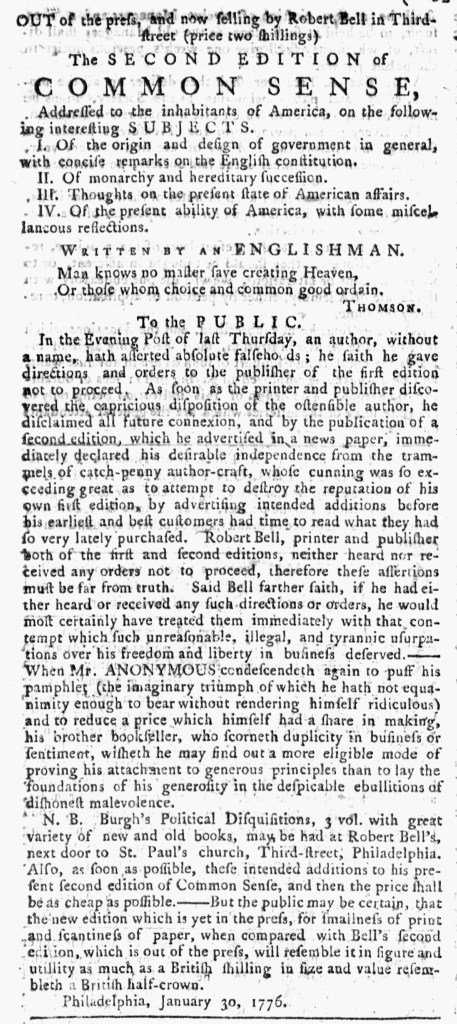
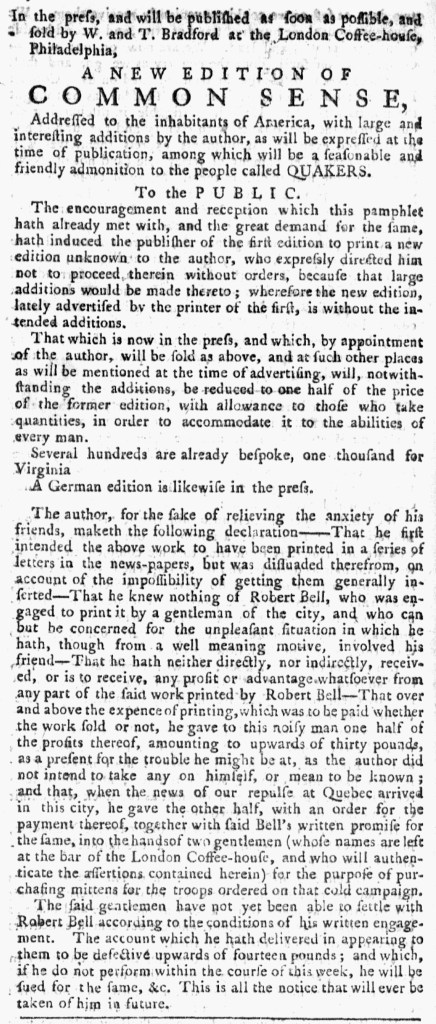
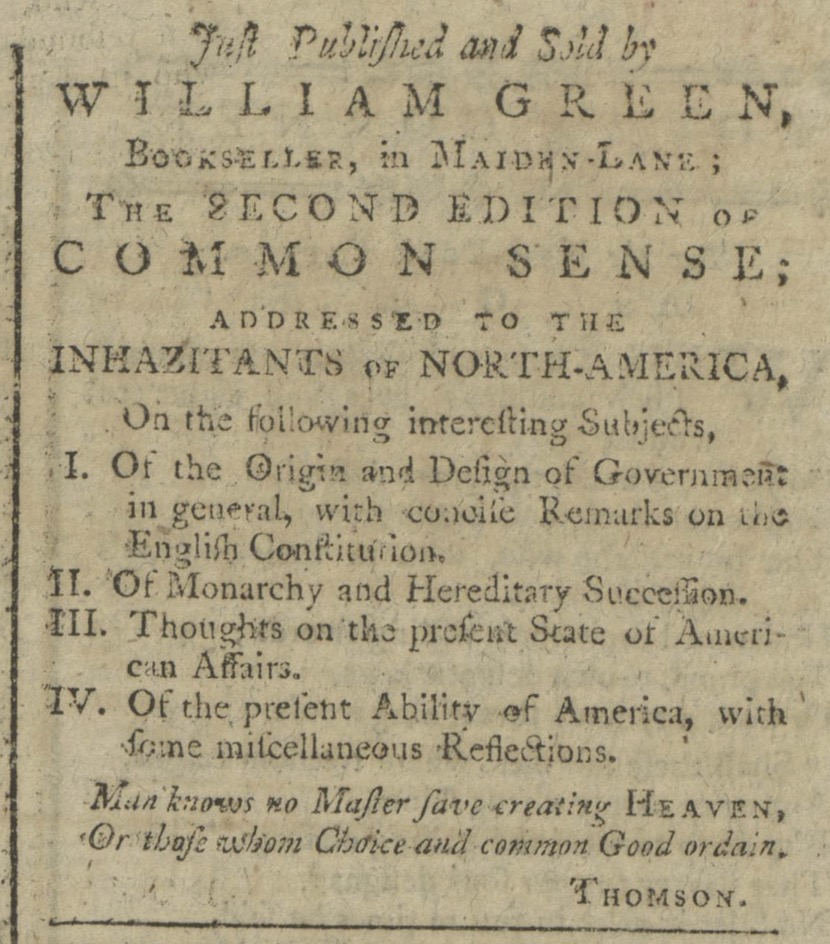
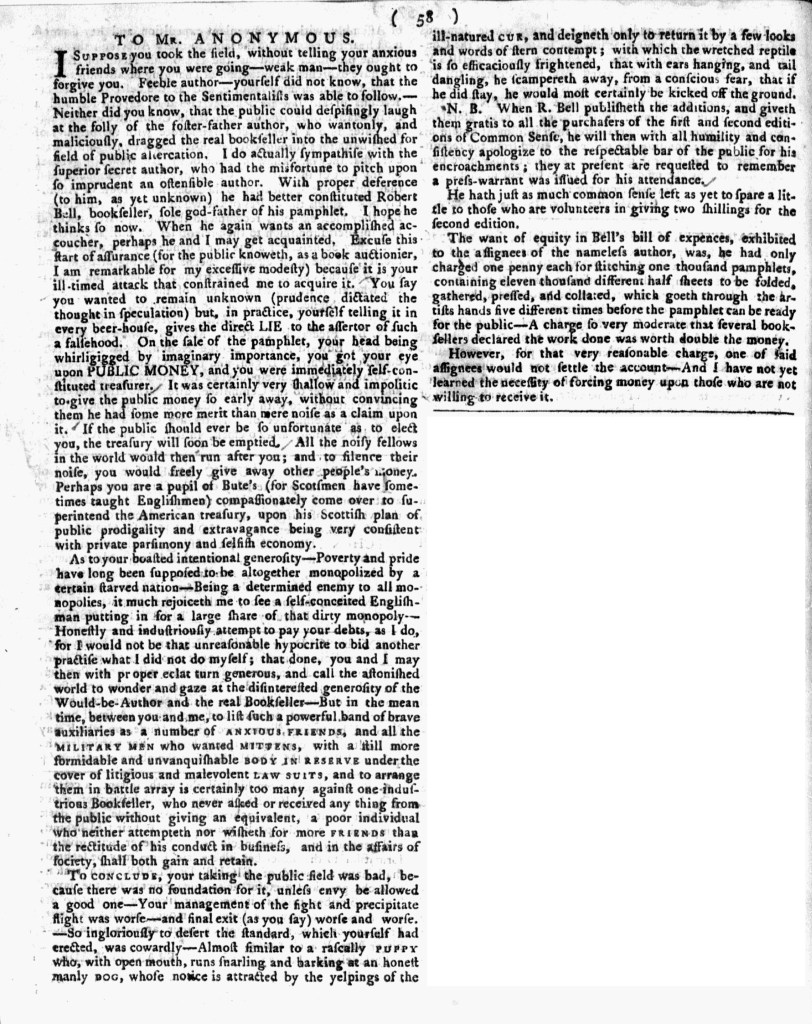
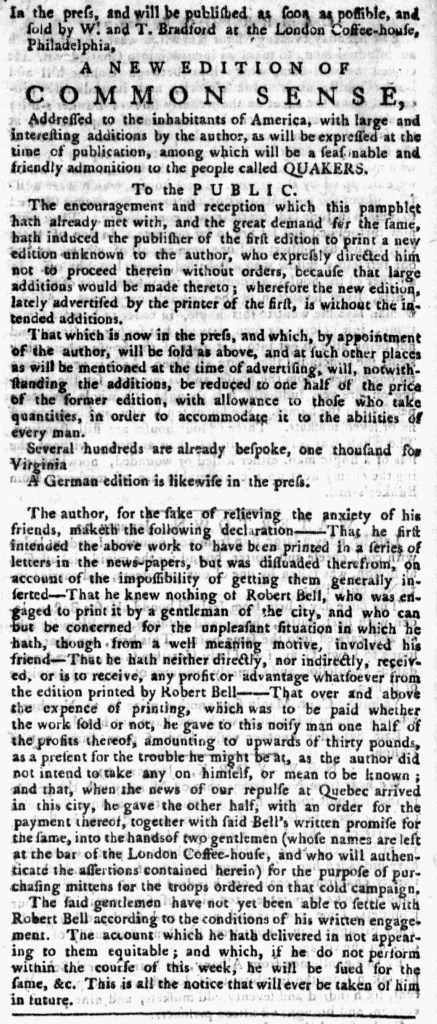
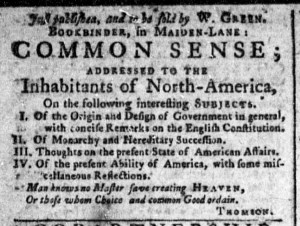
Colonizers certainly discussed Paine’s pamphlet … and printers, booksellers, and others advertised it widely. As a special feature, the Adverts 250 Projectchronicles those advertisements, starting with newspaper notices for Robert Bell’s first edition published in Philadelphia and then subsequent advertisements for that and other editions published and sold throughout the colonies.
These advertisements for Common Sense appeared in American newspapers 250 years ago today.
Historians consider Thomas Paine’s Common Sense, published anonymously on January 9, 1776, the most influential political pamphlet that circulated in the colonies during the era of the American Revolution. Written in plain language accessible to readers of all backgrounds, the pamphlet made a bold case for declaring independence at a time that many colonizers still sought a redress their grievances by George III and Parliament. Paine’s pamphlet played a vital role in swaying public opinion in favor of declaring independence.
Common Sense was an eighteenth-century bestseller, though Paine wildly overestimated how many copies were published, claiming 150,000 circulated in 1776, and historians later made even more dubious claims that American printing presses produced as many as 500,000 copies. Contrary to those exaggerations, American printers most likely published between 35,000 and 50,000 copies in 1776. Scholars have identified twenty-five American editions, more than twice as many as any other American book or pamphlet published in the eighteenth century.
Colonizers certainly discussed Paine’s pamphlet … and printers, booksellers, and others advertised it widely. As a special feature, the Adverts 250 Projectchronicles those advertisements, starting with newspaper notices for Robert Bell’s first edition published in Philadelphia and then subsequent advertisements for that and other editions published and sold throughout the colonies.
These advertisements for Common Sense appeared in American newspapers 250 years ago today.
Historians consider Thomas Paine’s Common Sense, published anonymously on January 9, 1776, the most influential political pamphlet that circulated in the colonies during the era of the American Revolution. Written in plain language accessible to readers of all backgrounds, the pamphlet made a bold case for declaring independence at a time that many colonizers still sought a redress their grievances by George III and Parliament. Paine’s pamphlet played a vital role in swaying public opinion in favor of declaring independence.
Common Sense was an eighteenth-century bestseller, though Paine wildly overestimated how many copies were published, claiming 150,000 circulated in 1776, and historians later made even more dubious claims that American printing presses produced as many as 500,000 copies. Contrary to those exaggerations, American printers most likely published between 35,000 and 50,000 copies in 1776. Scholars have identified twenty-five American editions, more than twice as many as any other American book or pamphlet published in the eighteenth century.
Colonizers certainly discussed Paine’s pamphlet … and printers, booksellers, and others advertised it widely. As a special feature, the Adverts 250 Projectchronicles those advertisements, starting with newspaper notices for Robert Bell’s first edition published in Philadelphia and then subsequent advertisements for that and other editions published and sold throughout the colonies.
These advertisements for Common Sense appeared in American newspapers 250 years ago today.
Historians consider Thomas Paine’s Common Sense, published anonymously on January 9, 1776, the most influential political pamphlet that circulated in the colonies during the era of the American Revolution. Written in plain language accessible to readers of all backgrounds, the pamphlet made a bold case for declaring independence at a time that many colonizers still sought a redress their grievances by George III and Parliament. Paine’s pamphlet played a vital role in swaying public opinion in favor of declaring independence.
Common Sense was an eighteenth-century bestseller, though Paine wildly overestimated how many copies were published, claiming 150,000 circulated in 1776, and historians later made even more dubious claims that American printing presses produced as many as 500,000 copies. Contrary to those exaggerations, American printers most likely published between 35,000 and 50,000 copies in 1776. Scholars have identified twenty-five American editions, more than twice as many as any other American book or pamphlet published in the eighteenth century.
Colonizers certainly discussed Paine’s pamphlet … and printers, booksellers, and others advertised it widely. As a special feature, the Adverts 250 Projectchronicles those advertisements, starting with newspaper notices for Robert Bell’s first edition published in Philadelphia and then subsequent advertisements for that and other editions published and sold throughout the colonies.
These advertisements for Common Sense appeared in American newspapers 250 years ago today.
Dunlap’s Pennsylvania Packet (February 5, 1776).
**********
Dunlap’s Pennsylvania Packet (February 5, 1776).
**********
New-York Gazette and Weekly Mercury (February 5, 1776).
Historians consider Thomas Paine’s Common Sense, published anonymously on January 9, 1776, the most influential political pamphlet that circulated in the colonies during the era of the American Revolution. Written in plain language accessible to readers of all backgrounds, the pamphlet made a bold case for declaring independence at a time that many colonizers still sought a redress their grievances by George III and Parliament. Paine’s pamphlet played a vital role in swaying public opinion in favor of declaring independence.
Common Sense was an eighteenth-century bestseller, though Paine wildly overestimated how many copies were published, claiming 150,000 circulated in 1776, and historians later made even more dubious claims that American printing presses produced as many as 500,000 copies. Contrary to those exaggerations, American printers most likely published between 35,000 and 50,000 copies in 1776. Scholars have identified twenty-five American editions, more than twice as many as any other American book or pamphlet published in the eighteenth century.
Colonizers certainly discussed Paine’s pamphlet … and printers, booksellers, and others advertised it widely. As a special feature, the Adverts 250 Projectchronicles those advertisements, starting with newspaper notices for Robert Bell’s first edition published in Philadelphia and then subsequent advertisements for that and other editions published and sold throughout the colonies.
These advertisements for Common Sense appeared in American newspapers 250 years ago today.
Historians consider Thomas Paine’s Common Sense, published anonymously on January 9, 1776, the most influential political pamphlet that circulated in the colonies during the era of the American Revolution. Written in plain language accessible to readers of all backgrounds, the pamphlet made a bold case for declaring independence at a time that many colonizers still sought a redress their grievances by George III and Parliament. Paine’s pamphlet played a vital role in swaying public opinion in favor of declaring independence.
Common Sense was an eighteenth-century bestseller, though Paine wildly overestimated how many copies were published, claiming 150,000 circulated in 1776, and historians later made even more dubious claims that American printing presses produced as many as 500,000 copies. Contrary to those exaggerations, American printers most likely published between 35,000 and 50,000 copies in 1776. Scholars have identified twenty-five American editions, more than twice as many as any other American book or pamphlet published in the eighteenth century.
Colonizers certainly discussed Paine’s pamphlet … and printers, booksellers, and others advertised it widely. As a special feature, the Adverts 250 Projectchronicles those advertisements, starting with newspaper notices for Robert Bell’s first edition published in Philadelphia and then subsequent advertisements for that and other editions published and sold throughout the colonies.
These advertisements for Common Sense appeared in American newspapers 250 years ago today.
Historians consider Thomas Paine’s Common Sense, published anonymously on January 9, 1776, the most influential political pamphlet that circulated in the colonies during the era of the American Revolution. Written in plain language accessible to readers of all backgrounds, the pamphlet made a bold case for declaring independence at a time that many colonizers still sought a redress their grievances by George III and Parliament. Paine’s pamphlet played a vital role in swaying public opinion in favor of declaring independence.
Common Sense was an eighteenth-century bestseller, though Paine wildly overestimated how many copies were published, claiming 150,000 circulated in 1776, and historians later made even more dubious claims that American printing presses produced as many as 500,000 copies. Contrary to those exaggerations, American printers most likely published between 35,000 and 50,000 copies in 1776. Scholars have identified twenty-five American editions, more than twice as many as any other American book or pamphlet published in the eighteenth century.
Colonizers certainly discussed Paine’s pamphlet … and printers, booksellers, and others advertised it widely. As a special feature, the Adverts 250 Projectchronicles those advertisements, starting with newspaper notices for Robert Bell’s first edition published in Philadelphia and then subsequent advertisements for that and other editions published and sold throughout the colonies.
These advertisements for Common Sense appeared in American newspapers 250 years ago today.
Historians consider Thomas Paine’s Common Sense, published anonymously on January 9, 1776, the most influential political pamphlet that circulated in the colonies during the era of the American Revolution. Written in plain language accessible to readers of all backgrounds, the pamphlet made a bold case for declaring independence at a time that many colonizers still sought a redress their grievances by George III and Parliament. Paine’s pamphlet played a vital role in swaying public opinion in favor of declaring independence.
Common Sense was an eighteenth-century bestseller, though Paine wildly overestimated how many copies were published, claiming 150,000 circulated in 1776, and historians later made even more dubious claims that American printing presses produced as many as 500,000 copies. Contrary to those exaggerations, American printers most likely published between 35,000 and 50,000 copies in 1776. Scholars have identified twenty-five American editions, more than twice as many as any other American book or pamphlet published in the eighteenth century.
Colonizers certainly discussed Paine’s pamphlet … and printers, booksellers, and others advertised it widely. As a special feature, the Adverts 250 Projectchronicles those advertisements, starting with newspaper notices for Robert Bell’s first edition published in Philadelphia and then subsequent advertisements for that and other editions published and sold throughout the colonies.
These advertisements for Common Sense appeared in American newspapers 250 years ago today.
Historians consider Thomas Paine’s Common Sense, published anonymously on January 9, 1776, the most influential political pamphlet that circulated in the colonies during the era of the American Revolution. Written in plain language accessible to readers of all backgrounds, the pamphlet made a bold case for declaring independence at a time that many colonizers still sought a redress their grievances by George III and Parliament. Paine’s pamphlet played a vital role in swaying public opinion in favor of declaring independence.
Common Sense was an eighteenth-century bestseller, though Paine wildly overestimated how many copies were published, claiming 150,000 circulated in 1776, and historians later made even more dubious claims that American printing presses produced as many as 500,000 copies. Contrary to those exaggerations, American printers most likely published between 35,000 and 50,000 copies in 1776. Scholars have identified twenty-five American editions, more than twice as many as any other American book or pamphlet published in the eighteenth century.
Colonizers certainly discussed Paine’s pamphlet … and printers, booksellers, and others advertised it widely. As a special feature, the Adverts 250 Projectchronicles those advertisements, starting with newspaper notices for Robert Bell’s first edition published in Philadelphia and then subsequent advertisements for that and other editions published and sold throughout the colonies.
These advertisements for Common Sense appeared in American newspapers 250 years ago today.
Dunlap’s Pennsylvania Packet (January 29, 1776).
**********
Dunlap’s Pennsylvania Packet (January 29, 1776).
**********
New-York Gazette and Weekly Mercury (January 29, 1776).
Though Benjamin Franklin is often considered the patron saint of American advertising in the popular press, I believe that his efforts pale in comparison to the contributions made by Mathew Carey (1760-1839) in the final decades of the eighteenth century. Franklin is rightly credited with experimenting with the appearance of newspaper advertising, mixing font styles and sizes in the advertisements that helped to make him a prosperous printer, but Mathew Carey introduced and popularized an even broader assortment of advertising innovations, ranging from inventive appeals that targeted potential consumers to a variety of new media to networks for effectively distributing advertising materials. In the process, his efforts played an important role in the development of American capitalism by enlarging markets for the materials sold by printers, booksellers, and publishers as well as a host of other goods marketed by merchants, shopkeepers, and artisans who eventually adopted many of Carey’s innovative advertising methods. Mathew Carey will probably never displace Benjamin Franklin as the founder of American advertising in the popular imagination, but scholars of early American history and culture should recognize his role as the most important leader in eighteenth-century advertising among the many other activities and accomplishments of his long career in business and public life.
Mathew Carey (January 28, 1760 – September 16, 1839). Portrait by John Neagle, 1825. Library Company of Philadelphia.
Carey’s efforts as an advertiser were enmeshed within transatlantic networks of print and commerce. Though he did not invent the advertising wrapper printed on blue paper that accompanied magazines in the eighteenth century, he effectively utilized this medium to an extent not previously seen in America, Ireland, or the English provinces outside of London. The wrappers distributed with his American Museum (1787-1792) comprised the most extensive collection of advertising associated with any magazine published in North America in the eighteenth century, both in terms of the numbers of advertisements and the diversity of occupations represented in those advertisements. In Carey’s hands, the American Museum became a vehicle for distributing advertising media: inserts that included trade cards, subscription notices, testimonials, and book catalogues in addition to the wrappers themselves.
Located at the hub of a network of printers and booksellers, Carey advocated the use of a variety of advertising materials, some for consumption by the general public and others for use exclusively within the book trade. Subscription notices and book catalogues, for instance, could stimulate demand among potential customers, but exchange catalogues were intended for printers and booksellers to manage their inventory and enlarge their markets by trading surplus copies of books, pamphlets, and other printed goods. Working with members of this network also facilitated placing advertisements for new publications in the most popular newspapers published in distant towns and cities.
Carey also participated in the development of advertising appeals designed to stimulate demand among consumers in eighteenth-century America. He targeted specific readers by stressing the refinement associated with some of his publications, while simultaneously speaking to general audiences by emphasizing the patriotism and virtue associated with purchasing either books about American history, especially the events of the Revolution and the ratification of the Constitution, or books published in America. In his advertising, Carey invoked a patriotic politics of consumption that suggested that the success of the republican experiment depended not only on virtuous activity in the realm of politics but also on the decisions consumers made in the marketplace.
For my money, Carey is indeed the father of American advertising. Happy 266th birthday, Mathew Carey!