What was advertised in a revolutionary American newspaper 250 years ago today?
Independent Chronicle (October 3, 1776).
“The Printer is now waiting only for the names of a sufficient number of subscribers.”
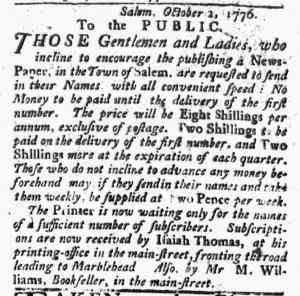
In early October 1776, Isaiah Thomas took to the pages of the Independent Chronicle to provide an update about the newspaper he proposed publishing in Salem, Massachusetts. In a previous notice, dated August 28, he announced that he “intends publishing a NEWS-PAPER, as soon as a sufficient Number of Subscribers appear to support it, which, it is supposed, will be in about four Weeks from the Date hereof.”
More than four weeks passed without Thomas printing and circulating the first issue of the newspaper. He explained that he was “now waiting only for the names of a sufficient number of subscribers,” suggesting that his previous advertisements had not yielded as much demand as he anticipated. Ther printer once again appealed to “THOSE Gentlemen and Ladies, who incline to encourage the publishing a News-Paper, in the Town of Salem … to send in their Names” and to do so “with all convenient speed.” Subscribers could submit their names directly to Thomas “at his printing-office in the main-street” or to his associate, “Mr. M. Williams, Bookseller, in the main-street.” The printer did not ask for any payment in advance but only upon “delivery of the first number.” This time around, Thomas did not make any predictions about when subscribers would receive that “first number.”
He did, however, provide an overview of the price, which he had not done in his previous advertisement. Perhaps he thought more “Gentlemen and Ladies” would subscribe upon learning that that the newspaper cost “Eight Shillings per annum, exclusive of Postage,” with only two shillings due each quarter. Alternately, Thomas allowed for subscribers “who do not incline to advance any money beforehand” to pay a slightly higher rate of two pence for each weekly issue. In the end, neither option enticed enough subscribers for Thomas to print the “first number” or any other issue of his proposed newspaper in Salem. After a couple of years, he returned to Worcester and resumed printing the Massachusetts Spy after leasing that newspaper to other printers during his time in Salem.
The Slavery Adverts 250 Project chronicles the role of newspaper advertising in perpetuating slavery in the era of the American Revolution. The project seeks to reveal the ubiquity of slavery in eighteenth-century life from New England to Georgia by republishing advertisements about enslaved people – for sale as individuals or in groups, wanted to purchase or for hire for short periods, runaways who liberated themselves, and those who were subsequently captured and confined in jails and workhouses – in daily digests on this site as well as in real time via the @SlaveAdverts250 Twitter feed, utilizing twenty-first-century media to stand in for the print media of the eighteenth century.
The project aims to provide modern audiences with a sense of just how often colonizers encountered these advertisements in their daily lives. Enslaved men, women, and children appeared in print somewhere in the colonies almost every single day. Those advertisements served as a constant backdrop for social, cultural, economic, and political life in colonial and revolutionary America. Colonizers who did not purport to own enslaved people were still confronted with slavery as well as invited to maintain the system by purchasing enslaved men, women, and children or assisting in the capture of so-called “runaways” who sought to free themselves from bondage. The frequency of these newspaper advertisements suggests just how embedded slavery was in colonial and revolutionary American culture in everyday interactions beyond the printed page.
These advertisements also testify to the experiences of enslaved men, women, and children, though readers must consider that those experiences have been remediated through descriptions offered by enslavers rather than enslaved people themselves. Often unnamed in the advertisements, enslaved men, women, and children were not invisible or unimportant in early America.
These advertisements appeared in revolutionary American newspapers 250 years ago today.
“In gratitude for so extraordinary a cure, I have desired this to be made public.”
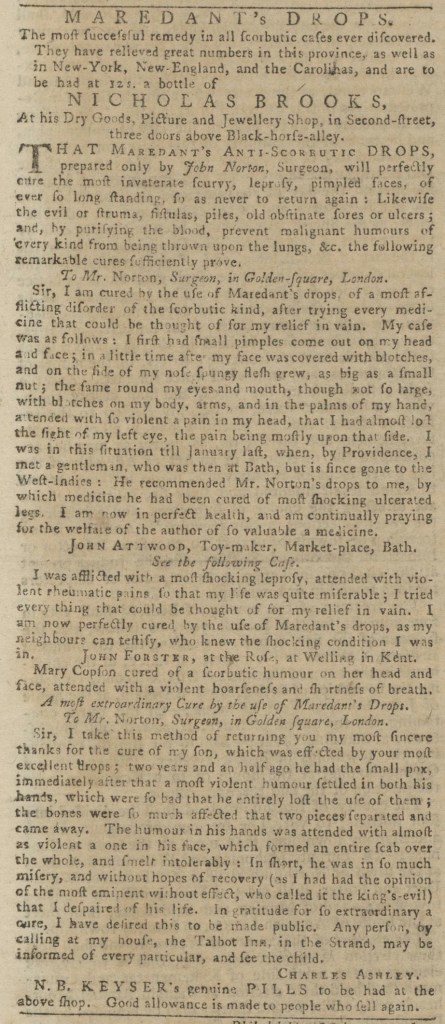
Nicholas Brooks peddled a variety of merchandise at his “Dry Goods, Picture and Jewellery Shop” in Philadelphia, including patent medicines. He devoted a lengthy advertisement in the October 2, 1776, edition of the Pennsylvania Gazette to promoting “MAREDANT’S ANTI-SCORBUTIC DROPS, prepared only by John Norton, Surgeon, … in Golden-square, London.” By way of introduction, Brooks described this patent medicine as the “most successful remedy in all scorbutic cases ever discovered,” proclaiming that Marendant’s Drops “have relieved great numbers” of people who suffered from scurvy and related health conditions “in this province, as well as in New-York, New-England, and the Carolinas.”
In case that recommendation was not enough to convince prospective patients to purchase this patent medicine, Brooks included a series of testimonials in his advertisement. In a letter addressed to Norton, John Attwood, a toymaker in Bath, confided, “I am cured by the use of Maredant’s drops, of a most afflicting disorder of the scorbutic kind, after trying every medicine that could be thought of for my relief.” That was a common theme in advertisements for many medical providers and many patent medicines. Those who wrote testimonials first detailed that they had visited other physicians or tried other remedies without relief, making their eventual cure even more remarkable.
Attwood provided all sorts of details about his ordeal: “I first had small pimples come out on my head and face; in a little time after my face was covered with blotches, and on the side of my nose spungy flesh grew, as big as a small nut; the same round my eyes and mouth, though not so large, with blotches on my body, arms, and in the palms of my hand, attended with so violent a pain in my head, that I had almost lost the sight of my left eye, the pain being mostly upon that side.” Fortunately, a “gentlemen, who was then at Bath, but is since gone to the West-Indies” recommended Maredant’s Drops to Attwood. Upon taking that medicine, the toymaker reported, “I am now in perfect health.”
In a shorter letter, John Forster, “at the Rose, at Welling in Kent,” declared that he “was afflicted with a most shocking case of leprosy, attended with violent rheumatic pains” that made his life “quite miserable.” Like Attwood, he “tried every thing that could be thought of for my relief in vain,” but was now “perfectly cured by the use of Maredant’s drops.” His neighbors knew his “shocking condition” and could also testify to his recovery after taking the patent medicine.
Next, a brief note with no attribution stated, “Mary Copson cured of a scorbutic humour on her head and face, attended with a violent hoarseness and shortness of breath.”
Finally, Brooks inserted a letter from Charles Ashley that rivaled the one from Attwood in length and gratitude for the effectiveness of Maredant’s Drops. In this instance, it was Ashley’s son who suffered from “a most violent humour [that] settled in both hand, which were so bad that he entirely lost the use of them.” At the same time, the “humour in his hands was attended with almost as violent a one in his face, which formed an entire scab over the whole, and smelt intolerably.” Ashley’s sone “was in so much misery, and without hopes of recovery,” even after consulting the “most eminent” physicians. Ashely “despaired of his life” until turning to Maredant’s Drops. Now, Ashley expressed “my most sincere thanks [to Norton] for the cure of my son, which was effected by your most excellent drops.” He felt such gratitude for “so extraordinary a cure” that he “desired this to be made public.” He also invited the curious to visit his house, “the Talbot Inn, in the Strand,” to learn more and “see the child.”
Readers of the Pennsylvania Gazette would not be visiting the Talbot Inn to learn more about Ashley’s testimonial or assess his son’s recovery for themselves, nor would they interview Forster’s neighbors in Kent. Norton supplied the testimonials and Brooks published them in his own advertisement as a proxy for such encounters. Even if prospective customers wanted to learn more, Brooks hoped that the testimonials would entice them to try Maredant’s Drops. Anyone who suffered as much as Attwood, Forster, Copson, or Ashley’s son might embrace whatever hope those testimonials offered.
The Slavery Adverts 250 Project chronicles the role of newspaper advertising in perpetuating slavery in the era of the American Revolution. The project seeks to reveal the ubiquity of slavery in eighteenth-century life from New England to Georgia by republishing advertisements about enslaved people – for sale as individuals or in groups, wanted to purchase or for hire for short periods, runaways who liberated themselves, and those who were subsequently captured and confined in jails and workhouses – in daily digests on this site as well as in real time via the @SlaveAdverts250 Twitter feed, utilizing twenty-first-century media to stand in for the print media of the eighteenth century.
The project aims to provide modern audiences with a sense of just how often colonizers encountered these advertisements in their daily lives. Enslaved men, women, and children appeared in print somewhere in the colonies almost every single day. Those advertisements served as a constant backdrop for social, cultural, economic, and political life in colonial and revolutionary America. Colonizers who did not purport to own enslaved people were still confronted with slavery as well as invited to maintain the system by purchasing enslaved men, women, and children or assisting in the capture of so-called “runaways” who sought to free themselves from bondage. The frequency of these newspaper advertisements suggests just how embedded slavery was in colonial and revolutionary American culture in everyday interactions beyond the printed page.
These advertisements also testify to the experiences of enslaved men, women, and children, though readers must consider that those experiences have been remediated through descriptions offered by enslavers rather than enslaved people themselves. Often unnamed in the advertisements, enslaved men, women, and children were not invisible or unimportant in early America.
These advertisements appeared in revolutionary American newspapers 250 years ago today.
Who was the subject of an advertisement in a revolutionary American newspaper 250 years ago today?
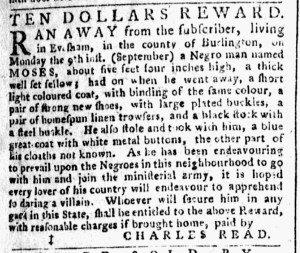
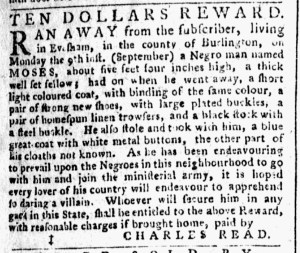
Dunlap’s Pennsylvania Packet (October 1, 1776).
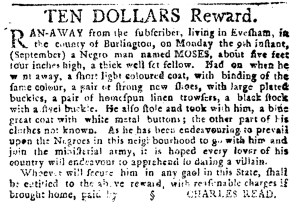
“A Negro man named MOSES … has been endeavouring to … join the ministerial army.”
Moses, an enslaved man, made his own declaration of independence in 1776 when he liberated himself by running away from his enslaver. Charles Read of Evesham, “in the county of Burlington,” New Jersey, provided a brief account in an advertisement on the front page of the October 1, 1776, edition of Dunlap’s Pennsylvania Packet. According to Read, Moses, “about five feet four inches high, a thick well set fellow,” made his escape on September 9. When he went away, he was wearing “a short light coloured coat, with binding of the same colour a pair of strong new shoes, with large plated buckles, a pair of homespun linen trowsers, and a black stock with a steel buckle.” That should have made Moses easy to recognize, but there was also a chance that he would change clothes since he “stole and took with him, a blue great-coat with white metal buttons” and “the other part of his cloaths [were] not known” to Read.
While those details were specific to Moses, his enslaver followed a formula for advertisements that described enslaved people who liberated themselves by running away. The next part of Read’s account, however, revealed that current events played a part in Moses’s decision about when to seek his freedom. Read lamented that Moses “has been endeavouring to prevail upon the Negroes in this neighbourhood” in New Jersey “to go with him to join the ministerial army.” In other words, Moses planned to join the British and encouraged other enslaved people to join him. He did not merely hope to elude his enslaver by getting away from Evesham and keeping a low profile elsewhere; instead, he aimed to secure his freedom by “join[ing] the ministerial army.” Moses almost certainly knew that nearly a year earlier John Murray, Lord Dunmore, the king’s governor in Virginia, offered freedom to enslaved people “appertaining to Rebels” (or enslaved by Patriots) in exchange for “joining his Majesty’s troops, as soon as may be.” Many enslaved men and women responded to the call, alarming and enraging both their enslavers and other residents of Virginia. The final grievance in the Declaration of Independence referred to Dunmore’s Proclamation, stating that the king “has excited domestic insurrections amongst us” by encouraging enslaved people to fight against those who enslaved them. Moses left Evesham just as the British occupation of New York began. He likely saw his best opportunity yet to secure his freedom. That gave additional urgency to Read’s efforts to capture him. Readers of Dunlap’s Pennsylvania Packet, he declared, should assist not only for the “TEN DOLLARS REWARD” but also out of a sense of patriotism. Read called on “every lover of his country [to] endeavour to apprehend so daring a villain” who had the audacity to seek his freedom by siding with those who promised him liberty rather than a life of enslavement. Moses was not the first or only such “villain” featured in newspaper advertisements during the Revolutionary War, yet stories of joining the British were not a common element of what have become known as “runaway advertisements.” Though rare, advertisements that reported enslaved people sought to join the British appeared on occasion, supplementing similar stories that circulated in conversation and in print. Read meant to condemn Moses, but the additional details he provided about the circumstances of his escape contributed to a complicated and nuanced narrative of the American Revolution.
The Slavery Adverts 250 Project chronicles the role of newspaper advertising in perpetuating slavery in the era of the American Revolution. The project seeks to reveal the ubiquity of slavery in eighteenth-century life from New England to Georgia by republishing advertisements about enslaved people – for sale as individuals or in groups, wanted to purchase or for hire for short periods, runaways who liberated themselves, and those who were subsequently captured and confined in jails and workhouses – in daily digests on this site as well as in real time via the @SlaveAdverts250 Twitter feed, utilizing twenty-first-century media to stand in for the print media of the eighteenth century.
The project aims to provide modern audiences with a sense of just how often colonizers encountered these advertisements in their daily lives. Enslaved men, women, and children appeared in print somewhere in the colonies almost every single day. Those advertisements served as a constant backdrop for social, cultural, economic, and political life in colonial and revolutionary America. Colonizers who did not purport to own enslaved people were still confronted with slavery as well as invited to maintain the system by purchasing enslaved men, women, and children or assisting in the capture of so-called “runaways” who sought to free themselves from bondage. The frequency of these newspaper advertisements suggests just how embedded slavery was in colonial and revolutionary American culture in everyday interactions beyond the printed page.
These advertisements also testify to the experiences of enslaved men, women, and children, though readers must consider that those experiences have been remediated through descriptions offered by enslavers rather than enslaved people themselves. Often unnamed in the advertisements, enslaved men, women, and children were not invisible or unimportant in early America.
These advertisements appeared in revolutionary American newspapers 250 years ago today.