March 22

What was advertised in a revolutionary American newspaper 250 years ago today?
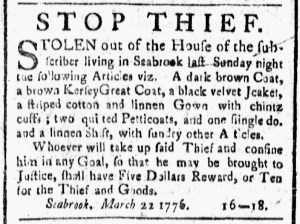
Essex Gazette (May 22, 1776).

“STOP THIEF.”

The advertisement had a bold headline: “STOP THIEF.”  Those two words likely attracted the attention of many readers of the March 22, 1776, edition of the Essex Gazette.  After all, the headlines for most other advertisements gave the name of the advertiser in a large font, such as “Nicholas Pike,” “Abel Morse,” and “John Sawyer,” or named a product being sold, such as “Garden-Seeds” and “Lemmons by the Box.”  This advertisement reported on a recent burglary: “STOLEN out of the House of the subscriber living in Seabrook last Sunday night the following Articles … A dark brown Coat, a brown Kersey Great Coat, a black velvet J[ac]ket, a striped cotton and linnen Gown with chintz cuffs; two quilted Petticoats, and one single d[itt]o. and a linnen Shift, with sundry other Articles.”

That was quite the haul.  Whoever stole the black velvet jacket and the striped cotton and linen gown was unlikely to wear both items.  They might have kept some of the stolen goods for personal use, but they likely sold or fenced most of them. Burglars, thieves, and shoplifters devised alternate means of participating in consumer culture during the era of the American Revolution.  Reports of their activities frequently appeared as newspaper advertisements alongside other notices that presented all sorts of clothing, textiles, and housewares imported and sold by merchants and shopkeepers.  Another advertisement in the same issue of the Essex Gazette had a headline that proclaimed, “Four Dollars Reward.”  In it, Israel Adams described the theft of “Four pair of men’s SHOES; two pair men’s Pumps; six pair women’s Pumps, and two pair boy’s Shoes.”  Both advertisements offered a reward for capturing the culprits and bringing them to justice … and both offered a reward for the return of the stolen goods.  The anonymous advertiser from Seabrook seemingly understood that the goods may have been fenced by the time anyone could “take up said Thief and confine him in any [Jail], so that he may be brought to Justice,” but just in case it was not too late “the subscriber” would double the reward for delivering “the Thief and Goods.”

Slavery Advertisements Published September 30, 1775

GUEST CURATOR: Massimo Sgambati

The Slavery Adverts 250 Project chronicles the role of newspaper advertising in perpetuating slavery in the era of the American Revolution. The project seeks to reveal the ubiquity of slavery in eighteenth-century life from New England to Georgia by republishing advertisements about enslaved people – for sale as individuals or in groups, wanted to purchase or for hire for short periods, runaways who liberated themselves, and those who were subsequently captured and confined in jails and workhouses – in daily digests on this site as well as in real time via the @SlaveAdverts250 Twitter feed, utilizing twenty-first-century media to stand in for the print media of the eighteenth century.

The project aims to provide modern audiences with a sense of just how often colonizers encountered these advertisements in their daily lives. Enslaved men, women, and children appeared in print somewhere in the colonies almost every single day. Those advertisements served as a constant backdrop for social, cultural, economic, and political life in colonial and revolutionary America. Colonizers who did not purport to own enslaved people were still confronted with slavery as well as invited to maintain the system by purchasing enslaved men, women, and children or assisting in the capture of so-called “runaways” who sought to free themselves from bondage. The frequency of these newspaper advertisements suggests just how embedded slavery was in colonial and revolutionary American culture in everyday interactions beyond the printed page.

These advertisements also testify to the experiences of enslaved men, women, and children, though readers must consider that those experiences have been remediated through descriptions offered by enslavers rather than enslaved people themselves. Often unnamed in the advertisements, enslaved men, women, and children were not invisible or unimportant in early America.

From compiling an archive of digitized eighteenth-century newspapers to identifying advertisements about enslaved men, women, and children in those newspapers to preparing images of each advertisement to posting this daily digest, Massimo Sgambati served as guest curator for this entry. He completed this work as part of the Summer Scholars Program, funded by a fellowship from the D’Amour College of Liberal Arts and Sciences at Assumption University in Worcester, Massachusetts, in Summer 2025.

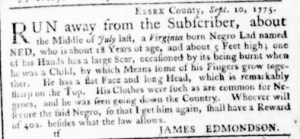
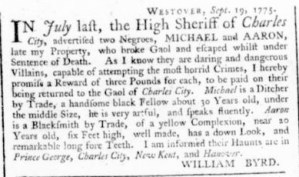
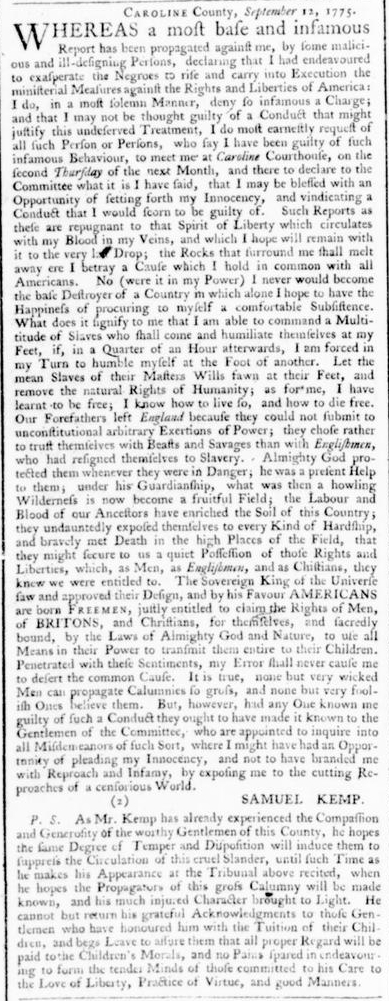
These advertisements appeared in colonial American newspapers 250 years ago today.

Virginia Gazette [Dixon and Hunter] (September 30, 1775)

**********

Virginia Gazette [Dixon and Hunter] (September 30, 1775)

**********

Virginia Gazette [Dixon and Hunter] (September 30, 1775)

**********

Virginia Gazette [Dixon and Hunter] (September 30, 1775)

**********

Virginia Gazette [Dixon and Hunter] (September 30, 1775)

**********

Virginia Gazette [Dixon and Hunter] (September 30, 1775)
.

Welcome, Guest Curator Massimo Sgambati

Massimo Sgambati with Old Number One at the American Antiquarian Society (AAS). He conducted much of his research in the reading room at the AAS, one of the nation’s oldest research libraries and learned societies.

Massimo Sgambati is a senior double majoring in History and Secondary Education at Assumption University in Worcester, Massachusetts. Originally from Farmington Hills, Michigan, he discovered his love for history through his father and time spent growing up in England. He is passionate about studying both the era of slavery and Reconstruction in America, hoping to attend grad school and specialize in the effects of those periods on Black Americans and connections to today’s mass incarceration. He hopes to continue research in the field and eventually become a professor, spreading awareness for how slavery has continued to resonate in American society. Massimo is involved in activities across campus, working in both the university’s d’Alzon Library and the Office of Admissions, serving as the Vice President of the Education Club, and being the kicker on the football team. Massimo conducted the research for his contributions as a guest curator for the Slavery Adverts 250 Project as a summer research assistant, funded through the D’Amour College of Liberal Arts and Sciences Summer Scholars Program.

Welcome, guest curator Massimo Sgambati!

June 7

What was advertised in a revolutionary American newspaper 250 years ago today?

Connecticut Journal (June 7, 1775).

“He has left his Business and all his Property … for the Good of the Common Cause.”

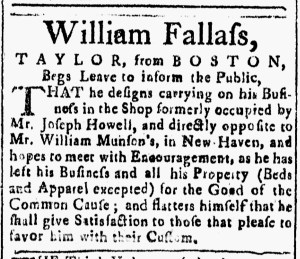
In the summer of 1775, William Fallass, a “TAYLOR, from BOSTON,” relocated to New Haven, Connecticut.  Upon arriving in town, he placed a newspaper advertisement to introduce himself to his new neighbors and prospective customers.  Fallass announced that he “designs carrying on his Business in the Shop formerly occupied by Mr. Joseph Howell … and hopes to meet with Encouragement.”  The locals did not yet know him or his work by reputation, prompting him to declare that he “flatters himself that he shall give Satisfaction to those that please to favor him with their Custom.”  The newcomer pledged his best efforts for his clients.

He also offered another reason that residents of New Haven should hire his services.  He had not planned to relocate to another town but instead “left his Business and all his Property (Beds and Apparel excepted) for the Good of the Common Cause.”  The battles at Lexington and Concord and the ensuing siege of Boston upended Fallass’s life and livelihood.  In late April, the Massachusetts Provincial Congress, meeting in Watertown, negotiated with General Thomas Gage, the governor, for safe passage in or out of Boston.  Loyalists could move into the city; Patriots and others could depart.  In each instance, they could take their “Effects” with them, “excepting their Fire-Arms and Ammunition.”  The unfortunate Fallass did not manage to move most of his “Effects,” just his clothing and bedding.  He hoped that sacrifice “for the Good of the Common Cause” would endear him to prospective clients and entice them to do business with him, a refugee.

In that regard, Fallass made a more explicit appeal than Polly Allen and Lucy Allen, milliners and mantuamakers from Boston, did when they ran a newspaper advertisement in Providence earlier in the week.  In both cases, however, advertisements help in tracing the movement of men and women who departed Boston during the siege.  They did not merely leave the city for the countryside; many relocated to other colonies and attempted to revive their businesses in new places as the Revolutionary War began.  Articles and “letters of intelligence” relayed some accounts of current events, yet advertisements played another role in revealing the effects of the war on some colonizers.

March 31

What was advertised in a colonial American newspaper 250 years ago today?

South-Carolina and American General Gazette (March 31, 1775).

“She intends again OPENING her BOARDING and DAY-BOARDING SCHOOL.”

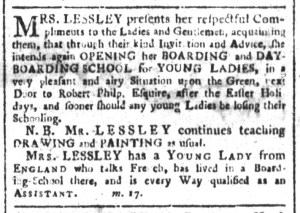
Mrs. Lessley ran a “BOARDING and DAY-BOARDING SCHOOL for YOUNG LADIES” in Charleston in the 1770s. She closed the school for a while, as schoolmasters and schoolmistresses often did for various reasons, but, as spring arrived in 1775, she took to the pages of the South-Carolina and American General Gazette to announce that she planned on “again OPENING” her school “after the Easter Holiday.”  She decided to do so, she stated, at the “kind Invitation and Advice” of “Ladies and Gentlemen” familiar with her school, offering an implicit endorsement she hoped would convince prospective pupils and their families.

Lessley also gave information about others who worked at her school.  “MR. LESSLEY continues teaching DRAWING and PAINTING as usual,” enriching the curriculum offered by his wife.  Readers, especially former students, may have assumed that was the case, but they did not necessarily know about a new employee.  The schoolmistress reported that she “has a YOUNG LADY from ENGLAND who talks French, has lived in a Boarding-School there, and is every Way qualified as an ASSISTANT.”  Those cosmopolitan skills and experiences enhanced the education that Lessley provided for her charges.  Her assistant aided in teaching a language considered a marker of gentility among the gentry and those who aspired to join their ranks.  Perhaps she even served as the primary instructor for that subject.  She may have consulted with Lessley on replicating an English boarding school without students having to cross the Atlantic while also serving as a role model for how “YOUNG LADIES” should comport themselves at such a school.

The schoolmistress gave less attention to the amenities at her school, though she did mention that it was located “in a very pleasant and airy Situation upon the Green.”  With classes slated to begin sometime after April 16, she assured prospective students and their families that they would live and learn in a comfortable environment.  She also indicated that she would commence lessons “sooner should any young Ladies be losing their Schooling.”  In other words, if other schoolmasters and schoolmistresses closed or suspended their schools, Lessley would gladly accept their students.  She hoped that these additional appeals in combination with her description of those who taught at her school would help in encouraging prospective pupils and their families to enroll.

February 22

What was advertised in a colonial American newspaper 250 years ago today?

Pennsylvania Gazette (February 22, 1775).

“Goods … have been exposed to sale … under the direction of the Committee, pursuant to the tenth article of the Congress.”

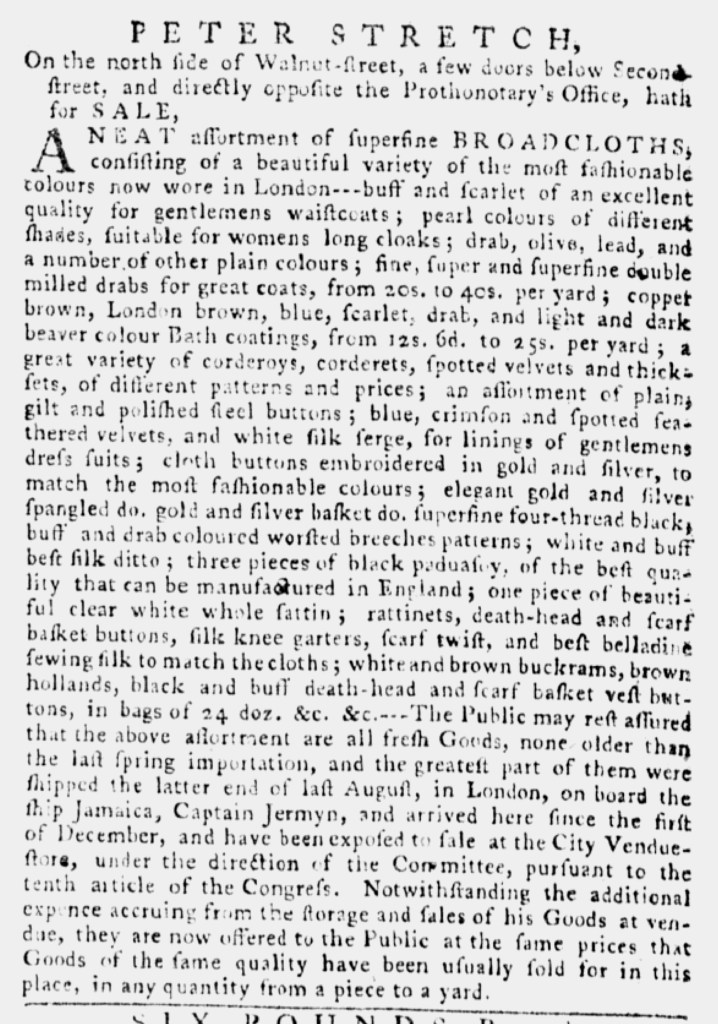
Even as the imperial crisis intensified in February 1775, Peter Stretch expected that consumers in and near Philadelphia would respond to marketing appeals that connected the textiles and accessories that he imported and sold to current fashions in London.  Such had been the case for quite some time before the political situation became so troubled.  A transatlantic consumer revolution bound together England and the colonies in the eighteenth century, helping to fuel a process of Anglicization among subjects of the empire in British mainland North America.  When it came to advertising, it made sense to Stretch to open his notice in the February 22 edition of the Pennsylvania Gazette with a “NEAT assortment of superfine BROADCLOTHS, consisting of a beautiful variety of the most fashionable colours now wore in London.”

He anticipated such an appeal would resonate with prospective customers even with the Continental Association in effect.  The First Continental Congress enacted that nonimportation agreement in response to the Coercive Acts.  Yet Stretch acknowledged those circumstances as well.  He wanted consumers to know that he sold new merchandise rather than items that had lingered on the shelves or in the warehouse for years, so he assured readers that “the above assortment are all fresh Goods, one older than the last spring importation.”  He went into more detail, explaining that “the greatest part of them were shipped the latter end of last August, in London, on board the ship Jamaica, Captain Jermyn.”  That meant that his wares had been ordered and shipped before the First Continental Congress began its meetings in September and October 1774 and certainly before delegates devised the Continental Association.

However, the Jamaica “arrived here since the first of December,” the day the nonimportation agreement went into effect.  The tenth article made provisions for imports that arrived in December 1774 and January 1775, allowing merchants to refuse and return the goods, turn them over to a local committee to store while the pact remained in force, or entrust them to the committee to sell with the original costs returned to the importer and any profits designated to the relief of Boston where the harbor had been closed and blockaded since June 1774.  Stretch reported that he adhered to the Continental Association.  His wares “have been exposed to sale at the City Vendue-store, under the direction of the Committee, pursuant to the tenth article of the Congress.”  Having done its due diligence, the committee apparently returned items not sold at auction to Stretch, provided that he also observe the ninth article that prohibited price gouging or “tak[ing] Advantage of the Scarcity of Goods that may be occasioned by this Association.”  Stretch pledged that he offered his merchandise “at the same prices that Goods of the same quality have been usually sold for in this place.”  The merchant demonstrated to consumers that they could still acquire textiles “of the most fashionable colours now wore in London” without violating the Continental Association.

Welcome, Guest Curator Gabriela Vargas

Gabriela Vargas is a senior double majoring in History and Elementary Education as she pursues a dual graduate degree in Special Education at Assumption University in Worcester, Massachusetts. She hopes to become a special education teacher and an education attorney. Gabriela has been involved in Campus Ministry as a bible study leader. She also co-founded Latinos Unidos, the first Latin club. She served as public relations representative for ALANA, the multi-cultural club on campus.  She is currently the head editor for MUSE, the campus literary magazine. Gabriela also, published her first book, The Rhymes of My Times, when she was sixteen. She has also been involved in various community service and advocacy projects. Gabriela made her contributions to the Adverts 250 Project and the Slavery Adverts 250 Project while enrolled in HIS 359 Revolutionary America, 1763-1815, in Fall 2024.

Welcome, guest curator Gabriela Vargas!

Welcome, Guest Curator Ashley Schofield

Ashley Schofield is a junior at Assumption University in Worcester, Massachusetts. She is majoring in Psychology with a mental health concentration and minoring in Theology. Ashley is involved with Best Buddies on campus and enjoys going on nature walks, working out at the gym, drinking good coffee, and spending time with friends and family. She intends to obtain her Master’s of Clinical Psychology, become a therapist, and support the community around her in any way she can. Ashley made her contributions to the Adverts 250 Project and the Slavery Adverts 250 Project while enrolled in HIS 359 Revolutionary America, 1763-1815, in Fall 2024.

Welcome, guest curator Ashley Schofield!

Welcome, Guest Curator Ella Holtman

Ella Holtman is a first-year student at Assumption University in Worcester, Massachusetts. She is currently planning on triple majoring in Criminology, Sociology, and Spanish. Still, history, especially the American Revolution, is her favorite thing to learn about. She graduated from Charles W. Baker High School in New York last summer and is very excited to continue her education. A member of the National Honors Society and eight different sports teams during high school, she values hard work and determination. Ella is also on the DII Assumption Field Hockey Team and is looking forward to the coming years. Hopefully, with knowledge and passions to fuel her, she can make a true difference for the better in the world. She made her contributions to the Adverts 250 Project and the Slavery Adverts 250 Project while enrolled in HIS 359 Revolutionary America, 1763-1815, in Fall 2024.

Welcome, guest curator Ella Holtman!

Welcome, Guest Curator Jack Driscoll

James “Jack” Driscoll is a Junior at Assumption University in Worcester, Massachusetts.  He is majoring in Criminology and minoring in History.  He hopes to one day work for the U.S. Marshal Service, doing case work on fugitives and providing security to prisoners in transport and in the courtroom.  He decided to pursue a history minor because ever since he was a kid he has always been very passionate about learning about the past because it serves as an explanation for the present.  At Assumption, he plays left tackle for the football team, one of his proudest achievements.  He consistently devotes hard work to that position top contribute to positive outcomes on the field for his entire team.  Jac made his contributions to the Adverts 250 Project and the Slavery Adverts 250 Project while enrolled in HIS 359 Revolutionary America, 1763-1815, in Fall 2024.

Welcome, guest curator Jack Driscoll!