February 12

What was advertised in a colonial American newspaper 250 years ago this week?
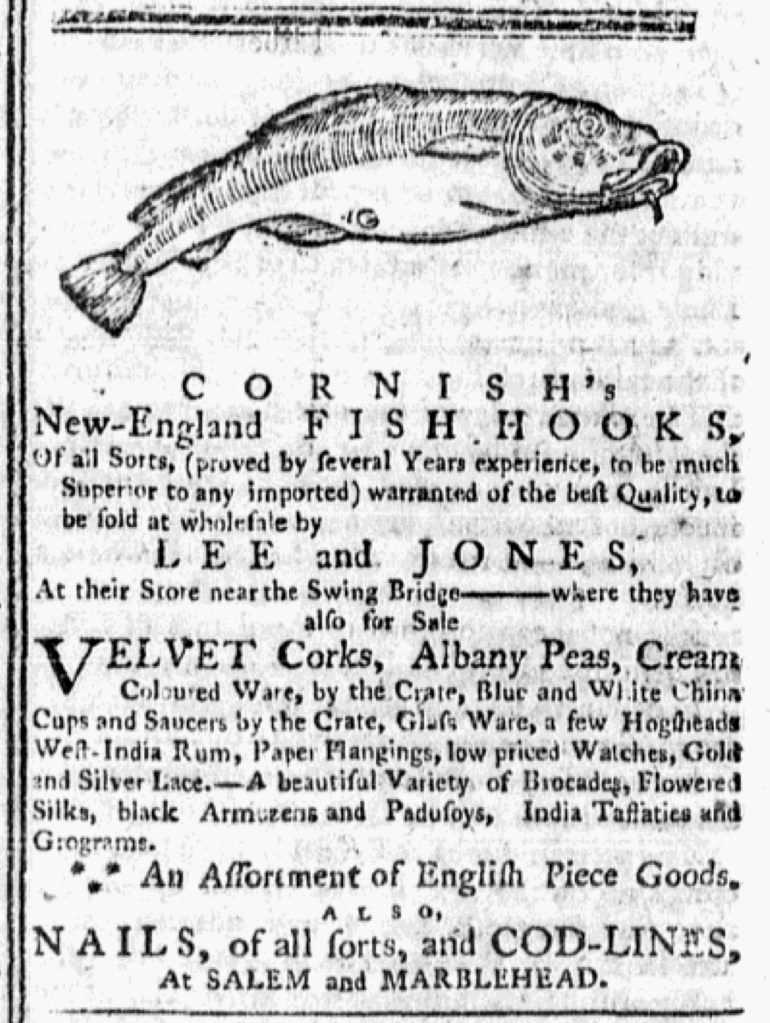
Massachusetts Spy (February 9, 1775).

“CORNISH’s New-England FISH HOOKS.”

Lee and Jones stocked a variety of merchandise at “their Store near the Swing Bridge” in Boston in February 1775, but they made “CORNISH’s New-England FISH HOOKS” the centerpiece of their advertisement in the February 9 edition of the Massachusetts Spy.  Not only did they list that product first and devote the most space to describing it, but they also adorned their advertisement with a woodcut depicting a fish.  That image previously appeared in advertisements that Abraham Cornish placed in the Massachusetts Spy in March 1772 and March 1773.  Either Lee and Jones acquired the woodcut from Cornish when they composed the copy for their notice or Isaiah Thomas, the printer of the Massachusetts Spy, held the woodcut for Cornish and determined that advertisers promoting his product could use it in their notices.  It was not the first time that Lee and Jones distributed “CORNISH’s New-England Cod-Fish HOOKS.”

By the time that Lee and Jones ran their advertisement, Cornish had established a familiar brand.  In addition to advertising in the Massachusetts Spy, he also advertised in the Massachusetts Gazette and Boston Weekly News-Letter and Salem’s Essex Gazette.  His marketing efforts regularly touted the approval he received when “Fishermen … made trial of his Hooks” and found them “much superior to those imported from England.”  Lee and Jones deployed similar appeals when they proclaimed that the hooks had been “Proved by several Years experience, to be much Superior to any imported.”  Such assertions held even greater significance with the Continental Association, a nonimportation pact, in effect and the imperial crisis becoming even more dire.  In protest of the Coercive Acts passed in response to the Boston Tea Party, colonizers vowed not to import good from Britain.  The Continental Association called for encouraging domestic manufactures or goods produced in the colonies as alternatives to imported items.  Cornish has been making that case for his product for several years, as many readers likely remembered when they saw Lee and Jones’s advertisement for “CORNISH’s New-England FISH HOOKS.”

August 18

What was advertised in a colonial American newspaper 250 years ago today?

Massachusetts Gazette and Boston Weekly News-Letter (August 11, 1774).

“Render this Country an essential Service, by establishing a Manufacture necessary to its Prosperity.”

Abraham Cornish had been in business and advertising long enough by the late summer of 1774 that he expected colonizers to be familiar with his brand of “CORNISH’s New-England Cod-Fish HOOKS.”  He deployed the name of his product as a headline for his advertisement in the August 18 edition of the Massachusetts Gazette and Boston Weekly News-Letter.  Still, for those who needed a refresher or a bit more encouragement to purchase his fishhooks, he provided more information about why those from “his Manufactory” were superior to others.  That they were made in America was central to his marketing efforts.

The savvy entrepreneur had recently moved from “the North-End of Boston, to the Upper Part of Charlestown,” where he continued to make fishhooks “warranted of the best Quality.”  He called on “all concerned in the Fishery” to “favor him with their Custom, as they will thereby promote their own private Interest, and render this Country an essential Service, by establishing a Manufacture necessary to its Prosperity.”  It was a win-win-win situation for “the American Fishery,” the manufacturer, and all colonizers at a time that the political crisis intensified due to the imposition of the Coercive Acts in retaliation for the Boston Tea Party.  Those whose livelihood depended on fishing could acquire equipment “found much Superior to any imported, Cornish could maintain or even expand his business, and the colonies would benefit from “domestic manufactures” that both supported a local industry and directly contributed to the local economy.  Ever since the boycotts inspired by the Stamp Act nearly a decade earlier, many colonizers had advocated for producing more “domestic manufactures” as a means of reducing their reliance on imported goods.  Doing so also served as political leverage in the struggles with Parliament.  Such plans placed obligations on both artisans and tradespeople to produce goods and consumers to purchase those goods instead of imported items.  Like many other producers of “domestic manufactures,” Cornish assured prospective customers that they did not have to sacrifice quality, decalaring that his fishhooks were “made of the best Wire only” and “better shap’d to take Fish.”  He proclaimed that they were “universally approv’d,” having gone into even greater detail in a previous advertisement about how “Fishermen who made Trial of his Hooks … found them … superior to those imported from England.”  Cornish devised a “Buy American” campaign before the colonies declared independence.

April 13

What was advertised in a colonial American newspaper 250 years ago today?

Essex Gazette (April 13, 1773).

“Said Hooks, also Cod-Lines, to be sold by WILLIAM VANS, in Salem.”

In the early 1770s, Abraham Cornish made “New-England Cod & Mackrell FISH-HOOKS … At his Manufactory” in Boston’s North End.  To promote his product, he placed advertisements in the Massachusetts Spy, printed in Boston, and in the Essex Gazette, printed in Salem in March and April 1773, hoping to capture the attention of fishermen in both maritime communities.  He presented his hooks as an alternative to those imported to the colonies, describing them as “the best Cod and Mackrell Hooks,” yet he did not ask prospective buyers to take his word for it.  Instead, he declared that “Fishermen who made Trial of his Hooks last Season, found them to correspond with his former Advertisement” in which he presented his hooks as “much superior to those imported from England.”

Cornish did not address solely the fisherman who would use his hooks.  He also called on those who supplied them to stock his hooks made in Boston in addition to those they acquired from England.  He set prices “as cheap by Wholesale for Cash on delivery” as imported hooks, hoping that the combination of price and quality would prompt retailers to add them to their inventory.  Cornish believed that various members of the community should demonstrate their interest in supporting the production of fish hooks in Boston, calling on “all Importers, and those concerned in the Fishery” to purchase his product.  To cultivate brand recognition, he noted that his hooks “are all marked A.C. on the Flat of the Stem of each Hook.”  In an earlier advertisement, he also noted that he packaged them in “paper … marked ABRHAM CORNISH” and called attention to his initials on each hook in order to “prevent deception” or counterfeit products.

To aid in distributing his wares, Cornish recruited a local agent in Salem.  His advertisement in the Essex Gazette stated that William Vans, a merchant who frequently placed his own advertisements, sold “Said Hooks.”  Vans, however, did not generate the copy for the notice about Cornish’s hooks.  The text replicated what appeared in the advertisement in the Massachusetts Spy, with the addition of a nota bene about the marks on each hook and an additional sentence identifying Vans as the local distributor.  The version in the Essex Gazette lacked the characteristic woodcut depicting a fish that adorned Cornish’s advertisements in the Massachusetts Spy.  Like most other advertisers who incorporated visuals images, Cornish apparently invested in only one woodcut.  He depended on the strength of the advertising copy when hawking his hooks in a second market.

March 14

What was advertised in a colonial American newspaper 250 years ago this week?

Massachusetts Spy (March 11, 1773).

“The Fishermen who made trial of his Hooks last season, found them to correspond with his former advertisement.”

Even before thirteen colonies declared independence from Great Britain, entrepreneurs encouraged consumers to support American industry.  Abraham Cornish, for example, marketed “New England COD and MACKREL FISH HOOKS” produced at “his Manufactory at the head of Hutchinson’s wharf, North End, Boston” in the early 1770s.  When he commenced advertising in the Massachusetts Spy in March 1772, Cornish proclaimed that his hooks were “warranted in every respect equal to any, and superior to most.”  In particular, he singled out hooks “marked IP” to declare that every fisherman who tried his hooks and “every impartial person on examining” them “will soon discover their superiority.”  Nearly a year later, Cornish reported that “the Fishermen who made trial of his Hooks last season, found them to correspond with his former advertisement,” that they were indeed “superior to those imported from England.”

Cornish’s hooks, however, were not produced from start to finish in the colonies.  Instead, he imported the “best STEEL WIRE” from London and then used that material to make the hooks at his manufactory in Boston.  What mattered, Cornish asserted to prospective customers, was the final stage of production combined with the superior quality of his hooks and his low prices.  He confidently boasted that he made “the best Cod and Mackerel Hooks.”

In his effort to supply the fishing industry with hooks, Cornish simultaneously ran the same advertisement (with variations in spelling) in the Essex Gazette, promoting his product to prospective customers in Salem and other maritime communities served by that newspaper.  He added two notes, one identifying William Vans as the local agent who carried his hooks.  Customers did not need to visit or contact Cornish in Boston if they found it more convenient to deal with Vans in Salem.  Given that those buyers would not interact directly with Cornish, he advised that his hooks “are all marked A.C. on the Flat of the Stem of each Hook.”  That helped customers verify their authenticity when they acquired the hooks from sellers beyond Cornish’s manufactory.  Such maker’s marks served as perpetual advertisements for the hooks.

March 22

What was advertised in a colonial American newspaper 250 years ago this week?

Massachusetts Spy (March 19, 1772).

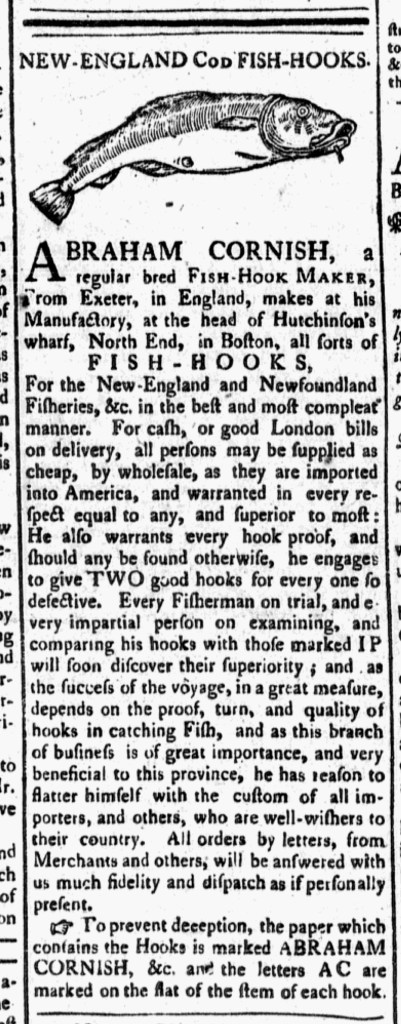
“To prevent deception, the paper which contains the Hooks is marked ABRAHAM CORNISH.”

Abraham Cornish deployed a variety of marketing strategies for the “NEW ENGLAND COD FISH-HOOKS” that he made in the North End of Boston.  In an advertisement that appeared in the March 19, 1772, edition of the Massachusetts Spy, he described himself as “a regular bred FISH-HOOK MAKER, From Exeter, in England,” who produced “all sorts of FISH-HOOKS … warranted in every respect equal to any, and superior to most,” whether imported or made in the colonies.  Cornish was so certain of the quality of his hooks that offered a guarantee, stating that he “warrants every hook proof, and should any be found otherwise, he engages to give TWO good hooks for every one so defective.”  That two-for-one replacement policy testified to his confidence in the quality of his product.

Cornish also challenged prospective customers to compare his hooks to those of a competitor who marked hooks with the initials “IP.”  He asserted that “Every Fisherman” who did such a “trial” as well as “every impartial person” who performed a similar examination “would soon discover” the “superiority” of his hooks.  The success of voyages to New England and Newfoundland fisheries depended in part on the “quality of hooks in catching Fish,” so “Every Fisherman” should outfit themselves with hooks that Cornish made “in the best and most compleat manner.”

Cornish also cautioned buyers to be cautious about counterfeits, especially if they acquired hooks from retailers rather than directly from him.  “To prevent deception,” he instructed, “the paper which contains the Hooks is marked ABRAHAM CORNISH, &c. and the letters AC are marked on the flat of the stem of each hook.”  Both the hooks and the packaging attributed the hooks to Cornish.  Marking each hook with “AC” served as an enduring advertisement for his work, even after buyers separated the hooks from their package.  Cornish used “&c.” (an abbreviation for et cetera) in describing the packaging.  What else did it include?  His newspaper advertisement featured a woodcut depicting a fish.  Did the packaging also have a visual image to make it distinctive and memorable?  Did the packaging include Cornish’s location?  Did it include the guarantee that he promoted in the newspaper?  Whatever might have appeared on the packaging, Cornish used it as an additional means of marketing his product.