March 25

What was advertised in a revolutionary American newspaper 250 years ago today?
New-York Gazette and Weekly Mercury (March 25, 1776).

“Work in the jewellery way … all sorts of silver-smiths work.”

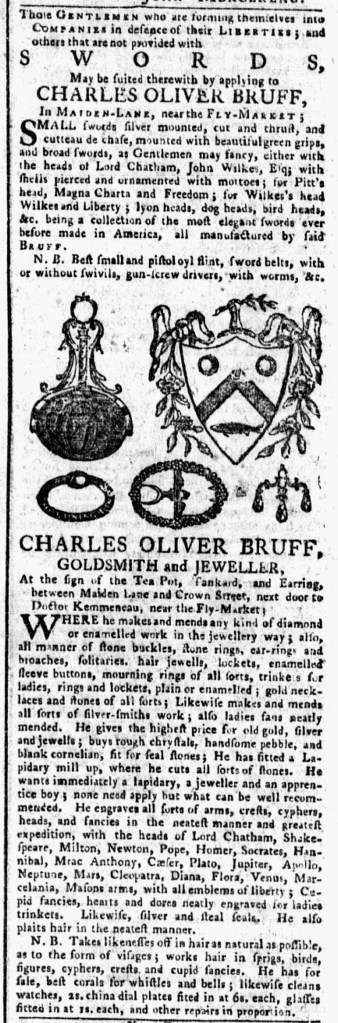
By the time that Charles Oliver Bruff, a goldsmith and jeweler, placed his advertisement in the March 25, 1776, edition of the New-York Gazette and Weekly Mercury he was a veteran advertiser with at least a decade of experience running notices in the public prints in New York.  While little direct evidence about the effectiveness of advertising in early America exists, the fact that Bruff repeatedly invested in marketing suggests that he believed that it worked and considered it worth the investment.  Indeed, his latest advertisement consisted of two advertisements.  The copy for the first one ran as its own notice in the Constitutional Gazette more than six months earlier.  As the first anniversary of the battles at Lexington and Concord approached, Bruff once again offered swords to “Those GENTLEMEN who are forming themselves into COMPANIES in defence of their LIBERTIES.”

Bruff may have considered advertising effective because he did more than merely announce that he had goods for sale.  Instead, he carefully crafted appeals to consumers, encouraging them to purchase his wares.  As he targeted prospective customers “forming themselves into COMPANIES,” for instance, he adorned them with likenesses of British politicians who advocated for the American colonies and corresponding mottoes, including “[William] Pitt’s head, Magna Charta and Freedom” and “[John]Wilkes’s head[,] Wilkes and Liberty.”  He also underscored that the words he stocked were “made in America, all manufactured by said BRUFF.”  When nonimportation agreements became one of the primary strategies for practicing politics, Bruff and other entrepreneurs marketed goods produced in the colonies.

The goldsmith and jeweler also deployed visual images to promote his business.  He advised readers that he kept shop “At the sign of the Tea Pot, Tankard, and Earring,” but they likely noticed the woodcut that adorned his advertisement before anything else.  It featured several of the items available at his shop, including a handheld looking glass with an ornate handle and frame, a ring, a buckle, and an earring.  The image also included an elaborate coat of arms.  A shield decorated with two silver balls, a chevron, and a fish was in the center.  A hand grasping a sheaf of wheat appeared above the shield.  Ribbons cascaded over the side, giving way to leaves and flowers.  The ornate woodcut corresponded to an appeal that Bruff made in the second of those advertisements combined into a single lengthy advertisement: “He engraves all sorts of arms, crests, cyphers, heads, and fancies in the neatest manner.”  For good measure, he reminded prospective customers that he also engraved “all emblems of liberty” on jewelry and other items.

In addition to his “work in the jewellery way” and “silver-smiths work,” Bruff provided other services to entice customers into his shop.  He cleaned watches, installed new glass, and made other repairs at reasonable prices and even “works hair in springs, birds, figures, cyphers, crests and cupid fancies” and “plaits hair in the neatest manner.”  Bruff made his advertisements worth the investment by developing a variety of appeals to consumers and promising an array of goods and services to encourage them to visit his shop.

February 12

What was advertised in a colonial American newspaper 250 years ago this week?

Massachusetts Spy (February 9, 1775).

“CORNISH’s New-England FISH HOOKS.”

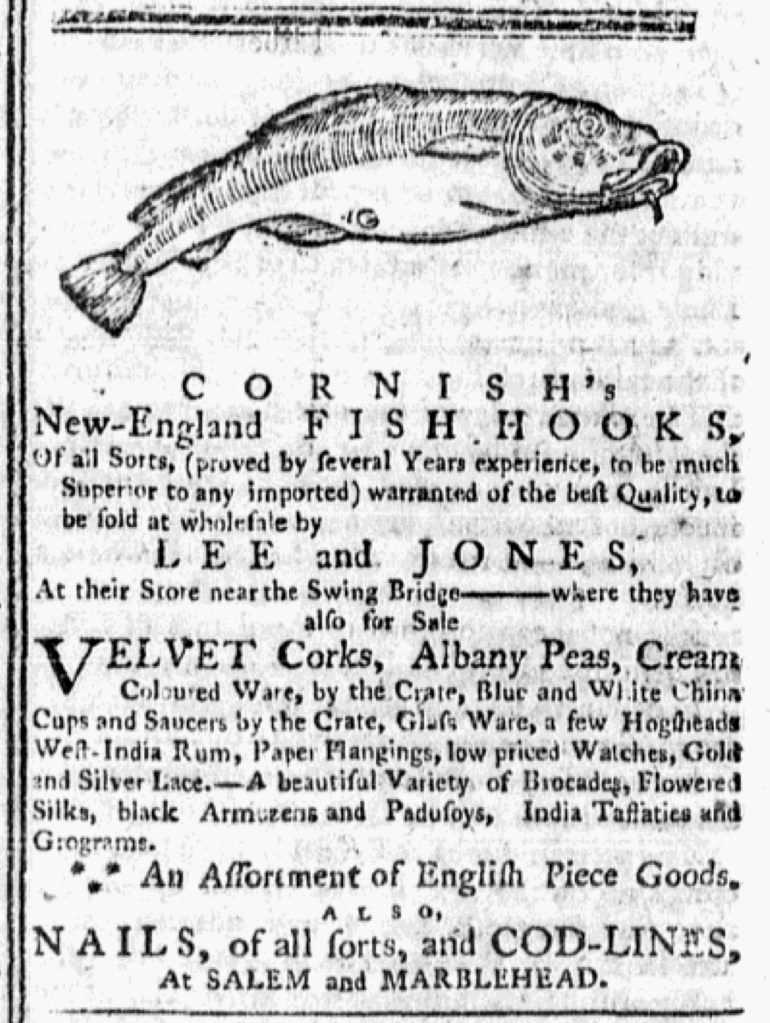
Lee and Jones stocked a variety of merchandise at “their Store near the Swing Bridge” in Boston in February 1775, but they made “CORNISH’s New-England FISH HOOKS” the centerpiece of their advertisement in the February 9 edition of the Massachusetts Spy.  Not only did they list that product first and devote the most space to describing it, but they also adorned their advertisement with a woodcut depicting a fish.  That image previously appeared in advertisements that Abraham Cornish placed in the Massachusetts Spy in March 1772 and March 1773.  Either Lee and Jones acquired the woodcut from Cornish when they composed the copy for their notice or Isaiah Thomas, the printer of the Massachusetts Spy, held the woodcut for Cornish and determined that advertisers promoting his product could use it in their notices.  It was not the first time that Lee and Jones distributed “CORNISH’s New-England Cod-Fish HOOKS.”

By the time that Lee and Jones ran their advertisement, Cornish had established a familiar brand.  In addition to advertising in the Massachusetts Spy, he also advertised in the Massachusetts Gazette and Boston Weekly News-Letter and Salem’s Essex Gazette.  His marketing efforts regularly touted the approval he received when “Fishermen … made trial of his Hooks” and found them “much superior to those imported from England.”  Lee and Jones deployed similar appeals when they proclaimed that the hooks had been “Proved by several Years experience, to be much Superior to any imported.”  Such assertions held even greater significance with the Continental Association, a nonimportation pact, in effect and the imperial crisis becoming even more dire.  In protest of the Coercive Acts passed in response to the Boston Tea Party, colonizers vowed not to import good from Britain.  The Continental Association called for encouraging domestic manufactures or goods produced in the colonies as alternatives to imported items.  Cornish has been making that case for his product for several years, as many readers likely remembered when they saw Lee and Jones’s advertisement for “CORNISH’s New-England FISH HOOKS.”

August 18

What was advertised in a colonial American newspaper 250 years ago today?

Massachusetts Gazette and Boston Weekly News-Letter (August 11, 1774).

“Render this Country an essential Service, by establishing a Manufacture necessary to its Prosperity.”

Abraham Cornish had been in business and advertising long enough by the late summer of 1774 that he expected colonizers to be familiar with his brand of “CORNISH’s New-England Cod-Fish HOOKS.”  He deployed the name of his product as a headline for his advertisement in the August 18 edition of the Massachusetts Gazette and Boston Weekly News-Letter.  Still, for those who needed a refresher or a bit more encouragement to purchase his fishhooks, he provided more information about why those from “his Manufactory” were superior to others.  That they were made in America was central to his marketing efforts.

The savvy entrepreneur had recently moved from “the North-End of Boston, to the Upper Part of Charlestown,” where he continued to make fishhooks “warranted of the best Quality.”  He called on “all concerned in the Fishery” to “favor him with their Custom, as they will thereby promote their own private Interest, and render this Country an essential Service, by establishing a Manufacture necessary to its Prosperity.”  It was a win-win-win situation for “the American Fishery,” the manufacturer, and all colonizers at a time that the political crisis intensified due to the imposition of the Coercive Acts in retaliation for the Boston Tea Party.  Those whose livelihood depended on fishing could acquire equipment “found much Superior to any imported, Cornish could maintain or even expand his business, and the colonies would benefit from “domestic manufactures” that both supported a local industry and directly contributed to the local economy.  Ever since the boycotts inspired by the Stamp Act nearly a decade earlier, many colonizers had advocated for producing more “domestic manufactures” as a means of reducing their reliance on imported goods.  Doing so also served as political leverage in the struggles with Parliament.  Such plans placed obligations on both artisans and tradespeople to produce goods and consumers to purchase those goods instead of imported items.  Like many other producers of “domestic manufactures,” Cornish assured prospective customers that they did not have to sacrifice quality, decalaring that his fishhooks were “made of the best Wire only” and “better shap’d to take Fish.”  He proclaimed that they were “universally approv’d,” having gone into even greater detail in a previous advertisement about how “Fishermen who made Trial of his Hooks … found them … superior to those imported from England.”  Cornish devised a “Buy American” campaign before the colonies declared independence.

May 30

What was advertised in a colonial American newspaper 250 years ago today?

Dunlap’s Pennsylvania Packet (May 30, 1774).

“Fox will engage his rifles to be as good as any that can be made in England.”

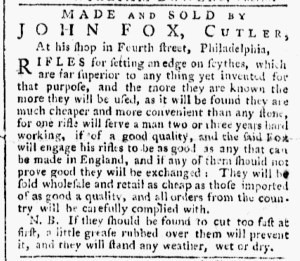
John Fox marketed American ingenuity when he advertised scythe rifles, instruments for “setting an edge on scythes,” that he invented.  In the May 30, 1774, edition of Dunlap’s Pennsylvania Packet, the cutler proclaimed that his rifles “are far superior to any thing yet invented for that purpose.”  He was so certain of that assertion that he confidently asserted that “the more [his rifles] are known the more they will be used,” especially since “it will be found they are much cheaper and more convenient than any stone.”  Rifles were made of wood, light enough for farmers to carry with them to sharpen the edges of scythes as they worked in the fields; whetstones were much heavier and, in turn, much less convenient for such purposes.  Continuing his pitch, Fox claimed that “one rifle will serve a man two or three years hard working, if of a good quality,” and he considered “his rifles to be as good as any that can be made in England.”  Furthermore, he pledged to sell his product “wholesale and retail as cheap as those imported of as good a quality.”  If any customers were not satisfied once they gave his rifles a try, the cutler offered to exchange any that “should not prove good.”

During the imperial crisis, colonial entrepreneurs promoted “domestic manufactures” or products made in America rather than imported.  Such appeals appeared in newspaper advertisements with greater frequency when confrontations with Parliament intensified, especially when colonizers enacted nonimportation agreements in response to the Stamp Act and the Townshend Acts.  Fox marketed his scythe rifles as relations between the colonies and Parliament once again deteriorated, this time because of duties on tea, the Boston Tea Party, and the Boston Port Act that closed the harbor until residents made restitution.  Dunlap’s Pennsylvania Packet and other newspapers published in Philadelphia carried extensive coverage of the debates and passage of the Boston Port Act and the responses in other cities and towns.  Fox’s advertisement appeared immediately below resolutions passed at “a meeting of the inhabitants of the city of Annapolis” on May 25, 1774.  They agreed “to put an immediate stop to all exports to Great-Britain” and, upon a date to be determined in coordination with other town in Maryland and “the principal colonies of America,” that “there be no imports from Great-Britain till the said act be repealed.”  Perhaps it was coincidence that Fox’s advertisement happened to follow the resolutions from Annapolis.  No matter where the two items appeared in relation to each other in the newspaper, the political crisis that inspired the resolutions provided support for Fox’s encouragement to purchase the rifle scythes he “MADE AND SOLD … At his shop in Fourth street, Philadelphia,” as an alternative to imported ones.