January 15

What was advertised in a colonial American newspaper 250 years ago this week?

Supplement to the New-York Journal (January 12, 1775).

“All kinds of business will be transacted on commission.”

John Holt included a significant amount of content – news, editorials, advertisements – in each issue of the New-York Journal.  Like other colonial newspapers, his publication consisted of four pages published once a week.  Most featured three columns per page, but the New-York Journal had four.  Even then, that often was not enough space for everything submitted to Holt’s printing office, prompting him to distribute supplements with even more content.

Such was the case with the January 12, 1775, edition.  In addition to the standard issue, Holt printed a four-page supplement that featured both news and advertising.  Some of that advertising, however, had an unusual format as the result of Holt using a smaller sheet that accommodated only three columns.  That left enough space to insert advertisements in the right margins, though they had to be divided into shorter segments and printed perpendicular to the rest of the content.

For instance, William Tongue’s advertisement for a “MERCHANT BROKER’S OFFICE” that previously ran in a single column appeared in five short segments in the right margin on the second page.  In addition to maximizing the use of space in the supplement, it saved the compositor time because the type had already been set.  On other pages, the right margins contained multiple shorter advertisements, such as Jonathan Durrell’s advertisement for locally produced “EARTHEN WARE” divided into three segments and a notice concerning Isaac Adolphus’s estate divided into two segments on the first page.  In total, Holt managed to squeeze eight advertisements of various lengths, including one offering an enslaved woman for sale, into the margins of the supplement, following a strategy commonly used by colonial printers.

Supplement to the New-York Journal (January 12, 1775).

Apparently, the printer made a calculated decision about the size of the sheets to use for the supplement; it was not the result of a disruption in his paper supply caused by current events.  A week earlier on January 5, he used the larger sheet for both the standard issue and a supplement with four full columns, but on January 19 used the larger sheet for the standard issue and, once again, the slightly smaller sheet for the supplement.  On that occasion, he used only a half sheet, distributing a two-page supplement devoted entirely to paid notices.  That suggests that he carefully managed his resources rather than resorting to whatever paper came to hand.  Advertisements and other content sometimes appeared in the margins out of necessity when printers had difficulty acquiring paper during the imperial crisis, but seemingly that was not the case in this instance.  Instead, Holt shrewdly balanced how much content to print against anticipated revenues from advertising.

Supplement to the New-York Journal (January 12, 1775).

August 6

What was advertised in a colonial American newspaper 250 years ago today?

New-Hampshire Gazette (August 6, 1773).

“RAN-AWAY … a Sailor, named John Morgan … Portsmouth, Aug. 5.”

The notice arrived in the printing office too late to appear in the August 6, 1773, edition of the New-Hampshire Gazette… almost.  John Morgan, a sailor, deserted or “RAN-AWAY from the Ship Exeter Galley” and William Pearne offered a reward to “Whoever will bring the said Man” to him in Portsmouth.  Readers could recognize Morgan, “pretty tall, well built, about 30 Years of Age,” by his “dark Complexion, & black short Hair” as well as his “blue Jacket, check Shirt, Oznabrigs Trousers, and a new Pair of Shoes.”

The advertisement was dated “Portsmouth, Aug. 5.”  The August 6 edition was already in production when Pearne delivered the notice to the printing office.  Like other colonial newspapers, the New-Hampshire Gazette consisted of four pages created by printing two pages on each side of a broadsheet and then folding it in half.  Daniel Fowle, the printer, and others in the printing office would have selected the contents, set the type, and printed the first and fourth pages on one side of the broadsheet in advance of working on the second and third pages on the other side.  They needed to hang the incomplete newspapers to dry after the first printing.  Fowle and the rest apparently had the type set for the second and third pages and were ready to take it to press when Pearne’s advertisement arrived.  Pearne may have pleaded or insisted that it needed to appear in the August 6 edition rather than wait an entire week for the next issue.  That would have given Morgan even more time to make good on his escape.

Fowle or one of the compositors made room for the advertisement in the margin at the bottom of the second page.  It consisted of nine lines, too many to appear together, but there was enough space to add three lines below each of the three columns of news on that page.  The text of the advertisement featured a larger font, a subtle visual cue to alert readers that they encountered content that was not part of the news items originally planned for that page.  The following week, the advertisement did appear as a single piece along with other paid notices on the third page of the August 13 edition.  For immediate publication, however, the printing office resorted to the margin to satisfy a customer who submitted a time-sensitive advertisement at the last minute.

December 4

What was advertised in a colonial American newspaper 250 years ago today?

Connecticut Journal (December 4, 1772).

“Whoever shall take up the said Mare and return her … shall have One Dollar Reward.”

William Hickcok’s advertisement about a bay mare “STRAYED or Stolen” from a local stable must have arrived in the printing office of the Connecticut Journal just before the December 4, 1772, edition went to press.  That would explain its unusual placement on the third page of that issue.  The notice ran across the bottom of the page, divided into three columns of four lines each.  A line ran above Hickcok’s advertisement, making clear where other content ended and his notice began.

Thomas Green and Samuel Green, the printers of the Connecticut Journal, or a compositor who worked in their printing office made room for the advertisement rather than forcing Hickcok to wait an entire week for the next issue.  Like other colonial American newspapers, a standard issue of the Connecticut Journal consisted of four pages created by printing two pages on each side of a broadside and then folding it in half.  Printers typically produced the front and final pages first, reserving the second and third pages for the most current news and advertising.  That seems to have been the case for the December 4 edition.  Advertisements that previously ran in the newspaper, including one dated November 13 and another dated November 16, appeared on the front page, along with news from London that continued on the second page.  The third page featured recent news from Boston and New York and shipping news from the customs house as well as some advertisements from previous issues and two new advertisements dated December 4 (in addition to Hickcok’s advertisement with that date).  Hickcok’s advertisement ran in what otherwise would have been the margin at the bottom of the page.

A week later, Hickcok’s notice ran once again, this time in a single column on the first page.  Whoever set the type anticipated a means of saving time and labor.  By setting the type in columns, even though the advertisement initially ran across the bottom of the entire page, the compositor eliminated the necessity of breaking down the type and setting it again for the next issue.  In this way, the printing office managed to accommodate Hickcok’s desire to run his advertisement as soon as possible while minimizing the amount of additional time and labor required to do so.

October 15

What was advertised in a colonial American newspaper 250 years ago today?

Massachusetts Gazette and Boston Weekly News-Letter (October 15, 1772).

“WANTED immediately, a Wet-Nurse.”

Richard Draper had too much content to publish all of it in the October 15, 1772, edition of the Massachusetts Gazette and Boston Weekly News-Letter.  He remedied the situation, in part, by printing and distributing a supplement on a smaller sheet.  That supplement included additional news, but no advertising.  Even with the supplement, Draper did not have enough space for all the news and advertising received in the printing office.  A note at the bottom of the final column on the third page instructed readers to “See SUPPLEMENT” and advised that “Other Articles and Advertisements must be defer’d.”

Why insert such a note on the third page instead of placing it at the end of the final column on the last page?  The process of printing newspapers on a manually-operated press provides an explanation.  Like most other newspapers from the era of the American Revolution, a standard issue of the Massachusetts Gazette and Boston Weekly News-Letter consisted of four pages created by printing two pages on each side of a broadsheet and folding it in half.  Printers usually set the type and printed the first and fourth pages on one side of the sheet.  After it dried, they printed the second and third pages on the other side.  That resulted in the latest news often appearing inside the newspaper rather than on the front page.  That also meant that the last portion of the newspaper arranged by the compositor was the third page, not the final page.  That being the case, announcements about supplements and omitted materials usually appeared on the third page.

Draper did manage to include one additional advertisement in the standard issue for October 15 rather than deferring it for a week.  The urgency of the notice may have convinced him to make a special effort to include it.  “WANTED immediately,” the advertisement proclaimed, “a Wet-Nurse, with a young Breast of Milk, that can be well Recommended, to suckle a Child in a Family: Enquire of the Printer.”  That notice ran in the right margin of the third page, almost the entire length of an extensive advertisement that listed merchandise stocked by John Barrett and Sons at their store “near the MILL-BRIDGE” in Boston.  With some creative graphic design, Draper squeezed an advertisement seeking a wet nurse, a notice that likely arrived late to the printing office, into that issue.  In so doing, he adapted to the technology of the printing press while providing a special service to that advertiser.

July 28

What was advertised in a colonial American newspaper 250 years ago today?

Connecticut Courant (July 28, 1772).

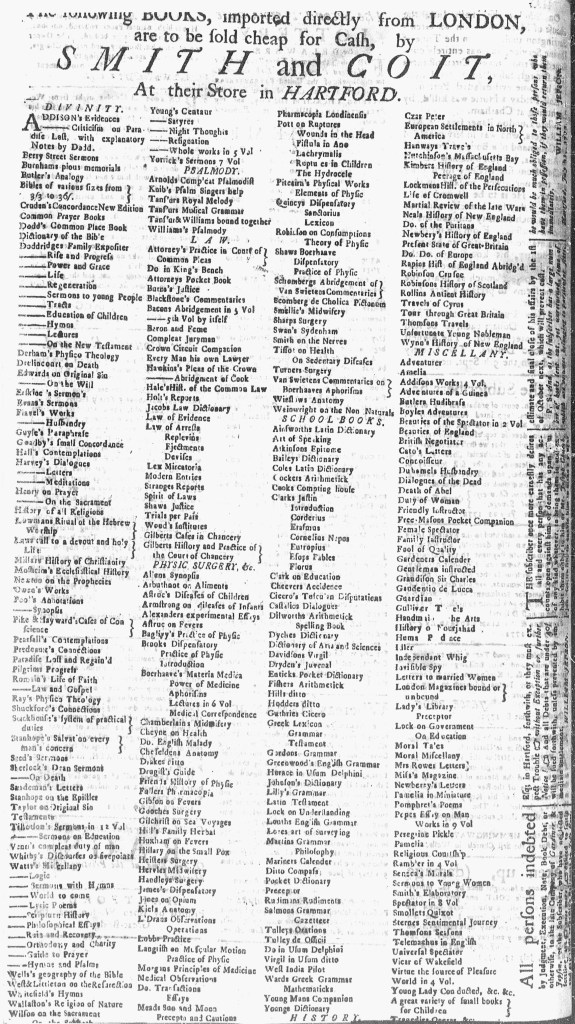
“BOOKS, imported directly from LONDON.”

Booksellers Smith and Coit took out a full-page advertisement in the July 28, 1772, edition of the Connecticut Courant.  Or did they?

A headline that extended four lines ran across the top of the final page, advising readers that “The following BOOKS, imported directly from LONDON, are to be sold cheap for Cash, by SMITH and COIT, At their Store in HARTFORD.”  The booksellers provided a list of authors and titles, arranged in four columns with one item per line.  They further aided prospective customers in navigating the list by organizing it according to genre, providing headings for each category, and alphabetizing the entries under Divinity; Law; Physic, Surgery, &c.; Schoolbooks; History; and Miscellany.  This design allowed Smith and Coit to distribute the advertisement separately as a broadside book catalog, if they placed an order for job printing with Ebenezer Watson, the printer of the Connecticut Courant.

Smith and Coit may have intended to run a full-page advertisement, but another notice also appeared on the final page, that one printed in the right margin on the final page.  To make the advertisement that William Jepson placed in the previous issue fit in the margin, either Watson or a compositor in his printing office rotated the type perpendicular to the other contents of the page and divided the notice into five columns of five or six lines each.  A common strategy for squeezing content into the margins, that saved the time and energy of completely resetting the type.

Jepson’s advertisement could be easily removed.  Indeed, it did not appear on the same page as Smith and Coit’s advertisement in the next edition of the Connecticut Courant.  Instead, the booksellers had the entire page to themselves, a true full-page advertisement.  Did Watson make the adjustment of his own volition?  Or had Smith and Coit complained that Jepson’s notice intruded into their advertisement, its unusual format distracting from the impression they hoped to make with a full-page advertisement?

June 24

What was advertised in a colonial American newspaper 250 years ago this week?

Supplement to the South-Carolina Gazette and Country Journal (June 23, 1772).

“Supplement to the South-Carolina Gazette, and Country Journal.”

Charles Crouch, printer of the South-Carolina Gazette and Country Journal, had far more content than would fit in a standard issue on June 23, 1772.  Like other newspapers printed throughout the colonies, his weekly newspapers consisted of four pages created by printing two pages on each side of a broadsheet and then folding it in half.  On that particular day, Crouch devoted two pages to news and two pages to advertising.  That left out a significant number of advertisements of all sorts, including legal notices, catalogs of goods sold by merchants and shopkeepers, and notices that described enslaved people who liberated themselves and offered rewards for their capture and return.  Since advertising represented significant revenue for printers, Crouch did not want to delay publishing those advertisements, especially since his newspaper competed with both the South-Carolina Gazette and the South-Carolina and American General Gazette to attract advertisers.

To solve the problem, Crouch printed and distributed a supplement comprised entirely of advertising.  From New England to South Carolina, printers often resorted to supplements when they found themselves in Crouch’s position.  Even as he devised the supplement to accompany the June 23 edition, Crouch carefully considered his resources and the amount of the content he needed to publish.  He selected a smaller sheet than the standard issue, one that allowed for only two columns instead of three.  That could have resulted in wide margins, but Crouch instead decided to print shorter advertisements in the margins, rotating type that had already been set to run perpendicular to the two main columns.  That created room for four additional advertisements per page, a total of sixteen over the four pages of the entire supplement.  With a bit of ingenuity, Crouch used type already set for previous issues or that could easily integrate into subsequent issues rather than (re)setting type just to accommodate the size of the sheet for the June 23 supplement.  Crouch managed to meet his obligation to advertisers who would have been displeased had he excluded their notices while simultaneously conserving and maximizing the resources available in his printing office.

November 22

What was advertised in a colonial American newspaper 250 years ago today?

Connecticut Journal (November 22, 1771).

“Whoever will bring said Saddle to the Printers hereof … shall be fully rewarded.”

Most likely the type for the rest of the newspaper had already been set when the copy for a notice about a missing saddle arrived at the printing office of the Connecticut Journal and New-Haven Post-Boy.  That would explain the unusual placement of an advertisement that ran in the right margin of the November 22, 1771, edition.  The advertiser, eager to recover lost property, apparently felt some urgency to publish the notice and did not want to wait an entire week until the next issue.  To accommodate the advertiser, the compositor placed the notice in the only empty space still available, the margin.  As a result, the text ran perpendicular to the masthead and the three columns containing news.  To make it fit, the compositor also divided the advertisement into four short columns, the first two featuring three lines and the last two with two lines.  Each of those short columns was the same width as the standard columns, allowing the compositor to gather all of them together to republish the advertisement in the next issue without having to start over with setting the type.

It was a common strategy deployed by printers and compositors throughout the colonies when they wanted to work additional items into newspapers, though most such notices usually appeared on the second or third pages rather than on the first.  The advertiser may have negotiated for a spot most likely to attract attention in hopes of recovering a “SADDLE, not entirely new, yet whole and sound” that had been “LOST out of the Shop of Captain John Mix.”  The notice offered a reward to whoever brought the saddle to the printing office (rather than the shop where it had been lost or perhaps stolen) or provided information about where it could be found.  Beyond publishing the advertisement, the printers of the Connecticut Journal would play a role in recovering the saddle if anyone wished to collect the reward.  They facilitated the transaction, just as they did for the sale of a “Likely, strong NEGRO LAD” described in an advertisement placed by an unnamed enslaver who instructed interested parties to “Enquire at the Printing Office.”  Squeezing the advertisement about the missing saddle into the newspaper as soon as they received it was one of multiple services offered by the printers.  They not only agreed to broker information in print but also to act as agents on behalf of the advertiser if anyone brought any leads or the saddle itself to the printing office.

May 23

What was advertised in a colonial American newspaper 250 years ago today?

Massachusetts Gazette and Boston Weekly Mercury (May 23, 1771).

“The Sale of the late Rev’d Dr. Sewall’s Library is postponed.”

The Adverts 250 Project has recently examined examples of printing in the margins of eighteenth-century newspapers, a strategy for increasing the amount of space available when printers had more content than would otherwise fit in an issue.  On May 17, 1771, Thomas Green and Samuel Green, the printers of the Connecticut Gazette, placed three advertisements describing enslaved men who liberated themselves and offering rewards for their capture and return in the margins of their newspaper.  They did not have enough additional content to justify publishing a supplement, another common means of creating space for material that did not fit in a standard issue.  To make those advertisements fit in the margins, the Greens took type that had already been set in a single column and divided it into several shorter columns.  The previous day, John Holt took a different approach when he inserted an advertisement in the margins of the New-York Journal.   His notice about a new “Carrier of this Paper” appeared for the first time, running the entire length of the rightmost column on the third page rather than separated into multiple shorter columns positioned side by side.  In each case, appearing in the margins may have enhanced the visibility of the advertisements.

Not every printer and compositor resorted to this strategy, but many did so frequently enough that additional content in the margins became a familiar sight to eighteenth-century readers.  Richard Draper, the printer of the Massachusetts Gazette and Boston Weekly News-Letter, placed two brief items in the margins of the May 23, 1771, edition.  One notice advised, “The Sale of the late Rev’d Dr. Sewall’s Library is postponed.”  The other provided instructions to readers to “See Supplement, for other News and Advertisements.”  A two-page supplement accompanied the standard issue.  Draper likely could have made space there for the notice about the postponed sale, but may have chosen not to do so.  Such a short notice would not have been nearly as visible among the other contents of the supplement as it was in the margin on the third page of the standard issue.  Its placement there also suggests that the information arrived too late to develop a more complete advertisement.  For a standard four-page issue, compositors set type for the third page last, making the notices in the right margin of the third page the last items incorporated into the issue.

Given the amount of advertising in the supplement, all of it previously published in other issues in recent weeks, and the dates listed for the news items, the supplement may have gone to press before the second and third pages of the standard issue.  Draper knew in advance that he would need to distribute a supplement, but he likely did not have much notice that “The Sale of the late Rev’d Dr. Sewall’s Library is postponed.”  As a result, he adopted both strategies for publishing content that did not fit in the standard four-page edition:  issuing a supplement and printing in the margins.  The latter was a clever adaptation prompted by the limits and possibilities of the printing technology available in the eighteenth century. It was a practical solution that had the added benefit of drawing attention to the items that appeared in the margins.

May 19

What was advertised in a colonial American newspaper 250 years ago this week?

New-York Journal (May 16, 1771).

Philip House, who has been for some Years past the Carrier of this Paper, is now discharged from my Business.”

When Thomas Green and Samuel Green, printers of the Connecticut Journal and New-Haven Post-Boy, discovered that that they had more content for the May 17, 1771, edition than space would usually allow, they opted to print several advertisements in the margins.  Although that format was not part of every issue of the Connecticut Journal or other eighteenth-century newspapers, printers and compositors did resort to placing advertisements in the margins fairly regularly.  On the previous day, for instance, John Holt, printer of the New-York Journal, placed an advertisement in the right margin on the third page, running perpendicular to the rest of the text on that page.

A couple of features, however, distinguished Holt’s notice from the advertisements the Greens ran in the margins.  First, Holt’s advertisement concerned his own business.  “Whereas Philip House, who has been for some Years past the Carrier of this Paper, is now discharged from my Business,” Holt announced, “This is to desire the Customers for the said Paper, to let me know if any of them should fail of getting their Papers, till the present Carrier becomes acquainted with the Places where they are to be left.”  Holt placed his notice for the purpose of customer service, maintaining good relationships with subscribers following a change in personnel that potentially had an impact on whether or how quickly they received their newspaper.

Placing such a notice in the margin may have been quite intentional, a means of enhancing its visibility and increasing the likelihood that subscribers noticed it.  Unlike the Greens, Holt did distribute an additional half sheet for advertisements that did not fit in the standard issue.  He could have placed his own advertisement there, but doing so ran the risk of it getting separated from the rest of the issue.  In the margin of the third page, Holt’s notice became part of the standard four-page issue.  Its placement in the margin encouraged readers to peruse it in order to discover what kind of information received special treatment.

The format also indicated that Holt intended for his notice to appear in the margin from the start.  It ran in two lines that extended the length of the column.  The advertisements the Greens placed in the margins of the Connecticut Journal, on the other hand, were divided into several columns of a few lines each.  Those advertisements ran in a previous edition.  Rather than resetting type, the Greens made them fit in the margins by distributing what originally appeared in a single column across five short columns.  They did so out of necessity when they did not have sufficient space in the standard issue of their newspaper, whereas Holt did not transpose his notice from a traditional column to the margin.  From its conception, Holt had a different vision for his note to subscribers about disruptions in delivering the New-York Journal.

At a glance, advertisements printed in the margins of eighteenth-century newspapers look like they ended up there simply because compositors ran out of space.  Closer examination combined with knowledge of the production of newspapers, however, reveals the range of factors likely influenced decisions to place advertisements in the margins.  Different circumstances prompted the Greens to place advertisements in the margins than led Holt to do so.

May 17

Who was the subject of an advertisements published in an colonial American newspaper 250 years ago today?

Connecticut Journal (May 17, 1771).

“RUN away … a Negro Man named ABEL.”

Thomas Green and Samuel Green, the printers of the Connecticut Journal and New-Haven Post-Boy, had more content than would fit in a standard four-page issue on May 17, 1771, but not so much to justify a half sheet supplement.  To make room for everything they wished to squeeze into the issue, the Greens resorted to a method frequently deployed by eighteenth-century compositors.  They placed advertisements in the margins.

Doing so required rotating the type so it ran perpendicular to the rest of the contents of the newspaper.  That did not, however, require them to set new type for the advertisements that appeared in the margins.  Instead, they adapted notices that appeared in the previous issue, dividing them into shorter columns.  For instance, Gideon Platt, Jr., placed an advertisement describing Abel, an enslaved man who liberated himself, and offering a reward for his capture and return.  In the May 10 edition, that notice filled fifteen lines in a single column.  In the May 17 edition, on the other hand, the Greens divided Platt’s advertisement into five columns of three lines each in order to make them fit in the left margin on the second page.  Two other advertisements offering rewards for enslaved men who liberated themselves ran in the right margin on the third page.  They accounted for twenty-six lines in the previous issue, but by placing the town and date on the same line as John Treat’s name, the Greens managed to create five columns of five lines each without making significant interventions into type already set.

Rather than diminish the effectiveness of those advertisements, this strategy likely resulted in greater visibility.  The unique format challenged readers to discover what was so noteworthy that it merited inclusion in the margins rather than waiting until the next edition.  The Greens also made those advertisements easily accessible, placing them in the outer margins rather than along the inner fold of the newspaper.  Even as Abel, Dover, and Glasgow, the men described in the advertisements attempted to elude attention, the unique placement of the notices in the margins of the Connecticut Journal encouraged greater scrutiny and familiarity with their descriptions.