October 14

What was advertised in a revolutionary American newspaper 250 years ago today?
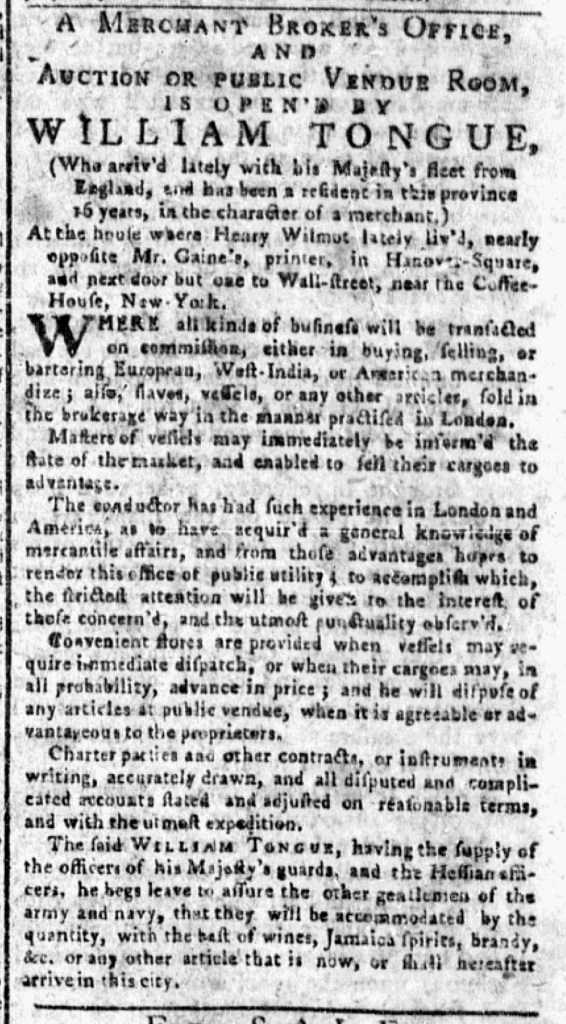
New-York Gazette and Weekly Mercury [New York] (October 14, 1776).
“All kinds of business will be transacted on commission … in the manner practised in London.”

The British occupation of New York created opportunities for William Tongue to open a “MERCHANT BROKER’S OFFICE, AND AUCTION OR PUBLIC VENDUE ROOM … in Hanover-Square.”  The enterprising broker announced that he “arriv’d lately with his Majesty’s fleet from England,” yet also confided that he “has been a resident in this province 16 years, in the character of a merchant.”  Although he had recently taken up residence in New York when British forces took control of the city, he was not a newcomer to the colony (now state).  He had years of experience living in New York and working as a merchant, so clients could draw on his familiarity with the region.  Tongue underscored that he “has had such experience in London and America, as to have acquir’d a general knowledge of mercantile affairs, and from those advantages hopes to render this office of public utility.”

The broker sought to strike a balance between the experience he gained in London and his knowledge of American markets.  He stated that “all kinds of business will be transacted on commission either in buying, selling, or bartering European, West-India, or American merchandize.”  To that end, he promised, “Masters of vessels may immediately be inform’d the state of the market, and enabled to sell their cargoes to advantage.”  In addition, clients could utilize his services to sell enslaved people, ships, and “other articles … in the brokerage way in the manner practised in London.”  Tongue also emphasized his connections to “the officers of his Majesty’s guards, and the Hessian officers,” declaring that he supplied them with “the best of wines, Jamaica spirits, brandy,” and other items.  He hoped to leverage that aspect of his business to gain additional clients among “the other gentlemen of the army and navy.”

Tongue quickly set up shop after arriving in New York “with his Majesty’s fleet.”  He inserted two advertisements in the September 30 edition of the New-York Gazette and Weekly Mercury published in the city at the behest of the British.  Hugh Gaine, the printer of that newspaper, had relocated to Newark, New Jersey, and resumed publication there, but the British, lacking a local newspaper, arranged for Ambrose Serle to publish an alternate New-York Gazette and Weekly Mercury.   Tongue, who conducted business “At the house where Henry Wilmot lately liv’d, nearly opposite Mr. Gaine’s, printer,” quickly submitted copy for both advertisements.  The lengthy one that gave an overview of his new business ran for several weeks while a shorter one announced a sale of “SUNDRY articles of dry goods” and other items “THIS MORNING.”  Tongue wasted no time in launching his new brokerage office and auction house when the British occupied New York.


January 15

What was advertised in a colonial American newspaper 250 years ago this week?

Supplement to the New-York Journal (January 12, 1775).

“All kinds of business will be transacted on commission.”

John Holt included a significant amount of content – news, editorials, advertisements – in each issue of the New-York Journal.  Like other colonial newspapers, his publication consisted of four pages published once a week.  Most featured three columns per page, but the New-York Journal had four.  Even then, that often was not enough space for everything submitted to Holt’s printing office, prompting him to distribute supplements with even more content.

Such was the case with the January 12, 1775, edition.  In addition to the standard issue, Holt printed a four-page supplement that featured both news and advertising.  Some of that advertising, however, had an unusual format as the result of Holt using a smaller sheet that accommodated only three columns.  That left enough space to insert advertisements in the right margins, though they had to be divided into shorter segments and printed perpendicular to the rest of the content.

For instance, William Tongue’s advertisement for a “MERCHANT BROKER’S OFFICE” that previously ran in a single column appeared in five short segments in the right margin on the second page.  In addition to maximizing the use of space in the supplement, it saved the compositor time because the type had already been set.  On other pages, the right margins contained multiple shorter advertisements, such as Jonathan Durrell’s advertisement for locally produced “EARTHEN WARE” divided into three segments and a notice concerning Isaac Adolphus’s estate divided into two segments on the first page.  In total, Holt managed to squeeze eight advertisements of various lengths, including one offering an enslaved woman for sale, into the margins of the supplement, following a strategy commonly used by colonial printers.

Supplement to the New-York Journal (January 12, 1775).

Apparently, the printer made a calculated decision about the size of the sheets to use for the supplement; it was not the result of a disruption in his paper supply caused by current events.  A week earlier on January 5, he used the larger sheet for both the standard issue and a supplement with four full columns, but on January 19 used the larger sheet for the standard issue and, once again, the slightly smaller sheet for the supplement.  On that occasion, he used only a half sheet, distributing a two-page supplement devoted entirely to paid notices.  That suggests that he carefully managed his resources rather than resorting to whatever paper came to hand.  Advertisements and other content sometimes appeared in the margins out of necessity when printers had difficulty acquiring paper during the imperial crisis, but seemingly that was not the case in this instance.  Instead, Holt shrewdly balanced how much content to print against anticipated revenues from advertising.

Supplement to the New-York Journal (January 12, 1775).
