December 5

What was advertised in a colonial American newspaper 250 years ago today?

Boston Gazette (December 5, 1774).

James Bruce of Boston … was never in Company with a Captain Lovett.”

James Bruce resorted to an advertisement in the December 5, 1774, edition of the Boston-Gazette in hopes of rehabilitating his reputation.  From London, the mariner sent a sworn statement that addressed a story about him relayed “by a Paragraph in the Boston Journal, dated 28 July, last.”  He referred to an update from a Captain Lovett published in the Massachusetts Spy on that day.  Lovett had recently arrived in Boston from Antigua, by way of Portsmouth, New Hampshire.  He delivered news that the “merchants and planters” in Antigua “were in great consternation on learning about proposals to suspend trade with Britain and its Caribbean colonies in response to the Boston Port Act and other Coercive Acts.

Despite anticipating hardships, those merchants and planters supposedly supported the American cause, even to the point of intervening when an “old troubler of Boston, Capt. Bruce, was railing against this town in a large company at a principal tavern.”  According to Lovett’s account, Bruce “expatiated largely on the abuse he had suffered for bringing his blessed cargo of Tea” to Boston aboard the Eleanor, one of the ships involved in the Boston Tea Party, and “hoped the next freight he brought them would be soldiers.”  At that point, a “gentleman” confronted him, noting how ungrateful he sounded toward a town that had contributed to his livelihood for so many years, and “caught Bruce by the nose and led him out of the company, requiring him to keep his distance, as a dirty ingrate, unworthy of any gentleman’s company or countenance.”

That story from July came to Bruce’s attention in September, prompting him to compose the statement that appeared in the Boston-Gazette in December.  Whether or not the incident in the tavern in Antigua occurred, Bruce apparently realized that he “got his bread” from the people of Boston and attempted to undo the damage.  He asserted that he “was never in Company with a Captain Lovett … at a Tavern in Antigua” and “the Contents of the Paragraph” inserted in the Massachusetts Spy “in order to hurt him” were “groundless and void of Truth.”  He “never made use of any such Expressions.”  Furthermore, he claimed that he “did not think or know at the Time he took the East India Company’s Tea on Board the Ship Eleanor, that the same would have been either detrimental, or displeasing to the Town of Boston.”  Had he been more aware of the circumstances, “himself and [the] owners would not have suffered any of the said Tea to have been shipt on Board the said Ship Eleanor.”  Bruce not only backtracked from the story told by Lovett but from his involvement in the events that culminated in the Boston Tea Party.

Just as many colonizers who signed an address to Governor Thomas Hutchinson upon his departure from Massachusetts later ran advertisements apologizing for having done so and claiming that they had not fully considered the contents of that address before affixing their signatures, Bruce paid to have his account of recent events run as an advertisement.  Among the five newspapers published in Boston at the time, he most likely chose to submit it to the Boston-Gazette because of that publication’s reputation for supporting patriots and opposing Parliament, thus placing his message before the eyes of those most offended by the reports of his conduct.  In placing such an advertisement, Bruce contributed to shaping the news that readers encountered, though that did not guarantee that anyone believed his version of events or the sincerity of his regret.
October 21

What was advertised in a colonial American newspaper 250 years ago today?

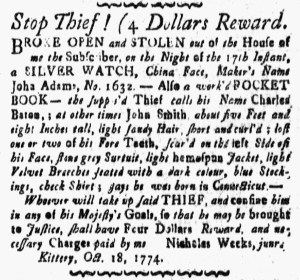
New-Hampshire Gazette (October 21, 1774).

Stop Thief!

Sometimes advertisements in colonial newspapers could have doubled as an eighteenth-century version of a local police blotter.  The October 21, 1774, edition of the New-Hampshire Gazette, for instance, included an advertisement that raised an alarm: “Stop Thief!”  Nicholas Weeks, Jr., reported that four days earlier someone “BROKE OPEN” his house in Kittery and stole a silver watch and a pocketbook.  Weeks alleged that the burglar was a man who sometimes went by the name Charles Baton and other times by John Smith.  No matter which alias the culprit used, the public could recognize him by his “light sandy Hair, short and curl’d,” missing front teeth, and the scars on the left side of his face.  Weeks offered a reward to anyone who “will take up said THIEF, and confine him in any of his Majesty’s [Jails], so that he may be brought to Justice.”

In another column on the same page, John Davenport of Portsmouth also proclaimed, “Stop Thief.”  Sometime during the night of October 12, a “THIEF or Thieves … broke open” his shop and stole a variety of merchandise, “some Cash,” and about five gallons of rum.  The shopkeeper listed several of the stolen items, hoping that would help in identifying the criminals if they attempted to sell them.  After all, theft gave some people an alternate means of participating in the transatlantic consumer revolution that extended to even small towns in the colonies.  Like Weeks, Davenport offered a reward to readers who “shall discover and bring to Justice” the perpetrators.  In yet another advertisement, Nicholas Boussard described a “St[r]ayed or Stolen” horse that went missing in Exeter.  He did not know for certain that someone took the “dark Bay HORSE,” but he did not dismiss the possibility.

Such incidents usually did not receive coverage among the news items in colonial newspapers, yet inserting advertisements allowed colonizers to bring them to the attention of the public and enlist the aid of the community in recovering stolen goods and prosecuting the offenders.  Advertisements delivered local news.

June 3

What was advertised in a colonial American newspaper 250 years ago today?

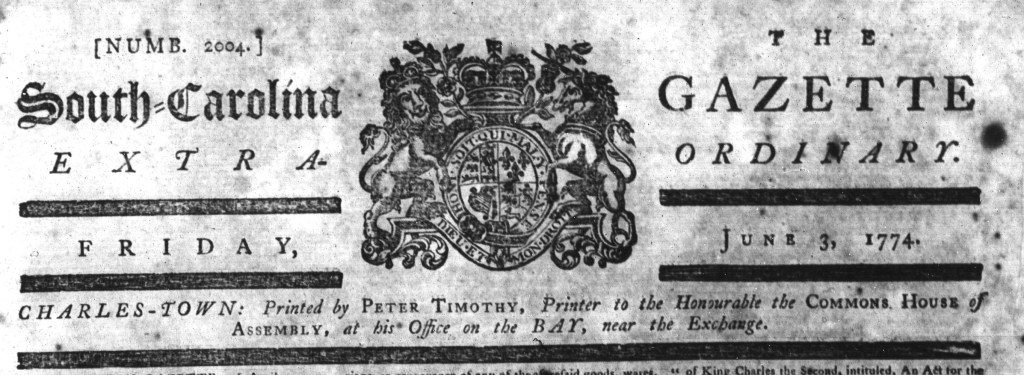
South-Carolina Gazette Extraordinary (June 3, 1774).

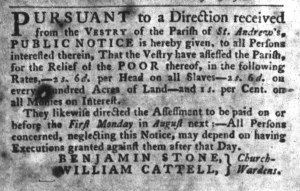
“The Vestry have assessed the Parish, for the Relief of the POOR.”

Peter Timothy usually published the South-Carolina Gazette on Mondays in 1774, but upon receiving the text of the Boston Port Act he considered the news momentous enough to merit an extraordinary edition on Friday, June 3.  Word certainly circulated via conversations among colonizers, yet Timothy gave them the opportunity to read the act for themselves and see all the details that might otherwise have been distorted as the news traveled.  The masthead for the extraordinary featured thick black lines, a symbol of mourning that usually signified the death of a prominent official but in this case lamented the death of liberty in the colonies.

The “Act to discontinue … the landing and discharging, lading or shipping of Hoods, Wares, or Merchandize, at the Town, and within the Harbour of Boston” accounted for the entire front page of the extraordinary.  News and editorials originally published in Boston and Philadelphia ran on the second page and most of the third.  Timothy had too much content for a two-page supplement, so he opted for four pages.  That left a page and a half to fill.  The printer opted for advertisements, items with type already set.  He certainly had enough of that kind of content at his printing office.  Advertising comprised three of the twelve columns in the previous standard edition of the South-Carolina Gazette and all four pages of the supplement distributed on the same day.  Yet Timothy may have been selective with which advertisements he chose to deliver with confirmation of the Boston Port Act.  The extraordinary did not include any notices from purveyors of goods and services hawking their wares.  Instead, Timothy chose advertisements that delivered news, including the “PRESENTMENTS of the GRAND-JURORS” for several districts in the colony, an announcement that the Recess Society would hold its quarterly meeting, and a “PUBLIC NOTICE” about taxes “for the Relief of the POOR” in the Parish of St. Andrew’s.  Given the significance of the news that the extraordinary carried, Timothy may have aimed to accompany the Boston Port Act with advertisements that also delivered news rather than attempts to convince consumers to make purchases.  The following Monday, he returned to business as usual with all manner of advertising in the standard issue and supplement published on June 6.

South-Carolina Gazette Extraordinary (June 3, 1774).

June 2

What was advertised in a colonial American newspaper 250 years ago today?

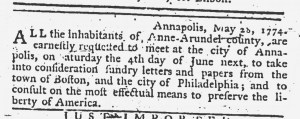
Maryland Gazette (June 2, 1774).

“Meet … to consult on the most effectual means to preserve the liberty of America.”

Advertisements in eighteenth-century newspapers served a variety of purposes.  Sometimes they carried news.  During the imperial crisis, colonizers used advertisements to help them organize.  Consider a notice that ran in the June 2, 1774, edition of the Maryland Gazette.  It advised, “ALL the inhabitants of Anne-Arundel county, are earnestly requested to meet at the city of Annapolis, on Saturday the 4th day of June next, to take into consideration sundry letters and papers from the town of Boston, and the city of Philadelphia.”  The organizers also planned for the participants to “consult on the most effectual means to preserve the liberty of America.”  Those “sundry letters and papers” referred to news of the Boston Port Act.  As punishment for the Boston Tea Party, Parliament closed and blockaded Boston Harbor, starting June 1 and continuing until the residents of that town paid for the tea destroyed the previous December.

More details from some of those “sundry letters and papers” appeared elsewhere in that issue of the Maryland Gazette, including “Extracts of private letters from London, dated April 7 and 8, to private persons in New-York and Philadelphia” on the front page, yet the call to meeting was not among the news items.  It appeared among the advertisements, though it received a privileged place as the first advertisement.  It ran immediately after the list of vessels that entered and cleared the customs house in Annapolis, traditionally the final news item.  The printers, Anne Catherine Green and Son, also ran a note that the “conclusion of the essay on the advantages of a classical education, is postponed for want of room” and “Advertisements omitted will be inserted next week.”  Yet they not only made certain to include the advertisement about the meeting to discuss news related to the Boston Port Act and how to respond but also placed it where readers who might not read the advertisements as closely as the news and editorials would be more likely to see it.  John Holt had done the same with a call to meeting that ran in the May 19 edition of the New-York Journal.  The press played an important role in “preserv[ing] the liberty of America” during the era of the American Revolution, but not solely in the sections of newspapers that carried coverage of current events.  Advertisements also contributed to keeping readers informed and mobilizing colonizers to resist legislation passed by Parliament.

May 19

What was advertised in a colonial American newspaper 250 years ago today?

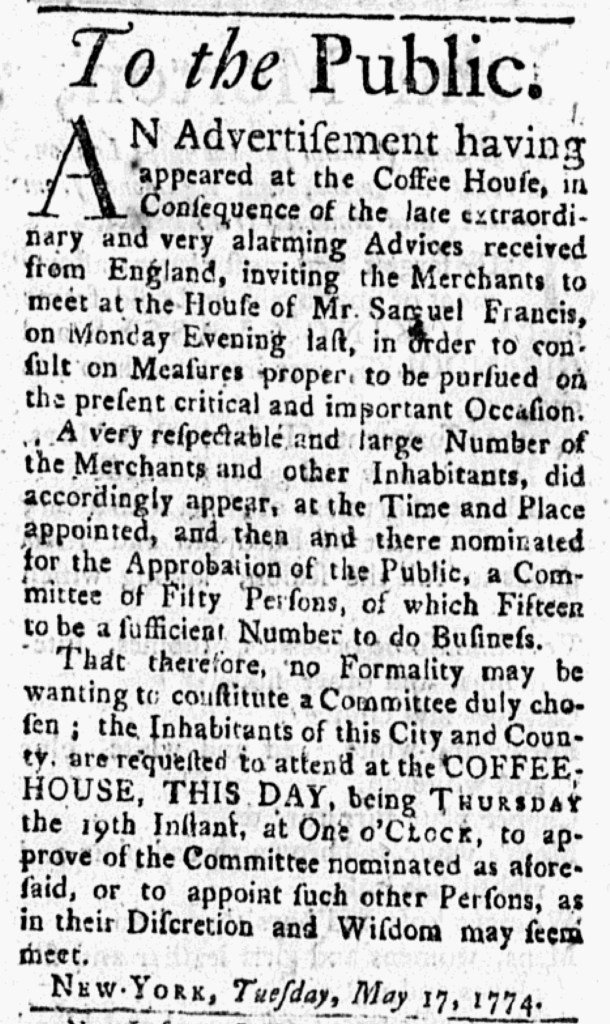
New-York Journal (May 19, 1774).

“Meet … to consult on Measures proper to be pursued on the present critical and important Occasion.”

Important news sometimes appeared among the advertisements in colonial newspapers during the imperial crisis that culminated in thirteen colonies declaring independence from Britain.  While the rest of the newspaper carried reports, updates, editorials, and extracts of letters meant to keep readers informed of “the freshest ADVICES, both FOREIGN andDOMESTIC” (as the masthead for the New-York Journal and other newspapers proclaimed), readers also needed to peruse the advertisements.  Such was the case in the spring of 1774 when New York received word of the Boston Port Act that closed the harbor until such time that resident made restitution for the tea destroyed by colonizers masquerading as Indians the previous December.

A notice in the May 19 edition of the New-York Journal referred to an “Advertisement” or announcement that “appeared at the Coffee House, in Consequence of the late extraordinary and very alarming Advices received from England.”  That announcement invited merchants to meet “at the House of Mr. Samuel Francis,” meaning the tavern operated by Samuel Fraunces, “in order to consult on Measures proper to be pursued on the present critical and important Occasion.”  In turn, the advertisement in the newspaper reported on what occurred at that meeting.  “A very respectable and large Number of the Merchants and other Inhabitants” gathered and nominated a committee “of Fifty Persons, of which Fifteen to be a sufficient Number to do Business.”  The advertisement, addressed “To the Public,” called on the “inhabitants of this City and County” to attend another meeting to “approve of the Committee nominated … or to appoint such other Persons, as in their Discretion and Wisdom may seem meet.”  The organizers intended to garner as much support as possible to “constitute a Committee duly chosen” to act on behalf of all residents concerned about the most recent abuse perpetrated by Parliament.

Disseminating notice about the meeting as a newspaper advertisement made more colonizers aware of the meeting, though word also spread in conversation.  It also kept readers at a distance informed that merchants and others in New York prepared to take action, encouraging them to continue checking the public prints for more news about politics and current events.  Those who also read Rivington’s New-York Gazetteer that day encountered the complete text of the Boston Port Act on the front page, an opportunity to assess it for themselves beyond whatever rumors they previously heard.  Working back and forth between news and advertisements, colonizers gained a more complete picture of the events unfolding in the wake of the Boston Tea Party.

January 29

What was advertised in a colonial American newspaper 250 years ago today?

Providence Gazette (January 29, 1774).

“Had the Fire got to any Height, it would have raged to an unknown Degree, for Want of Buckets to supply the Engines.”

Newspaper advertisements often delivered local news that did not appear elsewhere in the publication.  Such was the case in the wake of a fire in Providence that took place on January 21, 1774.  The following day the Providence Gazettereported, “Yesterday Evening the Town was alarmed by the Cry of Fire, which proved to be in the Pot-Ash Works, on the West Side of the Bridge; but by timely Assistance it was suppressed before much Damage had ensued.”  John Carter, the printer, downplayed the danger, perhaps unintentionally.  He did not have much time to gather information about the fire before the newspaper went to press, so important details did not appear in the Providence Gazette until the next issue.  When they did, they ran among the paid notices rather than in the news that Carter compiled.

On January 29, the newspaper carried an advertisement that transmitted an “Order of the Engine-Company, No. 1,” to residents of the town.  The dateline indicated it had been written the day after the fire, the same day as the previous issue of the Providence Gazette, but too late to appear in the weekly publication.  “WHEREAS it was observed at the Place of the Fire last Evening,” the advertisement proclaimed, “that the greater Part of the People attending had no Buckets; and it is generally thought, that had the Fire got to any Height it would have raged to an unknown Degree, for Want of Buckets to supply the Engines: Therefore all Families, for their own Preservation, are required to provide themselves with Buckets immediately.”  Carter’s initial reporter emphasized “timely Assistance” that “suppressed” the fire “before much Damage had ensued,” but this subsequent advertisement underscored how catastrophic the fire could have been as a result of so many residents not being prepared to provide the right kind of assistance.  Not only had they been negligent, they also disregarded a local ordinance.  The Engine Company instructed “all Families” to acquire buckets so they could provide aid in the future not only “for their own Preservation” but also to “avoid the Penalty of the Law.”  The advertisement concluded with a warning about “an Examination being intended to be made throughout the Town, and the Law put into Execution.”

Those details likely spread by word of mouth in the week between the fire and the advertisement running in the Providence Gazette, so Carter may not have considered it necessary to include the additional details among the local news.  In addition, having received the Engine Company’s advertisement in the printing office, he probably thought it a sufficient update.  Readers who lived at any distance would have been less likely to hear that so many people who showed up to the fire could not assist in putting it out because they did not bring buckets, so the advertisement did indeed present new news to them.  As was so often the case, collating information in news articles and advertisements yielded more complete coverage of local events.

November 17

What was advertised in a colonial American newspaper 250 years ago today?

Pennsylvania Journal (November 17, 1773).

“Mr. DOUGLASS’S concern for the peace of the Theatre prevented him from … confuting those falshoods … propagated against him.”

Something happened at the theater in Southwark on the outskirts of Philadelphia in November 1773, something that one of the actors, John Henry, believed he should address in the public prints.  Among the various advertisements in the November 17 edition of the Pennsylvania Journal, Henry inserted “A CARD” in which he “most respectfully assures the Town, that he has too great a deference for their opinion to wish to do any thing contrary to it.”  He did not elaborate on what had happened, nor did any of the newspapers published in Philadelphia at the time mention any controversy among the local news they printed that week, but conversation and gossip likely made any such coverage unnecessary.  If readers did not already know what happened, they could easily enough ask friends and acquaintances to learn more.

Henry made some references in his “CARD” that likely would have piqued the curiosity of readers and prompted some of them to make inquiries.  For instance, he indicated that a play had been canceled, but, if it had been performed as scheduled, he would have “addressed the Audience and submitted himself entirely to their judgment.”  However, “Mr. DOUGLASS’S concern for the peace of the Theatre prevented him from having an opportunity of evinceing that respect he has for the Public, and of confuting those falshoods that, he understands, have been propagated against him.”  Scandal!  What kinds of rumors circulated about Henry?  Henry’s “CARD” likely whetted the appetites of some readers to find out more about what kind of trouble the actor’s troubles.

An advertisement in the previous issue of the Pennsylvania Journal announced that the American Company would perform “A COMEDY called THE CLANDESTINE MARRIAGE,” first performed at Drury Lane in London in 1766, at the “Theatre in Southwark” for “POSITIVELY THE LAST WEEK.”  Douglass, the manager of the company, played the role of Sir John Melvile, while Henry played Lovewell.  Apparently, none of the rumors about Henry had circulated before the advertisement ran on November 10, at least not so widely to merit canceling any performances.  Whatever had conspired, Henry wanted a chance to address “those falshoods,” though the actor seemingly preferred to present his defense to an audience rather than in print.  He likely reasoned that he could more readily sway the sympathies of an audience who witnessed how he comported himself than readers who could not hear the tone of his voice or observe his demeanor.  In addition, he likely did not wish to commit some allegations to print.

That did not prevent him from making an earnest plea in his “CARD.”  Henry declared that had he been permitted to make an address that “his intention was to throw himself on the protection of an American Audience,—who, he was conscious, would not condemn him unheard.”  He believed this from experience, having been “Brought up to his profession on the American Stage, and having exerted his poor endeavours to please, for these seven years past.”  The Irish-born actor had previously performed in Dublin and London before migrating to Jamaica and, eventually, the mainland colonies.  He appeared in productions at the John Street Theatre in New York in 1767, later moving to the theater in Southwark.  In his “CARD,” he professed that American audiences “have hitherto honoured him with more marks of their indulgence than his small share of merit deserves.”  Given a chance, the actor was confident that “an American Audience, … from their known generosity, candour, and impartiality,” would have heard his story and accepted the explanation he gave.  Henry concluded by declaring that “it shall be his constant—his grateful study to deserve” the trust and approval of that audience.

Henry’s “CARD” did not tell the whole story, though it revealed more than appeared elsewhere in any of the newspapers published in Philadelphia at the time.  The truncated narrative delivered local news in its own way, while also prompting readers to seek out information from other sources to learn more about whatever scandal embroiled one of the actors at the Southwark Theatre.

August 17

Who was the subject of an advertisement in a colonial American newspaper 250 years ago today?

Connecticut Courant (August 17, 1773).

“Ruth, the Wife of me the subscriber threatens to run me in debt.”

Colonizers placed newspaper advertisements for a variety of purposes.  In many ways, their paid notices served as an extension of local news coverage, though in such instances the advertisers rather than the printers made editorial decisions about the information disseminated to readers.  Consider the August 17, 1773, edition of the Connecticut Courant.  An advertisement for the “SAY-BROOK BARR LOTTERY,” held for the purpose of “fixing Buoys and other Marks on an near Say-brook Barr at the Mouth of Connecticut River” to “render the Navigation into and out of said River, both safe and easy,” informed the public about where to buy tickets and when the drawing would be held.  Another advertisement described a horse “Stray’d or stolen out of the pasture of Martin Smith” and offered a reward for its return.  In yet another advertisement, Samuel Russel, “Sheriffs Deputy,” warned that Solomon Bill, “who the greater part of his life has been strongly suspected to be concern’d in counterfeiting money,” had escaped before his trial and offered a reward for his capture.

Other advertisements testified to marital discord in local homes, likely overlapping with the gossip that both men and women shared as they went about their daily routines.  Moses Phelps declared that his wife, Ruth, “threatens to run me in debt.”  Accordingly, he ran his advertisement “to forbid all persons trusting her on my account, as I will pay no debt contracted by her.”  Unable to exercise his patriarchal authority at home, Moses resorted to the public prints to try to compel his wife to behave in a manner he considered appropriate.  Cornelias Flowers, Jr., did so as well, stating that throughout his marriage to Mary that she “behaved herself in a very unbecoming manner, and has injured me in the most tender part.”  No doubt some readers gossiped and speculated about the particulars of what happened between Cornelias and Mary.  Utilizing the same formulaic language as Moses Phelps, Cornelias stated that Mary “intends to run me in debt” and instructed “all persons not to trust her on my account, for I will pay no debt she shall contract.”

Such news may not have been as momentous as some of the accounts from London, Paris, New York, Philadelphia, Boston, Charleston, and other places that the printer chose to include elsewhere in that issue of the Connecticut Courant, but, for many colonizers, it likely had just as much impact on their daily lives.  News of a notorious counterfeiter at large in the colony, a lottery to improve navigation of a river important to local commerce, and troubled marriages spread by word of mouth, yet the inclusion of these items among newspaper advertisements helped raise awareness and keep conversations about them flowing.

October 10

What was advertised in a colonial American newspaper 250 years ago today?

Providence Gazette (October 10, 1772).

“The Shop of Holden and Grainger, Taylors, was broke open.”

Advertisements in eighteenth-century newspapers sometimes served as precursors to police blotters that recorded crimes in later centuries.  In particular, they most often provided details about burglaries, in part because the victims offered rewards for the return of stolen goods and the conviction of the culprits.

Two burglaries occurred in Providence on the night of September 22, 1772.  Perhaps the same “Thief or Thieves” perpetrated both crimes.  William Barton reported his shop “was broke open, and robbed of … five new Beaver Hats, not coloured; one second handed Hat, cut in the new Fashion; and one Cloth coloured Surtout, with Basket Buttons.”  Similarly, tailors Holden and Grainger declared that their shop “was broke open” and an even greater array of items taken.  The details that the tailors provided would have made it easy to identify the stolen goods, including “one Suit of Claret coloured Broadcloth, not finished, the Lining nearly of the same Colour, with Leather Pockets, a Pocket in the Lining of the left Forebody, having Gold Basket Buttons, and Gold Knee-straps, the Breeches not lined” and “a light grey Broadcloth lapelled Jacket, with Basket Buttons of the same Colour, partly worn, having new Lining to the Skirts, and Tow-cloth Pockets.”  Holden and Grainger also stated that “the same Shop was broke open” near the end of August.  Unfortunately for Barton, that had been the case for his shop as well.  The “Thief or Thieves” may have kept some or all of the stolen items for themselves, but they more likely fenced them.  The articles then entered what Serena Zabin has called an “informal economy” that made participating in the consumer revolution more accessible to the lower sorts – free, indentured, and enslaved – who did not have the means to purchase new goods directly from shopkeepers who retailed them or artisans who produced them.

Barton offered a reward of fifteen dollars for apprehending the burglars or five dollars for recovering the stolen articles.  Similarly, Holden and Grainger promised twelve dollars to “Whoever apprehends the Thief or Thieves” and six dollars for the stolen items.  They also decided to take advantage of placing their notice in the Providence Gazette by concluding with a nota bene that informed the public that they “have for Sale choice Deer Skins, and ready made Breeches, cheap for Cash or Grain.”  Like many other advertisers, they placed an advertisement with more than one purpose.  As long as they had the public’s attention, they figured they could benefit from promoting their services in addition to seeking assistance in recovering their stolen goods.

June 3

What was advertised in a colonial American newspaper 250 years ago this week?

Pennsylvania Packet (June 3, 1772).

“FOR KINGSTON, IN JAMAICA, THE SHIP POLLY AND PEGGY.”

Readers frequently encountered advertising on the front page of eighteenth-century newspapers.  Printers did not relegate that content to other sections.  Some filled all or most of the front page with advertising, as Hugh Gaine did in the June 1, 1772, edition of the New-York Gazette and Weekly Mercury.  Others divided the space between advertising and news. William Goddard devoted the first two columns of the June 1 edition of the Pennsylvania Chronicle to advertisements, reserving the third column for news.  John Dunlap, on the other hand, gave priority to news on the front page of the Pennsylvania Packet published that day, but that did not prevent him from including some advertisements.  The first two and a half columns contained news.  Four advertisements filled the remainder of the final column.

Those advertisements delivered news of a different sort.  One notice informed the public that the Polly and Peggy sought passengers and freight for a voyage to Jamaica.  Another let travelers know that Martin Delany opened a tavern “at Appiquimany Bridge (commonly called Cantwell’s Bridge) on the great road from Philadelphia to Dover.”  He encouraged them to lodge there, promising “the best usage,” “a variety of the first wines, [and] spirits,” and “completely refitted” stables.  In another advertisement, Robert Mack called on “James Pearce, of George-Town” and “David Foset of Snowhill” to “pay charges” and “take away” Jack and Charles, enslaved men in his custody at the jail in New Castle.  In addition, White and Montgomery reported that “just opened [a] store on the north side of Market-street wharf.”  A note at the bottom of the column advised, “FOR MORE NEW ADVERTISEMENTS SEE THE FOURTH PAGE.”  Dunlap suggested that readers would be just as interested in the information relayed in the paid notices that appeared on the last page as the news from Europe, the shipping news from the custom house, and the prices current in Philadelphia on the second and third pages.

Printers did not adopt uniform practices about where advertisements should appear in relation to other content, though they usually reserved some or all of the final page for paid notices.  Advertisements could appear just about anywhere in the newspaper, including on the front page, with the arrangement within any newspaper changing from week to week. Printers did not classify advertisements as content that could not appear on the front page.  As a result, advertisements often accounted for some of the first news or information that readers encountered when they perused eighteenth-century newspapers.