October 31

GUEST CURATOR: Ceara Morse

What was advertised in a colonial American newspaper 250 years ago today?

oct-31-10311766-new-hampshire-gazette
New-Hampshire Gazette (October 31, 1766).

An Astronomical DIARY, Or ALMANACK, For the Year of our Lord CHRIST 1767.”

In this advertisement the printers of the New-Hampshire Gazette announced that their almanac for 1767 “soon will be Publish’d, and Sold.”

My previous knowledge of almanacs was that they told about the weather, moon phases, and other astronomical events, as well as gave information that helped with raising crops. Many different almanacs were published, each depending on the location where colonists lived. The almanac in this advertisement was made for Portsmouth, New Hampshire, and the surrounding area.

As a result of my research on this advertisement, I learned that almanacs were almost as popular as the Bible in colonial America. Jon Butler discusses the demand people had for information about the next year such, such as “all of the astronomical information … necessary to make astrological calculations.[1] Colonists enjoyed the predictions about the weather and astronomical events, often craving more.

Butler also noted that some colonists used “almanacs rather than Bibles to solve personal crises through occult means.”[2] The authors of some almanacs, however, “linked astrology to the ‘filthy Superstition of Heathens.’”[3] Some authors saw astrology as a form of sorcery and witchcraft, even though many colonists demanded almanacs with astrological features, including the “anatomy,” which was “a crude figure of a man … circled by signs of the zodiac that pointed to the parts of the body that each controlled.”[4]

**********

ADDITIONAL COMMENTARY: Carl Robert Keyes

Ceara correctly notes that almanacs were extremely popular in eighteenth-century America. Thanks to the useful and entertaining information they contained, these pamphlet-like periodicals could be found in all sorts of households, from the elite to the most humble. This advertisement hints at their popularity: the printers of the New-Hampshire Gazette sold their almanac both “Wholesale and Retail.” In addition to individual customers purchasing copies for personal use, the printers anticipated that booksellers, shopkeepers, and other retailers would buy in volume and then resell almanacs.

Printers in practically every city that had a printing press produced almanacs for local use in the eighteenth century. This was not merely a matter of authors and printers attempting to get a share of the market (though that played a part as well); each almanac contained precise astronomical information specific to a particular location. Note that the almanac promoted in this advertisement was “Calculated for the Meridian of Portsmouth in New-Hampshire, Lat. 43. 15 N. Long. 70 45 W.” Provided the calculations had been done correctly, readers of the New-Hampshire Gazette would have found this almanac more accurate and useful than one keyed to nearby Boston and certainly better than almanacs produced in other cities. The printers underscored that “Care and Pains ha[d] been taken to have this Almanack Correct.”

To that end, many printers and authors created a sort of brand loyalty associated with the almanacs they produced throughout the eighteenth-century. Benjamin Franklin’s “Poor Richard” lives on in popular memory as the most famous, but other authors gained prestige for the accuracy of their astronomical calculations. Year after year the titles of many almanacs included the names of authors who had gained the public’s confidence. This advertisement also makes a nod in that direction: “’tis presum’d ‘twill be as Acceptable as tho’ it appear’d under the very respectable Name of the late Doctor AMES, or his surviving Son and Successor Nathaniel.” The advertisement did not indicate the author of this particular almanac, but the printers sought to at least associate it with the names of two of the most popular and trusted authors.

Like newspapers and the advertisement they contained, almanacs provided an important source of revenue for colonial printers. The printers of the New-Hampshire Gazette announced that their almanac would soon be for sale while it was still in press, an entire two months before the new year began. Other printers began advertising their almanacs two months earlier. Demand certainly existed for these slim periodicals, but printers used frequent advertisements over many months to encourage even greater numbers of customers to purchase almanacs.

**********

[1] Jon Butler, “Magic, Astrology, and the Early American Religious Heritage, 1600-1760,” American Historical Review 84, no. 2 (April 1979): 330.

[2] Butler, “Magic, Astrology,” 331.

[3] Butler, “Magic, Astrology,” 340.

[4] Butler, “Magic, Astrology,” 330.

September 1

What was advertised in a colonial American newspaper 250 years ago today?

Sep 1 - 9:1:1766 New-York Gazette
New-York Gazette (September 1, 1766).

“THOMAS MORE’S ALMANACK, For the Year 1767. Is in the Press at W. Weyman’s.”

When it came to the printers and booksellers in colonial America, almanacs were a staple among the merchandise they produced and sold. These inexpensive pamphlets were in great demand, finding their way into the hands of readers from all kinds of backgrounds, from the elite to the most humble. In the 1960s Milton Drake compiled a bibliography of hundreds of almanacs printed in America in the eighteenth-century. Printers met the high demand for these calendars that doubled as reference periodicals by delivering an extensive supply to colonial customers, competing with each other in the process.

Given the diversity of almanacs available for public consumption, printers (as well as the authors of the almanacs themselves) needed to direct potential customers to the volumes they produced. Among the most common appeals, they promoted the accuracy of their almanacs, sometimes underscoring the education or other qualifications of the author or compiler. Benjamin Franklin’s almanacs, authored under the pseudonym Richard Saunders or Poor Richard, gained popularity for the aphorisms the astute printer inserted. (Arguably, those aphorisms made Franklin’s almanacs the most famous of the eighteenth century. Poor Richard’s almanacs remain well known in popular culture today, not just among scholars of early American print culture, thanks not only to their connection to one of the founders but also because the aphorisms have become nuggets of wisdom passed down from one generation of Americans to the next.) The authors and compilers of almanacs, like “Poor Richard,” became brands in and of themselves, contributing to the popularity of certain almanacs and forging a loyalty that predisposed colonists to continue purchasing familiar publications.

William Weyman devised another strategy for placing his almanacs in the hands of readers. He advertised them early (indeed, very early!), which allowed him to bring his almanacs to the attention of potential customers before they even considered others printed by competitors. “THOMAS MORE’S ALMANACK, For the Year 1767” was not yet ready for sale at the time that Weyman placed today’s advertisement. It was merely “in the Press … and will be published in due Time.” This advertisement appeared on September 1, a full four months ahead of the year covered in the almanac, but Weyman was priming customers to consider his almanac. They might not have needed it yet, but it was a product many of them knew that they would purchase eventually.

Modern retailers engage in similar practices. This year many stores started stocking Halloween items in August. Thanksgiving and Christmas merchandise will be available soon, if it is not on shelves already. Today’s merchants did not invent promoting seasonal goods well before customers needed them. William Weyman and others were already doing that in the eighteenth century.

February 15

GUEST CURATOR:  Elizabeth Curley

What was advertised in a colonial newspaper 250 years ago today?

Feb 15 - 2:14:1766 New-London Gazette
New-London Gazette (February 14, 1766).

“Ames’s Almanacks for the Present Year, to be Sold by T. Green.”

An almanac is “an annual publication containing a calendar for the coming year, the times of such events and phenomena as anniversaries, sunrises and sunsets, phases of the moon, tides, etc., and other statistical information and related topics.” In today’s society we do not see an almanac in everyone’s back pocket and purse; however back in the 1700s they were a lot more popular.

Here in the New-London Gazette, T. Green is advertising Ames’s Almanack for the “present year” which was 1766. Nathaniel Ames is considered to be the first person to publish an almanac in colonial America. The first annual publishing was done in 1725 and was published in Bridgewater, Massachusetts, until he moved to the South Shore later in his life. Ames’s Almanack was for many yeas considered the greatest with it publishing more then 60,000 copies. That’s quite a large number of copies for a colonial work. He started an industry that would spawn the likes of Poor Richard’s Almanack (Ben Franklin, 1733, Pennsylvania) and Rhode-Island Almanack (James Franklin, 1727, Rhode Island)

Almanacs were a major part of day-to-day life for people during the colonial time. They helped “everyday” people such as farmers, shopkeepers, and black/silversmiths know a little about each day. They would include astrological information, some details of the previous years weather, tide flow charts, copies of poems and stories, and historical essays. They also promoted reading throughout the countryside, and commerce for people such as T. Green. One family could purchase an almanac annually and it would give them access to literary works and a variety of useful information.

**********

ADDITIONAL COMMENTARY:  Carl Robert Keyes

Elizabeth is correct when she notes the ubiquity of almanacs in colonial America. They were cheap print. These small, inexpensive pocket references could be found in households from the grandest to the most humble and were published locally in large numbers from an early date.

Oct 25 - 10:25:1765 New-London Gazette
New-London Gazette (October 25, 1765).

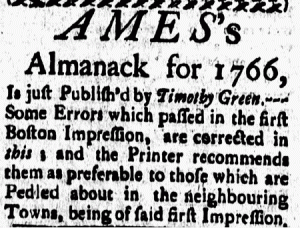
This is not the first time that an advertisement for Ames’s Almanack in the New-London Gazette has been featured by the Adverts 250 Project. In fact, it was the second advertisement I selected when this project was still confined to #Adverts250 on Twitter. This earlier advertisement demonstrates how far in advance almanacs were printed. By the end of October, Timothy Green advertised that his imprint of the almanac did not include “Some Errors which passed in the first Boston Impression” and marketed the version of Ames’s Almanack he printed as “preferable to those which are Pedled about in the neighbouring Towns.”

Not unlike purchasing calendars in the modern era, it is reasonable to expect that colonial consumers bought almanacs before the first of the year or as shortly thereafter as possible. To gain the full value of a calendar or an almanac requires using it throughout the entire period it covers. I previously featured an advertisement for almanacs placed three weeks into the new year. Elizabeth selected an advertisement for almanacs placed nearly seven weeks into the new year!

Jan 21 - 1:20:1766 Connecticut Courant
New-London Gazette (February 14, 1766).

What is happening here? It could be that the advertisement is filler, especially given its brevity, but it is also possible that Green ended up with a surplus and sought to continue to sell as many almanacs as possible to those who had not yet purchased them or desired additional copies. This advertisement could have been both padding that filled the page and the issue and an attempt to recoup his investment in printing Ames’s Almanack. This was the very first advertisement to appear in this issue of the New-London Gazette. Subscribers who read the news would have had to also read this advertisement to register that the advertising section had begun. Even if they did not continue with the other advertisements, at least they would have seen this one. It was the printer’s prerogative to place advertisements for his own goods and services wherever he wished in the issue.

January 21

What was advertised in a colonial newspaper 250 years ago this week?

Jan 21 - 1:20:1766 Connecticut Courant
Connecticut Courant (January 20, 1766)

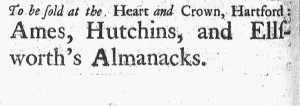
“To be sold at the Heart and Crown, Hartford:  Ames, Hutchins, and Ellsworth’s Almanacks.”

Historians who study newspapers in colonial America usually argue that if printers made any money at all from publishing newspapers that the profits derived from the advertisements rather than subscriptions.  Given the number of advertisements that appeared in many colonial newspapers, this is not hard to believe.

That being the case, did Thomas Green make any money when he printed this issue of the Connecticut Courant?  Only two advertisements appeared in the broadsheet folded in half to create four pages.  One was a legal notice; the other was this advertisement for almanacs, seemingly placed by the printer himself and thus not generating any revenue except for whatever sales might result from its inclusion.  Still, it is an odd advertisement:  presumably most consumers would have purchased almanacs much earlier, not nearly three weeks into the new year.  In addition, the lower edge of the advertisement is not even with the column on the left (unlike the two columns on the other three pages in this issue), suggesting that the advertisement was included as filler, and hastily at that.  Did Green have a bit of extra space and decide to fill it with an attempt to get rid of merchandise that was going out of date with each passing week?

Much of this is speculation.  This advertisement interests me because it raises so many questions about printers and their practices in the 1760s.

Jan 21 - 1:20:1766 - Connectictu Courant - full page
Final Page of Connecticut Courant (January 20, 1766)