June 30

What was advertised in a colonial American newspaper 250 years ago today?
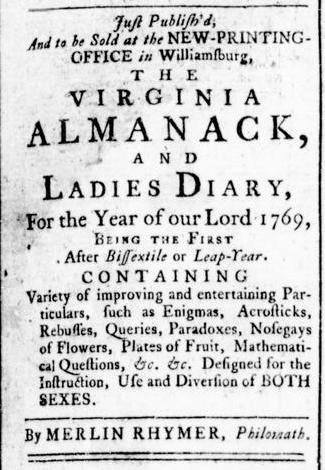
Jun 30 - 6:30:1768 Virginia Gazette Rind
Virginia Gazette [Rind] (June 30, 1768).
“THE VIRGINIA ALMANACK, AND LADIES DIARY, For the Year of our Lord 1769.”

William Rind got a jump on the market for almanacs for 1769, publishing The Virginia Almanack, and Ladies Diary, for the Year of Our Lord 1769 in June of 1768. He began advertising the almanac more than six months before the new year commenced, deviating significantly from the practices of most printers who published almanacs. Usually advertisements for almanacs began appearing in September and October, often announcing plans for publishing specific titles and promising that they would go to press soon. Such advertisements attempted to incite demand for products that were not yet available for purchase, seeking to predispose customers to specific titles long before they needed to acquire an almanac for the coming year. Advertisements announcing that almanacs had indeed been published and calling on customers to obtain their copies usually began appearing in November and December, increasing in number and frequency as January approached. Some of those advertisements continued after the first of the year as printers sought to relieve themselves of surplus copies, but they steadily tapered off. Most disappeared by the middle of February, though some advertisements continued to pop up at irregular intervals. The day before Rind promoted the Virginia Almanack in the Virginia Gazette, Charles Crouch inserted a brief advertisement in his South-Carolina Gazette and Country Journal that simply announced, “BALL’s ALMANACKS for the Year 1768, to be sold by the Printer.” Attempts to sell leftover almanacs for the current year continued even as the earliest of advertisements marketed almanacs for the coming year.

Rind realized that the end of June 1768 was indeed early for distributing an almanac for 1769. Accordingly, his advertisement did not include the usual information about the accuracy of the astronomical calculations or other aspects of the calendar specific to certain days or months. Instead, he focused on the “Variety of improving and entertaining Particulars” contained within the almanac, contents that could be consulted and enjoyed no matter the season or year. These included “Enigmas, Acrosticks, Rebusses, Queries, Paradoxes, … [and] Mathematical Questions” that were “Designed for the Instruction, Use and Diversion of BOTH SEXES.” Rind also listed “Nosegays of Flowers” and “Plates of Fruit.” Although these could have refered to illustrations, the American Antiquarian Society’s entry for the Virginia Almanack indicates that “[t]he Anatomy … is the only illustration.” Rind likely meant “Nosegays of Flowers” and “Plates of Fruit” figuratively, evoking the pleasures to be derived from perusing the many and varied contents of the almanac. Considering the schedule followed by most other printers, it was indeed early for publishing and advertising an almanac, but Rind adjusted his marketing to compensate and perhaps even generate greater demand than if he had waited until the fall.

April 5

What was advertised in a colonial American newspaper 250 years ago today?

Apr 5 - 4:5:1768 South-Carolina Gazette and Country Journal
South-Carolina Gazette and Country Journal (April 5, 1768).

“BALL’s ALMANACKS for the Year 1768, to be sold by the Printer.”

Published in the lower right corner of the first page of the April 5 issue, this advertisement for “BALL’s ALMANACKS for the Year 1768” made an unseasonably late appearance in the South-Carolina Gazette and Country Journal.  Readers throughout the colonies were accustomed to a certain rhythm when it came to printers advertising almanacs in newspapers. Some commenced as early as September, seeking to gain an advantage over competitors by announcing that their almanacs would soon go to press.  They peddled the promise of a product that did not yet exist, but primed consumers to contemplate the version they offered before encountering any others.  The number and frequency of advertisements for almanacs increased throughout the fall as the new year approached.  The advertisements usually continued for the first few weeks of January but then tapered off by the time February arrived. After all, more and more of the contents became outdated every week.  Yet Charles Crouch still opted to publish an advertisement for almanacs in his newspaper in early April 1768.  More than a quarter of the year had passed, but Crouch tested whether he could create a market for leftover copies that he had not managed to sell.

Many eighteenth-century printers sought to generate revenues beyond job printing, newspaper subscriptions, and advertising fees by publishing and selling almanacs.  Doing so was a savvy investment of their time and resources since colonists from the most humble households to the most grand acquired these popular periodicals each year … but only if printers accurately estimated the market for almanacs.  Not printing a sufficient number meant turning customers away. Even worse, it could mean losing their business in future years if they purchased another almanac and developed loyalty toward its contents, author, or printer.  On the other hand, printing too many almanacs could undermine any profits if a printer ended up with a significant surplus.  That Crouch was still advertising “BALL’s ALMANACKS for the Year 1768” in April suggests that he did indeed have an unacceptable surplus crowding the shelves or storage space at his printing shop.  Indirectly, it also testifies to the utility of almanacs in the eighteenth century.  Prospective customers may not have dismissed the almanacs simply because a portion of the calendar and astronomical calculations had already passed. Instead, some may have instead focused on the other information contained within the pages of almanacs, information that remained useful throughout the year.  Among their many contents, almanacs typically contained lists of colonial officials, dates for holding courts ands fairs, cures and remedies for various maladies, and amusing anecdotes.  That being the case, Crouch took a chance that he might find buyers for some of his remaining almanacs even if readers did not expect to see them advertised at that time of the year.

February 6

What was advertised in a colonial American newspaper 250 years ago today?

Feb 6 - 2:6:1768 Providence Gazette
Providence Gazette (February 6, 1768).

“JUST PUBLISHED … THE NEW-ENGLAND ALMANACK.”

Despite the headline, Benjamin West’s “NEW-ENGLAND ALMANACK, OR LADY’S and GENTLEMAN’S DIARY, For the Year of our LORD 1768” had not been “JUST PUBLISHED” when the advertisement appeared in the February 6, 1768, edition of the Providence Gazette. Marketing for the almanac commenced nearly four months earlier with a short notice in the October 17, 1767, issue. That notice briefly announced the almanac was “NOW IN THE PRESS, and speedily will be PUBLISHED.” The same notice ran again the following week before being replaced in the October 31 issue with a much more extensive advertisement. The new version ran exactly as it would appear for the next several months with the exception of the first line. The interim notice stated “On Saturday next will be Published” before being updated to “JUST PUBLISHED” in all subsequent advertisements. The notice in the February 6 issue had been inserted in the Providence Gazette regularly throughout November and December 1767 and January 1768.

Just like leaves changing color on trees, the appearance of advertisements for almanacs in colonial newspapers marked the arrival of fall, starting with just a few sporadically published in a couple of newspapers yet gradually increasing in number until just about every newspaper printed in the colonies featured advertisements for one or more almanacs by the time winter arrived. The frequency of such advertisements tapered off after the first of January, but they did not disappear immediately. Some printers continued to hawk surplus almanacs well into the new year, even as portions of the contents became obsolete with each passing week. In addition to the daily astronomical calculations, by early February the “neat TYPE of the solar Eclipse that will happen on the 19th of January” had already passed. Printers still attempted to generate as much revenue as possible by selling leftover almanacs to any customers they could attract.

Unlike modern merchandisers, however, they did not experiment with discounts that acknowledged that an almanac for 1768 did not have the same utility in early February that it possessed in late December. Sarah Goddard and John Carter, the printers of the Providence Gazette, did not reduce the prices of their almanacs, at least not in their advertisements. They set a rate of “Two Shillings and Eightpence … per Dozen, or Fourpence single” in the fall and continued to list the same prices in February. Goddard and Carter aggressively marketed the almanac by extensively listing the contents and advertising it every week, but, like their counterparts throughout the colonies, they overlooked an opportunity for innovative pricing that later became standard practice when it came to merchandising calendars.

January 15

What was advertised in a colonial American newspaper 250 years ago today?

Jan 15 - 1:15:1768 New-Hampshire Gazette
New-Hampshire Gazette (January 15, 1768).

“Mein and Fleeming’s REGISTER … With all the BRITISH LISTS.”

John Mein and John Fleeming marketed “Mein and Fleeming’s REGISTER FOR NEW ENGLALD [sic] AND NOVA SCOTIA, With all the BRITISH LISTS, AND AN Almanack for 1768” in several newspapers in New England in late 1767 and early 1768. Their advertisement in the January 15, 1768, edition of the New-Hampshire Gazette indicated that readers could purchase copies directly from Mein at his “London Book Store, in Kingstreet Boston” or from local vendors, either William Appleton, a bookseller, or Daniel Fowle and Robert Fowle, the printers of the colony’s only newspaper.

Their advertisement, which extended an entire column, also elaborated on the contents. Despite the length, the advertisement placed relatively little emphasis on many of the standard items included in almanacs, such as “Sun’s rising and setting” and other astronomical details. Instead, Mein and Fleeming devoted much more space to the various “BRITISH LISTS” in their Register, including “Marriages and Issues of the Royal Family,” “Summary of the house of Commons,” and “Officers of His Majesty’s houshold.” The Register also contained lists of colonial officials in Massachusetts, New Hampshire, Connecticut, Rhode Island, and Nova Scotia.

Both the contents and the advertisement distinguished “Mein & Fleeming’s REGISTER” from all other almanacs for 1768 advertised anywhere in the colonies. Though useful, the astronomical calculations seemed secondary to content that positioned the American colonies within an expansive and powerful British empire. Mein and Fleeming, both Tories, began publishing the Boston Chronicle, near the end of December 1767. Although that publication only ran until 1770, it qualifies as a Loyalist newspaper based on the editorial position of the printers. Mein and Fleeming pursued a single purpose in simultaneously publishing the Boston Chronicle and their Register: deploying print culture to celebrate their identity as Britons at a time that the imperial crisis intensified as a result of an ongoing trade imbalance between colonies and mother country, the imposition of new duties when the Townshend Act went into effect in November 1767, and renewed nonimportation agreements that commenced at the beginning of 1768.

Even if readers of the New-Hampshire Gazette and other newspapers that carried Mein and Fleeming’s advertisements did not purchase or peruse the Register, the extensive notice reminded them that they shared a common culture with king, nobles, and commoners on the other side of the Atlantic. Lengthy lists of officials that served the empire and colonies on both sides of the Atlantic suggested good order and the benefits of being British, a system that many colonists did not wish to disrupt unnecessarily in the process of seeking redress of grievances from Parliamentary overreach. Mein and Fleeming may not have been able to make such arguments explicitly among the news items in newspapers published by others, but they could advance that perspective implicitly in the advertisements they paid to place in those publications.

December 27

What was advertised in a colonial American newspaper 250 years ago this week?

Dec 27 - 12:24:1767 New-Hampshire Gazette
New-Hampshire Gazette (December 24, 1767).

“MEIN and FLEEMING’s Register for 1768.”

Daniel Fowle and Robert Fowle, the printers of the New-Hampshire Gazette, inserted a short advertisement for an almanac, “MEIN and FLEEMING’s Register for 1768,” in the final issue published in 1767. More than any other aspect, the typography of this notice distinguished it from news items and advertisements that appeared on the same page and throughout the rest of the newspaper. It appeared as a single line that ran across all three columns at the bottom of the second page. Another short advertisement, that one calling on the owner to retrieve a boat recently found adrift, mirrored the position of the Fowles’ advertisement on the facing page, running across all three columns at the bottom of the third page. Had they been set into columns, each advertisement would have consisted of three lines.

Why did the Fowles choose to deviate from the usual format in this issue of their newspaper? They may have wished to draw particular attention to the almanacs for 1768 as the first day of the new year approached. In that case, they might have inserted the notice concerning the boat on the opposite page in order to provide balance. Alternately, they may have received the notice about the boat too late to integrate it into columns that had already been set, but found a creative way to include it in the issue. In that case, the advertisement for the almanac provided balance (though they exercised their privilege as printers to place it first in the issue) and supplemented their lengthier advertisement for “AMES’s Almanack” and “Bickerstaff’s curious Almanack” on the final page.

Measuring the length of the columns on each page would aid in determining the viability of either of these options as explanations for what occurred. That, however, requires access to the original copies rather than digital surrogates. Digitized editions standardize the size of every page to the dimensions of the screen on which they appear. Although metadata, including measurements, could be included in the process of producing digital editions, that would significantly increase the time and cost, ultimately further limiting access to a format intended to broaden access for historians, other scholars, and the general public. Even as librarians and archivists and the communities they serve celebrate new opportunities presented by evolving technologies, they also acknowledge that digital surrogates supplement rather than replace original sources.

December 16

What was advertised in a colonial American newspaper 250 years ago today?

Dec 16 - 12:16:1767 Georgia Gazette
Georgia Gazette (December 16, 1767).

“The SOUTH-CAROLINA & GEORGIA ALMANACK, FOR THE YEAR OF OUR LORD 1768.”

During the final months of the year colonial newspapers published advertisements for almanacs with increasing frequency. Throughout the fall and into the winter they became a standard feature in newspapers as printers and booksellers first encouraged colonists to acquire their almanacs before the new year commenced and later attempted to sell surplus copies before too much of the new year passed.

In Savannah, James Johnston, Messrs. Clay and Habersham, and Mr. Zubly advertised the “SOUTH-CAROLINA & GEORGIA ALMANACK, FOR THE YEAR OF OUR LORD 1768” in the Georgia Gazette. Like their counterparts who sold almanacs in other colonies, they provided readers with a volume specifically intended for the local market. The calculations were “Fitted for the Latitude of 33 Degrees North,” but that was not the only reference material unique to local conditions. The contents also included “a Tide Table for the Bar and Harbour of Charlestown” as well as “Tables of Roads” to facilitate travel and commerce in the region.

Just as John Holt had done in promoting Freeman’s New-York Almanack in the New-York Journal earlier in the same week, the booksellers in Savannah enticed customers with a preview of the contents, concluding with a poem that introduced readers to the verses they would find in the South-Carolina and Georgia Almanack. Also like Holt, they informed prospective customers that the almanac contained a mixture of useful (“an Interest Table at Eight per cent”) and entertaining (“Remarkable Sayings”) entries, though they did not provide such elaborate detail as their counterpart in New York. A relative lack of competition may have explained the difference: readers in New York could choose among many almanacs printed and advertised there, but colonists in Georgia had far fewer options. Still, the local booksellers apprised customers that the South-Carolina and Georgia Almanack was well worth nine pence because it included so much valuable content “besides what is common in Almanacks,” including “a curious Preface, containing Nostradamus’s Prophecy.” For colonists who had not yet obtained almanacs for the coming year, such hints were intended to pique their interest and convince them to make their purchases. This was an early modern version of the current practice of giving consumers access to the table of contents when advertising books online.

December 10

What was advertised in a colonial American newspaper 250 years ago today?

Dec 10 - 12:10:1767 New-York Journal
New-York Journal (December 10, 1767).

“One of the most useful and entertaining Almanacks in America.”

The new year was fast approaching. Just three weeks remained in 1767 when this advertisement for “FREEMAN’s New-York ALMANACK For the Year 1768” appeared in John Holt’s New-York Journal. Over the past month advertisements for almanacs had proliferated in New York’s newspapers and their counterparts printed throughout the colonies. Some merely encouraged customers to acquire their almanacs, but others, like this one, provided much more detail about the contents as a means of inciting demand and convincing consumers to select this particular almanac over any of the alternatives.

Freeman’s New-York Almanack included the usual calendars and calculations, including “Hour and Minute of the Sun’s Rising and Setting” and the “Moon’s Age, Quartering, Full and Change, Rising, Setting,” but these were “intermixed with Proverbs or moral Sentiments.” It also contained a combination of astronomical and astrological material inserted in most almanacs, especially “The 12 signs, with an Account of the several Parts of the Body they are supposed to govern” and “a Table of the Planets’ Motions.” The almanac also featured other valuable reference information, such as a “Table of Interest at 7 per Cent,” a “List of the Council Assembly, and Officers in New-York,” and a “Table of the Value of Coins in England, New-York, Connecticut, Philadelphia, and Quebec.” The author also incorporated a variety of items to entertain and instruct readers, including “The Rose, a Fable” and “Verses on New-Year and Winter.”

Many printers relied on the contents of their almanacs to do most of the work in marketing them, but Holt added a nota bene proclaiming that Freeman’s New-York Almanack “contains more in Quantity than any other Almanack publish’d in America, and is at least as useful and entertaining as any other.” Just in case potential customers had not been duly impressed with the extensive contents listed in the advertisement, Holt underscored that this almanac overflowed with useful and entertaining material. Still, sensible that the astronomical calculations remained the foremost reason many colonists purchased almanacs, he also promised that they had been “made with the greatest Care and Accuracy.” He also placed special emphasis on the treatment of an impending eclipse on January 19, a “great Eclipse” that merited additional attention.

Holt concluded the advertisement by announcing that he also sold “DUTCH ALMANACKS,” pocket almanacs, and sheet almanacs, though he provided no other information except the prices. At his “PRINTING-OFFICE, at the EXCHANGE,” customers could select from a variety of titles and an assortment of sizes and formats. They also enjoyed a similar range of choices at other printing offices and bookseller shops throughout the city. Realizing the fierce competition to sell publications that could not be held in reserve and sold at a latter date, Holt invested significant effort in marketing the one he had published.

November 29

What was advertised in a colonial American newspaper 250 years ago this week?

Nov 29 - 11:26:1767 New-York Journal
New-York Journal (November 26, 1767).

“English and Dutch Almanacks may be had at the same Place.”

Among the many advertisements in the November 26, 1767, edition of the New-York Journal and its supplement, printer John Holt’s advertisement for almanacs appeared first. Like many other newspaper publishers, Holt carried a variety of almanacs to suit the needs and preferences of potential customers. When it came to selecting this annual reference volume, many colonists had likely developed some sort of nascent brand loyalty to particular versions and looked for their favorite publications with familiar features. Name recognition helped to move “FREEMAN’s New-York Royal Sheet Almanack” and the “New-York Pocket Almanack” out of the printing shop and into homes throughout the port city and beyond.

In promoting an array of almanacs with various features and formats, Holt acknowledged the ethnic and religious diversity of colonial New York. In addition to the particular titles mentioned first in his advertisement, Holt also proclaimed that “English and Dutch Almanacks may be had at the same place.” The English conquest of New Netherland (now New York) had occurred a century earlier. Descendants of the original Dutch settlers resided throughout the colony, comprising a potential market for almanacs in the language they passed down from one generation to the next.

In printing, marketing, and selling almanacs, Holt also catered to another constituency, one that was much smaller than the Dutch population. Still, a sufficient number of Jewish colonists resided in New York to justify the expense of printing a “Kalender of the Sabbaths, Months, and other Holy-days, which the Jews observe and keep.” This was not a separate publication but was instead added to some copies of the English almanacs, transforming them into distinctive editions intended for specific readers. Holt did not indicate whether the “Kalender of Sabbaths” had been added as a supplement or if other content had been removed in order to make room for it. Either way, almanacs for Jewish colonists were simultaneously part of and separate from the assortment of almanacs marketed and sold in the colonies, reflecting other aspects of Jewish experiences in eighteenth-century America.

Advertisements for almanacs appeared with increasing frequency in newspapers throughout the colonies during the final months of the year in the 1760s. Printers and booksellers resorted to a variety of marketing strategies to convince consumers to purchase their almanacs. In New York, a busy port with residents from many backgrounds, John Holt advertised titles that reflected some of the ethnic and religious diversity of his potential customers.

October 17

What was advertised in a colonial American newspaper 250 years ago today?

Oct 17 - 10:17:1767 Providence Gazette
Providence Gazette (October 17, 1767).

“NOW IN THE PRESS, … THE NEW-ENGLAND ALMANACK.”

As surely as leaves turned colors and then fell from trees in the fall, colonists had another reminder of the changing seasons and the approach of a new year: advertisements for almanacs published in newspapers throughout the colonies. Some printers and booksellers placed notices as early as September, prompting potential customers to anticipate the impending publication of the most accurate and most fashionable almanacs. Others began promoting their almanacs in October, but the advertisements became more frequent and more extensive in November and December. Although printers and booksellers attempted to gauge demand, some always ended up with surplus almanacs that they then advertised well into the new year.

Sarah Goddard and John Carter, printers of the Providence Gazette, made an early start on printing and advertising the New-England Almanack, or, Lady’s and Gentleman’s Diary, for the Year of Our Lord 1768. Potential customers still had nearly eleven weeks to acquire their almanacs, but Goddard and Carter knew that their printing office would face competition from the many printers and booksellers in Boston who marketed competing volumes. Advertising early raised the visibility of their almanac, perhaps giving it a privileged place in the minds of potential customers who would eventually encounter other options. Using advertisements to make their almanac familiar to readers could have instilled a sense of loyalty even before they were available for purchase.

Goddard and Carter’s advertisement for the New-England Almanack, relatively sparse in terms of words and space, served as an initial announcement. Upon publication, the printers introduced more extensive advertisements that included the table of contents and listed the price (both by the dozen and singles). In that manner, some advertisements for almanacs offered yet another visual marker of the passing seasons. As the new year drew closer, advertisements for almanacs became lengthier. Just as modern Americans have grown accustomed to certain advertising practices timed to the holiday season, early American readers experienced annual rhythms of marketing for almanacs as the newspaper advertisements became more frequent and more prominent before fading after the new year.

May 1

What was advertised in a colonial newspaper 250 years ago today?

May 1 - 5:1:1767 New-Hampshire Gazette
New-Hampshire Gazette (May 1, 1767).

“MEIN and FLEMING’S MASSACHUSETTS REGISTER, with an Almanack for 1767.”

Readers of the New-Hampshire Gazette knew that John Mein had not “JUST PUBLISH’D” the “MASSACHUSETTS REGISTER, with an Almanack for 1767.” Printers throughout the colonies produced almanacs for the next year during the final months of the previous year. Some began advertising almanacs for 1767 as early as September 1766. Advertising continued throughout January and even into the first works of February, with every newspapers inserting notices about at least one and often several competing almanacs, but such advertising tapered off as the year progressed. By the time that May arrived, one-third of the year had passed and a good portion of the contents of any almanac became obsolete. Compared to the fall and early winter, it was probably particularly difficult to sell almanacs in the middle of spring.

This advertisement, however, cleverly emphasized the continuing usefulness of this volume. The Massachusetts Register just happened to include an almanac, but it also contained all sorts of other valuable reference information that residents of Portsmouth and other parts of New Hampshire might need to consult. For instance, readers knew more about the operations of local government and the legal system because the Massachusetts Register listed “the sitting of the superior and inferior Courts in the Four Provinces of New England.” In addition, its contents facilitated commerce and communication, especially the lists of the “Names of the Packet Boats and times of sailing” and the “Roads along the Continent.” To that end, “a Table of the different Currencies in North America” and a “Table of Interest at 6 per Cent” would have been useful throughout the colonies, not just in Massachusetts and other parts of New England.

Daniel and Robert Fowle, printers of the New-Hampshire Gazette, indicated “a Few of the above Registers to be sold by the Printers hereof.” John Mein may have had nothing to do with inserting this advertisement so late in the year, though he likely composed the copy for its initial publication, realizing that much of the contents would appeal to potential customers in the neighboring province. The Fowles likely had surplus copies, space to fill in their weekly newspaper, and type previously set for this advertisement (hence “JUST PUBLISH’D” as the headline), making it worth an attempt to move this inventory before it became any more outdated.
