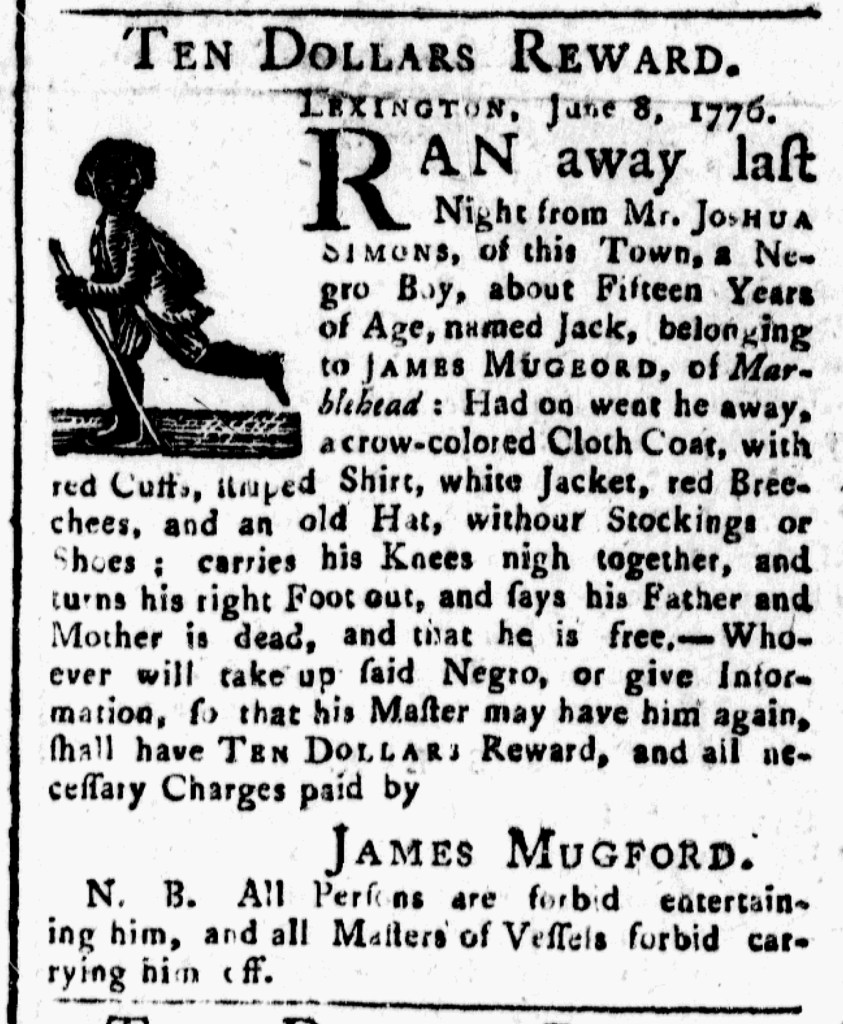
What was advertised in a revolutionary American newspaper 250 years ago today?
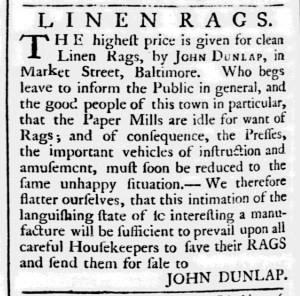
“The Paper Mills are idle for want of Rags.”
Calls for linen rags appeared regularly in colonial American newspapers, though some readers may have had the impression that the frequency increased after the battles at Lexington and Concord. Printers and their associates needed rags for American paper mills to recycle into paper. They needed them more than ever due to disruptions in the supply of paper from England that resulted from nonimportation agreements and the Revolutionary War.
John Dunlap made a plea for “LINEN RAGS” in the July 30, 1776, edition of Dunlap’s Maryland Gazette. Some advertisements consisted of only a couple of lines, but Dunlap made a longer appeal. “THE highest price is given for clean Linen Rags, by JOHN DUNLAP, in Market Street, Baltimore,” the printer proclaimed. He “begs leave to inform the Public in general, and the good people of this town in particular,” he continued, “that the Paper Mills are idle for want of Rags; and of consequence, the Presses … must soon be reduced to the same unhappy situation.” In other words, anyone who got even some of their news from Dunlap’s newspaper had a duty to collect rags if they wanted that newspaper to continue circulating updates about the war and the actions taken by the Continental Congress as well as all sorts of other news. Dunlap described printing presses as “the important vehicles of instruction and amusement,” underscoring the responsibility that he felt toward subscribers and “the Public in general.” The printer hoped that this appeal, “this intimation of the languishing state of so interesting a manufacture” as rags into paper, “will be sufficient to prevail upon all careful Housekeepers to save their RAGS and send them for sale to JOHN DUNLAP.” Women, those “careful Housekeepers” in Baltimore and the countryside, could make an essential contribution to keep the presses operating and news about the war circulating.
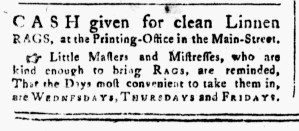
On the same day, John Rogers made a similar request to readers in Salem, Massachusetts, for “clean Linnen RAGS” in the American Gazette. “Little Masters and Mistresses, who are kind enough to bring RAGS,” he instructed, “are reminded, That the Days most convenient to take them in, are WEDNESDAYS, THURSDAYS and FRIDAYS.” In addressing “Little Masters and Mistresses,” Rogers suggested that children played an important part in gathering rags, delivering them to the printing office, and receiving payment on behalf of their families. In addition to women, boys and girls made significant contributions when it came to supplying an important resource for producing the paper necessary to keep newspapers, broadsides, pamphlets, and other items coming off of American presses during the American Revolution.