
What was advertised in a revolutionary American newspaper 250 years ago today?

“THE AMERICAN GAZETTE; OR, THE CONSTITUTIONAL JOURNAL; To be published every TUESDAY.”
Samuel Hall and Ebenezer Hall moved the Essex Gazette from Salem to Cambridge and renamed it the New-England Chronicle shortly after the battles at Lexington and Concord. At the same time, the Salem Gazette ceased publication. That left Salem without its own newspaper until the publication of the American Gazette: Or, the Constitutional Journal in June 1776. John Rogers signed an address “To the PUBLIC” from the publisher and the colophon stated that the newspaper was “Printed by J. ROGERS, at E[zekiel]. RUSSELL’S Printing-Office.” The final line of the colophon advised readers that the “PRINTING-BUSINESS, in its several branches, [was] still carried on as usual by said Russell.” Russell previously published The Censor, a political newspaper-magazine “supported, during the short period of its existence, by those who were in the interest of the British government.,” from November 1771 to May 1772.[1] Russell had also published the Salem Gazette from July 1775 to April 1775. He was apparently the publisher of the American Gazette, though Rogers printed and managed the newspaper and presented himself as the publisher.
In the address “To the PUBLIC,” Rogers expressed “his Gratitude, in this First Number, to all the good LADIES and GENTLEMEN, who have so cheerfully, and in such Numbers appeared … by their Subscriptions already come to Hand.” Rogers (and Russell) likely distributed subscription proposals for the newspaper in advance of issue “NUMB. 1” appearing on June 18, 1776. “PROPOSALS FOR CONTINUING BY SUBSCRIPTION, THE AMERICAN GAZETTE” appeared immediately below Roger’s address. The proposal was dated June 3, suggesting that they had been printed separately and circulated in Salem and beyond. In addition, an unnumbered “Extraordinary” issue was published in June 12. The only known copy has not been digitized for greater accessibility. Russell had previously distributed an unnumbered prospectus issue when he announced his plans to publish the Salem Gazette in the summer of 1774. The unnumbered “Extraordinary” issue of the American Gazette likely featured the subscription proposal, including instructions for “Gentlemen in Town or Country who are possessed of Proposals” with subscribers’ names added to them “to return them by Saturday next, and give Directions for the Conveyance of their Papers.” Local agents aided Rogers (and Russell) in recruiting subscribers and delivering newspapers. That explains how Rogers could already “good LADIES and GENTLEMEN, who have so cheerfully, and in such Numbers” subscribed before the publication of the first issue of the American Gazette.
Despite the editorial stance that Russell took in The Censor, the American Gazette, according to the subscription proposal, would “contain the freshest and most important INTELLIGENCE” as part of an “Undertaking agreable to every FRIEND to the RIGHTS and LIBERTIES of Mankind in general” at a time that Patriots fought for the “GLORIOUS CAUSE of the AMERICAN COLONIES.” The subscription proposal also outlined the “CONDITIONS,” including the price of the newspaper (“one third than the New-York or Philadelphia Papers”) and day of publication (“every Tuesday, unavoidable Accidents excepted”). The publisher promised that it “will be printed on good Paper and a neat Type, of which this is a Specimen.” The reference to a “Specimen” or sample suggests that Rogers (and Russell) circulated separated proposals on June 3.
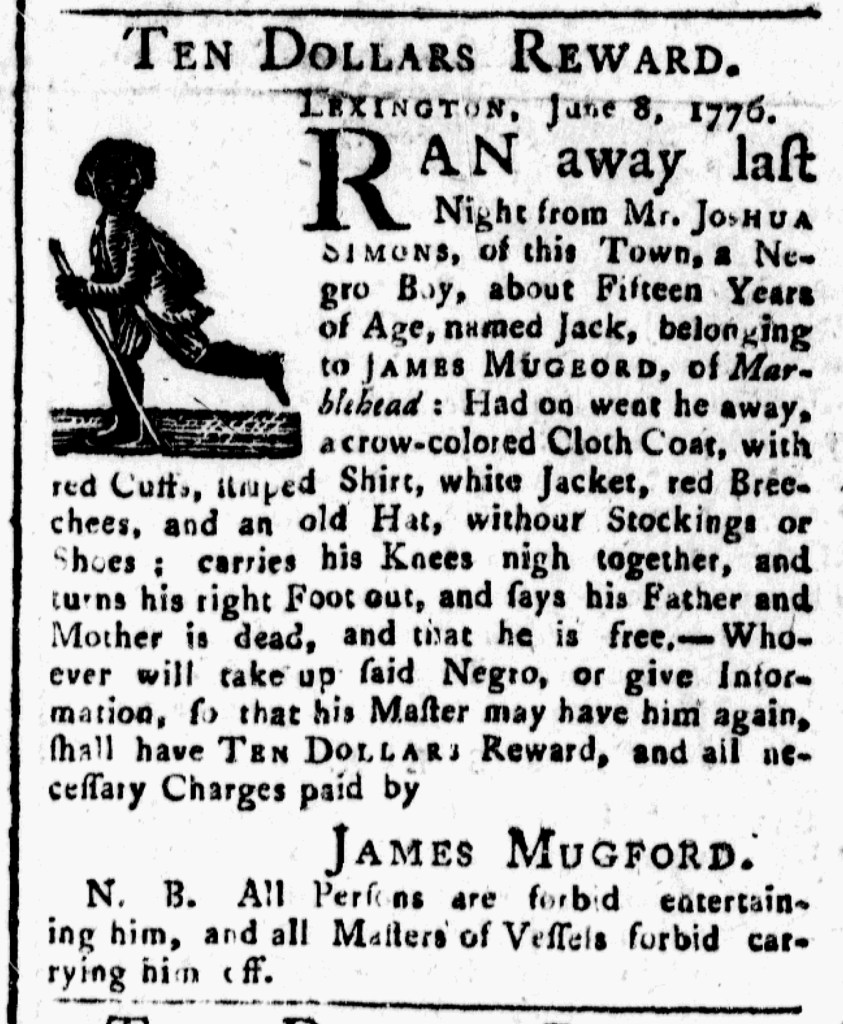
One of the “CONDITIONS” stated that “Advertisements will be thankfully received and inserted in a conspicuous Manner, and at a moderate price. The unnumbered “Extraordinary” issue from June 12 and separate subscription proposals already in circulation would help explain how Rogers (and Russell) attracted a handful of advertisements for issue “NUMB. 1” on June 18. That edition contained an advertisement about a mare for sale, another offering a reward for horse that strayed, and one about an auction of several ships. Rogers (and Russell) also heeded the call for the “Printers of the several News-Papers in the colonies” to assist in the effort to “STOP A TORY” by inserting an advertisement about Moses Kirkland escaping from jail in Philadelphia. That issue also included one more advertisement. James Mugford described Jack, a “Negro Boy” who liberated himself by running away from his enslaver in early June. Mugford offered a reward for Jack’s capture and return. Mugford resided in Lexington, the site where the war began just over a year earlier. Even though the subscription proposal stated that the American Gazette would be an “Undertaking agreable to every FRIEND to the RIGHTS and LIBERTIES of Mankind in general,” issue “NUMB. 1” carried an advertisement intended to deprive Jack of his rights and liberties.
**********
[1] Isaiah Thomas, The History of Printing in America: With a Biography of Printers and an Account of Newspapers (1810; New York: Weathervane Books, 1970), 153.