July 7

What was advertised in a colonial American newspaper 250 years ago today?
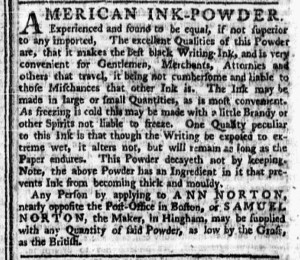
Massachusetts Spy (July 7, 1774).

“AMERICAN INK-POWDER.”

In an advertisement in the July 7, 1774, edition of the Massachusetts Gazette, Ann Norton of Boston and Samuel Norton of Hingham heralded “AMERICAN INK-POWDER” made by Samuel.  They encouraged “Gentlemen, Merchants, Attornies and others that travel” to purchase this product “found to be equal, if not superior to any imported.”  Most of the advertisement described the various qualities of the ink powder that made it better than imported alternatives.  As colonizers in Boston and other towns considered enacting nonimportation agreements to protest the Boston Port Act, entrepreneurs like the Nortons seized the opportunity to present “domestic manufactures” or goods produced in the colonies as patriotic choices for consumers.  On the same page as the Nortons’ advertisement for “AMERICAN INK-POWDER,” Philip Freeman once again ran his notice asserting that “we can manufacture enough [gloves] here, to supply the whole Continent” and recommending that “the importation of this article at least will be totally stopped” during such “threatning” times.

Both advertisements ran in a newspaper that featured a new addition to its masthead: a snake in several segments facing a dragon.  The words “JOIN OR DIE” appeared above the snake and abbreviations for New England and other colonies accompanied each segment.  Readers understood that the snake represented the colonies and the dragon represented Great Britain.  As Isiah Thomas, the printer of the Massachusetts Spy, explained in his History of Printing in America(1810), “The head and tail of the snake were supplied with stings, for defence against the dragon, which appeared furious, and as bent on attacking the snake.”[1]  It was a more elaborate version of the “JOIN, OR DIE” emblem that ran in Benjamin Franklin’s Pennsylvania Gazette twenty years earlier and the “UNITE OR DIE” emblem added to the masthead of the New-York Journal just two weeks earlier.  With this image, Thomas made the threat to American liberty explicit with the addition of the dragon.  That “political device,” as Thomas called it, joined a quotation from Joseph Addison’s Cato that had been part of the masthead for many months: “DO THOU Great LIBERTY inspire our Souls – And make our Lives in THY Possession happy – Or, our Deaths glorious in THY just Defence.”  An assertion that the Massachusetts Spy was “Open to ALL Parties, but Influenced by None” disappeared from the masthead.  The combination of the quotation from Cato and the “political device” made the editorial perspective of the newspaper clear.  Thomas ceased publishing the Massachusetts Spy in Boston and left the city in April 1775 and soon after established the Massachusetts Spy; or, American Oracle of Liberty in Worcester.  Throughout the remainder of the newspaper’s publication in Boston, the snake defending itself against the dragon was part of the masthead, setting the tone for all the news, editorials, and advertisements that appeared below.

Massachusetts Spy (July 7, 1774).

**********

[1] Isaiah Thomas, The History of Printing in America: With a Biography of Printers and an Account of Newspapers (1810; New York: Weathervane Books, 1970), 273.

March 11

What was advertised in a colonial American newspaper 250 years ago today?

Massachusetts Spy (March 11, 1773).

“American Ink-Powder.”

Buy American!  That was the message that many advertisers presented to consumers during the imperial crisis, before the first shots were fired at Lexington and Concord.  It was the message that Samuel Norton of Hingham, who made ink powder, and Ann Norton of Boston, his broker in town, proclaimed to prospective customers in the March 11, 1773, edition of the Massachusetts Spy.  Other advertisers made similar appeals, including Abraham Cornish for his “New England COD and MACKEREL FISH HOOKS.”

For their part, the Nortons introduced their product with a headline for “American Ink-Powder” followed immediately by a secondary headline that declared, “Experienced and found to be equal, if not superior to any imported.”  Earlier in the week, Henry William Stiegel made similar assertions about the glassware he made in Manheim, Pennsylvania.  To entice colonizers to try the ink powder made in Hingham, the Nortons listed several of its “excellent qualities.”  They claimed that even when documents written with the ink were “exposed to extreme wet” the ink did not run; instead, it “alters not, but will remain as long as the paper endures.”  Furthermore, the ink powder contained an ingredient that “precents ink from becoming think and mouldy.”  These factors prompted the Nortons to proclaim that this ink powder “makes the best black writing-ink,” doubling down on the secondary headline about it being as good as, or even better than, imported alternatives.

The Nortons also offered practical advice for using the ink powder.  They considered it “very convenient for gentlemen, merchants, attornies and others that travel, it being not cumbersome and liable to those mischances that other ink is.”  Purchasers could choose to mix ink “in large or small quantities, as is most convenient,” and did not have to worry about it freezing if they used “a little brandy or other spirits not liable to freeze” instead of water.  In guiding prospective customers in how to use the product, the Nortons hoped to increase the chances that some of them would purchase their ink powder and follow their directions.

They also benefited from the compositor’s choice about where to place their advertisement within that issue of the Massachusetts Spy.  It appeared immediately below coverage of the annual commemoration of the Boston Massacre. Residents of Boston marked the third anniversary with an oration “on the dangerous tendency of standing armies being placed in free and populous cities” by Dr. Benjamin Church, a lantern with paintings that depicted soldiers firing on colonizers, and the tolling of bells.  The Nortons did not make arguments about consumers’ civic responsibility to practice politics in the marketplace by purchasing domestic manufactures, goods produced in the colonies, as explicitly as some other advertisers.  Given the commemoration of the Boston Massacre that just occurred and other news about current events that crowded the pages of the Massachusetts Spy, they did not necessarily need to do so.  Prospective customers very well understood the context in which the Norton’s hawked their “American Ink-Powder.”