What was advertised in a revolutionary American newspaper 250 years ago today?
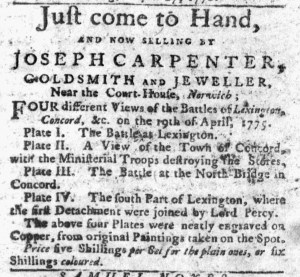
“FOUR different Views of the Battles of Lexington, Concord, &c. on the 19th of April, 1775.”
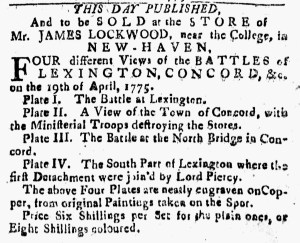
With the war now in its second year, Joseph Carpenter, a goldsmith and jeweler, marketed a series of commemorative prints depicting the battles of Lexington and Concord that he sold at his shop “Near the Court-House” in Norwich, Connecticut. Even though he stated that these “FOUR different Views” had “Just come to Hand,” other retailers had made them available months earlier. In fact, his advertisement in the May 6, 1776, edition of the Norwich Packet replicated large portions of the James Lockwood’s advertisement in the December 13, 1775, edition of the Connecticut Journal.
In addition to the description of the series of prints matching, the titles that Carpenter listed for the prints reflected Lockwood’s advertisement rather than the titles engraved at the top of each of them. Plate I was called “The Battle of Lexington” on both the print and in the advertisement, but Plate II was simply called “A View of the Town of Concord” on the print. In both advertisements, however, it had a more elaborate title, “A View of the Town of Concord, with the Ministerial Troops destroying the Stores.” The title engraved on Plate III named it “The Engagement at the North Bridge in Concord,” yet the advertisements called it “The Battle at the North-Bridge in Concord.” Finally, the tile on Plate IV declared that it presented a “View of the South Part of Lexington,” yet the advertisements said that it show “The south Part of Lexington, where the first Detachment were joined by Lord Percy.
Both advertisements informed prospective customers that “[t]he above four Plates were neatly engraved on Copper, from original Paintings take on the Spot.” Amos Doolittle engraved the images based on painting by Ralph Earl. How Carpenter acquired them, he did not say, only that they had “Just come to Hand.” When they did, it appears that whoever supplied them to the goldsmith and jeweler in Norwich also sent an advertisement clipped from a newspaper printed in New Haven or a letter that copied the notice in the Connecticut Journal. Lockwood’s original advertisement circulated in unintended ways before being disseminated in print once again for the benefit of another purveyor of the commemorative prints in another newspaper. Carpenter did not generate his own copy when he marketed the “FOUR different Views of the Battles of Lexington, Concord, &c. on the 19th of April, 1775,” but instead relied on an advertisement originally published months earlier.