December 13

What was advertised in a revolutionary American newspaper 250 years ago today?
Connecticut Journal (December 13, 1775).

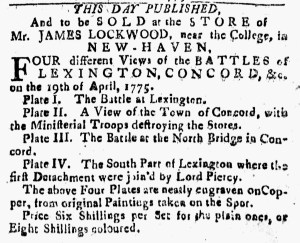
“FOUR different Views of the BATTLES of LEXINGTON, [and] CONCORD.”

The marketing of memorabilia that commemorated events associated with the American Revolution began before the Second Continental Congress declared independence.  Shortly after the Boston Massacre, for instance, Paul Revere, Henry Pelham, and others produced and advertised images depicting the “BLOODY MASSACRE perpetrated in King-Street.”  Revere also marketed a “Copper-Plate PRINT, containing a View of Part of the Town of Boston in New-England, and British Ships of War landing their Troops in the Year 1768.”  As the imperial crisis intensified, Charles Reak and Samuel Okey advertised a print depicting “that truly staunch Patriot, the Hon. SAMUEL ADAMS, of Boston.”  The production of commemorative items accelerated following the battles at Lexington and Concord in April 1775 and the Battle of Bunker Hill in June 1775.

In December 1775, James Lockwood advertised “FOUR different Views of the BATTLES of LEXINGTON, CONCORD, &c. on the 19th of April, 1775.”  He provided a short description of each: “The Battle at Lexington,” “A View of the Town of Concord with the Ministerial Troops destroying the Stores,” “The Battle at the North Bridge in Concord,” and “The South Part of Lexington where the first Detachment were join’d by Lord Percy.”  Lockwood promoted both the quality and accuracy of the prints, noting that the “Four Plates are neatly engraved on Copper, from original Paintings taken on the Spot.”  He almost certainly stocked and sold a series of prints engraved by Amos Doolittle based on paintings by Ralph Earl.  Although Lockwood may have sold the prints separately on request, he promoted them as a package, charging six shillings for as set of “the plain ones” or eight shillings for “coloured” prints.  This collection of prints supplemented news coverage of the battles, helping educate colonizers about recent events, yet many consumers may have desired them as symbols of their patriotism and support of the American cause to display in their homes and offices.  During the first year of the Revolutionary War, the marketing of images that celebrated Americans who defended their towns and their liberties likely encouraged some colonizers to imagine declaring independence rather than merely seeking a redress of grievances.

May 3

What was advertised in a revolutionary American newspaper 250 years ago today?

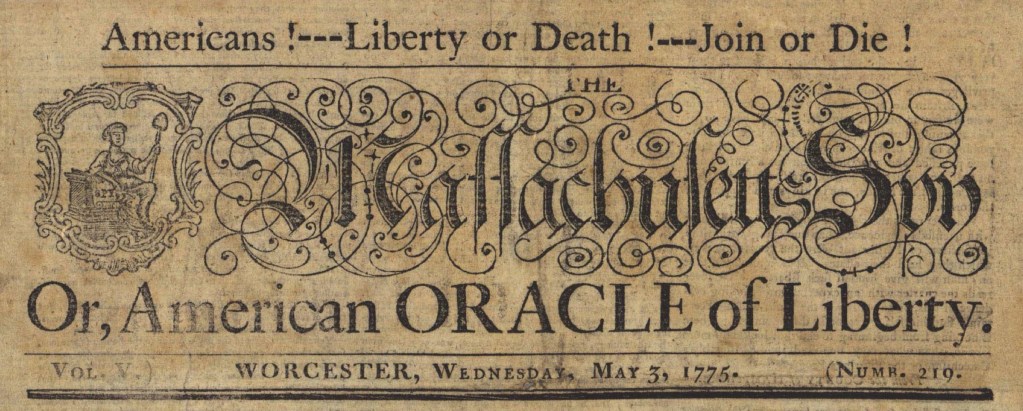
Massachusetts Spy (May 3, 1775). Courtesy American Antiquarian Society.

“I beg the Assistance of all the Friends to our righteous Cause to circulate this Paper.”

When the patriot printer Isaiah Thomas revived the Massachusetts Spy, originally published in Boston, after fleeing to Worcester to evade “friends of the British administration” who “openly threatened him with the effects of their resentment,” the first issue published in that town opened with a notice to the public.[1]  He reminded readers that he had previously entered into an agreement to aid in establishing a press in Worcester, installing a junior partner to manage a printing office there while he oversaw the enterprise from Boston.  He had issued proposals for the newspaper, intending to name it the “WORCESTER GAZETTE, or AMERICAN ORACLE of LIBERTY.”  However, when Thomas determined that it became “highly necessary that I should remove my Printing Materials from Boston to this Place,” he decided to “continue the Publication of the well-known MASSACHUSETTS SPY, or THOMAS’S BOSTON JOURNAL.”  He continued the numbering but gave it a new title, combining elements of the existing one and the proposed one: Massachusetts Spy Or, American Oracle of Liberty.  In addition, the masthead proclaimed, “Americans! — Liberty or Death! — Join or Die!”

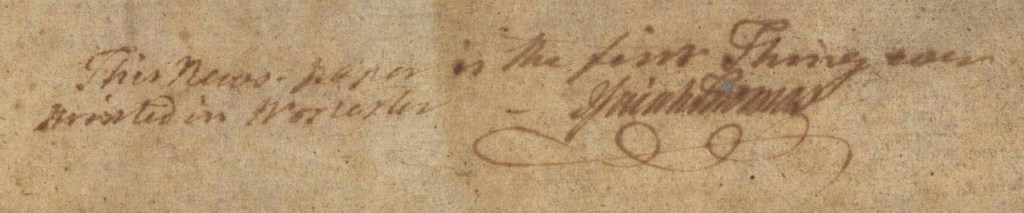
In his notice, Thomas reported that first he sent his “Printing Utensils” to Worcester and then “escaped myself from Boston on the memorable 19th of April, 1775, which will be remembered in the future as the Anniversary of the BATTLE of LEXINGTON!”  Elsewhere that first issue published in Worcester, Thomas provided a chronicle of the battle “collected from those whose veracity is unquestioned.”  That narrative likely incorporated elements drawn from the printer’s own firsthand account.  Several years later, he recorded that at daybreak on April 19 he “crossed from Boston over to Charlestown in a boat with Dr. Joseph Warren, went to Lexington, and joined the provincial militia in opposing the king’s troops.”[2]  The following day, went to Worcester to open the printing office and revive his newspaper.  He was proud of that work and the service he provided, making a note and signing his name in the margin at the bottom of the first page of the first issue published there: “This News-paper is the first Thing ever printed in Worcester – Isaiah Thomas.”

Massachusetts Spy (May 3, 1775). Courtesy American Antiquarian Society.

Having installed himself in that town, he made clear his purpose in publishing the Massachusetts Spy as such momentous events occurred.  He pledged to give “the utmost of my poor Endeavours … to maintain those Rights and Priviledges for which we and our Fathers have bled!”  To that end, he would “procure the most interesting and authentic Intelligence” to keep his readers in central Massachusetts and beyond informed of the latest news.  In addition, he called on “all the Friends to our righteous Cause” to aid in circulating the Massachusetts Spy.  Many had already enlisted in that endeavor, serving as local agents who collected the names of subscribers and forwarded them to the printing office.  In revised proposals that ran immediately below Thomas’s notice, he listed associates who accepted subscriptions in nearly three dozen towns in Worcester County and indicated that “many other Gentlemen in several parts of the province” did as well.

Of the five newspapers published in Boston at the beginning of April 1775, the Massachusetts Spy was the first to suspend publication, the decision resulting from Thomas leaving town rather than the outbreak of hostilities at Lexington and Concord.  It was also the first to resume circulating weekly issues on a regular schedule, a result of the printer’s foresight in relocating to Worcester.  Some of the other newspapers folded completely, but the Massachusetts Spy continued throughout the war and well beyond.

Massachusetts Spy (May 3, 1775). Courtesy American Antiquarian Society.

Click here to view the entire May 3, 1775, edition of the Massachusetts Spy, including Thomas’s note on the first page and the account of the Battle of Lexington on the third page.  That copy is in the collections of the American Antiquarian Society, founded by Thomas in 1812.

**********

[1] Isaiah Thomas, The History of Printing in America: With a Biography of Printers and an Account of Newspapers (1810; New York: Weathervane Books, 1970), 168

[2] Thomas, History of Printing, 168-9.

April 20

What was advertised in colonial American newspaper 250 years ago today?

Norwich Packet (April 20, 1775).

“Ebenezer Punderson … has repeatedly drank Tea … in open Contempt and Defiance of the Continental Association.”

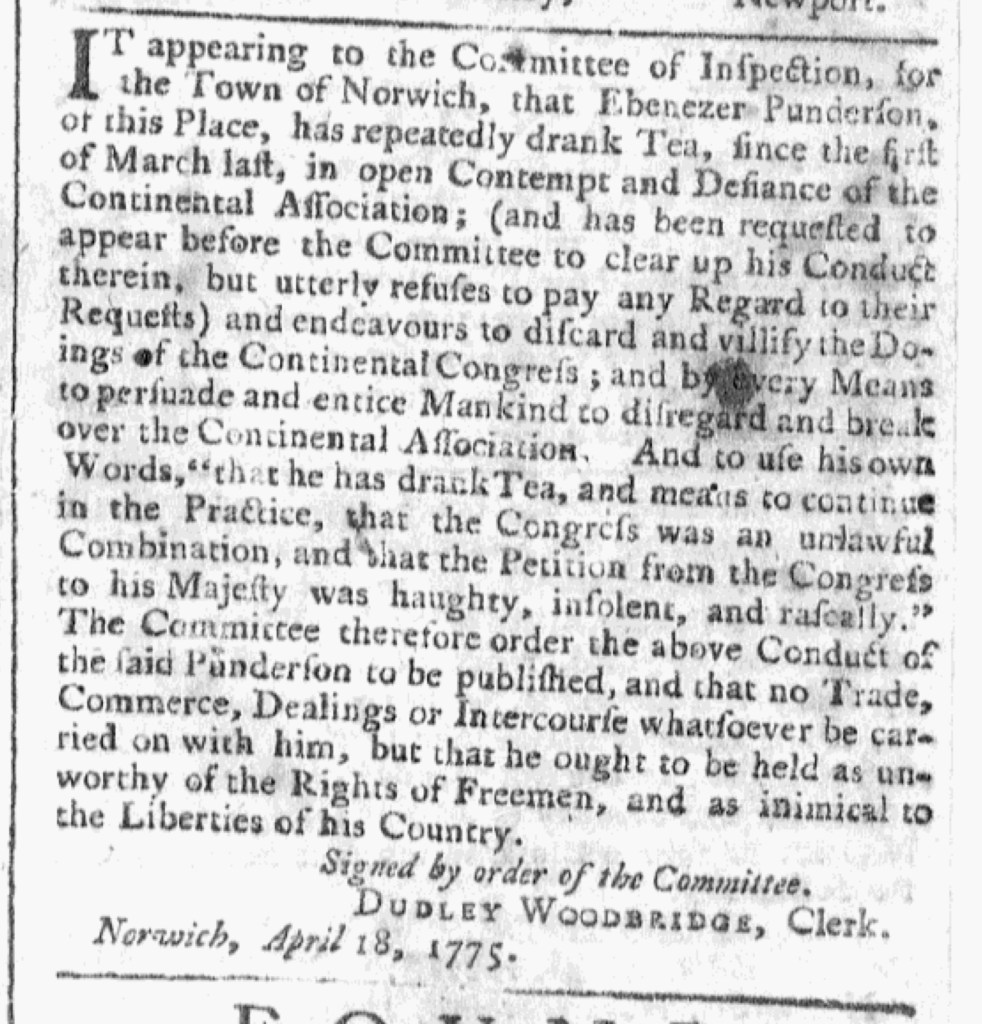
Ebenezer Punderson went too far and now it was time for consequences.  He brazenly and repeatedly violated the Continental Association, the nonimportation and nonconsumption agreement enacted by the Continental Congress in response to the Coercive Acts.  As a result of his actions, the Committee of Inspection in Norwich, Connecticut, placed an advertisement in the April 20, 1775, edition of the Norwich Packet to document his behavior and advise the community to shun Punderson.

The committee reported that Punderson “has repeatedly drank Tea … in open Contempt and Defiance of the Continental Association.”  When the committee sought to investigate the matter, he “utterly refuse[d] to pay any Regard to their Requests” to appear before it.  Even worse, he “endeavours to discard and vilify the Doings of the Continental Congress; and by every Means to persuade and entice Mankind to disregard and break over the Continental Association.”  His refusal to abide by the Continental Association damaged the movement and had the potential to do even more harm by inspiring others to ignore it as well.  In addition, he stridently declared that he had no intention of adhering to the agreement, insulting the Continental Congress in the process:  “to use his own words, ‘that he has drank Tea, and means to continue in that Practice, that the Congress was an unlawful Combination, and that the Petition from the Congress to his Majesty was haughty, insolent, and rascally.’”

The Committee of Inspection, in turn, determined that it was Punderson who was haughty, insolent, and rascally.  It ordered that the “Conduct of the said Punderson be published, and that no Trade, Commerce, Dealings or Intercourse whatsoever be carried on with him.”  Furthermore, the committee declared that “he ought to be held as unworthy of the Rights of Freemen, and as inimical to the Liberties of his Country.”  Punderson acted in opposition to the patriot cause.  The Committee of Inspection intended to see him pay for his transgressions.

Norwich Packet (April 20, 1775).

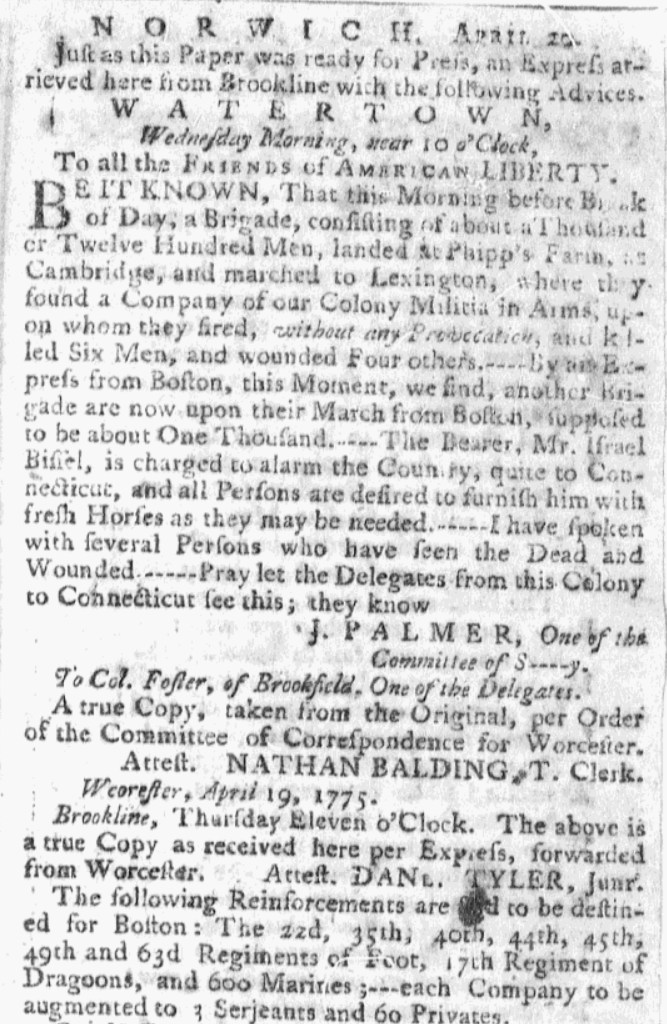
Punderson chose the wrong time to draw attention to himself.  Some of the first coverage of the battle at Lexington to appear in American newspapers ran at the top of the column that featured the advertisement about his offenses.  “Just as this Paper was ready for Press,” the printers declared, “an Express arrived here from Brookline with the following Advices” from J. Palmer, “One of the Committee of S[afet]y,” and dispatched to “Col. Foster, of Brookfield.”  The missive reported that before dawn on the morning of April 19 “a Brigade [of British troops] … marched to Lexington, where they found a Company of our Colony Militia in Arms, upon whom they fired, without any Provocation, and killed Six Men, and wounded Four others.”  Palmer stated that he had “spoken with several Persons who have seen the Dead and Wounded.”  He also relayed news that another Brigade “are now on their March from Boston.”  Israel Bissell carried the message, “charged to alarm the Country” in western Massachusetts all the way to Connecticut.  The printers published this account from a “true Copy, taken from the Original, per Order of the Committee of Correspondence for Worcester.”  The details were sparse, yet the “FRIENDS of AMERICAN LIBERTY” reading the Norwich Packet now knew that fighting had commenced near Boston.  That news quite likely had an impact on their attitude when they read about Punderson’s offenses further down the column.