April 9

What was advertised in a colonial American newspaper 250 years ago today?
Providence Gazette (April 9, 1774).

“… to be sold by the Printer hereof.”

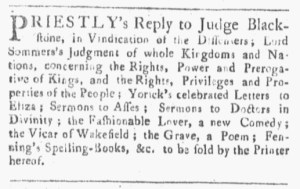
Advertisements filled the final column on the third page and the entire last page of the April 9, 1774, edition of the Providence Gazette.  They generated significant revenue for John Carter, the printer, yet not all the advertisements were paid notices.  Like many other printers, Carter used his newspaper to disseminate his own advertisements.  He inserted five of the notices that appeared in that issue.

Those advertisements related to a variety of aspects of operating Carter’s printing office “at Shakespear’s Head, in Meeting-Street, near the Court-House.”  In one, he called on “ALL Persons indebted for this Gazette one Year, or more” and anyone else indebted to him for other services “to make immediate Payment.”  In another, Carter sought a “trusty and well-behaved Lad, about 13 or 14 Years of Age” as “an Apprentice to the Printing Business.”  Candidates needed to be able to “read well, and write tolerably.”  In yet another, a headline in a larger font than anything else in that issue, even the title of the newspaper in the masthead, proclaimed, “RAGS.”  Carter offered the “best Prices … for clean Linen Rags, of any Kind, and old Sail-Cloth, to supply the PAPER MANUFACTORY in Providence.”  The printer intended to recycle rags into paper that he would then use to publish subsequent editions of the Providence Gazette.

Providence Gazette (April 9, 1774).

Other advertisements promoted items for sale at the printing office.  Most printers also sold books.  A few came from their own presses or other colonial presses, but most were imported from England.  Carter listed several titles for readers with diverse interests, from “PRIESTLY’s Reply to Judge Blackstone, in Vindication of the Dissenters” to “the Fashionable Lover, a new Comedy” to “the Grave, a Poem” to “Fenning’s Spelling-Books.”  An “&c.” (an abbreviation for et cetera) indicated that he stocked many more books, pamphlets, and broadsides.  A shorter advertisement stated, “BLANKS of various Kinds to be sold by the Printer hereof.”  Carter printed and sold forms for common legal and commercial transactions.  Even the colophon doubled as an advertisement, informing readers that “all Manner of Printing-Work is performed with Care and Expedition.”

Carter took advantage of his access to the press to tend to the different parts of operating a busy printing office.  While his advertisements did not generate revenue in the same manner as the paid notices placed by merchants, shopkeepers, artisans, estate executors, lottery managers, and others, they supported his business in other ways and some likely resulted in revenue from the sale of books and blanks or the settling of accounts.  Collectively, they gave Carter a very visible presence in the pages of the Providence Gazette.
January 7

What was advertised in a colonial American newspaper 250 years ago today?

New-Hampshire Gazette (January 7, 1774).

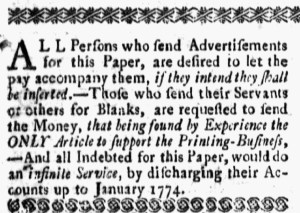
“ALL Persons who send Advertisements for this Paper, are desired to let the pay accompany them, if they intend they shall be inserted.”

Daniel Fowle, the printer of the New-Hampshire Gazette, frequently inserted notices that tended to the business of operating a newspaper.  He had also done so when in partnership with his nephew, Robert Fowle, with most such notices most often calling on subscribers to settle accounts.  Fowle commenced 1774 with an advertisement that addressed several services available at his printing office in Portsmouth.  He exercised his prerogative as proprietor to give that notice a privileged place on the page; it appeared as the first item in the first column on the first page of the first issue of the New-Hampshire Gazette published in the new year.

Fowle presented a variety of instructions to current and prospective customers.  “ALL Persons who send Advertisements for this Paper,” he advised, “are desired to let the pay accompany them, if they intend they shall be inserted.”  In other words, Fowle did not extend credit for advertising.  Most colonial printers likely required advertisers to pay in advance, securing revenues from advertising to balance the credit they allowed for subscriptions, though occasionally some placed notices that called on advertisers to pay overdue bills.  Whatever the policies at the New-Hampshire Gazette had been in the past, Fowle made clear that no advertisements would make it into the pages of his newspaper before receiving payment.  He concluded his notice with a familiar appeal to subscribers to pay what they owed: “all Indebted for this Paper, would do an infinite Service, by discharging their Accounts up to January 1774.”

In addition, Fowle addressed another aspect of his business between his directions about advertisements and subscriptions.  “Those who send their Servants or others for Blanks,” he declared, “are requested to send the Money, that being found by Experience the ONLY  Article to support the Printing-Business.”  Fowle and other printers frequently advertised blanks or printed forms for common commercial and legal transactions.  In the January 7 issue, Fowle ran a short advertisement, “Blanks of most sorts, sold cheap At the Printing Office in Portsmouth,” on the final page.  He suggested that printing and selling blanks represented the only lucrative element of his business, provided that customers paid for them at the time of purchase.  He implied that he only broke even, at best, on advertisements, while the chronic tardiness of subscribers meant that he lost money on subscriptions.  In that case, printing the New-Hampshire Gazetteamounted to a public service rather than a profitable venture for Fowle.  He may have exaggerated whether he made money on anything other than blanks, but Fowle’s exasperation with advertisers and subscribers who did not pay their bills was unmistakable.

September 2

What was advertised in a colonial American newspaper 250 years ago today?

Pennsylvania Journal (September 2, 1772).

“All kinds of office and other blanks, hand-bills, &c. &c.”

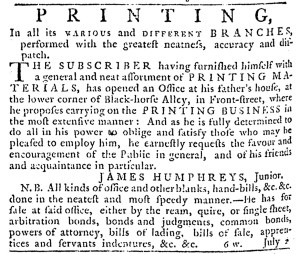
When James Humphrey, Jr., opened a printing shop in Philadelphia in the summer of 1772, he placed advertisements in the Pennsylvania Journal to inform the public that he sought orders for “PRINTING, In all its VARIOUS and DIFFERENT BRANCHES.”  Perhaps he received a discount for notices he placed in that newspaper, despite being a competitor for job printing, having apprenticed to William Bradford, one of the partners who printed the Pennsylvania Journal.  Humphreys stated that he “earnestly requests the favour and encouragement of the Public in general, and of his friends and acquaintance in particular.”  That encouragement likely commenced with a mentor who had a thriving business and could afford to help his former apprentice establish his own printing office.  Humphreys eventually published the Pennsylvania Ledger from January 1775 through November 1776 with a brief revival when the British occupied Philadelphia, but he focused on books and job printing when he first entered the business.

In particular, he solicited orders for “All kinds of office and other blanks, [and] hand-bills.”  Throughout the colonies, printers produced and sold a variety of blanks, printed forms that facilitated common commercial and legal transactions.  Humphreys listed some of the blanks available at his printing office, including “arbitration bonds, bonds and judgments, common bonds, powers of attorney, bills of lading, bills of sale, [and] apprentices and servants indentures.”  Concluding the list with “&c.” (an abbreviation for et cetera) signaled that he had others on hand to sell “either by the ream, quire, or single sheet.”  Some colonizers purchased blanks in volume, making them an even more lucrative revenue stream for printers.  Humphreys also declared that he printed handbills “in the neatest and most speedy manner.”  When they advertised, printers often included handbills among the items they produced, suggesting that many more advertisements circulated in eighteenth-century America, especially in urban centers, than survive in research libraries, historical societies, and private collections.  Such ephemera may have been much more numerous and visible than bibliographies of early American imprints suggest.  Newspaper advertisements like the one that Humphreys inserted in the Pennsylvania Journal in 1772 hint at a vibrant culture of advertising during the era of the American Revolution.