June 14

What was advertised in a colonial American newspaper 250 years ago today?
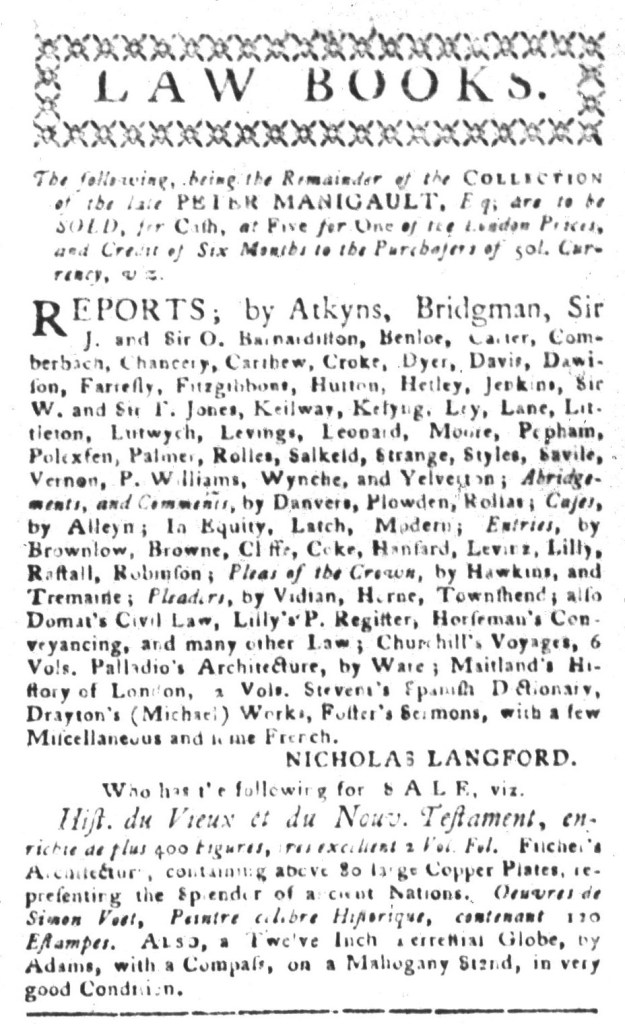
South-Carolina Gazette and Country Journal (June 14, 1774).

“LAW BOOKS … being the Remainder of the COLLECTION of the late PETER MANIGAULT, Esq.”

Nicholas Langford advertised dozens of law books for sale in the June 14, 1774, edition of the South-Carolina Gazette and Country Journal.  In addition to listing the authors and titles, his advertisement featured a headline, “LAW BOOKS,” enclosed within a border composed of decorative type.  It was the only notice in that issue that received such treatment.  Langford also advertised in the June 10 edition of the South-Carolina and American General Gazette, deploying the same headline with the list of books.  In that instance, the headline did not receive special treatment, suggesting that the printing office was responsible for the enhancement to the version in the South-Carolina Gazette and Country Journal instead of Langford issuing instructions or making a request.

Why might Charles Crouch, the printer of that newspaper, have decided that this advertisement merited such a headline?  Perhaps it was an act of deference.  Langford advertised “the Remainder of the COLLECTION of the late PETER MANIGAULT, Esq.”  Crouch and readers would have been familiar with the prominent lawyer, legislator, and plantation owner.  “Because of his large land and slave holdings,” Michelle Brown notes, Manigault “became one of the wealthiest men in eighteenth-century British North America.”  He owned thousands of acres and enslaved hundreds of men, women, and children.  Manigault served in the Commons House of Assembly from 1755 to 1772, elected as Speaker during the time that South Carolina and other colonies protested the Stamp Act and reelected seven times.  His political career began shortly after he returned from London, where he studied law at the Inner Temple from 1750 to 1754.  He resigned in 1772 due to ill health, returning to England in hopes of recuperating, but died there on November 12, 1773.  Brown reports that “his body was returned to Charleston for burial in the family vault of the Huguenot Church.”  His estate entrusted Langford, a bookseller, with selling his library of law books.  Given Manigault’s influence in the colony, Crouch may have decided that this advertisement deserved a more elaborate headline than others published in his newspaper.

October 22

What was advertised in a colonial American newspaper 250 years ago today?

Massachusetts Gazette and Boston Weekly News-Letter (October 22, 1772).

“CHEAP GOODS.”

In the fall of 1772, David Sears joined other advertisers in Boston who used borders composed of decorative type to enclose either the headline or their entire newspaper notice.  Sears proclaimed that he sold “CHEAP GOODS,” that headline surrounded by printing ornaments that called attention to his advertisement and prompted subscribers of the Massachusetts Gazette and Boston Weekly News-Letter to read more about the “fresh Assortment of Gall and Winter Goods” he recently imported from London.  His advertisement in the October 26 edition of the Boston-Gazette included the same headline within a decorative border.  In with instances, the headline and its border directed prospective customers to his bold claim that he set “such Prices that is not possible to be conceived of without Trial.”  In other words, it would take some effort to even imagine such low prices.

Sears certainly was not the first advertiser in Boston to incorporate a border into a newspaper advertisement.  As early as 1766, Jolley Allen made borders around his entire notices a signature element of his marketing.  Occasionally other advertisers deployed borders as well, but greater numbers did so simultaneously in the summer and fall of 1772.  Jolley Allen and Andrew Dexter both published advertisements with borders in May, though the Massachusetts Spy seemingly rejected any requests or instructions to include a border around Allen’s advertisement.  Martin Bicker ran an advertisement surrounded by a border in August.  Jonathan Williams, Jr., also did so in September.  Other merchants and shopkeepers opted for borders around just the headlines.  The week before Sears ran his advertisement on October 22, William Jackson introduced his notice with a border around the headline, “Variety Store.”  A few days later, Herman Brimmer and Andrew Brimmer had a border enclosing “Variety of Goods” at the top of their advertisement in Supplement to the Boston-Gazette.  The printers of that newspaper had recently used a decorative border for their own notice calling on subscribers with overdue accounts “to make immediate Payment.”

These examples may seem scattered, but considering how infrequently borders adorned advertisements in Boston’s newspapers (or newspapers printed elsewhere in the colonies) they suggest a trend among advertisers in 1772.  Sears may have observed that others included borders in their notices and determined that he desired the same for his advertisement, combining a pithy headline and graphic design to demand the attention of readers.