March 9

What was advertised in a colonial American newspaper 250 years ago today?
Massachusetts Spy (March 9, 1775).

“Imported from LONDON the Spring before the Harbour of Boston was blockade up.”

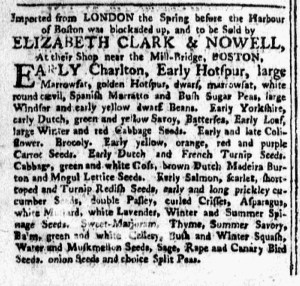
Although marketing began a little later in the season than in recent years, several retailers placed advertisements for garden seeds in Boston’s newspaper in early March 1775.  The March 9 edition of the Massachusetts Spy, for instance, once again carried Susannah Renken’s advertisement as well notices placed by John Adams, Elizabeth Clark and Elizabeth Nowell, and Ebenezer Oliver.  Each of these purveyors of seeds took to the public prints as spring approached each year, though many familiar names did not yet appear.  More than half a dozen women usually advertised garden seeds that they sold in Boston, but the imperial crisis, especially the closing of the harbor because of the Boston Port Act, disrupted that annual ritual.

Renken, one of the most enterprising of those female seed sellers, apparently acquired her inventory from a ship that landed at Salem.  She identified the captain of the vessel that had transported them across the Atlantic.  Adams and Oliver both declared that they sold seeds “Imported from London,” but did not provide additional details to allow prospective customers in the eighteenth century (or historians in the twenty-first century) to reach conclusions about when and how they came into possession of those seeds.  Clark and Nowell, on the other hand, made clear that their seeds had been “Imported from LONDON the Spring before the Harbour of Boston was blockade up.”  They received their seeds at least nine months earlier, a factor that may or may not have been an advantage.  Adams declared that he “warrants [his seeds] good, and of the last Year’s Growth.”  Similarly, Renken described her seeds as “New and warranted of the last Year’s Growth.”  Clark and Nowell could not make such claims.  Instead, they attempted to leverage the date of delivery as a point in their favor.  Although not “new,” their seeds also were not so old that they would not germinate, especially if Clark and Nowell had stored them carefully.  They asked prospective customers to take into account the challenges that they all faced due to the blockade, hoping that a sense of mutual support would convince consumers to select their seeds over the ones offered by their competitors.
March 2

What was advertised in a colonial American newspaper 250 years ago today?

Massachusetts Spy (March 2, 1775).

“GARDEN SEEDS New and warranted of the last Year’s Growth.”

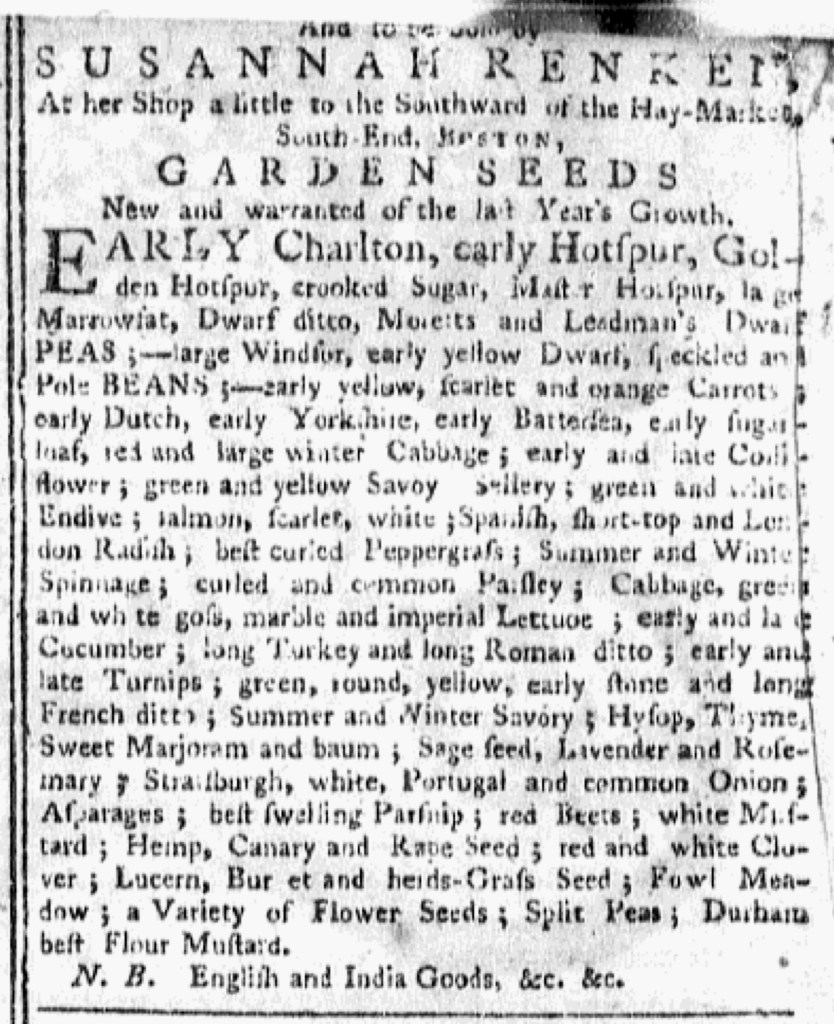
Although her advertisement appeared later than in some years, Susannah Renken was the first to advertise “GARDEN SEEDS” in Boston in 1775.  She had also been first in 1768, 1770, and 1773, commencing an annual ritual of seed sellers, most of them women, taking to the pages of Boston’s newspapers to hawk extensive selections of garden seeds.  In 1775, Renken’s first advertisements was brief, just two lines in the February 23 edition of the Massachusetts Spy: “SUSANNAH RENKEN, has received a fresh supply of Garden Seeds.  Particulars in our next.”  She may have been in such a rush to run any advertisement at all that she did not have time to prepare her usual list of seeds before Isaiah Thomas, the printer, took that issue to press, though Thomas may have opted to publish an abbreviated notice.  A note at the bottom of the column advised, “Advertisements omitted will be in our next.”  Renken may have been fortunate that even a short notice appeared.  The following week, her full advertisement, featuring dozens of varieties of seeds, ran in the Massachusetts Spy.

The copy of the March 2 edition digitized to grant greater access has been damaged, eliminating the first lines of Renken’s advertisement, but it ran again the following week.  That issue reveals that the notice began with a familiar introduction: “Imported in Capt, Shayler from LONDON, And to be Sold by SUSANNAH RENKEN.”  Merchants, shopkeepers, and other purveyors of goods often stated which vessels carried their merchandise, revealing to prospective customers when their wares had been shipped and delivered.  In this case, it meant that Renken’s seeds arrived in the colonies, but not in Boston, several months before she placed her advertisement; she may have acquired her seeds only recently.  With the city’s harbor closed to commerce because of the Boston Port Act, Shayler’s vessel arrived in Salem with “Fresh Advices from London” in late November 1774, according to the December 5 edition of the Boston-Gazette.  Shayler delivered goods as well as news, but Renken had to arrange to have her seeds transported from Salem to Boston.  Perhaps she had only just confirmed delivery when her brief notice appeared in the Massachusetts Spy.  When W.P. Bartlett advertised garden seeds in the February 21, 1775, edition of the Essex Gazette, published in Salem, he proclaimed that his wares were “JUST IMPORTED, in the Venus, from LONDON.”  In previous years, Renken and her sister seed sellers in Boston usually did not describe their seeds as “just imported.”  In 1775, the imperial crisis prevented them from even considering doing so.

November 18

What was advertised in a colonial American newspaper 250 years ago today?

Connecticut Journal (November 18, 1774).

“THE New-Haven Committee for soliciting Subscriptions for Relief of their suffering Brethren at Boston.”

Colonizers in Connecticut and other places rallied to support residents of Boston once the Boston Port Act went into effect on June 1, 1774.  In retaliation for the Boston Tea Party, Parliament passed legislation that closed and blockaded the harbor until the town made restitution for the property that had been destroyed.  As Bob Ruppert explains, “All shipping and commerce came to standstill.  Ships-of-war appeared in the harbor, army regiments arrived from England and only food was allowed to enter the town (by way of the town of Marblehead, sixteen miles to the north).”

As far away as South Carolina, patriots formed committees to aid Boston.  In Connecticut, the “New-Haven Committee for soliciting Subscriptions for Relief of their suffering Brethren at Boston” provided an update of their activities and invited readers to join their efforts in an advertisement in the November 18 edition of the Connecticut Journal.  It ran in the same column as advertisements for the “Votes & Proceedings Of the American CONTINENTAL CONGRESS” and a “likely Negro Girl, about 10 Years old,” for sale.  The committee advised their “generous Subscribers to being in their Grain, &c. [et cetera] on Thanksgiving Week, as they expect a Vessel will then be lying at the Long-Wharf for the purpose of taking in such Benefactions.”  In other advertisements, Josiah Burr hawked an “Assortment of GOODS suitable for the Season,” Jacob Daggett promoted a “fresh Assortment of Goods,” and Joseph Howell touted a “good Assortment of English and India GOODS,” making overtures to consumers.  In contrast, the Committee for the Relief of Boston put advertising to another purpose, alerting the public to an opportunity to play a part in current events and express their political principles.  Their notice also served as a news update, supplementing the content selected for inclusion by the printers of the Connecticut Journal.

October 18

What was advertised in a colonial American newspaper 250 years ago today?

Essex Gazette (October 18, 1774).

“In Consequence of the Boston Port-Bill … he has opened a Store in Salem.”

In October 1774, Nathan Frazier did what he could to continue selling “an Assortment of Goods, suitable for the Season,” when the Boston Port Act closed the harbor in retaliation for colonizers destroying shipments of tea the previous December.  He opted to open a second location, renting a shop in Salem.  In the October 18 edition of the Essex Gazette, published in that town, he informed readers that “in Consequence of the Boston Port-Bill, and with a View of accommodating those of his Customers to whom it may be most convenient to have their Supplies conveyed by Water,” he now did business in Salem as well as in Boston.  The circumstances had not caused him to close his original store; he “still continues his Business at his Store in Boston as usual.”  Accordingly, his customers “may be supplied at either of said Stores,” though Frazier, “for the present, give[s] his personal Attendance at his Salem Store.”

In addition to inserting this notice in the Essex Gazette, the merchant also placed it in the Boston Evening-Post and the Boston-Gazette on October 17, increasing the chances that readers in Boston, Salem, and other towns would see it.  In the Boston Evening-Post, Frazier’s advertisement happened to appear immediately below William Blair Townsend’s notice that he sold goods “imported before the oppressive Acts on this Town and Province were laid” and, accordingly, could be bought and sold “without any Breach on the solemn League and Covenant” that called for ceasing trade with Britain until Parliament repealed the Coercive Acts.  In the Essex Gazette, Samuel Flagg asserted that “he is determined not to import any more Goods at present,” alluding to current events without naming them as plainly as Frazier and Townsend.  All three advertisements testified to the challenges that merchants and shopkeepers faced as well as their efforts to meet them.  As much as Frazier wished to encourage consumers to visit either of his shops, it was not business “as usual” in Boston and other towns in Massachusetts.  Advertisements, as well as news articles and editorials, made that clear.

July 5

What was advertised in a colonial American newspaper 250 years ago today?

South-Carolina Gazette and Country Journal (July 5, 1774).

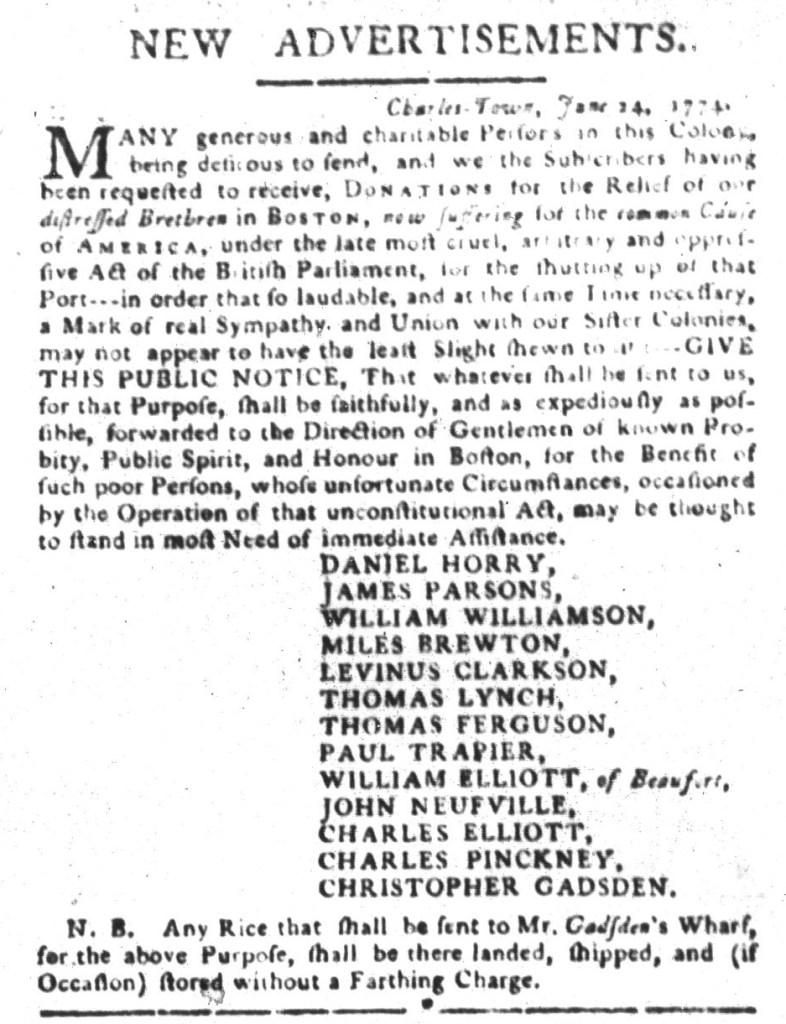
“DONATIONS for the Relief of our distressed Brethren in BOSTON, now suffering for the common Cause of AMERICA.”

Parliament intended to punish Boston when it closed and blockaded the harbor, effective June 1, 1774, as punishment for the destruction of the tea the previous December, yet colonizers from New England to Georgia protested what some described as “that unconstitutional Act.”  The Boston Port Act halted trade in what had been a bustling port city.  In early July, a dozen prominent residents of Charleston and other towns in South Carolina published an advertisement that outlined their plans to send aid to Massachusetts.  They described how “MANY generous and charitable Persons in this Colony” were “desirous to send … DONATIONS for the Relief of our distressed Brethren in BOSTON, now suffering for the common Cause of AMERICA.”  Parliament had miscalculated if it believed that other colonies would not react to the Boston Port Act and the other Coercive Acts.  As many colonizers mobilized to protest, contemplating measures that included nonimportation agreements, some directed their attention to assisting the people of Boston whose patriotic spirit put them in the position of enduring Parliament’s retribution.  Bostonians had acted in the interests of all colonizers, so they had earned the support of colonizers near and far.

The committee that collected donations in Charleston described the Boston Port Act as the “most cruel, arbitrary and oppressive Act of the British Parliament.”  As they explained in their advertisement, it prompted them to organize a “laudable” and “necessary” plan to collect donations “for the Benefit of such poor Persons, whose unfortunate Circumstances, occasioned by the Operation of that unconstitutional Act, may be through to stand in most Need of immediate Assistance.”  The committee encouraged other to participate in this endeavor as “a Mark of real Sympathy and Union with our Sister colonies.”  They made that appeal at the same time that John Holt incorporated a “JOIN OR DIE” emblem into the masthead of the New-York Journal, another testament to belief in the “common cause of AMERICA.”  The committee pledged to “faithfully, and as expediously as possible” send donations to “Gentlemen of known Probity, Public Spirit, and Honour in Boston” to distribute as they deemed appropriate.  One member of the committee, Christopher Gadsden, even offered to store and ship rice donated in support of the people of Boston, likely hoping that gesture would inspire others to similar generosity.

News coverage of reactions to the Boston Port Act appeared elsewhere in the July 5 edition of the South-Carolina Gazette ad Country Journal, though the appeal from the committee ran among “NEW ADVERTISEMENTS.”  Throughout the imperial crisis, advertisements often relayed news and opinion that supplemented articles and editorials.  In this instance, the committee collecting aid for Boston made a forceful argument about politics and attempted to shape public opinion concerning current events.  Their advertisement bolstered commentary that readers encountered throughout the newspaper, not solely in the portion for “freshest Advices, both Foreign and Domestic” selected by the printer.

June 3

What was advertised in a colonial American newspaper 250 years ago today?

South-Carolina Gazette Extraordinary (June 3, 1774).

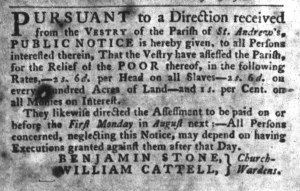
“The Vestry have assessed the Parish, for the Relief of the POOR.”

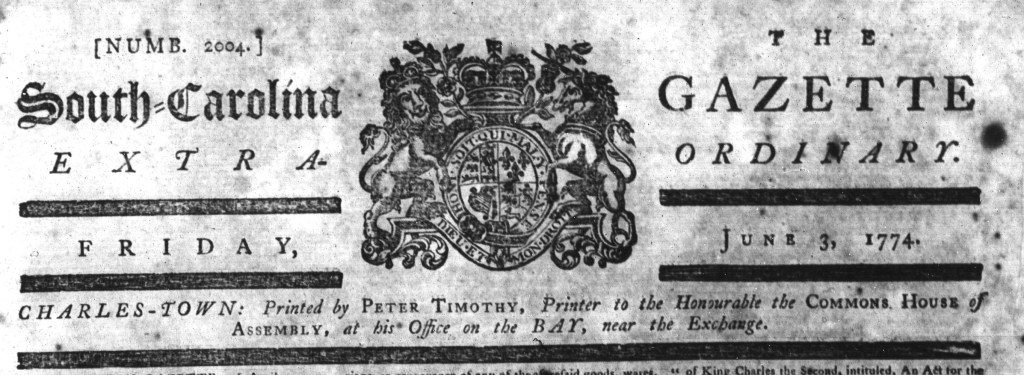
Peter Timothy usually published the South-Carolina Gazette on Mondays in 1774, but upon receiving the text of the Boston Port Act he considered the news momentous enough to merit an extraordinary edition on Friday, June 3.  Word certainly circulated via conversations among colonizers, yet Timothy gave them the opportunity to read the act for themselves and see all the details that might otherwise have been distorted as the news traveled.  The masthead for the extraordinary featured thick black lines, a symbol of mourning that usually signified the death of a prominent official but in this case lamented the death of liberty in the colonies.

The “Act to discontinue … the landing and discharging, lading or shipping of Hoods, Wares, or Merchandize, at the Town, and within the Harbour of Boston” accounted for the entire front page of the extraordinary.  News and editorials originally published in Boston and Philadelphia ran on the second page and most of the third.  Timothy had too much content for a two-page supplement, so he opted for four pages.  That left a page and a half to fill.  The printer opted for advertisements, items with type already set.  He certainly had enough of that kind of content at his printing office.  Advertising comprised three of the twelve columns in the previous standard edition of the South-Carolina Gazette and all four pages of the supplement distributed on the same day.  Yet Timothy may have been selective with which advertisements he chose to deliver with confirmation of the Boston Port Act.  The extraordinary did not include any notices from purveyors of goods and services hawking their wares.  Instead, Timothy chose advertisements that delivered news, including the “PRESENTMENTS of the GRAND-JURORS” for several districts in the colony, an announcement that the Recess Society would hold its quarterly meeting, and a “PUBLIC NOTICE” about taxes “for the Relief of the POOR” in the Parish of St. Andrew’s.  Given the significance of the news that the extraordinary carried, Timothy may have aimed to accompany the Boston Port Act with advertisements that also delivered news rather than attempts to convince consumers to make purchases.  The following Monday, he returned to business as usual with all manner of advertising in the standard issue and supplement published on June 6.

South-Carolina Gazette Extraordinary (June 3, 1774).

June 2

What was advertised in a colonial American newspaper 250 years ago today?

Maryland Gazette (June 2, 1774).

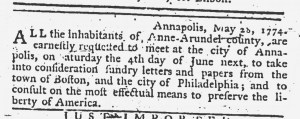
“Meet … to consult on the most effectual means to preserve the liberty of America.”

Advertisements in eighteenth-century newspapers served a variety of purposes.  Sometimes they carried news.  During the imperial crisis, colonizers used advertisements to help them organize.  Consider a notice that ran in the June 2, 1774, edition of the Maryland Gazette.  It advised, “ALL the inhabitants of Anne-Arundel county, are earnestly requested to meet at the city of Annapolis, on Saturday the 4th day of June next, to take into consideration sundry letters and papers from the town of Boston, and the city of Philadelphia.”  The organizers also planned for the participants to “consult on the most effectual means to preserve the liberty of America.”  Those “sundry letters and papers” referred to news of the Boston Port Act.  As punishment for the Boston Tea Party, Parliament closed and blockaded Boston Harbor, starting June 1 and continuing until the residents of that town paid for the tea destroyed the previous December.

More details from some of those “sundry letters and papers” appeared elsewhere in that issue of the Maryland Gazette, including “Extracts of private letters from London, dated April 7 and 8, to private persons in New-York and Philadelphia” on the front page, yet the call to meeting was not among the news items.  It appeared among the advertisements, though it received a privileged place as the first advertisement.  It ran immediately after the list of vessels that entered and cleared the customs house in Annapolis, traditionally the final news item.  The printers, Anne Catherine Green and Son, also ran a note that the “conclusion of the essay on the advantages of a classical education, is postponed for want of room” and “Advertisements omitted will be inserted next week.”  Yet they not only made certain to include the advertisement about the meeting to discuss news related to the Boston Port Act and how to respond but also placed it where readers who might not read the advertisements as closely as the news and editorials would be more likely to see it.  John Holt had done the same with a call to meeting that ran in the May 19 edition of the New-York Journal.  The press played an important role in “preserv[ing] the liberty of America” during the era of the American Revolution, but not solely in the sections of newspapers that carried coverage of current events.  Advertisements also contributed to keeping readers informed and mobilizing colonizers to resist legislation passed by Parliament.

May 27

What was advertised in a colonial American newspaper 250 years ago today?

South-Carolina and American General Gazette (May 27, 1774).

“Souchong Tea at 60s. the Pound.”

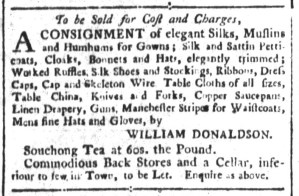
As summer approached in 1774, William Donaldson advertised a variety of goods in the South-Carolina and American General Gazette.  On May 27, he promoted “elegant Silks, Muslins and Humhums for Gowns; Silk and Sattin Petticoats, Cloaks, Bonnets and Hats, elegantly trimmed; [and] Table China,” among other merchandise.  He had a separate entry for “Souchong Tea at 60s. the Pound.”  As in other towns, decisions about buying, selling, and consuming tea were part of an unfolding showdown between the colonies and Parliament.

Residents of Charleston were well aware of the Boston Tea Party that occurred the previous December.  They also anticipated some sort of response from Parliament, but at the time that Donaldson ran his advertisement, word of the Boston Part Act had not yet arrived in South Carolina.  Indeed, four days after Donaldson’s advertisement appeared in the South-Carolina and American General Gazette, another newspaper, the South-Carolina Gazette and Country Journalcarried updates from London, dated March 15, that included an overview of the proposed act to close Boston Harbor until the town paid for the tea that had been destroyed and “made proper concession for their tumultuous behaviour.”  In addition, the report stated that a “light vessel is said to have been kept ready by some friends to the Bostonians in England, in order to carry accounts of the first determination of a Great Assembly.”  By the end of May, colonizers in New England and New York knew that the Boston Port Act had passed and would go into effect on June 1.  The news was still making its way to South Carolina.

When it arrived, Peter Timothy, the printer of the South-Carolina Gazette, considered it momentous enough to merit an extraordinary, a supplemental issue.  Timothy usually published his newspaper on Mondays, but felt that this news could not wait three more days.  He rushed the South-Carolina Gazette Extraordinary to press on Friday, June 3.  The masthead included thick black borders, traditionally a sign of mourning the death of an influential member of the community but increasingly deployed by American printers to lament the death of liberty.  Confirmation of the Boston Port Act inspired new debates about consuming tea and purchasing other imported goods, eventually leading to a boycott known as the Continental Association, but colonizers did not immediately forego buying, selling, drinking, or advertising tea following the Boston Tea Party.  That happened over time (and loyalists like Peter Oliver claimed that even those who claimed to support the boycott devised ways to cheat).  In the interim, Donaldson continued marketing tea along with other merchandise.

May 21

What was advertised in a colonial American newspaper 250 years ago today?

Providence Gazette (May 21, 1774).

ENGLISH LIBERTIES, Or, The free-born Subject’s Inheritance.”

Like the issue of the Connecticut Journal and New-Haven Post-Boy published the previous day, the May 21, 1774, edition of the Providence Gazette devoted much less space to advertising than in most issues.  News items, especially those concerning the Boston Port Act, accounted for almost all the content, leaving room for six brief advertisements in the final column on the third page and two in the bottom right corner on the last page.  The “Substance of the DEBATES on the BOSTON PORT-BILL” filled the entire front page and spilled over onto the next.  Other news from London, followed by updates from Philadelphia and Boston followed.  Updates from Boston continued on the third page, eventually giving way to coverage of a “Town-Meeting held a Providence, on the 17th Day of May.”  A speech delivered in Parliament in opposition to the Boston Port Act and calling for the “immediate REPEAL OF THE TEA DUTY” comprised most of the final page.  John Carter, the printer, included a brief note about the paucity of advertising in that issue: “To make Room for the interesting Advices in this Day’s Gazette, we are obliged to omit several Advertisements.”

Carter did not choose to omit his own advertisement about publishing “ENGLISH LIBERTIES, Or, The free-born Subject’s Inheritance” by subscription.  For a year and a half, the printer had circulated subscription papers, advertised in the Providence Gazette and other newspapers published in New England, and encouraged colonizers to reserve copies of a book that became even more timely as the imperial crisis intensified.  The Boston Port Act served as an advertisement for the volume, as did the speech warning against its passage and other news that Carter included in the May 21 edition of the Providence Gazette.  Coverage of the recent town meeting in Providence included resolutions that the residents “will heartily join with the Province of the Massachusetts Bay, and the other Colonies, in such Measures as shall be generally agreed on by the Colonies, for the protecting and securing their invaluable Natural Rights and Privileges.”  Furthermore, the resolutions called on the “Committee of Correspondence of this Town … to assure the Town of Boston, that we consider ourselves greatly interested in the present alarming Conduct of the British Parliament towards them.”  They went on to recommend a “Stoppage of all Trade” until the repeal of the Boston Port Act, using commerce as political leverage.

Carter’s advertisement for English Liberties did not merely appear in proximity to all this news.  He very intentionally gave it a privileged position.  It appeared on the final page, immediately after the speech against the Boston Port Act, the news item seamlessly leading into the advertisement for a book that provided justification for colonizers demanding their rights.  Yet its placement on the page had even more significance considering the methods for producing eighteenth-century newspapers.  Like other newspapers, the Providence Gazette consisted of four pages created by printing two pages on each side of a broadsheet and folding it in half.  That meant that printers typically set the type and printed the first and last pages before the second and third pages.  That Carter’s advertisement for English Liberties ran in the bottom right corner of the fourth page indicates that he gave it priority over all other advertisements.  Considering the other news flowing into his printing office, he did not know how much space he might have for advertisements on the second and third pages, so he made sure that his advertisement appeared on the first side of the broadsheet that went to press.  It turned out that he had room for half a column of advertising on the third page, but Carter did not wait to find out whether that would be the case.  Like many other printers, he simultaneously used current events to sell books and pamphlets about political philosophy and he published those items to influence current events.

May 19

What was advertised in a colonial American newspaper 250 years ago today?

New-York Journal (May 19, 1774).

“Meet … to consult on Measures proper to be pursued on the present critical and important Occasion.”

Important news sometimes appeared among the advertisements in colonial newspapers during the imperial crisis that culminated in thirteen colonies declaring independence from Britain.  While the rest of the newspaper carried reports, updates, editorials, and extracts of letters meant to keep readers informed of “the freshest ADVICES, both FOREIGN andDOMESTIC” (as the masthead for the New-York Journal and other newspapers proclaimed), readers also needed to peruse the advertisements.  Such was the case in the spring of 1774 when New York received word of the Boston Port Act that closed the harbor until such time that resident made restitution for the tea destroyed by colonizers masquerading as Indians the previous December.

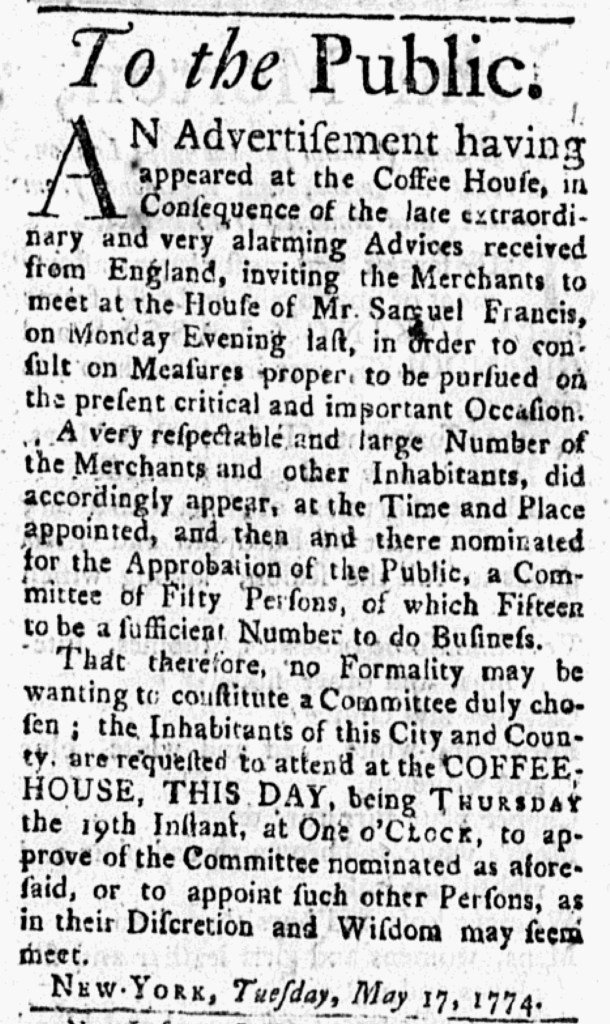
A notice in the May 19 edition of the New-York Journal referred to an “Advertisement” or announcement that “appeared at the Coffee House, in Consequence of the late extraordinary and very alarming Advices received from England.”  That announcement invited merchants to meet “at the House of Mr. Samuel Francis,” meaning the tavern operated by Samuel Fraunces, “in order to consult on Measures proper to be pursued on the present critical and important Occasion.”  In turn, the advertisement in the newspaper reported on what occurred at that meeting.  “A very respectable and large Number of the Merchants and other Inhabitants” gathered and nominated a committee “of Fifty Persons, of which Fifteen to be a sufficient Number to do Business.”  The advertisement, addressed “To the Public,” called on the “inhabitants of this City and County” to attend another meeting to “approve of the Committee nominated … or to appoint such other Persons, as in their Discretion and Wisdom may seem meet.”  The organizers intended to garner as much support as possible to “constitute a Committee duly chosen” to act on behalf of all residents concerned about the most recent abuse perpetrated by Parliament.

Disseminating notice about the meeting as a newspaper advertisement made more colonizers aware of the meeting, though word also spread in conversation.  It also kept readers at a distance informed that merchants and others in New York prepared to take action, encouraging them to continue checking the public prints for more news about politics and current events.  Those who also read Rivington’s New-York Gazetteer that day encountered the complete text of the Boston Port Act on the front page, an opportunity to assess it for themselves beyond whatever rumors they previously heard.  Working back and forth between news and advertisements, colonizers gained a more complete picture of the events unfolding in the wake of the Boston Tea Party.