March 4

GUEST CURATOR:  Ethan Sawyer

What was advertised in a revolutionary American newspaper 250 years ago today?

Norwich Packet (March 4, 1776).

“All Sorts of Doe and Buck-Skin Breeches.”

This advertisement announced the arrival of John Saltmarsh, a “LEATHER BREECHES MAKER” from London.  He offered to make breeches for anyone who needed them in Norwich, Connecticut.  He uses both doe and buckskin and made them fit properly.  He also promised they would fit well, offering to “make them fit properly, or demand nothing for his trouble.” This sounds confusing, but it was the equivalent of modern lawyers only asking for a payment if they win.  Saltmarsh was that confident in his ability to make new breeches or alterations that pleased his customers.

I was not sure what “breeches” were when I first read this advertisement.  From an interview with historian Kate Haulman in Vox, I learned that breeches are a kind of pants made distinctive through the wrappings that tighten them just below the knees.  Some had buttons or buckles, but for a cheaper option some just had simple ties to hold them in place.  They were fashionable, which was one reason Saltmarsh said that he was “from London,” but that was not the only way he tried to convince customers to buy breeches from him.  He also focused on service, promising the work to be done with “one Day’s Notice” or else he will compensate the customer for the inconvenience.  He even said, “he will pay for their trouble of coming after them.”  Overall, Saltmarsh ran an honest business. He focused on not only making a good product that fits the needs of each customer, but also on a timetable that works for them.

**********

ADDITIONAL COMMENTARY:  Carl Robert Keyes

One of my favorite parts of having students in my upper-level early American history courses serve as guest curators for the Adverts 250 Project is observing their sense of wonder and discovery as they encounter everyday life in the eighteenth century for the first time.  That starts with each student compiling an archive that consists of one week of newspapers published during the era of the American Revolution.  Those newspapers look familiar, but they also have significant difference compared to modern newspapers … and not just the long “s” that looks so strange to novice researchers.  The purposes of some advertisements surprise them, such as what are today known as “runaway wife” advertisements in which husbands made public proclamations that they would not pay any expenses incurred by the unruly women who abandoned their household responsibilities (and that gives us a chance to discuss both coverture and the perspectives of the wives who did not have ready access to the public prints).  Students also encounter consumer goods commonly advertised in early America that are not familiar to them, such as andirons and “AMERICAN CAKE-INK.”  Breeches also fall in that category.  Ethan was not the only student enrolled in my senior seminar in Fall 2025 who included an entry on breeches in the advertising portfolio he created throughout the semester.

In addition to seeing fresh perspectives on consumer goods, I am always interested to see which advertisements draw the attention of my students because they usually select different advertisements to examine as guest curators than I would if I produced that entry of the Adverts 250 Project on my own.  I would have skipped over “JOHN SALTMARSH, LEATHER BREECHES MAKER, FROM LONDON,” in favor of the two advertisements for Thomas Paine’s Common Sense that appeared in the March 4, 1776, edition of the Norwich Packet, advertisements even more notable because the printers also included “EXTRACTS FROM A PAMPHLET ENTITLED, COMMON SENSE.”  Perhaps they previewed the pamphlet for the edification of their readers, though they likely also hoped to incite greater demand for sales of the pamphlet at their printing office.  This helps make a point that I underscore in all my courses: the stories that historians tell about the past depend on the sources they consult and, among those, which they choose to examine in greater detail.  Ethan and I both chose advertisements that illuminate the past, though different advertisements engaged our curiosity.  Elsewhere in his advertising portfolio, Ethan examined other advertisements from other newspapers.  Considered together, his advertisements looked at many aspects of consumer culture, commerce, politics, and everyday life during the first year of the Revolutionary War.  They included an advertisement for a riding manual “for gentlemen of every rank and profession,” an advertisement for pig iron, an advertisement for an assortment of books and pamphlets for supporters of the American cause, … and an advertisement for a local edition of Common Sense that appeared in the March 1 edition of the Connecticut Gazette.  When we perused that newspaper, Ethan and I selected the same advertisement!
January 26

What was advertised in a revolutionary American newspaper 250 years ago today?

Thomas’s Massachusetts Spy (January 26, 1775).

“Leather-Dresser and Breeches-Maker, from BOSTON.”

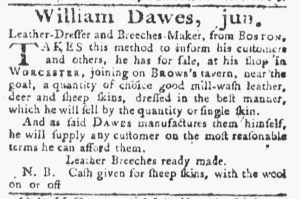
William Dawes, Jr., a “Leather-Dresser and Breeches-Maker, from BOSTON,” placed an advertisement in the January 26, 1776, edition of Thomas’s Massachusetts Spy.  Just as Isaiah Thomas had moved his printing press from tumultuous Boston to the relative security of Worcester just as the Revolutionary War began, Dawes relocated to the inland town.  According to his advertisement, he now ran a shop “in WORCESTER,” adjoining a tavern and near the jail.  Since he was a newcomer, he could not expect that prospective customers knew his location, so he identified familiar landmarks to help them find him.  He had on hand “a quantity of choice good mill-washed leather, [and] deer and sheep skins, dressed in the best manner,” selling them either individually or “by the quantity.”  Dawes processed or “manufacture[d]” the leather himself, allowing him to “supply any customer on the most reasonable terms he can afford them.”  To that end, he sought “sheep skins, with the wool on or off,” and offered cash to his suppliers.

Under other circumstances, identifying himself as an artisan “from BOSTON” would have told prospective customers something about his origins and suggested that he possessed the skills and knowledge of changing styles that allowed him to run a business in one of the largest urban ports in the colonies.  While that was still the case in this advertisement, noting that he was “from BOSTON” likely resonated in another way.  The residents of that town had endured a lot during the imperial crisis, especially after the Boston Port Act closed the harbor to commerce on June 1, 1774, in retaliation for the destruction of tea the previous December.  The situation became even more precarious once the fighting began at the battles at Lexington and Concord in April 1775.  A siege of Boston ensued.  The Second Continental Congress appointed George Washington as commander of the Continental Army and dispatched him to lead the American forces that surrounded Boston.  Early in the siege, the Sons of Liberty and other leaders negotiated with General Thomas Gage for an exchange, allowing Loyalists to enter Boston and Patriots and others to depart.  Dawes may have been among those refugees in search of better fortunes and greater safety in other towns in New England.  By introducing himself as a “Leather-Dresser and Breeches-Maker, from BOSTON,” he may have hoped to play on the sympathies of prospective customers, giving them one more reason to support his shop in Worcester.

April 10

What was advertised in a colonial American newspaper 250 years ago this week?

Rivington’s New-York Gazetteer (April 7, 1774).

“ETHAN SICKELS, Leather-Dresser and Breeches-Maker.”

Even if imitation is the sincerest form of flattery, Cornelius Ryan, “LEATHER DRESSER and BREECHES MAKER,” probably did not feel particularly flattered when Ethan Sickels, “Leather-Dresser and Breeches-Maker,” ran an advertisement that imitated Ryan’s advertisement a little too much.  Compare the copy from Ryan’s notice, which first appeared in the New-York Gazette and Weekly Mercury on March 21, 1774, and Sickels’s notice, which first appeared in Rivington’s New-York Gazetteer on March 31.

Ryan: “MAKES and sells best Buck and Doe Skin Breeches, find ground Lamb do, best Buck and Doe Skin Gloves, also the very best Kind of Caraboo Skin Breeches and Gloves.”

Sickels: “MAKES and sells the best buck and doe skin breeches, fine ground lamb best buck and doe skin gloves; Also the very best Caraboo skin breeches, and gloves.”

Ryan: “He likewise has a great Variety of Buck Skin Breeches for Traders or Country Stores … all which he will sell on as low Terms as they can be had from Philadelphia, or any Part of the Continent.”

Sickels: “he likewise has a great quantity of buckskin breeches for traders, or country stores … all which he will sell on as low terms as they can be had from Philadelphia, or any part of the continent.

This was not an instance of using standardized or formulaic language as was often the case in eighteenth-century advertisements for consumer goods and services.  Instead, Sickels quite clearly borrowed Ryan’s advertising copy … but that was not the only undeniable similarity between the two newspaper notices.  Each of them included a woodcut depicting a pair of breeches and the initials of the advertiser that accounted for approximately half of the space occupied by the advertisements.  Ryan’s image also included a sun, replicating his “Sign of the SUN and BREECHES,” while Sickels’s image had a border around it instead.

Sickels apparently admired Ryan’s advertisement or feared that it gave his competitor too much of an advantage or recognized a means of drawing more attention to his own business.  All those factors may have been at play when he saw Ryan’s notice in the New-York Gazette and Weekly Mercury and decided to cross the street from his workshop “Opposite Mr. RIVINGTON’S PRINTING-OFFICE” to arrange for such a similar advertisement to run in Rivington’s New-York Gazetteer.  This suggests that entrepreneurs did not place newspaper advertisements as mere announcements in the eighteenth century but instead some of them monitored the public prints to devise their own marketing efforts or at least keep up with their competitors.

March 28

What was advertised in a colonial American newspaper 250 years ago today?

Supplement to the New-York Gazette and Weekly Mercury (March 28, 1774).

“The Sign of the SUN and BREECHES.”

Cornelius Ryan, “LEATHER DRESSER and BREECHES MAKER,” pursued his trade at “the Sign of the SUN and BREECHES, IN THE BROADWAY” in New York.  Residents and visitors to the busy port likely glimpsed his sign as they traversed the streets of the city.  Readers of the New-York Gazette and Weekly Mercury almost certainly noticed the woodcut that adorned the advertisements he ran in that newspaper.  It included the same elements as the sign that marked his location, a sun above a pair of breeches.  The sun had a face that stared directly at readers as well as eight rays enclosed within a corona.  In addition, the initials “CR,” for Cornelius Ryan, appeared between the legs of the breeches.  The woodcut may or may not have replicated Ryan’s sign; at the very least, it strengthened the association that the leather dresser and breeches maker wanted consumers to have with his business and visual representations of it.

To achieve that, Ryan invested in commissioning a woodcut stylized for his exclusive use.  Most entrepreneurs did not go to such lengths when they advertised in colonial newspapers, though Smith Richards, who kept shop “At the Tea canister and two sugar loaves,” once again included a woodcut depicting those items in his notice in the same supplement that carried Ryan’s advertisement.  Nesbitt Deane advertised hats he “Manufactured,” but did not adorn his notice with the image of a tricorne hat and his name within a banner that he had included in other notices on several occasions over the years.  Since advertisers paid by the amount of space their notices occupied rather than the number of words, woodcuts amounted to significant additional expense beyond the costs of producing them.  For Ryan, the woodcut accounted for nearly half of his advertisement, doubling the cost of running it in the New-York Gazette and Weekly Mercury.  He may very well have considered it worth the investment if the striking image prompted prospective customers to read the copy more closely.  The visual image served as a gateway for the appeals to skill, quality, price, consumer choice, and customer satisfaction that followed.

October 14

What was advertised in a colonial American newspaper 250 years ago today?

Pennsylvania Journal (October 14, 1772).

“Having for some years operated for, and with the most proficient of the art, in the above-mentioned metropolis (of London).”

When William Johnson, a “GLOVER and BREECHES-MAKER,” arrived in Philadelphia in the fall of 1772, he placed advertisements in the Pennsylvania Journal to introduce himself to the community and invite prospective clients to visit the shop he opened on Front Street.  Like many other artisans who migrated across the Atlantic, Johnson emphasized his experience working in London, the cosmopolitan center of the empire.  Until he had time to establish his reputation in the local market, he depended on his connections to London to sell his services.  In the headline for his advertisements, he described himself as “lately arrived from LONDON.”  In the nota bene that concluded his notice, Johnson declared that he “hopes himself capable to give all possible satisfaction, with respect to the neatness of the fitting, and execution of the workmanship; having for some years operated for, and with the most proficient of the art, in the above-mentioned metropolis (of London).”  He opened and closed his advertisement with references to London.

Johnson also intended for the timing of his arrival to resonate with prospective clients.  Having “lately arrived from LONDON” suggested that he was familiar with the most recent styles in that “metropolis.”  His clients could depend on getting news and advice about current trends, helping them to keep up with new tastes on the other side of the Atlantic and perhaps stay ahead of friends and acquaintances in Philadelphia.  Some artisans continued to promote their connections to London long after they relocated to the colonies.  Johnson provided details that made it possible for prospective clients to determine for themselves that he did indeed recently arrive in the city and, by extension, his knowledge of fashions in London was as current as possible.  He reported that he “lately arrived from LONDON, by Capt. SPARKS.”  The “ship Mary and Elizabeth, J. Sparks from London” appeared among the “ARRIVALS” in the shipping news from the “Custom-House, Philadelphia,” in the September 30 edition of the Pennsylvania Journal.  When Johnson’s advertisement ran in the October 14 edition, he had been in the city for less than three weeks.  In addition, merchants, shopkeepers, and others also referenced the arrival of the ship in their advertisements.  Randle Mitchell, for instance, stated that he “Just imported” new merchandise “in the Elizabeth and Mary, Capt. Sparks, from London.”  Robert Bass, an apothecary, stocked new medicines “JUST IMPORTED in the Mary and Elizabeth, Capt. Sparks from London.”

As yet unknown to prospective clients in Philadelphia, Johnson attempted to leverage his experience in the “metropolis” of London to convince prospective clients to avail themselves of his services.  That experience garnered proficiency in his craft, including “the neatness of the firring, and the execution of the workmanship,” while also giving him access to current styles in the most fashionable city in the empire.  He included the name of the captain of the vessel that transported him across the Atlantic as a means of confirming that he possessed recent knowledge of the latest trends.

November 26

What was advertised in a colonial American newspaper 250 years ago today?

Connecticut Courant (November 26, 1771).

“WE also return out sincere thanks to all our good customers.”

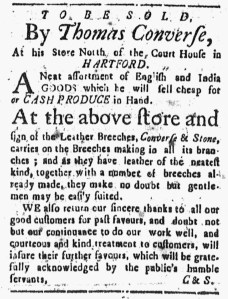
In the fall of 1771, Thomas Converse placed an advertisement in the Connecticut Courant to inform prospective customers that he stocked a “Neat Assortment of English and India GOODS” at his store in Hartford.  In addition, he and a partner continued to make breeches at the same location, conveniently marked by the “sign of the Leather Breeches.”  Converse and Stone had on hand “a number of breeches already made” as well as “leather of the neatest kind,” both options sure to suit the “gentlemen” of the town.

Converse and Stone devoted a significant portion of the advertisement to expressions of gratitude directed at both current and prospective customers.  “WE also return our thanks,” the partners declared “to all our good customers for past favours, and doubt not but our continuance to do our work well … will insure their further favours.”  In addition, Converse and Stone emphasized customer service, stating that they provided “courteous and kind treatment.”  Eighteenth-century advertisers, especially artisans who produced the goods they sold, regularly acknowledged their customers in their advertisements.  Doing so suggested to those who had not yet availed themselves of the goods and services being offered that an advertiser already had an established clientele.  In the case of Converse and Stone, prospective customers may have felt more confident engaging their services if they believed that their “good customers” were also satisfied customers.  This served as an invitation to join a community of consumers that the breeches makers already cultivated.  Extending “sincere thanks” in print also contributed to the customer service that Converse and Stone purported to practice at the “sign of the Leather Breeches,” demonstrating to current and prospective customers that their attention to their patrons continued after they departed their store.  Converse and Stone sought to be “the public’s humble servants” if customers would give them the opportunity.

October 16

What was advertised in a colonial American newspaper 250 years ago today?

Connecticut Courant (October 16, 1770).

They have a Number of Pairs of Breeches already made.”

In the fall of 1770, the partnership of Converse and Stone, “Breeches Makers, at the Sign of the Breeches in Hartford,” took to the pages of the Connecticut Courant to inform “Gentlemen” that they had set up shop.  They told prospective clients that pursued “the Business of Breeches Making in all its Branches,” intending for that short phrase to provide assurances that they possessed all of the necessary skills of the trade and that they could construct breeches in a variety of styles according to the tastes and budgets of their customers.

In a nota bene, Converse and Stone asked potential clients to take note that they “have a Number of Pairs of Breechesalready made, together with skins of the neatest Kind, so that Gentlemen may suit themselves.”  The breeches makers catered to their customers.  Although they could measure clients and construct new garments for those who desired such services, Converse and Stone also offered the convenience of an eighteenth-century version of buying off the rack.  They already made and had on hand an inventory of breeches for men who wished to acquire them in a single visit to the shop. They adopted business practices and a marketing strategy similar to those that Thomas Hewitt, a wigmaker in Annapolis, described in his advertisement running in the Maryland Gazette at the same time.  Hewitt also promoted both custom-made items and “ready made” alternatives.

For those gentlemen who preferred custom-made breeches, Converse and Stone had “Skins of the neatest Kind” that they could examine and choose what suited them when they came to the shop for measurements.  In that case, their breeches were tailor-made in a collaboration between the breeches makers and individual patrons.  The clients expressed their tastes and preferences and Converse and Stone supplied the skill to create the garments envisioned and commissioned by their customers.  In their advertisement, the breeches makers balanced consumer choice and convenience against their abilities and expertise in their trade.

July 7

What was advertised in a colonial American newspaper 250 years ago today?

Jul 7 - 7:7:1769 Connecticut Journal
Connecticut Journal (July 7, 1769).

“Hugh Glassford … now carries on his Business, at Glen and Gregory’s.”

Moving to a new location prompted Hugh Glassford, a leather breeches and glove maker in New Haven, to place an advertisement in the Connecticut Journal in the summer of 1769. Glassford stated that he resided with Mr. Beers for the past year, but he “now carries on his Business, at Glen and Gregory’s.” He reported that he served customers “much to their Satisfaction” at his former location, suggesting that he would offer the same quality of service at his new location. It does not appear that Glassford inserted an advertisement in the local newspaper when he first arrived in New Haven. He likely engaged customers via word of mouth. After building a clientele for his leather breeches and gloves and cultivating a reputation in the town and beyond, however, he likely considered an advertisement worth the investment. Advising the public of his new location would help Glassford retain current customers as well as encourage new ones to seek out his services.

To quickly discover if Glassford had previously advertised, I did a keyword for his last name in all 2752 issues of the Connecticut Journal, spanning dates from October 23, 1767 to December 26, 1820, available in America’s Historical Newspapers database. That search yielded zero results, but that did not surprise me since I had searched for the breeches and glove maker’s name as I read it – Glassford – rather than as optical character recognition software would interpret it – Glafsford. As a person with experience working with eighteenth-century newspapers, I possess knowledge and creativity that the software lacks. I easily recognize the long s commonly used in the eighteenth century and effortlessly translate “Glafsford” into “Glassford.” The database’s OCR does not.

Armed with that knowledge, I did a second keyword search, this time for “Glafsford.” It yielded five results, all of them for the advertisement Glassford ran in the summer of 1769. According to the keyword search, his notice appeared five times: June 30, July 7, 14, and 28, and August 25. In order to produce these results, I had to adopt a methodology that tricked the software into doing what I needed. This is a valuable lesson that I pass along to students when we work with primary sources. Beyond our usual manner of thinking, we also have to think like people from the era we are investigating and think like the tools we deploy in doing our work. For the latter, sometimes that means thinking about how a cataloger might have organized a collection of documents, but other times it means thinking about the shortcomings of optical character recognition.

December 30

What was advertised in a colonial American newspaper 250 years ago today?

dec-30-12301766-south-carolina-gazette-and-country-journal
South-Carolina Gazette and Country Journal (December 30, 1766).

“Those who … left Breeches to clean, are requested to call for them.”

Most advertisements for consumer goods and services attempted to convince potential customers to make purchases, to participate in the consumer revolution taking place around them. On occasion, however, shopkeepers and artisans placed advertisements requesting that customers actually take possession of the goods that belonged to them. Two such advertisements appeared in the December 30, 1766, issue of the South-Carolina Gazette and Country Journal.

In the first, Alexander Caddell, a “Breeches-maker and Glover,” announced that he planned to return to London. He called on business associates and former customers to settle their accounts, but he also informed anyone who “left Skins to be manufactured for Breeches” to retrieve them. Similarly, those who “left Breeches to clean” had two months to pick them up. Otherwise, Caddell planned to sell them.

dec-30-12301766-advert-2-south-carolina-gazette-and-country-journal
South-Carolina Gazette and Country Journal (December 30, 1766).

In another advertisement, Edward Weyman noted that he had “in his Possession sundry Looking-Glasses belonging to different Persons” who had entrusted him with silvering them. He called on the owners to “pay the Charges” and “take them away.” Like Caddell, he threatened to sell them, though he allowed six months, rather than two, for the owners to recover their property from his shop.

In both cases, the advertisers had provided services but presumably had not yet been paid. Selling items that had been abandoned by their owners, after giving sufficient notice that they planned to do so, became a method for receiving payment for their services through a different means.

This situation also illuminates one of the convoluted routes for delivering goods to consumers. Many eighteenth-century advertisements featured new goods that moved along a simple path from producer to retailer to consumer. The breeches that Caddell threatened to sell and the looking glasses that Weyman threatened to sell, however, did not traverse such a simple trajectory. Instead, these used goods had multiple owners, multiple sellers, and rather complicated provenances. The consumer revolution occurred not only because buyers and sellers valued and exchanged new goods but also because they developed markets for used wares, sometimes as an expediency when the original owners neglected to reclaim possessions left in the care of shopkeepers and artisans.

April 30

What was advertised in a colonial newspaper 250 years ago this week?

Apr 30 - 4:28:1766 New-York Gazette
New-York Gazette (April 28, 1766).

“May depend on having their commands executed with expedition, and in the neatest manner.”

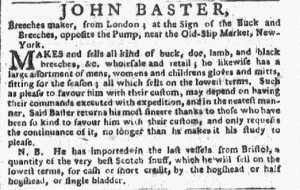
Breechesmaker John Baster understood the importance of customer service, and he wanted potential customers to know that he would treat them well if they called on him. He promised that his clients “may depend on having their commands executed with expedition, and in the neatest matter.” In other words, he did the job quickly but well, not sacrificing quality for speed.

In choosing to use the word “commands” rather than “orders” or “instructions,” he also established the relationship between artisan and customer. Whether elite, middling, or more humble, all customers could expect deference from Baster throughout their commercial interaction, regardless of their relative status and relationship to each other beyond his shop at the Sign of the Buck and Breeches.

Baster thanked former customers for their patronage (letting potential customers know that others had visited his shop) before stating that he “only requests the continuance of it, no longer than he makes it his study to please.” This convoluted passage was the eighteenth-century method of assuring customers that he understood that if he failed to offer good customer service that he realized that they would seek out other breechesmakers. Not only did he realize that was the case, he expected it.

Customer service is a major aspect of running a retail enterprise today, but colonial Americans understood its value as well, though they may have expressed it differently.