October 1

What was advertised in a revolutionary American newspaper 250 years ago this week?
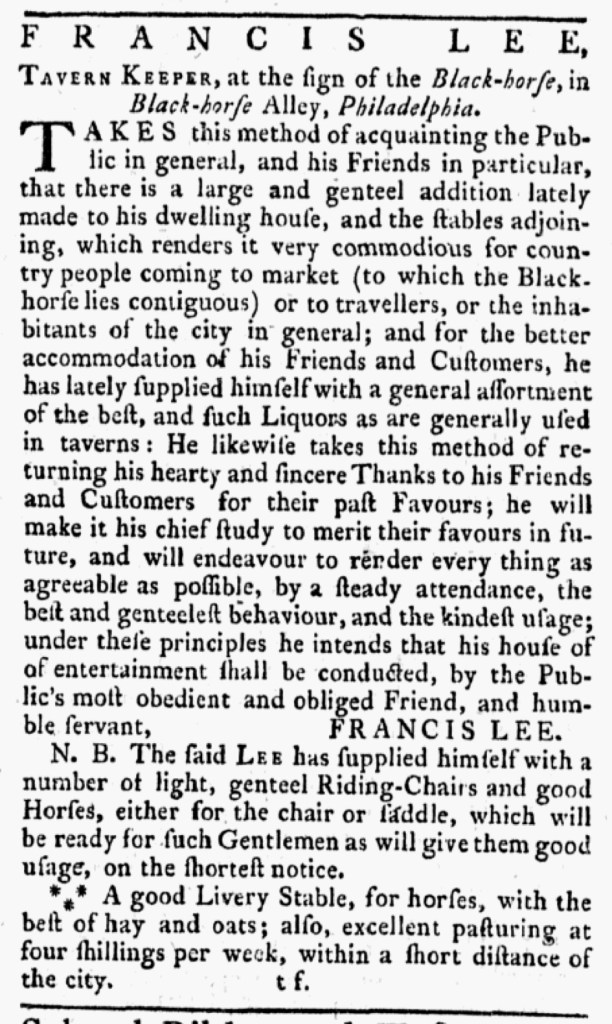
Pennsylvania Ledger (September 30, 1775).

“Genteel Riding-Chairs … ready for Gentlemen as will give them good usage, on the shortest notice.”

In the fall of 1775, Francis Lee operated a tavern “at the sign of the Black-horse, in Black-horse Alley, Philadelphia.”  In an advertisement in the September 30 edition of the Pennsylvania Ledger, he advised readers about a “large and genteel addition lately made to his dwelling house, and the stables adjoining, which renders it very commodious for country people coming to market.”  His tavern was conveniently located “contiguous” to the market.  In addition to those prospective patrons, Lee also wanted travelers and “the inhabitants of this city in general” to know about the improvements he made at his tavern.  He also promoted his “general assortment of the best, and such Liquors as are generally used in taverns.”  That was all part of providing a pleasant and enjoyable experience for his guests.

Lee also provided other services for the convenience of his “Friends and Customers.”  They included a “good Livery Stable, for horses, with the best of hay and oats” or pasturing by the week, just outside the city, for those staying for a length of time.  He also made a point of highlighting the “genteel Riding-Chairs and good Horses, either for the chair or saddle” that he made available “on the shortest notice.”  In other words, Lee offered an eighteenth-century version of car rentals.  His customers could borrow a horse to ride (the reference to “saddle”) or a horse and fashionable carriage (the “genteel Riding-Chairs”) to transport them to their destination.  Travelers who arrived in Philadelphia on foot, via stagecoach, or on a ship could avail themselves of this service for getting around the city.

The tavernkeeper may have been especially interested in attracting the attention of visitors in the city to attend the Second Continental Congress.  With delegates from throughout the colonies converging on Philadelphia, Lee likely hoped that some of them would visit his “house of entertainment” to enjoy the “best and genteelest behaviour, and the kindest usage” from their host while they enjoyed the amenities of the establishment.  Lee pledged “to render every thing as agreeable as possible” for his customers.  Why not continue discussions or just relax at Lee’s “commodious” tavern after a busy day of meetings to discuss the imperial crisis that had become a war?

May 26

What was advertised in a colonial American newspaper 250 years ago today?

May 26 - 5:26:1767 South-Carolina Gazette and Country Journal
South-Carolina Gazette and Country Journal (May 26, 1767).

“Good horses and chairs, which he will hire out by the day.”

Personal transportation was a major investment in eighteenth-century America, just as it continues to be today. Not all colonists could afford to own horses, considering the costs of stabling, feeding, and caring for them. Even for those with horses, coaches and carriages were another significant expense, one often incurred only by the most affluent colonists who wished to demonstrate their gentility and wealth through conspicuous displays of consumption.

The costs, however, did not put the use of horse and carriage completely beyond the means of colonists who did not rank among the elite. Those who did not have either cause or the means to own horses or carriages of their own could rent them from entrepreneurs who took advantage of that void in the marketplace. Thomas Eustace, for instance, advertised that he had “purchased some good horses and chairs, which he will hire out by the day.” (Colonists used the term “chair” generically to denote all sorts of carriages.) In choosing the device to identify his location, Eustace positioned such rentals as a central component of his business: he could be found “at the sign of the Horse and Chair.” There he also stabled horses and “proposes taking in wagons” for the night. In effect, he provided parking in the bustling port of Charleston.

Eustace’s approach to providing personal transportation for other colonists anticipated practices commonly associated with the age of automobiles, but he was not the only innovative entrepreneur who pioneered what may otherwise seem to be particularly modern practices. The day before Eustace advertised in the South-Carolina Gazette and Country Journal, Adino Paddock informed readers of the Boston-Gazette that in addition to making new coaches he also had to sell “a second-hand Phaeton, two Curricles, several Chaises and Chairs.” In addition he “will take old Chaises in part Pay for new.” Paddock had been offering used vehicles and trade ins for at least the better part of a year. Two days after Eustace’s advertisement, John Mercereau and John Barnhill inserted a notice in the New-York Gazette: Or, the Weekly Post-Boy to promote their “Stage-Waggons” that ran between Philadelphia and New York, complete with a woodcut of horses pulling a covered wagon. They ran a shuttle service not unlike buses that connect major urban centers today.

Thomas Eustace’s plan to “hire out” horses and carriages “by the day” was part of a larger network of services that made personal transportation accessible to greater numbers of people in eighteenth-century America. Some of the practices easily associated with the age of automobiles had precursors in the colonial era.