
What was advertised in a revolutionary American newspaper 250 years ago this week?
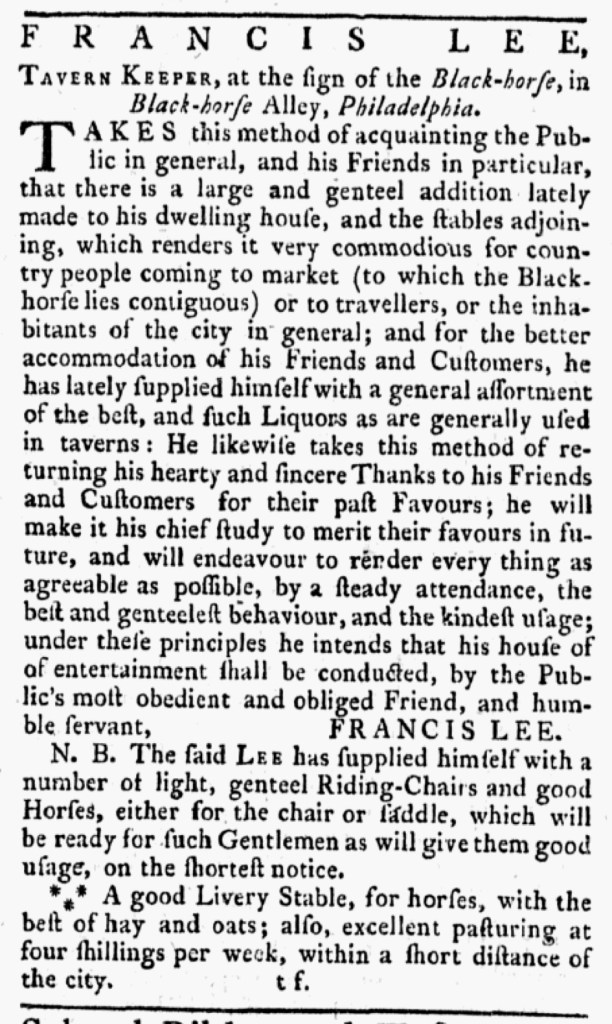
“Genteel Riding-Chairs … ready for Gentlemen as will give them good usage, on the shortest notice.”
In the fall of 1775, Francis Lee operated a tavern “at the sign of the Black-horse, in Black-horse Alley, Philadelphia.” In an advertisement in the September 30 edition of the Pennsylvania Ledger, he advised readers about a “large and genteel addition lately made to his dwelling house, and the stables adjoining, which renders it very commodious for country people coming to market.” His tavern was conveniently located “contiguous” to the market. In addition to those prospective patrons, Lee also wanted travelers and “the inhabitants of this city in general” to know about the improvements he made at his tavern. He also promoted his “general assortment of the best, and such Liquors as are generally used in taverns.” That was all part of providing a pleasant and enjoyable experience for his guests.
Lee also provided other services for the convenience of his “Friends and Customers.” They included a “good Livery Stable, for horses, with the best of hay and oats” or pasturing by the week, just outside the city, for those staying for a length of time. He also made a point of highlighting the “genteel Riding-Chairs and good Horses, either for the chair or saddle” that he made available “on the shortest notice.” In other words, Lee offered an eighteenth-century version of car rentals. His customers could borrow a horse to ride (the reference to “saddle”) or a horse and fashionable carriage (the “genteel Riding-Chairs”) to transport them to their destination. Travelers who arrived in Philadelphia on foot, via stagecoach, or on a ship could avail themselves of this service for getting around the city.
The tavernkeeper may have been especially interested in attracting the attention of visitors in the city to attend the Second Continental Congress. With delegates from throughout the colonies converging on Philadelphia, Lee likely hoped that some of them would visit his “house of entertainment” to enjoy the “best and genteelest behaviour, and the kindest usage” from their host while they enjoyed the amenities of the establishment. Lee pledged “to render every thing as agreeable as possible” for his customers. Why not continue discussions or just relax at Lee’s “commodious” tavern after a busy day of meetings to discuss the imperial crisis that had become a war?
