February 2

What was advertised in a revolutionary American newspaper 250 years ago today?
Essex Journal (February 2, 1776).

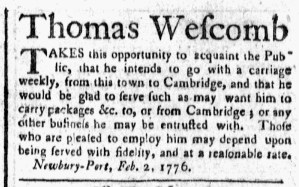
“He intends to go with a carriage weekly, from this town to Cambridge.”

When Thomas Wescomb of Newburyport, Massachusetts, launched a new enterprise, he placed an advertisement in the February 2, 1776, edition of the Essex Journal to promote it to prospective customers.  He described his notice as an “opportunity to acquaint the Public, that he intends to go with a carriage, weekly, from this town to Cambridge.”  Presumably he took passengers, but he did not provide the rates he charged, describe any of the amenities they could expect, or give further details about the schedule.  Other entrepreneurs who advertised carriage or stagecoach service between towns frequently included that kind of information to entice customers.  Just a few days earlier, for instance, John Mercereau ran an advertisement for the “New STAGE COACHES, THAT constantly ply between New-York and Philadelphia” in the January 29 edition of the New-York-Gazette and Weekly Mercury.  It included a schedule and prices per passenger “in the Coach” and “out” on seats exposed to the weather.  He also advised that a second service, called “The Flying Machine” for its speed, “Still continues … from Powles-Hook Ferry, opposite New-York, and from the Sign of the Cross-Keys in Philadelphia.”  Mercereau had years of experience operating and advertising his stagecoaches, with advertisements going back as far as 1769.

While Wescomb’s advertisement was not as elaborate or sophisticated, he did pitch other services that he offered, declaring that he “would be glad to serve such as may want him to carry packages” and other items “to, or from Cambridge; or any other business he may be entrusted with.”  Notably, Wescomb’s route terminated at Cambridge, not Boston.  The Continental Army’s siege of Boston continued, making Cambridge a more significant site than it had been before the Revolutionary War began.  Samuel Hall and Ebenezer Hall relocated the Essex Gazette from Salem to Cambridge and renamed it the New-England Chronicle.  George Washington, appointed commander-in-chief of the Continental Army by the Second Continental Congress, had his headquarters in Cambridge.  Readers of the Essex Journal in Newburyport and other nearby towns likely had a variety of reasons to visit Cambridge or to send packages to officers, soldiers, and others in that town.  Wescomb pledged his “fidelity” in delivering those packages or undertaking any other business assigned to him in his efforts to drum up business for his new venture.
June 17

What was advertised in a colonial American newspaper 250 years ago today?

South-Carolina and American General Gazette (June 17, 1774).

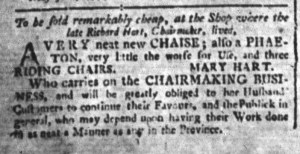
“MARY HART … will be greatly obliged to her Husband’s Customers to continue their Favours.”

When she took to the pages of the South-Carolina and American General Gazette in the summer of 1774, Mary Hart advertised several wheeled vehicles for sale “remarkably cheap, at the Shop where the late Richard Hart, Chairmaker, lived” in Charleston.  Her inventory included a “VERY neat new CHAISE,” described by the Oxford English Dictionaryas a “light open carriage for one or two persons, often having a top,” and a “PHAETON, very little the worse for Use,” described as a “light four-wheeled open carriage, usually drawn by a pair of horse, and having one or two seats facing forward.”  Like the modern automobile industry, Hart marketed both new and used vehicles.  She also had three “RIDING CHAIRS,” which public historians at George Washington’s Mount Vernon describe as a “wooden chair on a cart with two wheels … pulled by single horse.”  They explain that riding chairs “could travel country lanes and back roads more easily than bulkier four-wheeled chariots and coaches.”  Hart offered different kinds of wheeled vehicles to suit the needs, tastes, and budgets of her customers.

The widow did not merely seek to sell carriages previously produced by her late husband.  Instead, she announced that she “carries on the CHAIRMAKING BUSINESS.”  Eighteenth-century readers understood that she referred to making wheeled vehicles, not household furniture.  Her husband had cultivated a clientele for the family business, one that Hart wished to maintain and even expand.  She declared that she “will be greatly obliged to her Husband’s Customers to continue their Favours, and the Publick in general, who may depend upon having their Work done in as neat a Manner as any in the Province.”  Did Hart construct carriages herself?  Perhaps, though if that was the case it demonstrated what was possible rather than what was probable.  In a dissertation on “Women Shopkeepers, Tavernkeepers, and Artisans in Colonial Philadelphia,” Frances May Manges demonstrated that female entrepreneurs worked in a variety of trades.[1]  Hart may have worked alongside her husband before his death and then continued.  Rather than building carriages, she may have supervised employees in the workshop, running other aspects of the business both before and after her husband’s passing.  Either way, she confidently asserted that a workshop headed by a woman produced carriages equal in quality to any others made in the colony.  Out of necessity, Hart joined the ranks of widows who continued operating family businesses in colonial America.

**********

[1] Frances May Manges, “Women Shopkeepers, Tavernkeepers, and Artisans in Colonia Philadelphia” (Ph.D. diss., University of Pennsylvania, 1958).

April 14

GUEST CURATOR:  Clare Teskey

What was advertised in a colonial American newspaper 250 years ago today?

Maryland Gazette (April 14, 1774).

“A neat post coach.”

John King’s advertisement for this “coach” first interested me because, according to Ron Vineyard at Colonial Williamsburg, coaches were bought mainly by the gentry (or upper class) in eighteenth-century America. Upon further consideration, however, I noticed that this was an advertisement for a “post coach,” which confused me, as I thought that only the postal system would have use for “post coaches.” Most people rode horses or travelled by foot at this time, but those who had the luxury of owning a coach could decide between different kinds of coaches. In “Wheeled Carriages in Eighteenth-Century Virginia,” Mary Goodwin identified “plain,” “neat ornamented,” “town,” “travelling,” and “elegant crane neck” coaches among the variety of coaches that buyers could choose from, as well as “post coaches.” Depending on the size and price of the coach, buyers had certain preferences about the coach they would purchase. While “post coaches” were typically used by the postal system for the distribution of mail in the colonies, they could also be bought by private owners, who may have enjoyed the style, price, and other features of the vehicles.

**********

ADDITIONAL COMMENTARY:  Carl Robert Keyes

John King sought to sell a used post coach.  In his advertisement in the April 14, 1774, edition of the Maryland Gazette, he noted that the wheels “are as good as new, and the carriage in good order, having been through a thorough repair last year,” assuring prospective customers that even though the carriage was used it was in good order.  He also had a “genteel phaeton” for sale at his stables in Annapolis, that carriage also presumably used.

In selling secondhand carriages, King competed with Pryse and Parker, “COACH and COACH HARNESSMAKERS from London,” and the new carriages they built according to the instructions they received then customers placed orders.  In the same issue that carried King’s advertisement, Pryse and Parker once again inserted their notice to inform the public that they acquired “the best materials for the coachmaking business, which they now carry on, in all its various branches.”  Colonizers in the market for a coach had the option, if they wished, to order a new one made to their specifications, one that matched the latest styles in London and port cities in the colonies.

Yet new coaches were more expensive than secondhand coaches, not unlike new and used cars today.  Consumers made decisions that took into account price, quality, fashion, and prestige.  The eighteenth-century marketplace for carriages anticipated some of the common practices of the modern automobile industry, especially when it came to used carriages.  For instance, Adino Paddock, a coachmaker in Boston, advertised that he “will take second hand Chaises in part Pay for new,” a version of trading in a new vehicle to reduce the cost of a new one.  He also offered for sale a “very good second-hand Coach, Curricule, and several Chaises, some almost new.”  Paddock operated a precursor to a used car lot, making bargains available to those who chose not to invest in new carriages.  With a “neat post coach” and a “genteel phaeton” for sale at his stables, King adopted a similar business model.

April 7

What was advertised in a colonial American newspaper 250 years ago this week?

Pennsylvania Journal (April 4, 1771).

“Spencer has already given convincing proofs of his abilities.”

In the spring of 1771, Brent Spencer, a “Coach & Coach Harness MAKER,” opened a new shop on Lombard Street in Philadelphia.  In an advertisement in the April 4 edition of the Pennsylvania Gazette, he noted that he drew on his experience “in all the branches of Coach, Chariot, Phaeton, and Chaise making” gained in London and Dublin.  Like many other artisans who migrated across the Atlantic, he intended that prospective customers would associate his time in those cities with superior skill and training.

That was one way of attempting to establish a reputation in a new place, but Spencer did not ask consumers merely to take his word.  Instead, he declared that he already had work on display in the local marketplace.  Spencer asserted that he had “already given convincing proofs of his abilities, in executing some of the principal Carriages now running in this city and province.”  He did not name his clients, but he did suggest that some of the most prominent residents of Philadelphia and its environs previously hired him.  Anyone who had admired or otherwise taken note of carriages already traversing the streets of the busy port city, Spencer suggested, had likely seen some that he constructed.

Given that he already cultivated a clientele among the better sorts, Spencer gave their peers and those who aspired to their ranks an opportunity to acquire one of his carriages.  Immediately following his comment about making “some of the principal Carriages” in the city, he noted that he “has now for sale a coach body and a waggon body, both of new construction.”  Prospective customers did not need to settle for secondhand carriages that may have previously belonged to friends or acquaintances, not when Spencer could outfit them with carriages that observers would recognize as new.

Spencer concluded his advertisement with assurances about customer service and low prices, two more reasons for consumers to purchase coaches from him.  In a short advertisement, he established his experience working in two of the largest cities in the empire, suggested that readers already glimpsed his carriages on the streets of Philadelphia, and promoted new carriages available at his shop.  Even for the most affluent colonists, purchasing a carriage was a major investment.  Spencer offered many reasons to choose his workshop over others in the city or imported alternatives.

February 26

GUEST CURATOR: Samuel Birney

What was advertised in a colonial American newspaper 250 years ago today?

feb-26-2261767-massachusetts-gazette
Massachusetts Gazette (February 26, 1767).

“TO BE SOLD A standing Top-Chaise … and a very neat Sulkey.”

The advertisement featured today offered two types of carriages, “A standing Top-Chaise” and “a very neat Sulkey.” As the colonies expanded and populations grew, carriages became an important means of travel within cities and between colonies. Colonists made, bought, and used a variety of carriages, also commonly referred to as chairs, chaises, chariots, gigs, whiskeys, and sulkies.

According to Mary R.M. Goodwin, a chaise, which was interchangeable with the term chair, was a “light open carriage for one or two persons, often having a top or calash; those with four wheelers resembling a phaeton, those with two the curricle; also loosely used for pleasure carts and light carriages generally.” Goodwin consulted William Felton’s Treatise on Carriages, published in London in 1796, to describe sulkies. Sulkies were single seated “small, light four-wheeled vehicle, ‘built exactly in the form of a Post-chaise, Chariot, or Demi-Landau.’” Although some accounts referred to them as two-wheelers, the defining feature of the sulkey was its single person carrying capacity, basically making it a private and personal means of transportation. (For more information about the different kinds of carriages Goodwin mentions, see “Wheeled Carriages in Eighteenth-Century Virginia.”)

Carriages were either privately owned by the wealthy who could afford to purchase either locally built or imported carriages. By the 1760s, sometimes they were operated by local companies that charged for transportation.

**********

ADDITIONAL COMMENTARY: Carl Robert Keyes

As Sam indicates, affluent colonists imported carriages of all sorts from England, but by the 1760s coachmakers set up shops and advertised their wares in the largest American cities, sometimes noting that they consulted imported pattern books in order to produce carriages of the same style and quality as those available in London and other English cities. For instance, just a few days after today’s featured advertisement appeared in the Massachusetts Gazette, Hawes and Company, “Coach-makers,” inserted a lengthy notice about their services in the Supplement to the South-Carolina Gazette.

Today’s advertisement does not indicate the place of production for any of the conveyances it offered, but it does reveal a significant aspect of the marketplace in the revolutionary era. Just as many colonists acquired secondhand clothing and other goods, a market for used carriages emerged. The previous summer Adino Paddock, who followed “the Coach and Chaise-making Business” at a shop in Boston, advertised that he “always [had] a Number of second-hand Chaises to dispose of, very cheap.” Similarly, Hawes and Company’s advertisement noted that in addition to new carriages they also sold “on the most reasonable Terms, TWO second hand POST-CHAISES, a FAMILY COACH, and several CHAIRS.” Consumers who could not afford new carriages could discover a bargain when considering used ones instead.

The anonymous seller of “a very neat Sulkey” and a “standing Top-Chaise” may have found that maintaining these carriages was no longer practical or affordable. Alternately, the seller may have been in the process of acquiring a new – perhaps more impressive or fashionable – carriage and hoped to apply the proceeds from the sale of the chaise and sulkey to the purchase. If that was the case, the seller presumably was not dealing with Paddock, who pledged that he “will take old Chaises as Part of Pay for new.” These examples reveal that the marketing and financing of cars in twentieth and early twenty-first century resemble techniques launched by coachmakers in the eighteenth century.


June 5

What was advertised in a colonial newspaper 250 years ago today?

Jun 5 - 6:5:1766 Pennsylvania Journal
Pennsylvania Journal (June 5, 1766).

“A handsome English made Phaeton, two Curricles in good order, two Chairs &c.”

William Tod, “Coach-Maker from London,” sold several kinds of wheeled conveyances, including carriages, chairs, curricles, and phaetons, to Philadelphia’s elite. Only the affluent could afford to purchase a coach, maintain the horses to pull it, and pay servants with specialized skills to drive the coach and care for the horses. When Tod spoke of “Gentlemans carriages” he was not extending a courtesy title to all possible customers regardless of their status; instead, he knew that his potential customers possessed wealth and renown in the colony.

Even though only a fraction of the readers of the Pennsylvania Journal could afford to purchase some sort of coach, they chose from a broad array of options to suit their tastes and budgets. According to Colonial Williamsburg, more than a dozen varieties of wheeled carriages traveled the streets of Virginia in the eighteenth-century: berlins, calishes, chairs, chaises, chariots, coaches, coaches, curricles, gigs, landaus, landaulets, phaetons, post-chaises, post-chariots, sociable, stage wagons, sulkies, and whiskies. Elite residents of Philadelphia likely purchased a similar array of coaches.

Among those advertised by Tod, a curricle was a light two-wheeled carriage usually drawn by two horses and a phaeton was a four-wheeled open carriage of light construction, with one or two seats facing forward, usually drawn by a pair of horses. Chair and chaise could be used interchangeably with each other and often with a variety of other types of carriages. In offering these definitions in “Wheeled Carriages in Eighteenth-Century Virginia,” Mary R.M. Godwin notes that these definitions come from the Oxford English Dictionary. During the eighteenth-century, however, colonists sometimes differed on the exact specifications that distinguished one sort of coach from another. Variety and innovation meant that names and descriptions had some fluidity. Much as modern consumers customize cars when they purchase them, colonial consumers could work with coachmakers like Tod to design carriages that suited their needs and desires.