September 2

What was advertised in a revolutionary American newspaper 250 years ago today?

Constitutional Gazette (September 2, 1775).

“A collection of the most elegant swords ever before made in America.”

John Anderson’s call for advertisers to insert notices in the Constitutional Gazette yielded more results.  He touted the circulation of his new newspaper in the August 23, 1775, edition, asserting that the “Public will easily perceive the advantage of advertising in the Constitutional Gazette.”  Three days later, Abraham Delanoy ran an advertisement for pickled lobsters and fried oysters, adorning it with the woodcut depicting a lobster trap and an oyster cage that accompanied his advertisements in other newspapers.  Like printers of other newspapers, Anderson also inserted several advertisements that promoted the goods and services available at his printing office.

For the September 2 edition, other advertisers submitted notices.  Roger Haddock and William Malcolm described the contents of a chest stolen from onboard the Thistle on August 30 and offered a reward for apprehending the thief and returning the missing items.  Peter Garson and Caleb Hall advertised a house and land at “Peek’s-Kill, on the post-road, within three quarters of a mile of a convenient landing” that they considered “suitable for a merchant, trader, or mechanick.”  In collaboration with Mrs. Joyce and other local printers, Anderson once again hawked “JOYCE’s Grand American Balsam,” a patent medicine that alleviated a variety of disorders.  He also continued advertising a pamphlet, “Self defensive WAR lawful.”

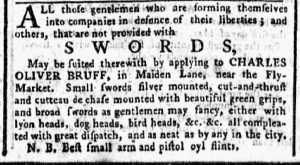
In addition, Charles Oliver Bruff, a goldsmith and jeweler with experience advertising in other newspapers, placed an advertisement for “SWORDS.”  Although Delanoy republished copy from his previous advertisements, Bruff generated new copy for his advertisement in the Constitutional Gazette.  “Those Gentlemen who are forming themselves into Companies in Defence of their LIBERTIES,” he proclaimed, “that are not provided with SWORDS, May be suited therewith by applying to Charles Oliver Bruff.”  Such an appeal kept with the tone of Anderson’s Constitutional Gazette.  Bruff presented several options for the pommel, including William Pitt’s head with the motto “Magna Charta and Freedom” and John Wilkes’s head and the motto “Wilkes and Liberty.”  Both men had been vocal advocates of American rights in Britain.  Bruff was not the first advertiser in the colonies to honor Pitt and Wilkes with commemorative items.  The goldsmith and jeweler declared that he stocked “the most elegant swords ever made in America, all manufactured by said BRUFF.”  His advertisement fit the times now that hostilities had commenced in Massachusetts and George Washington took command of the Continental Army laying siege to Boston.  As Anderson sought to expand advertising in the Constitutional Gazette, Bruff’s advertisement for swords addressed to gentlemen defending “their LIBERTIES” complemented his own advertisement for John Carmichael’s sermon, “Self defensive WAR lawful.”

May 29

What was advertised in a revolutionary American newspaper 250 years ago today?

New-York Gazette and Weekly Mercury (May 29, 1775).

“Small swords silver mounted … and broad swords as gentlemen may fancy.”

Charles Oliver Bruff, a goldsmith and jeweler who kept a shop at the “sign of the tea-pot, tankard, and ear-ring,” placed a familiar advertisement in the May 29, 1775, edition of the New-York Gazette and Weekly Mercury.  By then it had appeared several times, likely drawing the attention of readers because a woodcut depicting several items made by Bruff adorned the advertisement.  It showed a looking class, a ring, a buckle, and an earning.  It also featured a coat of arms, a sample of the “arms, crests, cyphers, heads and fancies” that he engraved.  The goldsmith and jeweler also declared that he ornamented his wares with “emblems of liberty” for customers who wished to make political statements with their rings, brooches, and other accessories.

New-York Gazette and Weekly Mercury (May 29, 1775).

In the wake of current events, including the battles at Lexington and Concord and the ongoing siege of Boston, Bruff decided to insert a second advertisement in the New-York Gazette and Weekly Mercury.  He placed it for the purpose of promoting “SWORDS” to “ALL those gentlemen who are forming themselves into companies in defence of their liberties.”  He offered “[s]mall swords silver mounted, cut-and thrust and cutteau de chase mounted with beautiful green grips, and broad swords as gentlemen may fancy,” decorating them with “lyon heads, dogs heads, bird heads,” and other figures.  Bruff encouraged his genteel clients to contemplate how they could be fashionable as they mobilized in support of the American cause.  The latest news out of Massachusetts presented a marketing opportunity for the goldsmith and jeweler.  Kate Haulman has documented how military service during the Revolutionary War allowed men, especially officers, to embrace sartorial splendors.[1]  Yet those in uniform were not alone in embracing what Haulman terms “the military mode, where fashion and politics merged.”[2]  The purveyors of garments, textiles, and accoutrements, including tailors, shopkeepers, and jewelers, welcomed such business at a time that demonstrating patriotism otherwise called for abstaining from consumption so often considered luxurious and unnecessary.  Bruff saw a new avenue for attracting clients and adjusting his marketing efforts accordingly.

**********

[1] Kate Haulman, “Fashion and the Culture Wars of Revolutionary Philadelphia,” William and Mary Quarterly, 3rd ser., 62, no. 4 (October 2005), 644-49.

[2] Haulman, “Fashion and the Culture Wars,” 644.

January 8

What was advertised in a colonial American newspaper 250 years ago this week?

New-York Gazette and Weekly Mercury (January 6, 1772).

“Will sell them cheaper than any in the city.”

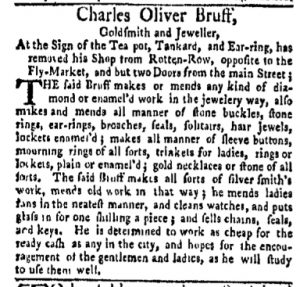
Charles Oliver Bruff, a goldsmith and jeweler, operated a shop at “the Sign of the Tea-pot, Tankard, and Ear-ring” on Maiden Lane in New York in the early 1770s.  He regularly placed newspaper notices to advise prospective clients of his services.  In the January 6, 1772, edition of the New-York Gazette and Weekly Mercury, for instance, he declared that he “makes or mends any kind of diamond or enamel’d work in the jewellery way” and “makes all sorts of silversmiths work, and mends old work.”  In addition, he mended “ladies fans in the neatest manner and at the lowest price” and sold rings, lockets, “hair jewels,” and a variety of other jewelry.

Bruff sought to draw attention to two other aspects of his business.  He informed readers that he had “just finished some of the neatest dies for making sleeve buttons, with the neatest gold cuts to them to stamp all sorts of gold buttons, silver, pinchbeck, or brass.”  Colonizers who desired such distinctive buttons could acquire them from Bruff … and at bargain prices.  He pledged to “sell them cheaper than any in the city.”  In addition to buttons, Bruff also highlighted his interest in working with “gentlemen merchants that travel the country, or pedlars,” anticipating that they would purchase in quantity for resale.  The goldsmith asserted that peddlers “may depend on being used well.”  That included maintaining good relationships as well as offering low prices.  Bruff confided that for such customers he would “make any kind of work cheaper than they can get it in the city elsewhere.”

Whether hawking buttons, cultivating relationships with retailers, or mending fans for fashionable ladies, Bruff deployed superlatives to compare his prices to those of his competitors in the bustling port city.  He did not merely declare that he offered comparable low prices; instead, he claimed that he undersold other goldsmiths and jewelers in New York, hoping that this strategy would bring customers into his shop.

April 27

What was advertised in a colonial American newspaper 250 years ago today?

Apr 27 - 4:27:1767 New-York Mercury
New-York Mercury (April 27, 1767).

“I will work for the following prices.”

Charles Oliver Bruff, “Gold-smith and Jeweler,” was in a price war with “three different Silver-smiths” in New York. Bruff frequently advertised in the New-York Mercury, but he departed from his usual description of his merchandise and promises to provide good service to “the Gentlemen and Ladies of this city and country” to address a problem created by some of his competitors. He accused those “three different Silver-smiths” of undervaluing his work, making it seem as though he charged unreasonable prices.

To protect his reputation and avoid losing more business to his unscrupulous competitors, Bruff went to the rather extraordinary measure of listing his prices for the entire community to see, assess for themselves, and compare to the rates charged by other “Gentlemen of the trade.” He specified nine prices, including “For making a silver tankard, 3s. per ounce,” and “For making a soop-spoon, 20s.”

Bruff may not have been the innocent victim that he tried to portray himself. His initial prices may have been inflated, but he could not admit to that in his advertisement. Instead, he offered an alternate narrative that depicted his competitors as lacking in sound judgment when it came to assessing the quality of his work and the value of products in their trade more generally. At the same time, he lowered his own prices, seemingly forced to do so in order to continue to attract clients. As a result, new customers would receive quite a bargain since Bruff did not wish to “hurt myself for others” by charging full value for his workmanship only to be undercut by competitors. He concluded his advertisement by stating definitively that he would “work as cheap as any in this city.” Even if Bruff had overcharged in the past, intentionally or not, potential patrons need not worry about that happening if they now chose to deal with him.

March 4

GUEST CURATOR:  Trevor Delp

What was advertised in a colonial newspaper 250 years ago this week?

Mar 4 - 3:3:1766 New-York Mercury
New-York Mercury (March 3, 1766).

“Making or mending any Kind of Diamond or enameled Work.”

Charles Oliver Bruff’s advertisement offers a wide variety of popular jewelry to be made and mended. Jewelry made between 1714 and 1847 comes from the Georgian Era. It is important to note that jewelry was not made the same way it is today. According to the International Gem Society, the process was far more labor-intensive. Gold and metal ingots needed to be rolled into thin sheets before they could be formed into the popular styles of the time.

Bruff chose to market a variety of popular merchandise, but one that is specifically interesting is pinchbeck buckles. Pinchbeck was a material commonly used that looks like gold but is much more affordable. Oliver’s choice to advertise this along with more expensive jewelry is interesting because it shows that he was trying to appeal to people of many different economic backgrounds. Jewelry was primarily a luxury of the elite society, but Oliver’s advertisement alludes to the inclusion of customers from other economic statuses.

**********

ADDITIONAL COMMENTARY:  Carl Robert Keyes

Of all the possible items in Bruff’s advertisement that Trevor chose to investigate, he selected pinchbeck buckles. That, in turn, led me to a fascinating discovery when I clicked the hyperlink to a dictionary definition of “pinchbeck” that he included to accompany his commentary for today. The first entry refers explicitly to “the Jewellery Way” (as Bruff put it): “an alloy of copper and zinc used especially to imitate gold in jewelry.”

A second entry, however, indicates that “pinchbeck” could also mean “something counterfeit or spurious.” It seems unlikely that Bruff intended to suggest that his buckles should be considered inferior in any way, but colonial consumers would have known that pinchbeck buckles were made of something other than gold (especially since Bruff promised to sell them “cheap by the dozen”).

A variety of scholars – including those who study consumer culture, material culture, manners, and reputation – have argued that assessing the dress and comportment of others became a cultural preoccupation in the eighteenth century. Especially as greater numbers of people of diverse statuses possessed an increasing array of goods as the consumer revolution progressed, colonists attempted to distinguish the truly genteel from those who merely simulated gentility. Colonists carefully observed each other to see if inner character matched an individual’s outward appearance.

In that context, pinchbeck buckles potentially presented a bit of a conundrum. What did it say about someone who wore accoutrements that looked like gold all while knowing that the appearance of the more costly metal misrepresented the true nature of the alloy that was actually used? Could that be interpreted as a reflection on one’s own character? Social mobility was fraught with such dilemmas in the eighteenth century.