What was advertised in a colonial American newspaper 250 years ago today?
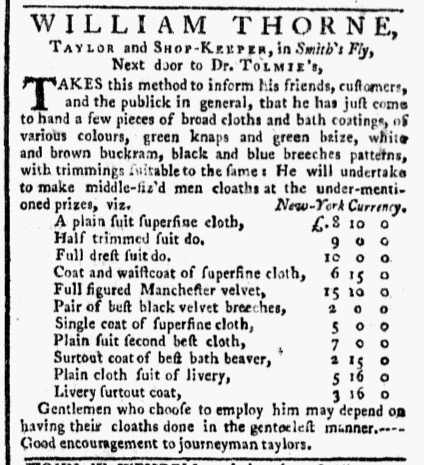
“He will undertake to make middle-siz’d men cloaths at the under-mentioned prices.”
William Thorne, a tailor, took to the pages of the New-York Gazette and Weekly Mercury to advertise his services in late December 1774. He began his notice with an announcement that he had recently acquired various textiles, trimmings, and patterns, though he devoted half of the space to a list of prices that he charged for “middle-siz’d men cloaths.” Presumably he adjusted the prices accordingly depending on whether a client was tall or short or stout. The “middle-siz’d” prices at least gave prospective customers an estimate of what they could expect to pay for an array of garments.
For instance, a ”Full figured Manchester velvet,” the most genteel item on the list, cost fifteen pounds and ten shillings “New-York Currency.” For some items, the list revealed a progression of prices. A “plain suit [made of] superfine cloth” cost eight pounds and ten shillings, a “Half trimmed suit” of the same material cost nine pounds, and a “Full drest suit,” also of the same material, cost ten pounds. Clients interested in just a “Coat and waistcoat of superfine cloth” paid only six pounds and fifteen shillings, with a “Single coat of superfine cloth” costing five pounds. For those of more modest means, a “Plain suit [made of] second best cloth” cost seven pounds. The prices for the “Half trimmed” and “Full drest” suits made of superfine cloth suggested the likely increase in price for such items made of “second best cloth.” Thorne also made other garments. A “Surtout coat” or overcoat “of best bath beaver” cost two pounds and fifteen shillings and a “Pair of best black velvet breeches” went for two pounds.
Tailors only occasionally listed prices in their advertisements. The list that Thorne published allowed “his friends, customers, and the publick in general” to do some comparison shopping without needing to visit his shop of contact him directly. Readers could determine for themselves how Thorne’s prices compared to what they paid their own tailors for similar garments, perhaps prompting them to recognize bargains that made Thorne’s services attractive to them.