December 5

What was advertised in a revolutionary American newspaper 250 years ago today?

New-Hampshire Gazette (December 5, 1775).

“Shopkeepers are cautioned, not to advance on their Goods, which is contrary to the Resolves of the Continental Congress.”

The December 5, 1775, edition of the New-Hampshire Gazette consisted of only two pages rather than the usual four.  That limited the amount of news and advertising that the printer, Daniel Fowle, could disseminate to readers, yet that issue carried good news that the “Printing Press is now again removed from Greenland to Portsmouth.”  Fowle had moved his press to Greenland, about six miles from Portsmouth, to protect it from an anticipated British attack on New Hampshire’s most important port.  In early December, he moved his press back to Portsmouth, “into an old Building adjoining the late Printing-Office … where it is hop’d the Types will remain undisturb’d, as this Harbour is so well fortified that any Enemy must pass thro’ a Hell of Fire, intermix’d with Brimstone, Pitch Tar, Turpentine, and almost every Sort of Combustible Matter to make the Passage dreadful.”

Yet enemies to the American cause did not approach Portsmouth solely by sea.  Some enemies resided in the port and nearby towns, undermining efforts to resist British tyranny through their actions in the marketplace rather than on the battlefield.  At the bottom of the last column on the last page, Fowle concluded that issue of the New-Hampshire Gazettewith a warning published “By desire” of a correspondent that “Shopkeepers are cautioned, not to advance on their Goods, which is contrary to the Resolves of the Continental Congress.”  The correspondent invoked the ninth article of the Continental Association, a nonimportant agreement devised by the First Continental Congress that went into effect on December 1, 1774.  That article stated that “such as are Venders of Goods or Merchandise will not take Advantage of the Scarcity of Goods that may be occasioned by this Association, but will sell the same at the Rates we have been respectively accustomed to do for twelve months past.”  Some shopkeepers in and near Portsmouth apparently considered charging an “Advance” (or markup) on their wares, prompting the patriotic correspondent to remind them of the Continental Association and the consequences they faced.  That would be their only warning because “if they do [raise prices], their Names will be return’d to the Congress ad publish’d, without further Notice.”  Once that happened, the ninth article specified that “if any Venders of Goods or Merchandise shall sell any such Goods on higher Terms … no Person ought, nor will any of us deal with any such Person … at any Time thereafter, for any Commodity whatever.”  That issue carried only two advertisements from local retailers, yet the address applied to all the shopkeepers in the vicinity.
August 16

What was advertised in a revolutionary American newspaper 250 years ago today?

Massachusetts Spy (August 16, 1775).

“An unwearied Pedlar of that baneful herb TEA.”

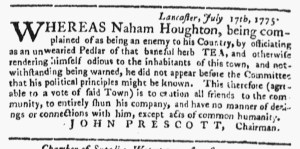
Naham Houghton of Lancaster, Massachusetts, went too far and there had to be consequences.  An advertisement in the August 16, 1775, edition of the Massachusetts Spy gave an abbreviated account of what occurred.  According to John Prescott, chairman of the local Committee of Inspection, there had been complaints that Houghton behaved as “enemy to his Country, by officiating as an unwearied Pedlar of that baneful herb TEA, and otherwise rendering himself odious to the inhabitants of this town.”  Prescott did not elaborate on the other infractions.  Selling tea was enough to get Houghton into hot water.

That violated the Continental Association, a nonimportation agreement devised by the First Continental Congress in response to the Coercive Acts imposed by Parliament in retribution for the Boston Tea Party.  The eleventh article outlined an enforcement mechanism, stating that a “Committee be chosen in every County, City, and Town” to monitor compliance with the pact.  When a majority determined that someone committed a violation, they would “cause the truth of the case to be published in the Gazette, to the End that all such foes to the rights of British America may be publickly known and universally condemned as Enemies.”  In turn, the rest of the community would “break off all Dealings with him, or her.”

The committee in Lancaster apparently sought to work with Houghton in seeking an explanation for his actions, but to no avail.  Prescott reported that Houghton refused to “appear before the Committee that his political principles might be known” even though he had been warned.  Neither the committee nor the town tolerated such defiance.  The town voted “to caution all friends to the community, to entirely shun his company,” as the Continental Association instructed, “and have no manner of dealings or connections with him, except acts of common humanity.”  Selling tea continued to resonate as a political act, yet it was only one of many offenses that made Houghton “odious” to his neighbors.  At the same time that others suspected of Tory sympathies confessed their errors and used newspaper advertisements to rehabilitate their reputations, Houghton steadfastly refused to bow to such pressure exerted by the Committee of Inspection.  He instead became the subject of an advertisement that made clear, far and wide, that he was not in good standing in his community.

May 11

What was advertised in a revolutionary American newspaper 250 years ago today?

Rivington’s New-York Gazetteer (May 11, 1775).

“Many Publications have appeared from my Press which have given great Offence to the Colonies.”

James Rivington seemed to change his tune about what he printed and sold at his printing office on Hanover Square in New York.  On April 20, the day after the battles at Lexington and Concord, the printer of Rivington’s New-York Gazetteer once again advertised “several pamphlets on the Whig and Tory side” of “THE AMERICAN CONTEST.”  Word of what had occurred in Massachusetts the previous day had not yet arrived in New York, but Rivington had other news concerning the imperial crisis to report.  That included residents of New Brunswick, New Jersey, hanging “an effigy, representing the person of Mr. Rivington … merely for acting consistent with his profession as a free printer.”  A rare woodcut depicting the scene accompanied the combination article and editorial about his “OPEN and UNINFLUENCED PRESS.”

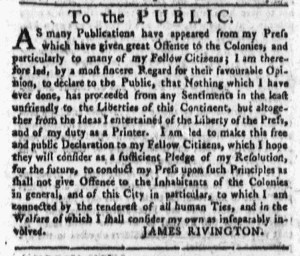
A week later, Rivington’s New-York Gazetteer carried news of Lexington and Concord.  The printer chose not to insert his advertisement hawking pamphlets representing both Whig and Tory perspectives in that issue.  In the next issue, two weeks after the battles in Massachusetts, Rivington ran a new advertisement, one that took a different tone than his coverage of the effigy.  “AS many Publications have appeared from Press which have given great Offence to the Colonies, and particularly to many of my Fellow Citizens,” the printer declared, “I am therefore led, be a most sincere Regard for their favourable Opinion, to declare to the Public, that Nothing which I have ever done, has proceeded from any Sentiments in the least unfriendly to the Liberties of this Continent, but altogether from the Ideas I entertained of the Liberty of the Press, and of my duty as a Printer.”  That being the case, “I am led to make this free and public Declaration to my Fellow Citizens, which I hope they will consider as a sufficient Pledge of my Resolution, for the future, to conduct my Press upon such Principles as shall not give Offence to the Inhabitants of the Colonies in general, and of this City in particular, to which I am connected by the tenderest of all human Ties, and in the Welfare of which I shall consider my own as inseparably involved.”  Rivington stopped short of offering an apology or stating that he regretted printing and selling newspapers and pamphlets that advanced Tory views, but he did take a less defiant tone in his effort to explain his editorial decisions.  He suggested that he would adopt a new approach, though he did not go into detail about that.  Perhaps he hoped that critics would notice that he did not advertise the problematic pamphlets.  Even if they did not, Rivington refrained from publishing an advertisement that ran counter to the message he delivered in his notice clarifying his prior actions.

That notice appeared in three consecutive issues of Rivington’s New-York Gazetteer, none of which carried advertisements for political pamphlets.  The events unfolding in Massachusetts may have encouraged the printer to take greater caution, though the masthead of his newspaper continued to proclaim that he operated an “OPEN and UNINFLUENCED PRESS.”  As far as the Sons of Liberty were concerned, however, the printer could not redeem himself.  On May 10, a week after Rivington first published his notice assuring the public that he would “conduct [his] Press upon such Principles as shall not give Offence to the Inhabitants of the Colonies,” the Sons of Liberty attacked his home and printing office.  Rivington fled to a British ship in the harbor.  Assistants maintained uninterrupted publication of the newspaper, continuing to run Rivington’s notice, while the printer petitioned the Second Continental Congress for pardon.  As Todd Andrlik documents, Rivington explained that “however wrong and mistaken he may have been in his opinions, he has always meant honestly and openly to do his duty.”  The Continental Congress forwarded the petition to the New York Provincial Congress.  Rivington received his pardon, but his reformation was not so complete as to avoid further notice from the Sons of Liberty.  In November 1775, Sons of Liberty from New Haven destroyed his press and reportedly melted down his types to make shot, bringing an end to Rivington’s New-York Gazetteer.