What was advertised in a colonial American newspaper 250 years ago today?
Essex Gazette (July 26, 1774).
“Public approbation … renders a pompous advertisement unnecessary.”
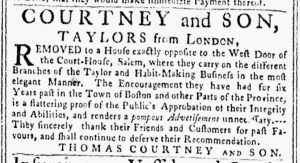
When Thomas Courtney and Son relocated from Boston to Salem, they ran in advertisement in the Essex Gazette to inform readers that they “carry on the different Branches of the Taylor and Habit-Making Business” at a shop near the courthouse. They described themselves as “from LONDON,” hoping that their origins gave them some cachet among prospective clients, yet also reported that they had followed their trade “for six Years past in the Town of Boston.”
Their experience there served as even more of a recommendation and evidence that prospective customers should give them a chance. The “Encouragement” they received for so many years, the tailors argued, “is a flattering proof of the Public’s Approbation of their Integrity and Abilities.” No tailoring shop could have lasted for so long without the “Encouragement” of satisfied customers who gave them return business or offered positive reviews to friends. Courtney and Son earned such a reputation that “renders a pompous Advertisement unnecessary.” With that critique of the elaborate appeals made by some of their competitors and other purveyors of goods and services, the tailors expressed gratitude to former customers and declared that they “shall continue to deserve their Recommendation.”
It was not the first time that Courtney and Son deployed that marketing strategy. Nine months earlier, they moved to a new location in Boston. On that occasion, they ran an advertisement in the Massachusetts Spy. Its copy was so similar, nearly identical, to their notice in the Essex Gazette that the tailors may have clipped it from the Massachusetts Spy and later from it. The two advertisements featured variations in capitalization, not uncommon when advertisers ran notices in more than one newspaper. In both, the phrase “pompous advertisement” appeared in italics. While this does not reveal the effectiveness of the advertisement, it does suggest that Courtney and Son believed that it met with a positive reception that merited republishing it rather than devising other sorts of appeals to prospective customers in their new town.
What was advertised in a colonial American newspaper 250 years ago today?
Massachusetts Spy (October 14, 1773).
“The encouragement they have had … renders a pompous advertisement unnecessary.”
Although they had operated a shop in Boston for quite some time, Thomas Courtney and Son continued to describe themselves as “TAYLORS, from LONDON,” when they advertised in the October 14, 1773, edition of the Massachusetts Spy. Like many tailors, milliners, and other artisans, they believed that associating themselves with the cosmopolitan center of the empire conferred a certain amount of cachet in the eyes of prospective customers. The tailors placed the notice to alert the public that they moved to a new location but continued to “carry on the different branches of the Taylor and Habit making business, in the truest and most elegant manner.”
Despite trumpeting their London origins in the headline of their advertisement, Courtney and Son asserted that they did not need to publish an extensive description of the quality of their work, the exceptional customer service they provided, or any of the other appeals that often appeared in notices placed by members of the garment trades. Their work spoke for itself, as demonstrated by the longevity of their business and the clientele they cultivated during their time in Boston. “The encouragement they have had for six years past in the town and province,” Courtney and Sons proclaimed, “is a flattering proof of the public approbation of their integrity and abilities.”
That being the case, the tailors considered “a pompous advertisement unnecessary.” On occasion, eighteenth-century advertisers promoted their goods and services by critiquing the kinds of marketing that appeared in the public prints. They suggested something unsavory in the manner that many of their competitors boasted of their abilities or told elaborate stories about their merchandise. Courtney and Son cast suspicion on the extravagant prose presented in many advertisements, implying that those advertisers oversold what they could deliver to customers. In the process, they attempted to enlist savvy consumers in expressing the same skepticism … and demonstrating that they could not be fooled with clever marketing by giving their business to Courtney and Son. After all, the tailors insisted, their reputation spoke for itself. Rather than publishing overzealous appeals to prospective customers, Courtney and Sons “sincerely thank[ed] their Friends and customers for past favours” and pledged to “continue to deserve their recommendation.” They considered their reputation essential in marketing their business.
What was advertised in a colonial American newspaper 250 years ago this week?
Massachusetts Gazette and Boston Weekly News-Letter (May 6, 1773).
“His Store is the cheapest after all is said and done, &c. &c. &c. &c.”
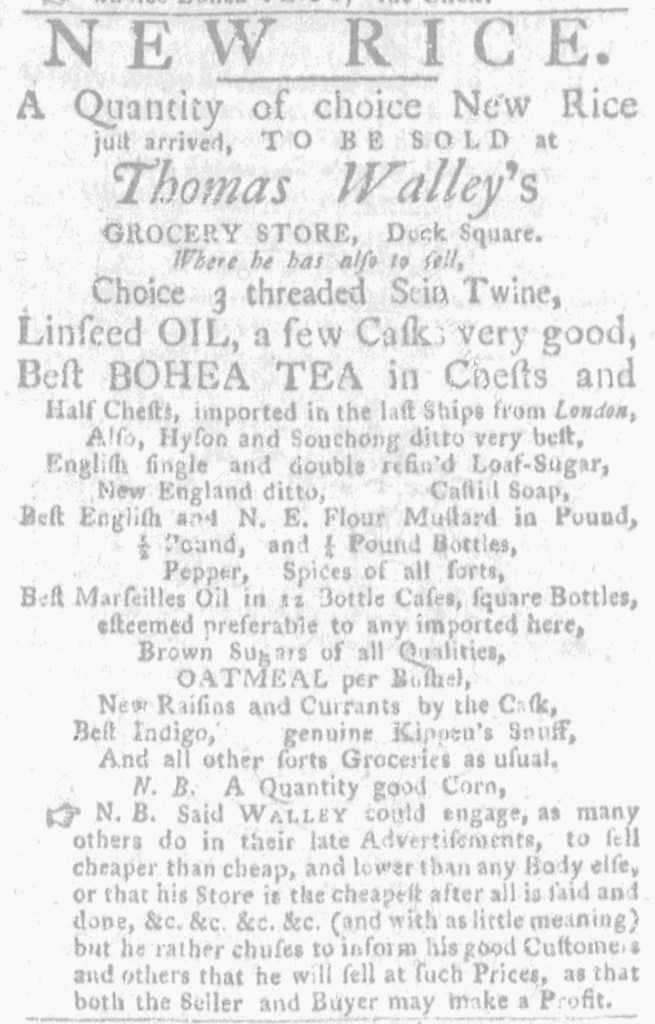
Thomas Walley stocked a variety of items at his “GROCERY STORE” on Dock Square in Boston in the spring of 1773. In an advertisement in the May 6 edition of the Massachusetts Gazette and Boston Weekly News-Letter, he listed many of those items, from “New Rice” to “BOHEA TEA” to “Flour Mustard” to “Brown Sugars of all Qualities.”
Walley concluded his advertisement with a lively nota bene that commented on the marketing strategies deployed in the city’s newspapers by various purveyors of goods. He stated that he “could engage, as others do in their late Advertisements, to sell cheaper than cheap, and lower than any Body else, or that his Store is the cheapest after all is said and done, &c. &c. &c. &c.” The string of “&c.” (which modern readers would recognize as “etc. etc. etc. etc.”) communicated his exasperation with advertisers who went on and on about the bargains that they made available to their customers. More bluntly, he declared that if he did the same that it would have “as little meaning,” something that he suspected both advertisers and savvy consumers realized. Instead of making bold claims about his prices to dazzle prospective customers, Walley considered simplicity and honesty the better means of cultivating relationships of trust. He “rather chuses to inform his good Customers and others that he will sell at such Prices, as that both the Seller and the Buyer may make a Profit.” In other words, both parties got a good deal.
Walley’s approach echoed the one taken by Samuel Flagg when he advertised imported goods available at his store in Salem several months earlier. Flagg proclaimed that he did not “mean to make such a Parade, not furnish the Publick with so many pompous Promises (as have lately been exhibited) of Goods being so amazingly cheap, but would rather convince them of the Cheapness of his Goods and of his Integrity in dealing, whenever they may please to call and favour him with their Custom.” When it came to engaging prospective customers with his advertisements, he did not wish to “tell them a Story” like in “so many flashy Advertisements as weekly present themselves.” Flagg asserted that such stories had no “true Meaning” … and readers knew that as well as he did.
Both Walley and Flagg saw critiquing advertising as the most effect means of marketing their wares. They flattered readers by suggesting that they all knew that other advertisers inflated their claim yet Walley and Flagg would not insult the intelligence of their prospective customers. Instead, they opted for honesty and integrity in presenting prices that worked to the advantage of both the shopkeepers and consumers.
What was advertised in a colonial American newspaper 250 years ago today?
Boston Evening-Post (June 1, 1772).
“He fears that some Folks would call it Puffing.”
Recently the Adverts 250 Projectfeatured Andrew Dexter’s advertisement to examine the type seemingly set in one printing office and transferred to others, but the copy merits attention as well. Dexter attempted to entice prospective customers into his shop with a notice that mocked and dismissed many of the most popular marketing strategies of the period.
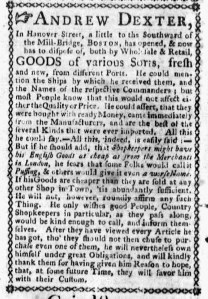
He began by stating that he sold ‘GOODS of various Sorts, fresh and new, from different Ports, but then refused to give details or elaborate. Many merchants and shopkeepers gave that information. Dexter critiqued the practice, proclaiming that he could mention the Ships by which he received them, and the Names of the respective Commanders; but most People know that this would not affect either the Quality or Price.”
Dexter then turned to other common elements of advertisements for imported goods. “He could assert, that they were bought with ready Money, came immediately from the Manufacturers, and are the best of the several Kinds that were ever imported.” Wanting it both ways, he implied that all of that was the case, but then called into question all of the advertisements that deployed such strategies. “All of this he could say.– All of this, indeed, is easily said.” He then leveled his most trenchant critique of a popular marketing strategy. “But if he should add, that Shopkeepers might have his English Goods as cheap as from the Merchants in London, he fears that some Folks would call it Puffing, & others would give it even a worse Name.”
He continued to imply that he offered bargain prices without stating that he did so. “If his Goods are cheaper than they are sold at any other Shop in Town, ‘tis abundantly sufficient. He will not, however, roundly affirm any such Thing.” Only after deriding the appeals made by his competitors in their advertisements did Dexter definitively present a reason for readers to visit his shop. “He only wishes good People, Country Shopkeepers in particular, as they pass along, would be kind enough to call, and inform themselves.” Figuring prospective customers engaged in comparison shopping, he acknowledged that they ultimately made decisions based on the information they gathered, no matter how much “Puffing” he included in his advertisements.
Ultimately, Dexter sought to build relationships with prospective customers, whether or not they bought anything the first time they visited his shop. “After they have viewed every Article he has got, tho’ they should not then chuse to purchase even one of them,” he confided, “he will nevertheless own himself under great Obligations, and will kindly thank them for having given him Reason to hope, that, at some future Time, they will favor him with their Custom.” Dexter prioritized prospective customers giving him the opportunity to serve them, now or in the future, over any of the usual appeals merchants and shopkeepers made about imported goods. To underscore his intention, he jeered at the claims made in other advertisements, though he never denied that they also applied to his own merchandise. He encouraged prospective customers to decide for themselves.
What was advertised in a colonial American newspaper 250 years ago this week?
Providence Gazette (February 28, 1767).
“A LARGE and general Assortment of English and India Goods.”
Today’s advertisement was more of an invitation for customers to peruse the goods being sold at “Benjamin & Edward Thurber’s Shops” as opposed to advertising the actual goods themselves. The advertisement offered a wide variety of imported goods from England, India, and the West Indies, all of which were being sold at low prices and could be purchased cheaply. Note that the advertisement offered goods from India which—while becoming a part of Colonial British rule—was on the other side of the world than the American colonies. Through further research I learned that the American colonists had a more significant economic relation to India than I had previously known.
Jonathan Eacott recently published a book about trade within the British Empire, specifically analyzing how India played a role in the economic development of both Britain and America. According to Thomas R. Metcalf’s review of the book, Eacott indicates that the British initially sought to use India to supply the American colonies with goods, such as spices and textiles, which the Americans might then cultivate themselves.[1] However, due to regional differences this endeavor failed. The English began to enjoy India goods themselves, while also exporting Indian goods to the colonies through the East India Company. When India textiles caused problems for the English at home they banned the importation of the goods in Britain, although the East India Company continued to monopolize the sale of Indian goods in the American colonies.
Americans began to associate the Indian goods with the East India Company, its influence in India, and the tyrannical British control over colonies. This did not, however, halt the importation of Indian luxury goods, which increased after the Revolution.
**********
ADDITIONAL COMMENTARY: Carl Robert Keyes
Sam makes an important observation in noting that this advertisement served as an invitation for prospective customers to visit the Thurbers’ shops and explore the merchandise on their own rather than listing any particular items for sale. Their notice could be divided into two parts, the first of which could run without the second and not look out of the ordinary. The first portion announced they had “JUST IMPORTED” a variety of goods and made some of the most common appeals – quality, choice, price. Indeed, price seemed particularly important to the Thurbers. They opened by stating that they sold their ware “Cheap” and concluded the first part of the advertisement by pronouncing that they offered “the very lowest Prices.”
The Thurbers then devoted the second (and lengthier) section to convincing potential customers that they did indeed sell their merchandise at low prices. Most eighteenth-century advertisers who made appeals to price quite simply inserted phrases about “reasonable rates” or “low prices.” Some elaborated by devoting a sentence or two to their prices. In presenting an entire paragraph to the cost of the goods they sold, however, the Thurbers provided an extraordinarily extensive discussion of their low prices.
They began by noting that they obtained their inventory “much cheaper” than at any time in the past, which in turn allowed them to sell their imported goods “lower than they ever yet sold.” They then made a old pronouncement that compared their prices to others in Providence and throughout the colonies: their prices, the Thurbers “dare presume to say,” were “as low as any Person in this or the neighbouring Towns, or in North-America.”
To underscore their ability to offer low prices, the Thurbers explained that they did not provide the list of goods so common in other eighteenth-century advertisements because they had they made only a “very moderate Profit” and to “enumerate each Particular in an Advertisement” would cancel their small gains as retailers. Joshua Blanchard, a shopkeeper in Boston, made a similar argument in the Massachusetts Gazette two months earlier, though he did not go into such extensive detail. The Thurbers’ objection to lengthy list advertisements raises additional questions about the oversized advertisements they previously published in the Providence Gazette, once again raising suspicions that the printer inserted such advertisements when lacking other content rather than advertisers themselves clamoring to pursue such an innovation.
The Thurbers concluded their advertisement by further extending invitations to potential customers to visit their shops. They even shifted away from the usual use of rather impersonal address, such as “the Public in general, and their former good Customers in particular,” to directly invite readers: “come and look for yourselves,” “you will be kindly and thankfully received,” and “they again invite you to come and trade with them,” and “whatever you want you will not be disappointed.” Low prices did not have to result in impersonal transactions.
**********
[1] Thomas R. Metcalf, review of Jonathan Eacott’s Selling Empire: India in the Making of Britain and America, 1600-1830, in Journal of Interdisciplinary History 47, no. 4 (Spring 2017): 579-580.