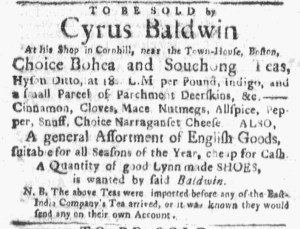
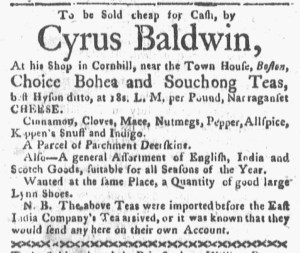
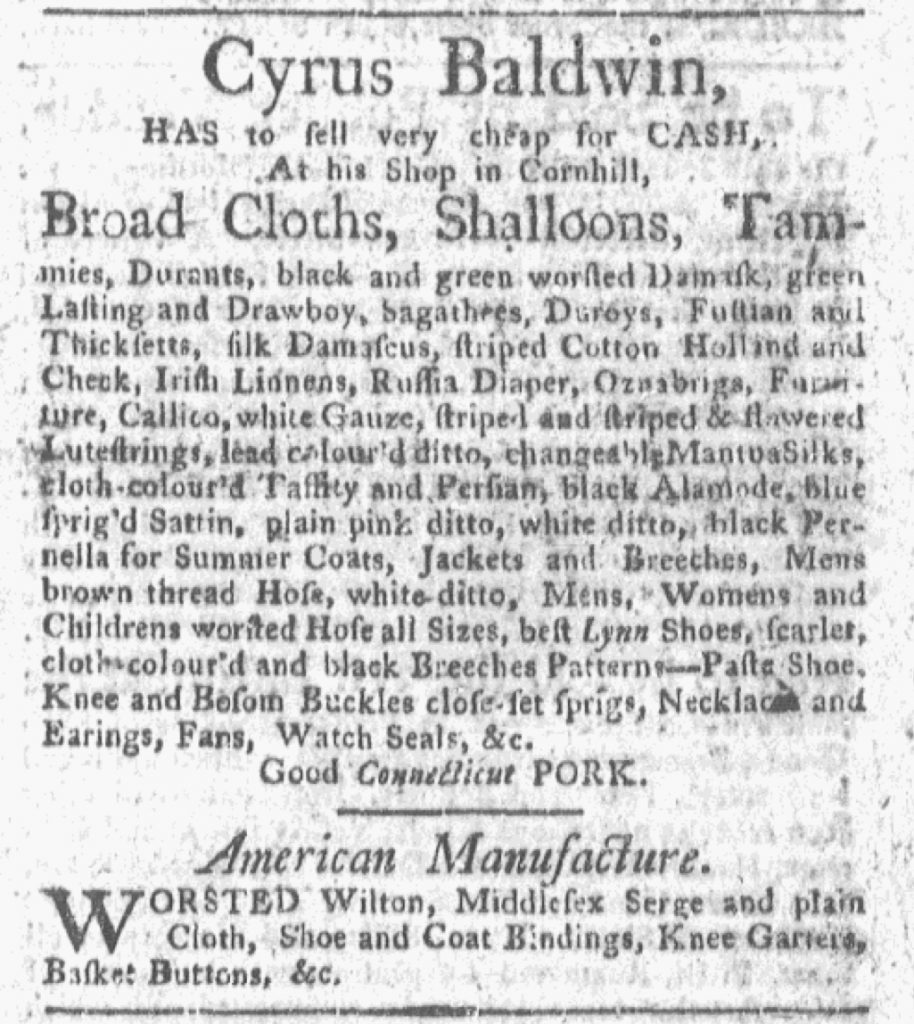
What was advertised in a colonial American newspaper 250 years ago today?
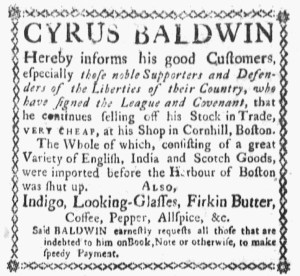
“Those noble Supporters and Defenders of the Liberties of their Country, who have signed the League and Covenant.”
The decorative border around Cyrus Baldwin’s advertisement in the January 16, 1775, edition of the Boston Evening-Postdrew attention to it … and the shopkeeper wanted the entire community to see what he had to say about the “great Variety of English, India and Scotch Goods” that he offered for sale “at his Shop in Cornhill, Boston.” It was a message not only for “his good Customers” but “especially those noble Supporters and Defenders of the Liberties of their Country, who have signed the League and Covenant.” Baldwin could have invoked the Continental Association that went into effect on December 1, 1774, but made an even stronger statement about fidelity to the American cause demonstrated by some of his customers.
As summer approached in 1774, the Boston Committee of Correspondence disseminated the Solemn League and Covenant, a nonimportation agreement drafted by Samuel Adams and Joseph Warren in response to the Boston Port Act. Colonizers in Boston and throughout Massachusetts debated the measure, some enthusiastically signing and others arguing that they should wait to engage in a coordinated effort that spanned the colonies. When the First Continental Congress met in Philadelphia in September and October, the delegates devised a nonimportation pact, the Continental Association, to achieve that unified response. Newspapers carried details in their coverage of the meetings, printers published and sold pamphlets that included the Continental Association along with other “EXTRACTS FROM THE VOTES AND PROCEEEDINGS OF THE AMERICAN CONTINENTAL CONGRESS,” some printers published broadside versions of the Continental Association for easy reference in homes and offices, and advertisements documented goods surrendered and sold under the conditions of the tenth article of the Continental Association.
Baldwin could have made an appeal to consumers who adhered to the Continental Association. Instead, he sought to associate his customers and his goods with the uncompromising spirit of the Solemn League and Covenant drafted as soon as the colonies received word about the Boston Port Act. The resolve of many colonizers strengthened as news about the other Coercive Acts – the Massachusetts Government Act, the Administration of Justice Act, and the Quartering Act – arrived, yet Baldwin declared that many of his customers had been unwavering in their determination to take action before receiving dispatch after dispatch about new abuses perpetrated by Parliament. Even those who had not signed the Solemn League and Covenant could ameliorate their regrets, Baldwin suggested, by making purchases alongside others who had been “noble Supporters and Defenders of the Liberties of their Country” months before the Continental Association. As the imperial crisis intensified, he offered consumers an opportunity to revise how they remembered their participation in resistance efforts.