July 16

What was advertised in a colonial American newspaper 250 years ago today?

New-Hampshire Gazette (July 16, 1773).

“DANCING SCHOOL For Young GENTLEMEN and LADIES.”

Edward Hacket (sometimes Hackett) announced that he “Has open’d his DANCING SCHOOL For Young GENTLEMEN and LADIES” in Portsmouth in the July 16, 1773, edition of the New-Hampshire Gazette.  The advertisements he previously placed in that newspaper may have helped the dancing master recruit enough students to make the endeavor viable.  He first advertised in March, four months earlier, placing himself in competition with Monsieur De Viart, another dancing master who advertised in the New-Hampshire Gazette at about the same time.  Hacket initially hoped to open his school “At the New ASSEMBLY HOUSE” in three weeks “on the First Tuesday in APRIL,” but he may not have acquired enough students to do so.  He envisioned offering lessons at the school on “Tuesdays in the Afternoon, and Wednesdays in the Forenoon” as well as private lessons for “Gentlemen or Ladies, either at the Assembly Houses, at such Hours as may be agreed on.”  He eventually gave lessons “On Thursdays in the Afternoon, and Fridays in the Forenoon,” perhaps choosing those times to match the preferences of his pupils.

By the time he opened his dancing school in July, Hacket apparently believed that prospective students and their families were familiar with his approach and his background.  He published a much shorter advertisement than the one in which he introduced himself in March.  Hacket initially described himself as “From EUROPE,” suggesting he passed along the same level of sophistication to his students as the French dancing master, Monsieur de Viart, did for his pupils.  He also listed other credentials, stating that he “has taught Dancing in many of the principal Towns in England, Ireland, and America.”  In addition, he confided to parents and guardians that those “who send their Children, may depend that great Care will be taken of their Education, and good Order observed.”  Hacket tended to developing appropriate personal comportment beyond learning the steps of the dances he taught.  By the time he opened his school, however, he did not consider it necessary to provide any of those details in his new advertisement.  The previous advertisement circulated widely over the course of several weeks, plus Hacket had opportunities to meet prospective students and their families to make overtures in person.  He may have considered a brief announcement in the colony’s only newspaper enough to rally any prospective pupils who had not yet committed.  Instead of a hard sell, this light tough may have suggested that his students needed his services more than he needed their patronage.
March 30

What was advertised in a colonial American newspaper 250 years ago today?

South-Carolina Gazette and Country Journal (March 30, 1773).

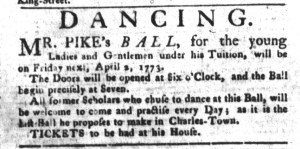
“It is the last Ball he proposes to make in Charles-Town.”

Mr. Pike, a dancing master who enhanced his image and authority by never including his first name in his advertisements, offered lessons in Charleston for many years.  (His earliest advertisement examined by the Adverts 250 Project appeared in the September 2, 1766, edition of the South-Carolina Gazette and Country Journal.)  In addition to advertising lessons, he also promoted the balls that he hosted, opportunities for his students to demonstrate the skills they developed and refined under his guidance.  Pike encouraged prospective students and their parents to consider those gatherings rites of passage within polite company, provided that they comported themselves well.  Accordingly, his marketing efforts sometimes leveraged a sense of anxiety.  For instance, when he announced a ball scheduled for December 1772, he advised parents to send their children for lessons “as soon as possible, that he may be enabled to complete his Figures in a proper Manner.”  In other words, if they did grant Pike sufficient time for instruction then they risked their children embarrassing themselves at the ball.

Pike did not take that approach when he announced that his “BALL, for the young Ladies and Gentlemen under his Tuition” would take place on the first Friday in April 1773.  That may have been because the dancing master had plans to depart the city.  (He began placing newspaper advertisements for dancing and fencing lessons in Philadelphia the following year.)  Pike proclaimed that this one was “the last Ball he proposes to make in Charles-Town.”  That being the case, he no longer needed to resort to the same tactics for attracting pupils.  Instead, he attempted to incite demand for tickets by presenting his final ball as a reunion for his students and a farewell fête.  Pike invited “former Scholars who chuse to dance at this Ball … to come and practise every Day” to prepare for it.  That allowed them to brush up on their skills and perhaps receive some pointers, free of charge, from their former instructor as a gift prior to his departure.  Anticipating both “the young Ladies and Gentlemen under his Tuition” and “former Scholars” in attendance, Pike arranged for a retrospective of his instruction and influence in cultivating a genteel pastime in one of the largest and most cosmopolitan cities in the colonies.  He hoped that would sell tickets.  After all, it was not merely the “ANNUAL BALL” for current students that he sometimes promoted in the public prints but instead his “last Ball” and final chance to partake in one of the gatherings he hosted.

March 12

What was advertised in a colonial American newspaper 250 years ago today?

New-Hampshire Gazette (March 12, 1773).

“He will teach Dancing in the politest Manner.”

Monsieur de Viart had competition for pupils at his dancing academy in Portsmouth.  The week after Viart commenced a new round of advertising in the New-Hampshire Gazette, Edward Hacket placed his own notice “to acquaint the GENTLEMEN and LADIES” that he would “open a Dancing-School, At the New ASSEMBLY HOUSE” in April.  Although dated February 11, that was likely a mistake.  Hacket’s advertisement did not appear in the New-Hampshire Gazette until March 12.  By then, Viart had taken the lead in advertising for the upcoming quarter in the public prints.

That did not deter Hacket from attempting to convince adults to take lessons from him and parents to enroll their children in his school.  For background, he described himself as “From EUROPE,” but did not go into greater detail.  He apparently hoped that his origins on the other side of the Atlantic gave him some cachet compared to dancing masters from the colonies … and made him competitive with his French rival, Monsieur de Viart.  Hacket did not believe that Viart was entitled to corner the market in Portsmouth.  According to his advertisement, neither did “many of the principal Inhabitants of the Town” who requested that he establish his own school even though Viart already operated a dancing academy there.  To further burnish his credentials, Hacket declared that he “has taught Dancing in many of the principal Towns in England, Ireland, and America.”  That being the case, he taught students how to dance “in the politest manner” and could assist them in learning “perfectly in a short Time,” preparing his pupils “for any Assembly or Company whatsoever.”

Just as participation in the consumer revolution was not restricted to the gentry in the largest colonial cities, neither was adopting the manners and skills associated with gentility.  As spring approached in 1773, two dancing masters offered their services in Portsmouth, Hampshire.  Each operated schools in that town and also offered private instruction in the homes of their pupils.  Hacket indicated that he also gave lessons in Exeter, New Hampshire, and Haverhill and Newbury, Massachusetts.  Prospective pupils in town and country alike, the dancing masters suggested, should consider how learning to dance well would secure and enhance their status.

March 5

What was advertised in a colonial American newspaper 250 years ago today?

New-Hampshire Gazette (March 5, 1773).

“Instruct their Scholars in those Rules of Decorum and Politeness.”

Monsieur de Viart, a dancing master, sought to cultivate a sense of anxiety among prospective clients when he offered his services in an advertisement in the March 5, 1773, edition of the New-Hampshire Gazette.  In particular, he suggested that parents needed to tend to the best interests of their children by enrolling them in classes taught by an expert who emphasized comportment as well as learning the steps of “Minuets, French Jiggs, Horn-Pipes, Rigadoons, and English Country Dances of all Kinds.”  His students, he promised, would exhibit grace in their interactions as well as in their movements.

In making that pitch, Viart asserted that he “has always endeavoured to merit the Approbation of those who have hitherto favoured him with their Custom,” especially parents of his young students, “by having at all Times obliged himself to instruct his PUPIULS in those Principles which he received in that Profession himself.”  The dancing master declared that he incorporated “Rules of Decorum and Politeness” into his curriculum, recognizing that dancing was part of much more extensive social interactions.  He cautioned parents of prospective pupils that their children needed such lessons, “which are absolutely necessary to be known, begore Young Persons can step abroad into the World with Elegance and Ease.”

Viart claimed that other dancing masters did not focus on the relationship between dancing and manners that he did, leaving their students to clumsily stumble through encounters with others.  He lamented that “not every one who pretends to teach this delicate Art … will take the Pains to instruct their Scholars” in manners.  As a result, parents had reason to fear that their children might embarrass themselves.  “[I]t often happens that Scholars,” Viart confided, “through the Ignorance of the Masters, are guilty of great Rudeness and commit gross Blunders on their first going into Company.”  Viart prepared his pupils for much more than moving across the dance floor, helping them avoid various kinds of awkwardness and difficulties when they gathered for social events.

Dancing masters in the largest cities in the colonies – Charleston, New York, Philadelphia – made similar appeals to prospective pupils and their parents.  They touted the gentility that their “Scholars” would exhibit upon taking lessons.  Viart suggested that this was not merely a concern for colonizers who resided in urban ports.  Instead, he encouraged students and, especially, their parents in Portsmouth, New Hampshire, to experience a sense of apprehension that they did not meet the standards expected in cosmopolitan society.

December 1

What was advertised in a colonial American newspaper 250 years ago today?

South-Carolina Gazette and Country Journal (December 1, 1772).

“PIKE’s ANNUAL BALL.”

The December 1, 1772, edition of the South-Carolina Gazette and Country Journal carried an advertisement that proclaimed “BALL” in a larger font than anything else in the entire issue.  That headline drew attention to an announcement that “PIKE’s ANNUAL BALL, for the young LADIES and GENTLEMEN, under his Tuition, will be on Tuesday the Eighth of December.”  The event would begin “exactly at SIX o’CLOCK.”  Presumably members of the community other than the dancing master’s students were welcome to attend the ball to observe the skills that Pike taught in what he had promoted as a “NEW SUIT of ROOMS” in another advertisement that he published in September.

Pike concluded that advertisement with a message to the “Parents and Guardians of his Scholars, that his BALL will be on Tuesday the 8th of December next.”  He underscored that they needed to sign up for classes “as soon as possible, that they may be enabled to complete his Figures in a proper Manner” when they were on display at the ball.  The dancing master aimed to excite some anxiety about public scrutiny, knowing that colonizers carefully observed each other to assess whether their appearance and comportment revealed authentic grace and gentility …or whether they merely put on an act and went through the motions.  Effortless dancing, many believed, revealed virtue, while stumbling around the dance floor and awkwardly interacting with partners and other dancers suggested character flaws.

As a result, colonizers who wished to demonstrate that they truly belonged among the ranks of the genteel relied on the services of various instructors, including tutors who taught them how to speak French, tutors who taught them how to play musical instruments, and dancing and fencing masters, like Pike, who taught them how to move gracefully and how to engage in polite exchanges at social gatherings.  In cautioning the parents and guardians of his prospective pupils that “his SCHOLARS” would be on display at his annual ball in December, Pike reminded them that they needed his services just as much as he needed their patronage if they wished to safeguard their social standing.

October 8

What was advertised in a colonial American newspaper 250 years ago today?

South-Carolina Gazette (October 8, 1772).

“Dancing & Fencing.”

“THE Sign of the Golden Cup.”

Mr. Pike, a dancing master, and Thomas You, a silversmith, both used graphic design to draw attention to their advertisements in the October 8, 1772, edition of the South-Carolina Gazette, yet they adopted different strategies.  Their notices further enlivened the vibrant graphic design that distinguished notices in that newspaper from those that ran in other newspapers.  The compositor for the South-Carolina Gazette made liberal use of varying font sizes, gothic letters for headlines, italics, capitals, and centering compared to advertisements.

That being the case, the compositor may have played a role in how the dancing master used decorative type and gothic letters to enhance his advertisement.  The headline “Dancing & Fencing” in gothic letters appeared inside a border composed of printing ornaments above a secondary headline spread over three lines: “PIKE’s ACADEMY / for / DANCING and FENCING.”  Compare that to a similar advertisement that Pike ran in the South-Carolina Gazette and Country Journal.  It featured only one headline, “DANCING and FENCING,” that did not appear in a different font than the rest of the advertisement.  Rather than constituting a second headline, “PIKE’s ACADEMY, for FENCING and DANCING” was part of the first paragraph of the advertisement.  An enterprising compositor at the South-Carolina Gazette likely played a significant role in designing Pike’s advertisement, perhaps assuming full responsibility without consulting the advertiser.

On the other hand, You almost certainly submitted instructions to include a woodcut depicting a golden cup in his advertisement for the merchandise he sold at the “Sign of the Golden Cup.”  You commissioned that image for his exclusive use, previously inserting it in advertisements in the South-Carolina Gazette in December 1770 and March 1771.  Prior to that, he used a different woodcut in his advertisements in December 1766 and July 1767.  He seemed to appreciate that images helped draw attention to his notices.  How to incorporate an image, however, he may have left to the discretion of the compositor.  In 1772, his woodcut of a golden cup appeared in the center, flanked by his name and location.  In earlier advertisements, it was positioned to the left, replicating the placement of woodcuts depicting ships that adorned other notices.

The advertisements in the South-Carolina Gazette testify to both the role of the compositor in designing newspaper notices and occasional collaboration or consultation involving both the compositor and the advertiser.  Rather than dense text, variations abounded in the advertisements in that newspaper, making the South-Carolina Gazette one of the most visually interesting publications in the early 1770s.

September 15

What was advertised in a colonial American newspaper 250 years ago today?

South-Carolina Gazette and Country Journal (September 15, 1772).

“Young Ladies and Gentlemen instructed in DANCING.”

An advertisement for “DANCING and FENCING” lessons in the September 15, 1772, edition of the South-Carolina Gazette and Country Journal alerted readers that “PIKE’s ACADEMY, for FENCING and DANCING” would soon offer a new “Season” of classes.  Pike was probably already familiar to many prospective pupils, having offered instruction in Charleston for several years.  He attempted to generate interest even among those who had already taken lessons with him by inviting students to his “NEW SUIT of ROOMS” on Church Street.

A significant portion of the advertisement consisted of the schedule.  Pike devoted early mornings, “Five o’Clock to Nine,” to fencing lessons.  He taught dancing to “Young Ladies and Gentlemen” in the afternoons on Thursdays and Saturdays in addition to his “EVENING SCHOOL, every Evening in the Week, from Six o’Clock to Nine.”  That left “four Afternoons at Liberty every Week” for Pike to venture beyond his academy to provide private lessons to students “at their own Houses.”  That may have been the preferred option for those who felt anxious about appearing anything other than graceful and genteel in front of observers.

Yet dancing was an activity meant to be undertaken in public, at least eventually.  Colonizers asserted their status and took great pride in being skillful dancers.  Smoothly completing complex steps testified to their refinement, while awkwardness or stumbling undermined impressions of politeness and sophistication they demonstrated in other aspects of their comportment and dress.  Understanding the stakes, Pike scheduled an exhibition ball for early December and encouraged the “Parents and Guardians of his Scholars” to enroll them in lessons “as soon as possible.”  The teacher and his pupils needed sufficient time “to complete his Figures in a proper Manner” during their lessons so the young ladies and gentlemen could showcase their skills in front of observers at the ball.  Other dancing masters also raised the specter of public embarrassment in their advertisements, encouraging prospective students and their parents to enroll in lessons in order to withstand public scrutiny.  By stoking anxiety, they aimed to motivate colonizers to engage their services.

June 12

What was advertised in a colonial American newspaper 250 years ago today?

New-Hampshire Gazette (June 12, 1772).

“Those Accomplishments which are so necessary for entring the World with Advantage.”

Many colonizers sought to demonstrate that they belonged to genteel society through their fashions, possessions, and comportment.  They participated in the consumer revolution, purchasing textiles, garments, accessories, and housewares according to the latest tastes in English cities, especially London.  They also concentrated on their comportment, putting into practice good manners and learning a variety of genteel skills, including dancing, fencing, speaking French, and playing musical instruments.  Merchants, shopkeepers, artisans, and tutors aided colonizers in acquiring both the things and the knowledge necessary for displaying their gentility.

This was not solely an urban phenomenon.  Far beyond the major port cities of Boston, Charleston, New York, and Philadelphia, purveyors of goods advertised their wares and consumers acquired them.  Similarly, colonizers in smaller towns had opportunities to take lessons in dancing, fencing, and other genteel pursuits.  As summer arrived in 1772, Monsieur Viart placed an advertisement in the New-Hampshire Gazette to inform the public, especially parents, that he taught “DANCING, FENCING, the FRENCH LANGUAGE, and the VIOLIN … in the most perfect and polite manner.”  He cautioned parents against overlooking the benefits of enrolling their children in his classes, arguing that his curriculum yielded “those Accomplishments which are so necessary for entring the World with Advantage.”  Even colonizers in Portsmouth, Viart declared, needed these skills.

Viart listed the tuition for each kind of lesson, both an initial entrance fee and additional payment for each quarter.  He also offered a discount if “a Scholar learns in two Branches,” encouraging pupils and their parents to sign up for more than one subject.  He anticipated the most interest in dancing and French, holding “School” for each at set times on Mondays, Thursdays, and Saturdays.  He may have also provided private tutoring, but he did not mention those lessons in his advertisement.  He gave fencing and violin lessons “at such times as may be convenient for his Scholars.”

Tutors like Viart attempted to entice colonizers to become even more immersed in the consumer revolution and the culture of gentility and cosmopolitanism often associated with it.  He expected that his pronouncement that learning to dance or speak French was “so necessary” in preparing children to successfully make their way in the world that it would resonate with parents and other readers in Portsmouth and nearby towns.  Such skills, he suggested, were not reserved for the gentry in New York and Philadelphia.

October 7

What was advertised in a colonial America newspaper 250 years ago this week?

New-York Journal (October 4, 1770).

“There is no other Art so various perhaps and universal in its Influence, as Music.”

D. Propert and W. C. Hulett took very different approaches to promoting music lessons in the October 4, 1770, edition of the New-York Journal. Hulett, who described himself as a “DANCING-MASTER,” advertised both his “public DANCING SCHOOL” and lessons for several instruments. Like many other dancing masters, he also provided fencing lessons for gentlemen.  Most of his advertisement focused on his work as a dancing master, but he did begin and end with information about music lessons.  The headline proclaimed, “The GUITTAR, TAUGHT By W. C. HULETT, DANCING-MASTER.”  In the final paragraph, he informed prospective pupils that also gave lessons for the violin and flute as well as the small sword.  Overall, Hulett’s notice resembled most advertisements for music lessons that appeared in American newspapers in the era of the American Revolution.

Propert, on the other hand, placed a very different advertisement, starting with the headline that introduced him to prospective students as “D. PROPERT, Professor of MUSIC.”  Nearly four times the length of Hulett’s notice, this advertisement included a short essay on how music benefited “Body and Mind” for those who heard it and those who performed it.  “Music,” Propert declared, “has ever been held in the highest Esteem, by the most exalted Characters, and finest Geniuses of almost every Age and Nation.”  Music had a sublime impact; it was “capable of raising the Soul into Dispositions for the most pleasing, useful and noble purposes.”  Propert extolled the influence of music in worship services, on the battlefield, and at funerals, banquets, and balls.  Music enhanced any activity “for it has Expression for all the various Passions and Emotions of the Heart and Soul.”  Making his pitch to those who considered themselves genteel or aspired to the ranks of gentility, Propert concluded his homily on music with an assertion that “this Art has obtained the Patronage, Regard and Praises of the greatest Personages” throughout recorded history.  He instructed prospective pupils that music “hath been the Delight and Study of every polished and ingenious National in all Climates and in all Ages.”

Propert’s advertisement and Hulett’s advertisement happened to appear one after the other, Propert’s first in the October 4 edition and Hulett’s first in the next issue on October 11.  Appearing alongside a competitor may have worked to Hulett’s benefit since Propert made a case for the virtues of learning to play an instrument that applied to Hulett’s lessons as well as his own.  According to the advertising rates in the colophon, Propert paid four times as much to run his advertisement.  Not only did the printer collect those revenues, Hulett accrued benefits as well in his quest for students for this “most pleasing of the liberal Arts.”  Propert’s innovation in marketing may have worked to the advantage of all music instructors in New York.

October 3

What was advertised in a colonial American newspaper 250 years ago today?

South-Carolina and American General Gazette (October 3, 1770).

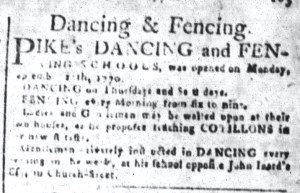
“He proposes teaching COTILLONS in the newest taste.”

The South Carolina Newspapers collection available via Accessible Archives is an invaluable resource for producing the Adverts 250 Project and the Slavery Adverts 250 Project.  The collection includes digitized images of three newspapers published in Charleston in 1770, the South-Carolina Gazette, the South-Carolina Gazette and Country Journal, and the South-Carolina and American General Gazette.

Transcriptions of the newspapers accompany the images.  In many cases, those transcriptions make it easier to decipher the contents of advertisements and other items that appear illegible for a variety or reasons.  Perhaps the original printing did not produce a clear impression in 1770 or the document suffered damage over time or poor photography resulted in a remediation that does not accurately the original.  Sometimes more than one of these factors influence the quality of digital surrogates.

Transcriptions, whether undertaken by people or technology, must be consulted with care.  Consider an advertisement for “PIKE’s DANCING and FENCING SCHOOLS” that ran in the October 3, 1770, edition of the South-Carolina and American General Gazette.  The digital image is not easily legible, though an experienced research familiar with the language and contents of eighteenth-century newspaper advertisements can piece together the contents.  The transcription, on the other hand, leaves out words, such as “Ladies” in the phrase “Ladies and Gentlemen,” and does not accurately reproduce others, such as “he proposes trashing COTILLONSisa new first” for “he proposes teaching COTILLONS in the newest taste.”

Flawed Transcription of Pike’s Advertisement

While this is obviously an error in the transcription, the interface created by Accessible Archives does correct an error that the compositor made when setting the type for the issue that contained Pike’s advertisement.  That issue consisted of six pages, four pages created by printing two on each side of a broadsheet and folding it in half and two additional pages of advertising printed on either side of a smaller sheet.  That supplement has the wrong date at the top, “Sept. 24 – Oct. 2” instead of “Sept. 24 – Oct. 3” at the top of the pages for the rest of the issue.  The page numbers for the supplement, 183 and 184, run continuously with the pages printed on the larger sheet.  The date 1770 appears in the title (an abbreviated masthead): “THE SOUTH-CAROLINA AND AMERICAN GENERAL GAZETTE, for 1770.”  Dates in some of the advertisements also make it clear that the supplement was printed in 1770.

Yet manuscript additions indicate that at some time the supplement was separated from the rest of the issue.  The first page includes a notation, either incomplete or partially illegible, that states, “Sup in 177[x],” with a missing digit at the end of the year.  Similarly, the supplement has a notation, not entirely legible, that declares it “does not belong in this [state].”  Most likely the “Oct. 2” error resulted in the supplement being cataloged or even bound with another issue of the South-Carolina and American General Gazette from another year, but an archivist noted the other discrepancies and context clues.  In the end, Accessible Archives arranged the digital images of all six pages of the issue together and in the correct order, despite an error made by the compositor in 1770.

South-Carolina and American General Gazette (October 3, 1770).

Human error and technological error sometimes creep into sources at every stage of their production, preservation, and remediation.  Such errors introduce miniature mysteries that can be entertaining to solve, but they also challenge researchers to constantly assess their sources to recognize any features that seem out of place or inconsistent with what they know about the period they are investigating or the subsequent collection and treatment of primary sources that make them accessible.