January 10

What was advertised in a revolutionary American newspaper 250 years ago today?
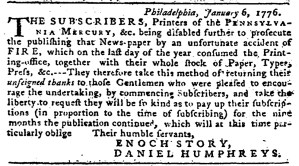
Pennsylvania Gazette (January 10, 1776).

“Disabled further to prosecute the publishing that News-paper by an unfortunate accident of FIRE.”

As the imperial crisis intensified, Enoch Story and Daniel Humphreys launched the Pennsylvania Mercury (quickly renamed Story and Humphreys’s Pennsylvania Mercury) on April 7, 1775.  That newspaper joined two others founded earlier in the year, the Pennsylvania Evening Post on January 24 and the Pennsylvania Ledger on January 28, as well as Dunlap’s Pennsylvania Packet, the Pennsylvania Gazette, the Pennsylvania Journal, and the Wochentliche Pennsylvanische Staatsbote.  During the first four months of 1775, Philadelphia surpassed Boston in terms of the number of newspapers printed there.  With the outbreak of hostilities at Lexington and Concord on April 19 and the ensuing siege of Boston, several of Boston’s newspapers ceased publication or relocated to other towns.

Yet Boston was not the only major port city that saw one of its newspapers cease publication during the first year of the Revolutionary War.  Story and Humphreys’s Pennsylvania Mercury lasted less than a year, though disruptions caused by the war did not lead to its demise.  Unfortunately, “an unfortunate accident of FIRE … consumed the Printing-office, together with their whole Stock of Paper, Types, Press,” and other equipment on December 31.  The situation did not leave any possibility for the partners to recover and eventually resume publication.  “[B]eing disabled further to prosecute the publishing [of] that News-paper,” they announced in an advertisement in the Pennsylvania Gazette, they instead expressed “their unfeigned thanks” to the subscribers who had supported the venture and requested that they “will be so kind as to pay up their subscriptions (in proportion to the time of subscribing) for the nine months the publication continued.”  In other words, they expected customers to make prorated payments based on the number of issues they received.  Humphreys eventually tried again, but not until after the Revolutionary War.  On August 20, 1784, he commenced publishing a new Pennsylvania Mercury.

Even with the loss of Story and Humphreys’s Pennsylvania Mercury, Philadelphia still had more newspapers than any other city or town in the colonies.  As the war continued, not all of them survived.  Some closed permanently while others moved to other towns or suspended publication during the British occupation of Philadelphia.  Yet, as the “unfortunate accident of FIRE” at Story and Humphreys’s printing office demonstrated, disruptions caused by the war were not the only dangers that forced newspapers to fold.
June 16

What was advertised in a revolutionary American newspaper 250 years ago today?

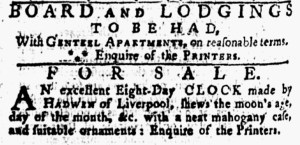
Story and Humphreys’s Pennsylvania Mercury (June 16, 1775).

“Enquire of the PRINTERS.”

Printing offices were busy places.  In addition to the master printers, journeymen, apprentices, and others who worked in them, a variety of associates and customers frequently visited to share news and information or to conduct business.  That was almost certainly the case in the printing office operated by Enoch Story and Daniel Humphreys in Norris’s Alley in Philadelphia when the American Revolution began.  The colophon on the final page of their newspaper, Story and Humphreys’s Pennsylvania Mercury, advised that “Subscriptions, … Advertisements, [and] Articles and Letters of Intelligence” were “gratefully received” there.  A constant stream of people likely visited their printing office.

Some of them arrived seeking more information about advertisements that ran in the Pennsylvania Mercury.  In addition to printing and disseminating notices on behalf of advertisers, the printers also served as brokers who provided additional information beyond what appeared in the public prints.  The June 16, 1775, edition, for instance, carried two advertisements that instructed interested parties to “Enquire of the Printers” to learn more.  One gave sparse details about “BOARD AND LODGING TO BE HAD, With GENTEEL APARTMENTS, on reasonable terms.”  Which additional details did Story and Humphreys give to those who did enquire?  Did they merely facilitate an introduction to the advertiser?  Did they have details about price, furnishings, or the schedule for meals?  The advertisement does not reveal how much information they relayed, only that both the printers and the advertiser anticipated that Story and Humphreys would have some involvement beyond publishing the advertisement.

Another advertisement offered for sale an “excellent Eight-Day CLOCK made by HADWEN of Liverpool” that “shews the moon’s age” and the “day of the month” in “a neat mahogany case” with “suitable ornaments.”  Again, the advertisement did not indicate which additional details Story and Humphreys relayed to those who did “Enquire of the Printers,” but it testified to their additional involvement in the transaction after publishing the advertiser’s notice in their newspaper.  Eighteenth-century printers brokered information both in print and in person, the latter an element of the customer service available to advertisers.

April 14

Who was the subject of an advertisement in a colonial American newspaper 250 years ago today?

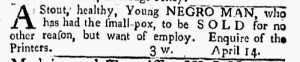
Story and Humphreys’s Pennsylvania Mercury (April 14, 1775).

“A Stout, healthy, Young NEGRO MAN … to be SOLD … Enquire of the Printers.”

On April 14, 1775, Enoch Story and Daniel Humphreys published “VOL. I.  NUMB. 2,” the second issue of their new newspaper.  They updated the title in the masthead from The Pennsylvania Mercury; and the Universal Advertiser to Story and Humphreys’s Pennsylvania Mercury, and Universal Advertiser.  The colophon running across the bottom of the final page remained the same, advising readers that they “gratefully received” subscriptions, advertisements, articles, and “Letters of Intelligence” at their printing office in Norris’s Alley in Philadelphia.  Their first issue featured a significant number of advertisements.  The second issue contained even more.  Advertisers were willing to take a chance with this new newspaper, apparently believing that its circulation justified the investment in purchasing space to disseminate their notices.

Among the advertisements that ran for the first time in the second issue of Story and Humphreys’s Pennsylvania Mercury, one offered “A Stout, healthy, Young NEGRO MAN, who has had the small-pox, to be SOLD for no other reason, but want of employ.”  It advised interested parties to “Enquire of the Printers” to learn more.  The notice was dated “April 14” and had a notation, “3 w,” that let the compositor know to include it in three issues.  Last week, Story and Humphreys’s Pennsylvania Mercury made its first appearance in the Adverts 250 Project to examine the advertisements in it (or its second appearance when counting subscription proposals that ran in another newspaper).  Today, the Adverts 250 Project features that newspaper once again because it is making its first appearance in the Slavery Adverts 250 Project.

Yet Story and Humphreys did not merely publish an advertisement that offered an enslaved man for sale.  They published an “Enquire of the Printers” advertisement that made them active participants in the sale.  They may have facilitated an introduction, or they may have negotiated on behalf of the advertiser.  The notice does not reveal the extent of their involvement, but it does indicate that they were involved beyond publishing the advertisement and earning revenue for doing so.  As Jordan E. Taylor documents, American printers acted as slave brokers in thousands of advertisements in newspapers published throughout the colonies and, later, states in the eighteenth century.[1]  Participating in the slave trade was part of the business model for operating a viable newspaper.  Taylor could not identify any printers who refused to run advertisements that offered enslaved people for sale as a matter of principle; the financial incentives were too strong to ignore.  Story and Humphreys very quickly incorporated perpetuating slavery into the practices for their press, both as printers who disseminated advertisements offering enslaved people for sale and as printers who served as slave brokers via “Enquire of the Printers” advertisements.

**********

[1] Jordan E. Taylor, “Enquire of the Printer: Newspaper Advertising and the Moral Economy of the North American Slave Trade, 1704-1807,” Early American Studies: An Interdisciplinary Journal 18, no. 3 (Summer 2020): 287-323.

April 7

What was advertised in a colonial American newspaper 250 years ago today?

Pennsylvania Mercury (April 7, 1775).

“DR. HILL’S AMERICAN BALSAM.”

Enoch Story and Daniel Humphreys began distributing subscription proposals for a new newspaper, the Pennsylvania Mercury and Universal Advertiser, in the middle of January 1775.  They began promoting their newspaper at the same time that James Humphreys, Jr., commenced publication of the Pennsylvania Ledger and Benjamin Towne established Philadelphia’s first tri-weekly newspaper, the Pennsylvania Evening Post.  Those two newspapers brought the total in the city to six, joining Dunlap’s Pennsylvania Packet, the Pennsylvania Gazette, the Pennsylvania Journal, and the Wöchentliche Pennsylvanische Staatsbote.  As the imperial crisis intensified, the number of newspapers published in the largest city in the colonies increased … but did a market exist for yet another?  Could Story and Humphreys attract enough subscribers and advertisers to make a go of the Pennsylvania Mercury?

They decided that they could.  On Friday, April 7, they published the first issue.  In a note to “Subscribers and the Public” on the first page, they explained that they deviated from the conditions in their proposals only slightly, distributing it on Fridays instead of Saturdays, because “one of the eastern mails is now dispatched from Boston, in such time as to arrive here on Thursday (instead of Saturday as formerly).”  That meant that Story and Humphreys could distribute “the most early intelligence from that interesting quarter.”  That meant that the Pennsylvania Mercury scooped the Pennsylvania Evening Post and the Pennsylvania Ledger, both published on Saturday.  The printers also proclaimed that “the TYPE with which THIS Paper is printed are of AMERICAN manufacture,” signaling their support for the article in the Continental Association that called for supporting domestic manufactures, and asked for “every patriotic allowance” if the quality did not give “entire satisfaction to the judicious and accurate eye.”  It was, after all, a small sacrifice.  “[W]e flatter ourselves,” the printers declared, “that the rustic manufactures of America will prove more graceful to the patriotic eye, than the more finished productions of Europe.”

Story and Humphreys also managed to line up advertisers for the first issue of the Pennsylvania Mercury, an importance source of revenue for any newspaper.  In addition to their notice, two advertisements appeared on the first page, including one for “DR. HILL’S AMERICAN BALSAM.”  Advertising filled more than a column on the third page and nearly twice as much on the last page.  In total, paid notices accounted for one-quarter of the content of the inaugural issue.  The colophon encouraged readers to submit advertisements to the printing office in Norris’s Alley near Front Street.  The success of Philadelphia’s newest newspaper would depend in part on advertisers choosing to insert their notices in it.

January 25

What was advertised in a colonial American newspaper 250 years ago today?

Pennsylvania Ledger (January 25, 1775).

“PROPOSALS For Printing by Subscription, a FREE and IMPARTIAL WEEKLY NEWS-PAPER.”

As the imperial crisis intensified, the number of newspapers published in Philadelphia, the largest city in the colonies, grew significantly.  Throughout the early 1770s, readers had access to Dunlap’s Pennsylvania Packet, the Pennsylvania Gazette, and the Pennsylvania Journal.  Until February 1774, the Pennsylvania Chronicle had also circulated in Philadelphia.  Less than a year after that newspaper folded, Benjamin Towne commenced publication of the Pennsylvania Evening Post, the first tri-weekly newspaper attempted in that city, on January 24, 1775, and James Humphrey, Jr., distributed the first issue of the Pennsylvania Ledger four days later.  Enoch Story and Daniel Humphreys also advertised plans for another newspaper, the Pennsylvania Mercury.  They published their inaugural issue in April 1775, two weeks before the battles at Lexington and Concord.

On January 25, the Pennsylvania Journal carried the proposals for both the Pennsylvania Ledger and the Pennsylvania Mercury, placing them side by side on the final page.  As was customary, the printers gave an overview of why they wished to publish their newspapers, explained what subscribers could expect among the contents, and listed the conditions for subscribing.  Among the various purposes the Pennsylvania Mercury would serve, Story and Humphreys included, “To communicate advertisements of every kind.”  The printers of both proposed newspapers sought advertisements, an essential revenue stream for any printer publishing a newspaper.  After noting the prices for subscriptions to the Pennsylvania Ledger, Humphreys indicated, “Advertisements to be inserted on the same terms as is usual with the other papers in this city.”  For the Pennsylvania Mercury, Story and Humphreys declared, “The Rates of the Paper and Advertisements will be the same with those now printed in this City.”  Dunlap’s Pennsylvania Packet and the Pennsylvania Journal both gave the price for subscriptions – “Ten Shillings per Annum” – in their colophons, but none of the newspapers then printed in Philadelphia regularly published what they charged for advertising.  Apparently, according to the proposals for the Pennsylvania Ledger and the Pennsylvania Mercury, none offered better deals than others.

Story and Humphreys did give a bit more attention to advertising in their proposals.  “All Advertisements,” they promised, “shall be inserted in order as they come in, and shall appear in a fair and conspicuous manner.”  They did not mean that paid notices would literally appear one after the other in the order received at the printing office but rather that a compositor would set type in that order and integrate them into the layout of the newspaper without privileging any later arrivals over those submitted sooner.  After all, newspaper printers sometimes inserted notes that advertisements had been omitted due to lack of space.  Story and Humphreys signaled that they would not take anything into consideration beyond the order that advertisers delivered their notices when delaying publication of some.  They also acknowledged that compositors arranged content to make pieces of different lengths complete columns and fill pages.  During that process, they would not privilege any advertisements over others, displaying each “in a fair and conspicuous manner.”  With such appeals, Story and Humphreys solicited the trust of prospective advertisers who wanted a good return on the money they invested in disseminating information in the Pennsylvania Mercury.

Neither of these proposals for new newspapers discussed advertising extensively, but each did seek advertisers along with subscribers.  Whatever goals they expressed for circulating news as the political situation deteriorated, the viability of pursuing their ideals of publishing “improving, instructive and entertaining” information depended in large part on recruiting advertisers as well as enlisting subscribers.