September 22

What was advertised in a colonial American newspaper 250 years ago today?

Sep 22 - 9:22:1767 South-Carolina Gazette and Country Journal
South-Carolina Gazette and Country Journal (September 22, 1767).

“Yorkshire stuffs, fit for house negroe’s gowns.”

John Davies frequently placed advertisements in Charleston’s newspapers in the 1760s, promoting the “Great variety of sundry merchandize” he imported from England and Ireland. His commercial notices incorporated fairly sophisticated marketing methods. In today’s advertisements, for instance, he offered a discount on Irish linens (“15 per cent. under the common advance”) and “no charge of commissions” because his supply chain eliminated middlemen and buying in credit. To obtain his ware, he “bought of the manufacturers with cash.” Unlike most other advertisers, he specified prices for some of his inventory, including “Yorkshire stuffs … at 8s. 9d. the yard” and blue and white plains at 10s. per yard,” which allowed potential customers to engage in comparison shopping before visiting Davies’s “store in Beadon’s Alley.”

All of these factors made Davies’s advertisements noteworthy, but another element also merits attention for what it reveals about life in eighteenth-century South Carolina. Davies lived and worked in a slave society. In distinguishing between slave societies and societies with slaves, the Lowcountry Digital History Initiative defines slave societies as settlements “where slavery stood at the center of politics, the economy, labor experiences, and social identities. Slaveholders made up the ruling class in these areas and the master-slave relationship shaped all aspects of society and daily life.” (In societies with slaves, on the other hand, “the institution of slavery was relatively peripheral to local economies and white social status.”)

Davies’s advertisement reveals just one of the many ways that slavery shaped commerce and everyday life in colonial South Carolina. Those Yorkshire stuffs that Davies sold at the low price of eight shillings and nine pence per yard were “fit for house negroe’s gowns.” Davies realized that many potential customers owned slaves, some of whom worked in domestic service rather than laboring to raise rice, indigo, or other agricultural commodities. He directed customers to take note of a textile appropriate for clothing enslaved women who worked in the home, a fabric fitting to their station (as opposed to the “negroe cloth” often advertised to clothe most other enslaved men, women, and children) but that also testified to the status of slaveholders who assigned some of their human property to domestic service. Slaveholders needed a fabric that was fine enough, but not too fine, to reflect well on them should visitors glimpse their domestic “servants” at work. He gave that part of the local culture only casual acknowledgment, making no fanfare or otherwise distinguishing that particular appeal from the rest of the advertisement. Instead, the “Yorkshire stuffs, fit for house negroe’s gowns” were sandwiched between descriptions of other textiles.

A nota bene, however, did stand out from the remainder of Davies’s advertisement. In it, he informed readers that “A young Negro Fellow, who is a good Cook, is wanted on hire.” This notice was unrelated to the “Great variety of sundry merchandize” Davies sold at his store, yet he apparently did not believe that it merited a separate advertisement. Instead, he appended it to an advertisement for his business. His own arrangements for domestic labor performed by an enslaved man merged with a commercial notice intended to entice customers to make purchases from him. The institution of slavery was inseparable from commerce and domestic life in Davies’s advertisement.
June 21

What was advertised in a colonial American newspaper 250 years ago this week?

Jun 21 - 6:19:1767 South-Carolina and American General Gazette
South-Carolina and American General Gazette (June 19, 1767).

“Will be sold 10 per cent. under the common advance.”

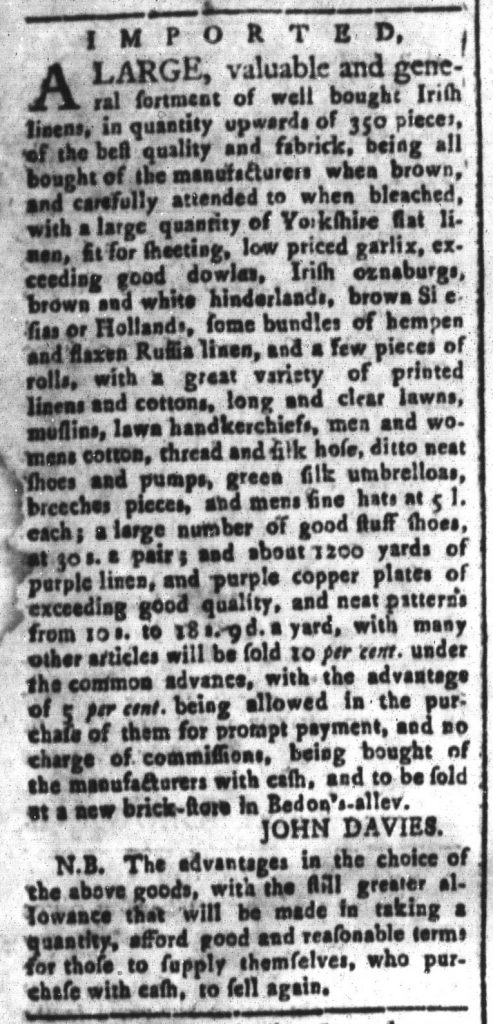
John Davies paid attention to quality and, especially, price in his advertisement for imported Irish linens and other textiles in the South-Carolina and American General Gazette. He encouraged customers to buy in volume as a means of lowering prices as he targeted retailers who needed “to supply themselves … to sell again.” Although he did not specify specific rates for most of his goods, he did offer some numbers that would have been attractive to potential customers looking to acquire inventory and turn a profit themselves.

For instance, he stated that he “sold 10 per cent. under the common advance.” He assumed that potential customers already had a general sense of the going rates for the various sorts of textiles he sold, enticing them with the savings he offered compared to what they otherwise expected to pay. To sweeten the deal, he also promoted “the advantage of 5 per cent. being allowed in the purchase of them for prompt payment.” In other words, as he stated later in the advertisement, those “who purchase with cash” rather than credit stood to enjoy an additional discount that made his prices even more competitive. Davies implied further discounts for buying in bulk – “still greater allowance that will be made in taking a quantity” – although he did not offer specifics. The size of the subsequent discount may have been tied to the quantity purchased, subject to negotiations between Davies and his customers at the time of sale.

How was Davies able to offer low prices and significant discounts? He had cultivated relationships directly with the manufacturers, sidestepping English merchants who usually supplied American wholesalers and retailers. There had been “no charge of commissions” to other parties to drive up Davies’s prices. He also kept costs down by making his own purchases in cash rather than credit that accumulated interest. He passed his savings on to his customers in Charleston.

May 3

What was advertised in a colonial American newspaper 250 years ago this week?

May 3 - 4:30:1767 New-York Journal
New-York Journal (April 30, 1767).

“Other trimmings for hatters.”

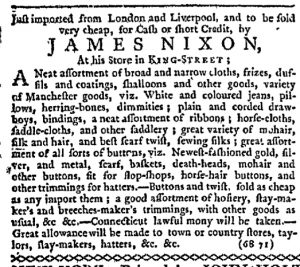
Unlike many shopkeepers who advertised their wares almost exclusively to end-use consumers, James Nixon sold an array of imported textiles and ornaments wholesale as well as retail. To be competitive with merchants and other wholesalers, he offered discounts to those who made purchases with the intention of acquiring inventory to resell to consumers. “Great allowance will be made,” Nixon stated, “to town or country stores, taylors, stay-makers, hatters, &c. &c.”

On occasion advertisers made such appeals to potential customers who bought in volume, but rarely did they specifically address members of so many occupations. In his advertisement, Nixon constructed a network of business associates, promoting himself as a supplier to men and women who made and sold apparel. In addition to the “Great allowance” he made to tailors, staymakers, hatters, and others, he also attempted to draw the attention of particular customers to specific goods. For instance, he listed a “great assortment of all sorts of buttons” among the various “trimmings for hatters” in stock, as well as other sorts of “stay-maker’s and breeches-maker’s trimmings.”

Doing so may have had the added advantage of attracting the attention of end-use consumers. By implying that tailors and hatters, whose livelihood depended in part on acquiring the right materials, trusted him to supply a “neat assortment” of “Newest-fashioned” dry goods, Nixon created the illusion of an endorsement from his associates. In the absence of testimonials, he prompted potential customers to imagine that “his Store in KING-STREET” was a hub of activity for members of the clothing trades.

He also suggested an impressive market penetration for his wares, which he sold to both shopkeepers in New York and others who operated “country stores,” some of them in neighboring provinces. “Connecticut lawful mon[e]y will be taken,” he pledged, alerting customers near and far that he was flexible when it came to which sort of currency he would accept.

Although “taylors, stay-makers, hatters, &c. &c.” certainly purchased materials from merchants who imported them, very few advertisers addressed them as an occupational group or promoted their goods specifically to them. Many likely concluded that notices offering goods wholesale were sufficient for their purposes. James Nixon, on the other hand, experimented with addressing various sorts of potential customers, making it clear to those in the clothing trades that he wished to work with them (and offered discounts) in addition to supplying “town or country stores.”

December 9

What was advertised in a colonial American newspaper 250 years ago today?

dec-9-1291766-south-carolina-gazette-and-country-journal
South-Carolina Gazette and Country Journal (December 9, 1766).

“All Stable and Chair Accounts must be paid Quarterly.”

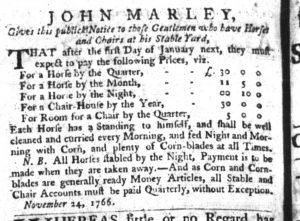
Eighteenth-century wholesalers sometimes advertised discounts for purchasing in volume, but rarely provided particulars rather than promises. In today’s advertisement, John Marley offered discount pricing for a service he provided, caring for horses at his “Stable Yard” in Charleston. Although his notice was addressed to “those Gentlemen who have Horses and Chairs at his Stable Yard” already, it communicated discounts to anyone who happened to read it, including current and prospective customers.

Marley gave customers three options, listing rates “For a Horse by the Quarter,” “For a Horse by the Month,” and “For a Horse by the Night.”(*) A single night cost 10 shillings, while a month cost 11 pounds and 5 shillings (or 225 shillings, which makes the calculations more intuitive to modern readers accustomed to the decimal system for currency). Since an entire month of single nights would have cost 15 pounds (or 300 shillings) when purchased individually, the customer who contracted by the month saved 25%, certainly a significant discount that also benefited Marley because it guaranteed consistent business.

Similarly, stabling a horse by the quarter cost 30 pounds (or 600 shillings) compared to 11 pounds and 5 shillings (or 225 shillings). Paying for each month separately would have amounted to 33 pounds and 15 shillings (or 675 shillings). The discount for stabling by the quarter rather than by the month was a more modest 11%, but a savings nonetheless. It was certainly a deal compared to paying by the night for an entire quarter. That would have amounted to a total of 45 pounds (or 900 shillings). In other words, “those Gentlemen who ha[d] Horses” stabled by John Marley saved 33% when they contracted for an entire quarter rather than by the night. Once again, customers benefited from the discounts while the hostler increased the likelihood of having horses in his stable over long periods.

These prices may seem deceptive to modern readers with less experience converting pounds, shillings, and pence, but eighteenth-century readers would have recognized the discounts much more readily. Marley did not need to state explicitly that he offered discounts for stabling horses over an extended period. Instead, he allowed the prices to speak for themselves.

(*) Keep in mind that there were 20 shillings in a pound. As was common in eighteenth-century bookkeeping, the list of prices or rates in this advertisement includes three columns: pounds, shillings, and pence. Marley used “round numbers” that did not include any pence, which streamlined the calculations. (There were 12 pence in a shilling and 240 pence in a pound.)