January 13

What was advertised in a colonial American newspaper 250 years ago today?
jan-13-1131767-south-carolina-gazette-and-country-journal-page-2
South-Carolina Gazette and Country Journal (January 13, 1767).

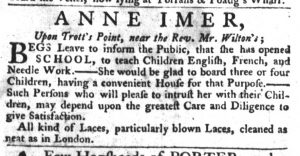
“ANNE IMER … has opened SCHOOL.”

Less than two weeks into the new year, Charleston’s schoolmasters encouraged parents to enroll their children in classes. The January 13, 1767, issue of the South-Carolina Gazette and Country Journal and its supplement included five notices promoting educational opportunities. Advertisements placed by schoolmasters and tutors of various sorts frequently appeared in the city’s newspapers in the 1760s, but not usually so many in a single issue. The start of the year, however, was an opportune time to seek new students as colonists thought about how to make the new year more prosperous than the last. As the advertisements indicate, parents who could afford to educate their children had many choices. Schoolmasters faced stiff competition from their peers, a factor that caused each to market more than just their curriculum.

William Hutchins, who operated a day school where students learned reading, writing, and arithmetic, asserted that he took “the greatest Care” in shaping the “Morals and Behaviour” of his students. For the convenience of scholars who could not attend during the day, he also kept an evening school.

Schoolmistress Anne Imer was the only educator who taught a subject specifically aimed at female students. She listed three subjects in her curriculum: “English, French, and Needle Work.” Most likely her charges learned needlework as a genteel pursuit for refined young ladies, a complement to their instruction in the French language, rather than solely as a practical skill. Imer also offered “to board three or four Children, having a convenient House for that Purpose.”

D’Ellient and Alexander welcomed both “Day boarders” and fulltime boarding students to their school, “where the English, French, Latin and Greek Languages, Writing and Arithmetick are taught as usual.” They offered a more refined education than Hutchins, as well as several amenities suited to the status of their students. The schoolmasters indicated that they had hired “a prudent Housekeeper” in order to provide satisfactory “boarding, lodging and washing of young Gentlemen from the Country.” They also provided lunch for “Day boarders,” students who lived in Charleston but far enough from the school that it was “inconvenient for them to return Home to dine.”

Walter Coningham supplemented the standard curriculum (reading, writing, and arithmetic) at his “Grammar-School” with lessons in Greek and Latin. Unlike others who taught foreign languages, he described his methods for parents of prospective students to review in advance. Like Imer, he accepted a limited number of boarders, though most of his pupils seemed to have been day students.

The enigmatic Pike (who never revealed his first name in any of his advertisements in Charleston or, later, Philadelphia) offered a very different curriculum, dancing and fencing. These genteel pursuits supplemented the knowledge students gained at other schools and academies. He invited male and female students to learn “proper address, the Minuet, Country Dances” or “any Branch of dancing they chuse.” Instruction in “the Use of the SMALL-SWORD,” however, was reserved for men.

The schoolmasters who placed these advertisements offered services and amenities in addition to instruction in the subjects they taught. In describing the ancillary aspects of they education they provided, these advertisers allowed prospective students and their parents to select the school that best fit their budget, status, and aspirations.

January 2

What was advertised in a colonial American newspaper 250 years ago today?

jan-2-121767-south-carolina-and-american-general-gazette-page-2
South-Carolina and American General Gazette (January 2, 1767).

“He now teaches LATIN in his Grammar School.”

At the turn of the new year, Walter Coningham sought students for his “Grammar School” in Charleston. He deployed several strategies to convince the parents to enroll their children in his academy.

Coningham opened his advertisements with a message of appreciation for fathers of his current and former students, stating that he “gratefully acknowledges the many favours he has received from those gentlemen who entrusted him with their childrens education.” While probably sincere, this public thank you also allowed the schoolmaster to underscore that other colonists previously sent their children to his school and had been satisfied with the results.

He then announced a new element of his curriculum – Latin – and described his teaching methods. He used “a plan entirely new” that immersed students in the language by consulting “books without English translations.” He assured parents that this method was “both easy and beneficial for the scholar,” but he understood that some readers might harbor some doubts on that account. Accordingly, he offered “ocular demonstration” of the “improvements his scholars make” in studying Latin through “the performance of those now under is care.” In other words, Coningham offered demonstrations. He invited those with reservations about his methods to observe his current students and decide for themselves how well they learned Latin. That he made this offer at all suggested his own confidence in the effectiveness of his pedagogy.

Coningham then elaborated on his curriculum – Greek, Latin, English, writing, and arithmetic – before noting that he cared for the mind, body, and spirit of his students, especially any boarders who were under his supervision at all times of the day and night. He promised that his students would be “improved in their morals” as well as undertake “necessary exercises, during their leisure hours.” (Coningham did not indicate the nature of these “necessary exercises.” Elsewhere on the same page Mr. Pike – a dancing and fencing master who never volunteered a first name in his advertisements in Charleston in the 1760s or in Philadelphia in the 1770s – stated that several days throughout the week he “employs in teaching at the principal boarding schools.” Was it possible that Coningham hired Pike and included fencing and dancing in his curriculum?)

Marketing is a major part of modern education. Anyone who works for a college or university is well aware of the institutional obsession with “the brand” in recent years, yet efforts to promote and to sell education through a variety of hooks and promises are not new to the twentieth and twenty-first centuries. Eighteenth-century educators also developed advertising to entice prospective students and their parents.

October 3

GUEST CURATOR: Elizabeth Curley

What was advertised in a colonial American newspaper 250 years ago today?

oct-3-1031766-new-london-gazette
New-London Gazette (October 3, 1766).

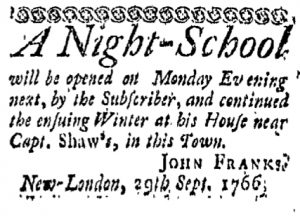
A Night-School will be opened on Monday Evening.”

Evening schools allowed children and adults who would not have normally attained an education to get the opportunity. In my Education class, Schools and American Society (taught by Prof. Casey Handfield), we discussed educational disparity in colonial America.[1] Children’s formal education in the colonies was limited, often to a select group of middling and elite white males. However, there were many other forms of education that took place in the colonies, such as apprenticeship, indentured servitude, and dame schools. Apprenticeship was a way for many children to learn a skill over time; although their formal education may have been limited, they learned a skill that provided them with a livelihood once they were older and finished the apprenticeship. Some forms of indentured servitude also allowed for learning a skill from the master. At dame schools, children learned basic skills from women (usually childless or older and widowed). However, most of these women had little formal schooling themselves, but would teach based on religious ideals.

Evening schools were another important form of education in colonial times, as I learned from also consulting Robert Francis Seybolt’s Evening School in Colonial America.[2] Some of the colonists sent their apprentices or indentured servants to night school during the winter months. Because the days were shorter, less light meant fewer work hours. This allowed some apprentices and servants to learn a skill during the day and then go to an evening school to learn basic writing, reading, and math skills. Apprentices and servants who got to go to evening schools would have been very lucky to learn both a skill that would provide them with a livelihood and the skills to make their future business successful.

Evening schools in the colonies originated in the Dutch colony of New Netherland in 1661. Once that colony became part of the New York in 1674, the evening schools were slowly taken over by English night schools. In Boston, the first mention of an evening school was in 1724 in the Boston Gazette. According to Seybolt, these two port cities, New York and Boston, were the first to establish this sort of schools, with inland towns and villages getting them later.

John Franks advertised his school in the New-London Gazette. He taught it in his home. Starting the classes in October and continuing every Monday for the whole of winter provided Franks’ students ample time for work during the week and then once darkness fell and the work day was done they could go to class.

**********

ADDITIONAL COMMENTARY: Carl Robert Keyes

Elizabeth is a veteran guest curator for the Adverts 250 Project, having already taken on these responsibilities for two weeks as part of my introductory Public History course last spring. As a result, she came to the project this time already possessing familiarity with the advantages and disadvantages of working with digitized sources. Rather than using my additional commentary to elaborate on her analysis of the advertisement she selected for today, I’ve decided instead to discuss one of the challenges inherent in using digital surrogates for the New-London Gazette.

Oct 3 - Page 3 New-London Gazette.jpg
Third Page of New-London Gazette (October 3, 1766).
oct-3-page-4-new-london-gazette
Fourth Page of New-London Gazette (October 3, 1766).

First, it’s necessary to understand the material aspects of the original October 3, 1766, issue of this newspaper. Like other colonial newspapers, each issue consisted of four pages created by printing on both sides of a broadsheet and then folding it in half. While some surviving issues have remained separate, many others have been gathered together, arranged chronologically, and bound into large volumes, either by printers or subscribers in the eighteenth century or by archivists and librarians at some point since. As a result, when historians consult eighteenth-century newspapers, they often work what look like oversized books that must be supported in special wooden cradles in order to preserve the bindings and avoid damage to the individual issues.

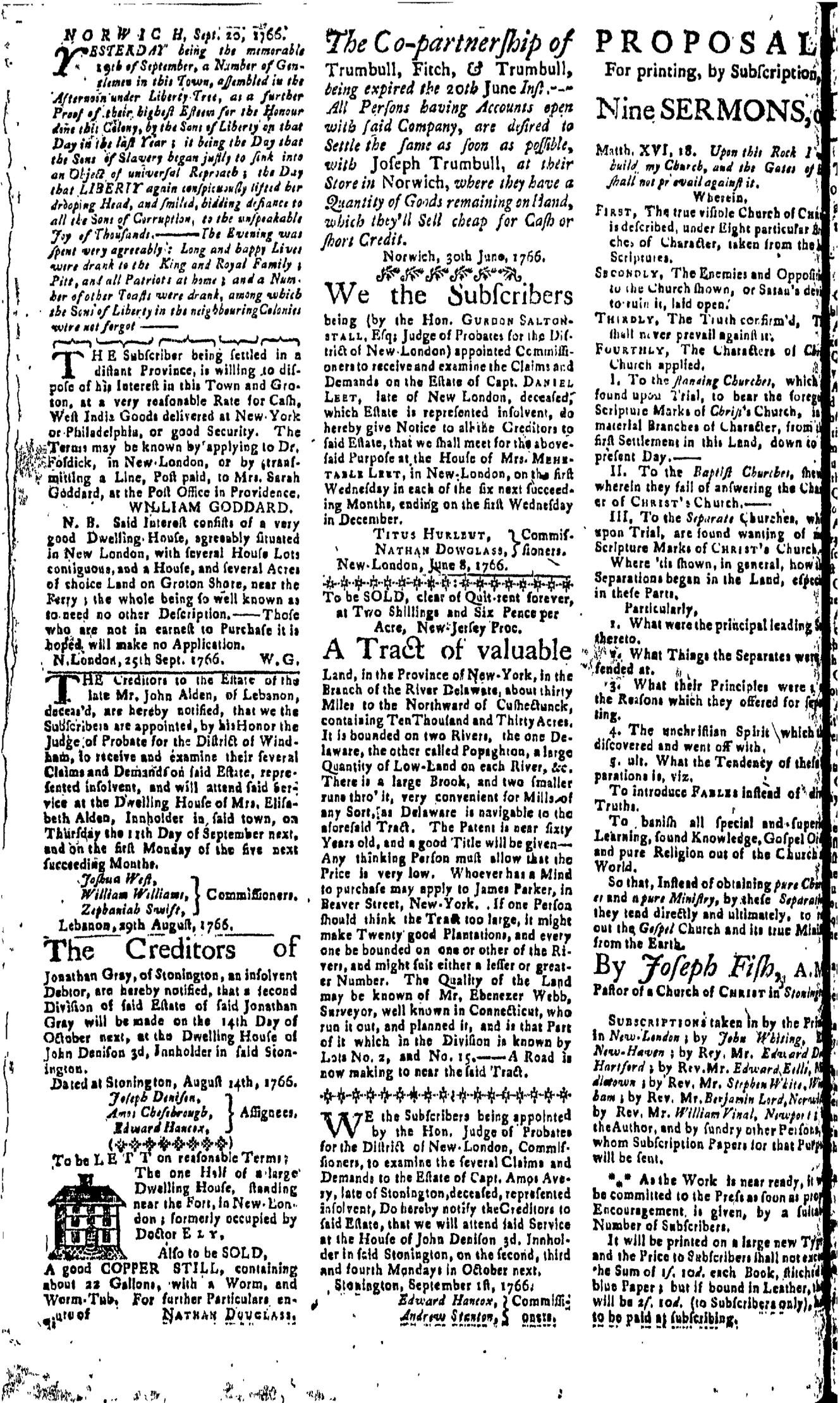
As a result of binding so many newspapers together, sometimes it is difficult to read the material in the column printed closest to the fold. Without sufficient space devoted to the margin that could later be used by the bookbinder, the binding draws the pages too close together to read (or photograph or digitize) all of the printing on the page. On the other hand, the distinctive appearance of a newspaper in a tightly bound volume makes it easy to determine at a glance which were even- and odd-numbered pages when reading the newspaper on microfilm or a computer screen. Both media eliminate other aspects of the material text that readers would otherwise use when working with an original issue. Have a look at the third and fourth pages of the issue that included today’s advertisement.

It is easy to tell which side of the page was adjacent to the binding, which also makes it easy to determine which was an even-numbered page and which was an odd-numbered page. Note that the advertisement Elizabeth chose appeared far away from the original fold of the newspaper and, thus, far away from the binding of the bound volume. This helped to make it legible when it was photographed and digitized. On the other hand, news items and advertisements that appeared close to the binding have been partially obscured. It is difficult to read them. Keyword searches using current technologies do not effectively “read” those items either. Readers working with the original bound volume of newspapers can shift position to view the page from a slightly different angle or carefully open the volume just a little wider, but these options are not available to researchers using microfilm or digital surrogates. The image of the page as it appears is the only possible image available to them.

As I have argued many times, digitization is wonderful, but it is not perfect. Sometimes it introduces new problems or eliminates possible solutions that working with original documents would allow. As an Education and History major, Elizabeth is especially interested in advertisements about colonial education. That John Franks’ advertisement for “A Night-School” was is legible for Elizabeth and other historians to consult is a wonderful circumstance that was in no way guaranteed by the historical and technological processes that have contributed to the production, preservation, and dissemination of the original documents.

**********

[1] See also Joel Spring, American Education, 16th ed. (McGraw Hill, 2013)

[2] Robert Francis Seybolt, The Evening School in Colonial America (Urbana: University of Illinois, 1925).

August 14

What was advertised in a colonial American newspaper 250 years ago today?

Aug 14 - 8:14:1766 Pennsylvania Gazette
Pennsylvania Gazette (August 14, 1766).

“Mr. Garner, from his approved Conduct in the teaching of Youth, having had many Solicitations to open an Academy …”

Joseph Garner was a well-known teacher who regularly advertised his schools and academies in Philadelphia’s newspapers. Although he addressed the topics students could expect to learn under his tutelage, he also emphasized the environment in which they would study. Students needed to be in surroundings, Garner suggested, that would contribute to their intellectual and moral growth.

Consider his description of the boarding school and its amenities in today’s advertisement. “The House is very extensive,” he proclaimed, so extensive “as to admit of many Boarders, without interrupting each other in their private Studies.” Pupils undertook those studies in “very elegant” rooms. Such surroundings lent themselves well “to the Design of carrying polite Literature into Execution.”

Garner understood that the youth he instructed also needed respite from their studies on occasion. To that end, the “commodious House” had “a large Yard, fit for the Relaxation of Youth after School Hours.” He assured parents of prospective students that this yard was “well inclosed.” Garner safeguarded the children entrusted to his care from the perils of the city, “where Vice is only too often so predominant.” Even when his pupils took a break from reading “polite Literature,” Garner provided an environment that nurtured morality and virtue rather than allowing them “the Liberty of the Streets.” In other words, he kept a close eye on his charges and did not allow them to potentially find trouble as they went gallivanting around the busy port city.

Garner also sought other teachers to assist instructing students. His list of qualifications placed greater emphasis on personal attributes than expertise. In addition to being “well versed in the Languages,” teachers also needed to be “of moral Behaviour, and unexceptionable Character.”

For Garner and the parents who enrolled their children in his academy, the purpose of education was more than the accumulation of knowledge. It was also intended to shape youth into moral men.

April 9

GUEST CURATOR:  Maia Campbell

What was advertised in a colonial newspaper 250 years ago this week?

Apr 9 - 4:7:1766 New-York Mercury
New-York Mercury (April 7, 1766).

“WILLIAM ADAMS, TUTOR to the Academy at COLDINGHAM, INFORMS the Gentlemen of the City, who have their sons there, that they are well.”

In 1766, an age of a growing importance on education, especially for men, was beginning to dawn in the American colonies. In the past throughout the Western world, tutoring services were offered mainly to nobility. During colonial times, this was also mostly the case, though different colonies had different experiences. In general, children of the “lower sorts” could not afford to get an education, and they also lacked opportunity (especially outside the New England colonies).

This tutor, William Adams, did not specify the social class of the boys he desired to tutor. The fact that this advertisement was published in a newspaper indicates progress in the right direction. Yet though Adams’ advertisement moves in the direction of educational opportunity for many, the academy he was advertising was a boarding school. Though the advertisement indicated that “any one having a mind to enter their sons” had a chance to speak with the tutor, the real opportunity remained for those with sufficient money for the boarding costs.

**********

ADDITIONAL COMMENTARY:  Carl Robert Keyes

Maia has identified some of the recurrent themes that appeared in advertisements for educational opportunities in the decade prior to the Revolution. Instructors advertising their classes frequently placed notices in newspapers. Both the men and women who ran boarding schools and Latin academies and the tutors and instructors who offered special subjects, such as foreign languages, dancing, or fencing, emphasized that they conducted their lessons in an atmosphere of morality and politeness and promoted their services by suggesting that refined individuals possessed the skills that they offered to teach. In so doing, they presented potential students and their parents with a strategy for asserting their own social status by acquiring skills and pursuing activities associated with metropolitan elites.

These advertisements preserved an aura of hierarchy in educational pursuits by associating them with elite gentility, but they opened up learning opportunities to prospective students who did not necessarily come from elite backgrounds. They sold – or attempted to sell – gentility to a broad reading public. Thus, they highlighted a tension between popularizing goods and services in order to sell them and the continued association of codes of gentility with elite social standing.

As Maia noted, we can see this tension in today’s advertisement. Adams posted this notice for two purposes. First, he let the “Gentlemen of the City, who have their Sons there” at the academy know that his charges were doing well and would be visiting the New York soon. In addition, he used this notice to recruit additional students. He addressed “Any one having a mind to enter their Sons,” suggesting that this was an opportunity open to all readers. In an era of significant social mobility, some middling readers may have seized such an opportunity to further enhance their status and their family’s prospects for the future. The tutor, for his part, appeared content to enroll middling as well as elite youths.

February 20

GUEST CURATOR:  Elizabeth Curley

What was advertised in a colonial newspaper 250 years ago today?

Feb 20 - 2:20:1766 Pennsylvania Gazette
Pennsylvania Gazette (February 20, 1766).

“INTENDS to open a School in the Country.”

Joseph Garner, “Master of the Church School,” and John Todd, “Master of the Friends Public School, in Philadelphia,” were looking for a fellow teacher to go into the Pennsylvania countryside to teach at a new school.   Many people think of teaching as a women’s profession but in 1766 it could be considered a man’s profession because they were the ones who had schooling in some subjects.

Garner and Todd go on to list different skills they would like this gentleman teacher to have, such as the ability to teach Navigation, “Mensuration of Superficies and Solids,” Surveying, and “Extraction of the Square and Cube Roots.” These arithmetic skills would have been applicable to the banker, the merchant, and the insurance officer.

The final application requirement was that the applier have an “Unexceptional Recommendation, respecting Morals.”

The key reason I chose this advertisement was because I am studying to become an elementary educator with a concentration in history. I believe that being an educator to the next generation of leaders, CEOs, union workers, pro athletes, service employees, and mothers and fathers is the biggest honor that can be bestowed upon me. I think all teachers believe this at their core, although there are many other benefits. Taking Professor Keyes’s Public History class has shown me all the ways history can be brought inside and beyond a classroom, and, as a future educator, it will be my job to show children that history is not just in their textbooks but all around them.

**********

ADDITIONAL COMMENTARY:  Carl Robert Keyes

As with yesterday’s featured advertisement, Elizabeth has chosen a notice that does not explicitly mention women yet allows us to explore how gender shaped women’s (and men’s) experiences in the late colonial period.

By and large, men and women received different kinds and levels of education in eighteenth-century America. In addition, schoolmasters operated “Latin” schools modeled on classical curricula in European schools for a small number of pupils, usually male, and “English” schools that provided instruction in basic reading, writing, and arithmetic for a greater number of students, both male and female. Men served as instructors at Latin schools, but both schoolmasters and schoolmistresses operated English schools.

This advertisement makes it clear that Garner and Todd envisioned a school for boys and young men who would eventually go on to careers as merchants or bankers or secure jobs in customs houses and insurance offices. It is possible that the school would have admitted girls and young women for instruction in basic skills. It is also possible that they would have pursued some of those lessons in mixed-sex classrooms (though other advertisements from the period make it clear that in such cases students would be closely monitored to make sure everyone behaved appropriately, as concerns about “Unexceptionable Recommendations, respecting Morals” make clear). When it came time for the more advanced and supposedly masculine subjects, male students would have met separately in sex-segregated classrooms with male instructors.